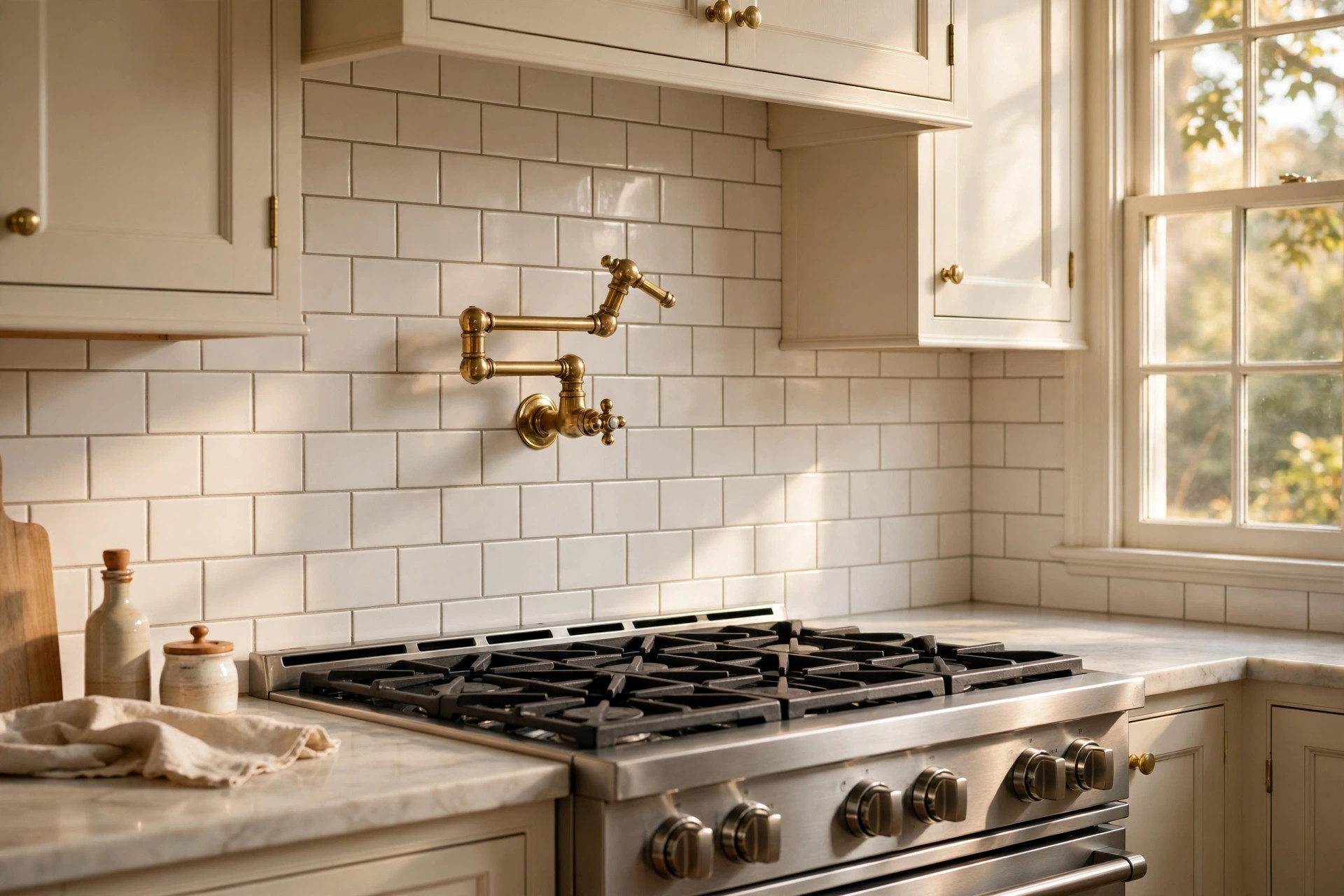

A pot filler is a faucet mounted on the wall behind the range. It swings out over the burners. You fill a pot right where it sits. Then you swing the arm back against the wall. That is the whole idea.
This pot filler faucets American homes guide walks through the subject in plain terms. It covers why cooks like them, what styles exist, what they cost, how to care for them, and how to keep them safe. If you are planning a kitchen change and wonder whether a pot filler belongs in it, read on.
Why It Matters
Kitchens are built around work. Filling a stockpot at the sink takes muscle. A full pot of water weighs twenty pounds or more. Carrying it across the kitchen strains the back and the arms. Older cooks feel this most. A wall faucet over the range removes the carry. You set the pot on the burner and fill it in place.
Time matters too. Soups, stocks, pasta water, and canning all need a large volume of water. A pot filler with a wide spout fills a vessel fast. The cook saves a trip or two to the sink on each batch. Over a week of cooking, the minutes add up.
Looks count as well. Many buyers choose a pot filler because it makes the range wall look finished. The fixture reads as a sign of a serious kitchen. Home appraisers rarely add value for it. But a polished pot filler, set in a tile backsplash, gives the whole wall a custom look that buyers notice.
Older houses gain from the change too. Many kitchens built before 1990 have narrow walks between sink and range. A pot filler shortens each carry to zero. It also helps anyone with a bad shoulder or a weak wrist. The task goes from a lift and a walk to a small reach and a lever turn.
What to Look For and How to Choose: Pot Filler Faucets American Homes Guide
Water lines and placement
A pot filler needs its own water line inside the wall. Cold water only is standard. The line must sit at the right height above the range, usually sixteen to twenty inches above the burners. Check your range height before you buy. Gas ranges throw heat upward, so the faucet must clear the flame.
Plan for this during a remodel, not after. Running a new pipe in a finished wall means opening the wall. That adds labor. If the wall is already open for a gas kitchen ranges buying guide usa project, ask the plumber to rough in the line at the same visit.
Spout reach and swing
The arm folds against the wall when idle. It should reach every burner you use most. Two-joint arms give the widest range. Single-joint arms are stiffer and cheaper. Measure from the wall to the far burner center. Add two inches. That is your minimum reach.
Valve quality
The pot filler has one valve, usually a lever or a small wheel. Open and close it with care. Cheap valves drip after a year. Solid brass bodies last longest. Look for a quarter-turn ceramic disc cartridge. It shuts off clean and resists mineral build-up.
Finish and match
Pot fillers sit in the open, so the finish shows. Match the finish to your other fixtures for a calm look. Polished chrome suits bright kitchens. Brushed nickel hides water spots. Matte black suits modern rooms. Oil-rubbed bronze suits farmhouse styles. Pick what your sink faucet wears, or near it.
Types and Options
Wall mount
The standard form. It screws to a stub pipe in the wall. Nearly every model sold today is wall mount. A single handle controls the flow. Two articulating joints let the spout swing and fold. This is the type most guides describe.
Deck mount
This type mounts on the counter or on the stove shelf behind the range. It suits kitchens where the wall cannot hold a pipe. It still swings aside when not in use. Deck mounts cost about the same as wall mounts. They are rare, and fewer finishes exist.
One-piece fixed arm
Some models have a rigid arm with no joints. The spout points straight down. You place the pot under it. There is nothing to swing. These are plain and sturdy. They cost less. They suit small ranges where the burner line sits right under the spout.
Double-handle models
A few makers sell fillers with two handles, one on each side of the arm. The second handle acts as a back-up shutoff. This design helps if the main valve ever sticks. It costs more. Most home cooks never need it.
Cost and Price
Prices run wide. A plain chrome wall mount sells for about one hundred fifty dollars. A mid-range brass model with good valves sells for three hundred to five hundred dollars. Designer models in special finishes can pass eight hundred dollars.
Labor costs as much as the fixture. If the wall is open, a plumber charges roughly two hundred to four hundred dollars to run the line and set the faucet. If the wall is finished and must be opened and patched, add three hundred to six hundred more. Tile work behind the range raises the bill. Many owners pair this job with a quartz countertop installation buying guide usa or a sink swap so the plumber is on site once.
Running costs are small. A pot filler uses water only when open. There is no energy use. Water bills rise by a few dollars a year at most, and only if you cook large batches often.
Buy from a maker with a clear parts line. Home Depot and Lowes stock common models and replacement cartridges. Specialty finish makers sell through showrooms. Keep the receipt and the model number. Parts for odd brands can be hard to find ten years later.
Warranties vary by maker. Most offer a limited lifetime warranty on the finish and the body for home use. Valves and cartridges often carry five years. Read the terms before you buy. Register the product online. It takes five minutes and speeds a claim if a valve fails in year four.
Care and Upkeep
A pot filler is simple to keep. Wipe the arm and spout with a soft cloth once a week. Mild dish soap and warm water are enough. Dry the finish after. This stops mineral spots from building up.
Hard water leaves scale at the spout tip. Soak a cloth in plain white vinegar and wrap the spout end for fifteen minutes. Then wipe clean. Do this once a month in hard-water areas.
Check the joints twice a year. Swing the arm through its full arc. It should move smooth and stop where you leave it. If a joint sags, tighten the small set screw at that joint. Do not force it. If the valve drips, shut the supply line, drain the faucet, and swap the cartridge. Most cartridges pull out with one clip.
A shutoff valve inside the cabinet below or behind the wall is a smart add. It lets you kill the line for service without touching the main water shutoff. Ask the plumber to fit one while the wall is open. The part costs a few dollars and pays for itself the first time the faucet needs work.
In homes that stand empty in winter, drain the line. Open the faucet after shutting the supply valve. Cold walls can freeze a standing line and split the pipe. This is the same care you give any cold line in an outside wall.
Pair cleaning habits with the rest of the kitchen. When you descale the main faucet and check the undermount stainless sinks buying guide usa area for seal wear, give the pot filler the same look.
Safety
Safety rules are short but firm. Mount the faucet high enough that flames never touch it. A gas burner under a low faucet can melt seals and scorch the finish. Sixteen inches above the grates is the least to allow.
Never leave a pot filling without watching it. The stream runs fast. A pot fills while you step away. Water can boil over later because the pot holds more than you meant. Fill, shut the valve, and stay near.
Check for leaks behind the wall at the start of each season. A damp spot on the backsplash or a soft smell means the connection may be weeping. Small leaks inside walls grow into mold. Call a plumber at the first sign.
Teach children not to play with the lever. The arm swings far and the handle turns easy. Keep step stools away from the range wall so small hands cannot reach it.
Cold water only. Pot filler lines carry cold water. Never tie one into a hot line. The fixture is not rated for hot water, and a blast of hot water from a surprise source can scald.
FAQ
Is a pot filler worth the money?
It is worth it if you cook big pots often. For stock, pasta, canning, and brining, it saves heavy carries. If you rarely fill pots bigger than four quarts, the gain is small. Then it is mostly a style choice.
Can I add a pot filler to a finished kitchen?
Yes, but the wall must be opened. A plumber cuts the drywall or tile, runs the line, and the wall is patched after. The cost rises because of the patch and any tile repair. The work is easiest inside a full remodel.
Do pot fillers waste water?
Not by design. The stream runs only while the valve is open. Waste comes from leaving the valve open too long or filling pots fuller than needed. Watch the pot and shut the valve when done.
What finish lasts longest?
Polished chrome and stainless finishes last longest with least care. Brushed finishes hide spots well. Dark coatings look sharp but can chip if scrubbed with rough pads. Follow the maker’s cleaning guide.
Should the pot filler match my main faucet brand?
Matching brand and finish gives the cleanest look. It is not required. What matters is that the metal tone matches. A brushed nickel filler beside a brushed nickel sink faucet reads as a set even from different makers.
How long do pot fillers last?
A well-made brass pot filler lasts fifteen to twenty years or more. The weak point is the cartridge. Replacing it every five to eight years keeps the valve drip-free. Cheap zinc models may fail in five years and are not worth repairing.
How tall should the mount be?
Plan for sixteen to twenty inches from the cooktop grates to the spout. Short cooks may favor the higher end so the arm swings clear of tall pots. Tall ranges with raised backsplashes may force the higher end anyway. Measure with the actual pots you use most.
A well-made brass pot filler lasts fifteen to twenty years or more. The weak point is the cartridge. Replacing it every five to eight years keeps the valve drip-free. Cheap zinc models may fail in five years and are not worth repairing.
A Short Final Word
A pot filler is a small fixture with a plain job. It puts water where the pot stands. Chosen well, set at the right height, and kept clean, it serves for decades. This pot filler faucets American homes guide aimed to keep the subject plain and the advice practical. Measure your reach, pick a sound valve, match your finish, and watch the pot while it fills. The rest is easy cooking.
For more background, see Consumer Reports, The Spruce, and Whirlpool. For more background, see ENERGY STAR, GE Appliances, and Bosch.
References
Bosch. (n.d.). Home appliances. https://www.bosch-home.com Consumer Reports. (n.d.). Product reviews and ratings. https://www.consumerreports.org ENERGY STAR. (n.d.). Energy efficient products. https://www.energystar.gov GE Appliances. (n.d.). Kitchen and home appliances. https://www.geappliances.com Lowe’s. (n.d.). Home improvement products. https://www.lowes.com The Home Depot. (n.d.). Home improvement products. https://www.homedepot.com The Spruce. (n.d.). Home and garden advice. https://www.thespruce.com Whirlpool. (n.d.). Home appliances. https://www.whirlpool.com
Was this guide helpful?

About Michael Thompson
The My Garden US editorial team writes practical, in-depth home and garden guides for American homeowners — tested advice, no fluff.
You May Also Like

French Door Refrigerators Reviews Buying Guide USA
May 2, 2026 0 views
Undermount Stainless Sinks Buying Guide USA: How to Choose the Right Sink for Your Kitchen
April 19, 2026 0 views
Where to Find Shaker Cabinet Doors Deals Near Me
June 26, 2026 0 views