
Good food needs good light. Many people build fine outdoor kitchens with solid grills and wide counters, and then they forget one simple thing. When the sun goes down, they can no longer see what they are doing. Meat looks gray on the grill, and sauces look the same color as the tongs. This is why outdoor kitchen lighting ideas for grilling matter so much. The right light lets you cook well at night, and it also makes the patio a place where people want to stay.
This article walks through the main ways to light an outdoor grilling area. It covers task light at the grill, soft light for the table, and small accents for paths and edges. It explains what to look for when you shop, how much the work may cost, and how to keep the lights working for years. By the end, you will have a clear plan that fits your yard and your budget.
Why Good Light Changes the Way You Grill
Cooking meat is a job of the eye. You watch the color of a steak to judge doneness, you look for the sheen on chicken skin, and you check the edges of a pork chop. At dusk, these details fade fast. A porch light twenty feet away is not enough: it throws shadows, and the grill hood throws another on top.
Direct light at the grill solves the problem. A bright, focused lamp over the cooking surface lets you see the food the way you see it at noon. This makes the meal better and the work safer, since hot oil, sharp tools, and open flame need clear sight.
Light also sets the mood. An outdoor kitchen with warm, layered light feels like a room, not a work site. Guests linger, and a yard that is dark past seven in the evening sits empty for half the year.
Plan the Light in Layers: Outdoor Kitchen Lighting Ideas for Grilling
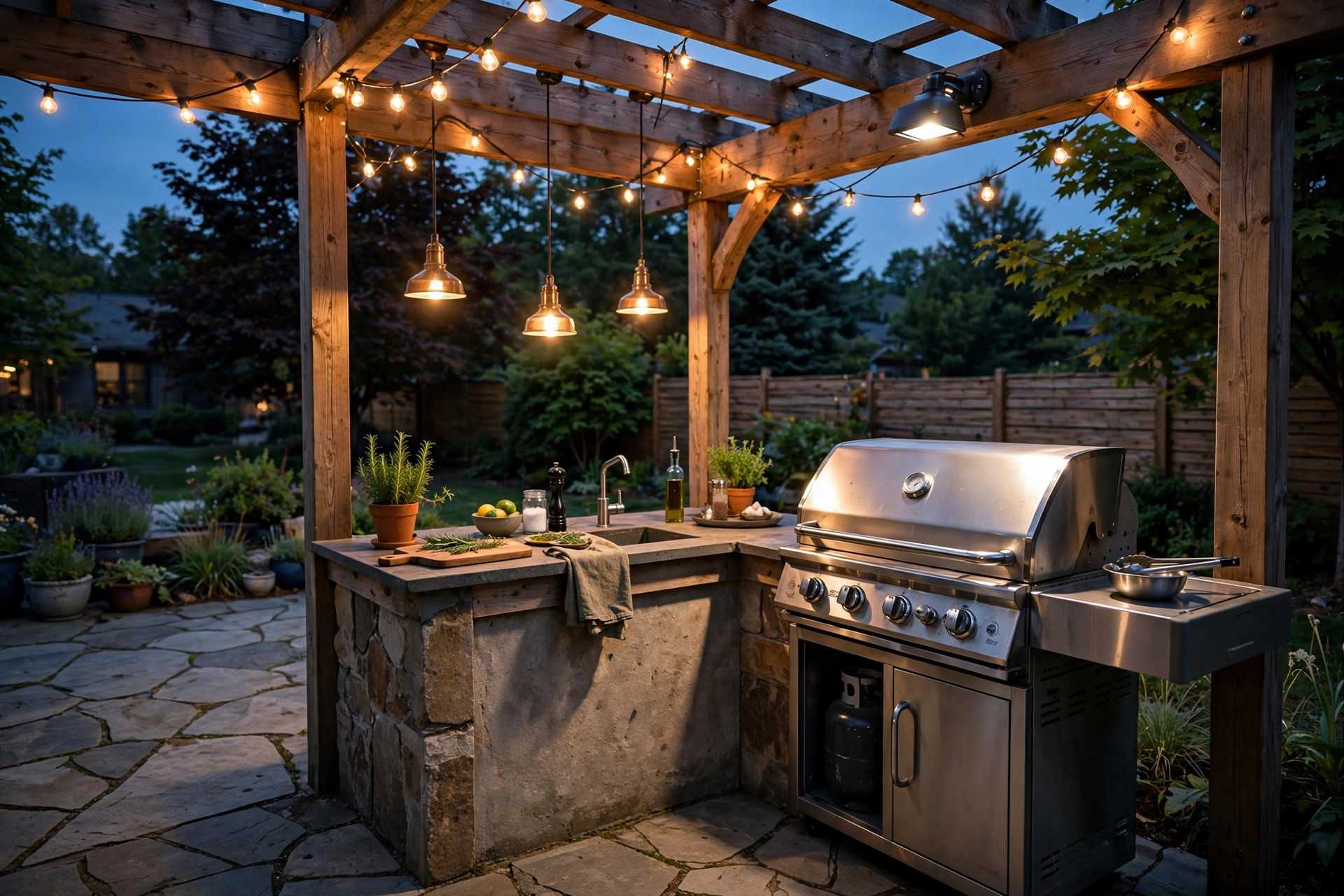
Designers use the word layers: no single lamp does all the work. Task light is bright, direct light aimed at the grill head, the prep counter, and the sink. Ambient light is soft, general light from string lights, lanterns, and low wall fixtures for sitting and walking. Accent light is small and low, marking steps, counter edges, and paths to keep feet safe and give the space shape at night. When the three work together, no corner is too bright and no corner is lost in dark.
What to Look for When You Choose Fixtures
Outdoor fixtures face rain, heat, dust, and sun. A lamp that is fine in a hallway will fail on a patio. Look for these marks before you buy.
Check the weather rating. A fixture should carry an IP rating, such as IP44 or higher, which shows it can stand up to splashing water. Choose a higher rating for fixtures under the open sky.
Check the housing. Metal housings with a powder coat finish last longer than plain plastic. Stainless steel and brass stand up well near the coast, where salt air eats cheap metal.
Check the bulb type. LED is now the clear choice. It uses far less power than old halogen bulbs, gives off little heat, and a good LED lasts for years. Energy Star has useful guidance on picking efficient bulbs for outdoor use (Energy Star).
Check the color of the light. Warm light, around 2700 to 3000 kelvin, feels like candlelight and suits dining areas. Cooler light, around 4000 to 5000 kelvin, shows true color and suits the grill head.
Check power and mounting. Battery and solar fixtures are easy to place but give less light. Hardwired fixtures give steady power but may need an electrician. Decide which kind fits your yard before you shop.
Types of Light for the Grilling Area
Task Lights at the Grill
The grill is the center of the work. It needs the strongest light in the plan.
Clamp-on grill lights are the simplest fix. They clip to the grill handle or lid and aim at the grates, and most run on batteries with a touch switch. Guides to the best grill light for night grilling compare the main designs side by side.
Fixed hood or counter lights give a steadier result. A small LED bar mounted under a hood, a shelf, or the pergola beam above the grill throws even light across the whole cooking surface, so no shadows fall from the lid. This is the choice for built-in grill islands.
Overhead spots work well too. A small outdoor-rated spot on a pergola or a wall can be aimed down at the grill. Keep the beam tight so it lights the grates and not the cook’s eyes.
Prep Counter and Sink Light
Chopping, trimming, and plating happen at the counter. This surface needs its own task light, close to the work.
Pendant lights hung from a pergola or a covered roof give good counter light and look warm and inviting. Hang them about thirty inches above the counter surface so they stay out of the way.
Under-cabinet strips are a neat answer for built-in kitchens. A slim LED strip under a shelf or a cabinet washes the counter in even light. It hides the fixture and shows the food. No shadows from hands or boards fall on the work.
Ambient Light for the Patio
Once the grill and counter are lit, turn to the rest of the space. The goal is soft light that lets people sit, talk, and eat in comfort.
String lights remain the favorite of backyard cooks. A few strands hung in a zigzag over the dining area give warm, even glow. They are cheap, easy to hang, and easy to replace. Look for outdoor-rated strands with shatterproof bulbs.
Lanterns and flame-style LED candles at the table add a low layer of light that marks the dining spot as the heart of the evening.
Wall lights on the house or on fence posts wash nearby surfaces with soft light. This helps the eye move from the bright grill zone to the dark yard without strain.
Path and Step Lights
Accent light keeps feet safe after dark. Low path lights along the walk from the door to the kitchen stop trips, and small step lights mark stairs and deck edges. Keep them low and pointed down so they do not blind guests.
Cost and Price Guide
The cost of the plan depends on how much you wire in and how much you plug in or stick on. Simple answers cost little. Built-in systems cost more but last longer and look cleaner.
A clamp-on grill light costs about twenty to forty dollars. It runs on batteries and needs no wiring. This is the cheapest way to start.
String lights cost about twenty-five to sixty dollars per strand, and most patios need two or three strands. Hanging them is a do-it-yourself job for most people.
Solar path lights cost about five to fifteen dollars each. A set of six or eight lights will mark a walkway well.
Hardwired fixtures cost more. A weather-rated pendant or spot costs forty to one hundred and fifty dollars each, plus wiring, and an electrician can add two hundred to six hundred dollars for a small job. A full built-in lighting plan often lands between five hundred and two thousand dollars.
Keep in mind that the grill itself sets the budget tone. A new cook shopping for their first serious unit may want to read up on the best gas grill under 500 for beginners before they plan the lights around it.
LED bulbs keep running costs low. A whole patio of LED lights often draws less power than one old porch bulb, and timer switches add a small cost while saving the trouble of turning lights on and off each night.
Care and Upkeep
Outdoor lights need a little care to stay bright. Most of the work is simple and takes only a few minutes a season.
Wipe the lenses. Dust, pollen, and grease settle on the glass and cut the light, so a damp cloth once a month keeps the beam clear. Near a grill, check more often, since cooking smoke leaves a film.
Trim the plants. Bushes and vines grow over path lights and wall fixtures, so a quick trim in spring and again in summer keeps the light where it belongs.
Check seals and gaskets. Once a year, look at the rubber seals on wired fixtures; if one is cracked, replace it before the rainy season.
Test the timers. Smart plugs and timer switches drift off schedule after a power cut, so walk the yard one evening a month and confirm that every light comes on when it should.
Store portable fixtures for winter. In cold regions, bring battery lanterns and clamp-on lights indoors for the winter. Cold drains batteries and shortens their life.
Safety Rules for Outdoor Kitchen Light
Light and heat and water share the same small space in an outdoor kitchen. A few rules keep the plan safe.
Keep fixtures clear of the grill. The grill head runs very hot, so no fixture, wire, or plastic housing should sit within the heat zone around it. Follow the grill maker’s clearance numbers. Weber, Char-Broil, Napoleon, and Broil King all publish placement guidance for their units (Weber, Char-Broil, Napoleon, Broil King).
Use outdoor-rated wiring. All wire, connectors, and junction boxes in the open air must be rated for outdoor use. Run wire through proper conduit where it is exposed. If you are not sure, hire an electrician. The cost of one visit is far less than the cost of a fault.
Outlets in an outdoor kitchen need weatherproof covers and GFCI protection, and no plug should sit where a sink can splash it.
Do not overload circuits. Count the watts on each circuit before you add fixtures. LED lights draw little power, but heaters and small appliances share the same outlets in many outdoor kitchens.
Mount fixtures firmly. Wind moves loose string lights and hanging pendants, so use rated hooks and wire, and check them each spring. A falling fixture near a hot grill is a hazard, and grease smoke from the grill will coat nearby lenses, so place fabric shades a little farther from the grill and choose glass or metal where the smoke blows.
Design Ideas That Work Well Together
A few common setups have proved themselves in many yards. They are worth copying.
The pergola kitchen is the classic. A wooden pergola over the grill island holds pendant lights over the counter and string lights along the beams, with a spot aimed at the grill. For wider yard plans, look at outdoor kitchen design ideas for backyard for shapes that pair well with this scheme.
The compact patio uses a wall-mounted task bar over a small grill, a pair of lanterns on the table, and path lights for the way in. Almost nothing is wired in, so this suits small yards.
The smoker corner is for low-and-slow cooks. A soft warm light near the smoker lets you check the meat through the night without harsh glare. Traeger and Big Green Egg publish useful notes on night cooking setups (Traeger, Big Green Egg).
Recipe sites can also help with timing night cooks. The Spruce Eats and AmazingRibs both carry long-tested guidance on managing grills after dark (The Spruce Eats, AmazingRibs). The Home Depot and Consumer Reports are practical places to compare fixtures side by side.
Frequently Asked Questions
How bright should a grill light be?
Look for roughly 200 to 400 lumens aimed at the cooking surface. That shows the true color of meat without washing out the space. Brighter is not always better, since harsh glare ruins night vision for the rest of the yard.
Are solar lights good enough for an outdoor kitchen?
Solar lights are fine for paths, steps, and accents, but they are usually not strong enough for task light at the grill or the prep counter. Output also drops on cloudy days and in shaded yards, so use solar for the low layer and wired or battery light for the work zones.
What color light is best for grilling?
Use neutral to cool white light, around 4000 to 5000 kelvin, at the grill head, since it shows the real color of the food. Use warm light, around 2700 to 3000 kelvin, over the dining table and in seating areas. The mix gives the cook clear sight and the guests a soft glow.
Can I install outdoor kitchen lighting myself?
Battery, solar, and plug-in fixtures are fine do-it-yourself jobs. Clamp-on grill lights, string lights, and path lights need no special skill. Hardwired fixtures that tie into house wiring should be installed by a licensed electrician, both for safety and because most local codes require it.
How do I keep bugs away from my grill lights?
Use warm-colored bulbs in the dining and seating areas, since warm light draws fewer insects than bright white light. Keep the brightest task light tight on the grill so it does not flood the whole yard. Citronella candles and a fan near the table also help during the meal.
Do LED lights hold up in rain and snow?
Good ones do. Look for an IP44 rating or higher and housings made for outdoor use. LEDs handle cold well and switch on at full brightness in freezing weather. Bring portable battery fixtures inside for the winter to protect the batteries.
A Short Final Word
A bright lamp at the grates, a soft line of light over the counter, warm strands above the table, and small markers on the path make a complete plan. Start with the grill light, since that is where the work happens, and add the other layers one at a time. The result is a yard that works as well at nine in the evening as it does at noon.
References
AmazingRibs.com. (n.d.). Barbecue and grilling science. https://www.amazingribs.com Big Green Egg. (n.d.). Kamado grills and outdoor cooking. https://www.biggreenegg.com Broil King. (n.d.). Gas and charcoal grills. https://www.broilkingbbq.com Char-Broil. (n.d.). Gas and charcoal grills. https://www.charbroil.com Consumer Reports. (n.d.). Product reviews and ratings. https://www.consumerreports.org ENERGY STAR. (n.d.). Energy efficient products. https://www.energystar.gov Napoleon. (n.d.). Fireplaces, grills, and heating products. https://www.napoleon.com The Home Depot. (n.d.). Home improvement products. https://www.homedepot.com The Spruce Eats. (n.d.). Recipes and cooking guides. https://www.thespruceeats.com Traeger. (n.d.). Wood pellet grills. https://www.traeger.com Weber. (n.d.). Grills and outdoor cooking. https://www.weber.com
Was this guide helpful?

About James Carter
The My Garden US editorial team writes practical, in-depth home and garden guides for American homeowners — tested advice, no fluff.
You May Also Like
Charcoal vs Gas Grill Cost Comparison: What Your Backyard Cookouts Really Cost
September 28, 2026 0 views
How to Pick the Best Outdoor Grill for Desert Heat
May 17, 2026 0 views
Best BBQ for Fathers Day Gift: How to Choose the Right One
May 15, 2026 0 views