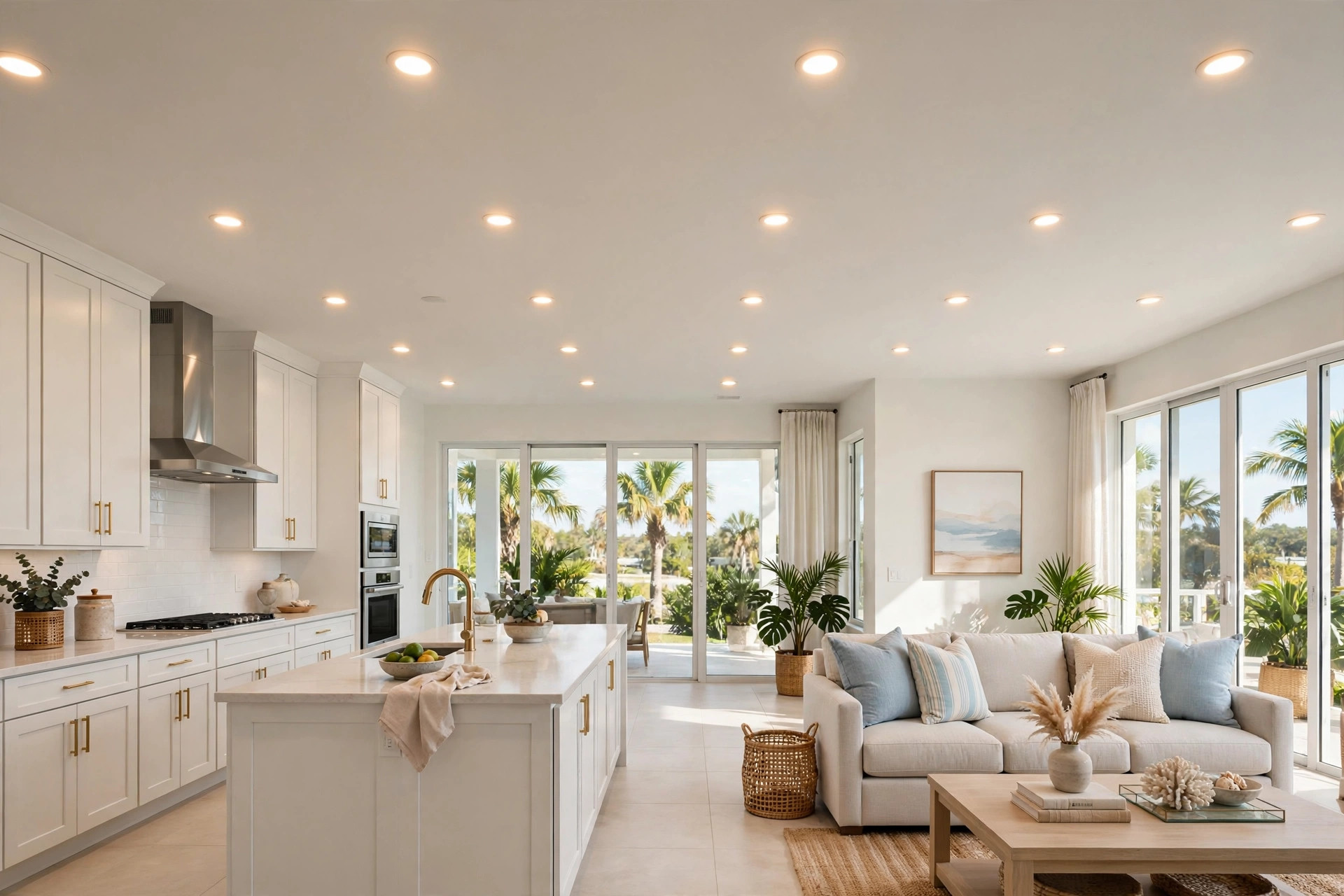

The choice of led recessed lights florida homes usa owners make each year shapes comfort, energy bills, and even resale value. Florida homes face special problems. The climate is hot and humid for most of the year. Afternoon storms are common. Many ceilings sit under hot attics. A fixture that works in a cool northern home can struggle in a Florida garage, lanai, or kitchen. This guide explains how to choose recessed LED lights that suit Florida homes, what the main types are, what they cost, how to keep them working, and how to stay safe during the job. No special training is needed to follow it.
Why Recessed LED Lights Matter in Florida Homes
Recessed lights sit flush with the ceiling. They give clean, even light without hanging fixtures that collect dust. In Florida, that flush design has a second benefit. Many rooms are cooled by ceiling fans and air conditioning. A bulky pendant or chandelier can block air flow and gather heat. A recessed downlight stays out of the way.
LED versions add three more gains. First, they use far less power than old incandescent cans. A typical LED recessed trim draws 9 to 15 watts. The bulb it replaces drew 65 watts or more. In a state where air conditioners run nine months a year, less heat from lights means the cooling system works less. Second, LED units last much longer. Most are rated for 25,000 to 50,000 hours. In a Florida home used year round, that can mean ten to fifteen years without a change. Third, many LED trims are rated for damp or wet locations, which matters in bathrooms, porches, and outdoor soffits.
There is also the matter of storms. When lights sit in soffits or lanai ceilings, they must stand up to wind-driven rain. A fixture rated only for dry indoor use will fail fast there. Choosing the right rating at the start saves money and trouble later.
What to Look for When You Buy: Led Recessed Lights Florida Homes Usa
Shopping for LED recessed lights can feel crowded. Boxes carry words like lumens, kelvin, IC-rated, and canless. Each term means something simple. Once the terms are clear, the choice is easy.
Brightness and Color
Brightness is measured in lumens. A small LED recessed light gives 600 to 800 lumens. That is enough for a hallway or closet. A main room needs more. Kitchens and living rooms often need 800 to 1,200 lumens per fixture. In general, plan for about 20 lumens per square foot in living areas and 30 to 50 per square foot in kitchens and work areas.
Color is measured in kelvin, written as K. Low numbers give warm yellow light. High numbers give cool white or bluish light. Most Florida homeowners pick 2700K to 3000K for living rooms and bedrooms. That range feels warm and relaxed. Kitchens, baths, and garages often do better at 3500K to 4000K. The light feels clean and helps with tasks. Some trims let you pick the color with a small switch on the back. These are called selectable color temperature units. They are a good choice when you are not sure which tone you want. Philips recessed downlight kits and other major brands mark the color right on the box. ENERGY STAR certified fixtures often list both lumens and color on the front of the box, which makes comparison simple.
IC Rating and Airtight Seals
IC means insulation contact. An IC-rated fixture can touch ceiling insulation safely. A non-IC fixture needs space around it. Most modern Florida homes have thick blown insulation in the attic. An IC-rated LED trim is the safe pick there. Many LED recessed lights are also airtight. That means they block air from passing between the attic and the room. An airtight seal keeps cooled air inside the house and hot attic air outside. Over a full summer, that small detail cuts cooling costs in a real way. The Department of Energy guidance on home lighting explains why air sealing around fixtures matters in hot climates.
Canless Versus Can Lights
Old recessed lighting used a metal can set into the ceiling. New LED designs often skip the can. These are called canless or wafer lights. A thin LED disk fits into a round hole in the drywall. A small junction box sits above the ceiling on a cable. They fit under low attic spaces and between tight joists. They are the most popular pick for Florida retrofits. The older can style still works when a full can housing is already in the ceiling and the owner only wants to swap the trim.
Types and Options for Florida Homes
Not every recessed light suits every room. Florida homes have indoor rooms, covered lanais, outdoor soffits, and pool areas. Each zone has its own rating need.
Standard Indoor Trims
These are the common 4-inch, 5-inch, and 6-inch trims for living rooms, halls, kitchens, and bedrooms. They are rated for dry locations. Most are IC-rated and dimmable. Online lighting showrooms carry a wide range of these standard trims. If you want dimming, buy a trim marked dimmable and pair it with an LED-rated dimmer switch. Old dimmer switches built for incandescent bulbs often cause flicker with LEDs.
Damp and Wet Location Trims
Bathrooms need damp-rated trims. A shower stall needs a wet-rated trim. Covered lanais and porches in Florida need damp ratings at minimum. Open soffits under the eaves need wet ratings, because wind-driven rain reaches them during storms. The rating is printed on the box or the fixture. Never use a dry-rated light in a damp or wet spot. Moisture will corrode the parts and shorten the life of the unit. Home guides at The Spruce show clear photos of which trims belong in which room.
Gimbal and Adjustable Trims
They cost a little more than fixed trims. For general room light, fixed trims give better, more even coverage.
Smart and Connected Options
Some LED recessed lights connect to Wi-Fi. They can change color, dim from a phone, or follow a schedule. They cost more and add a point of failure. For most Florida homeowners, a good standard LED trim with a wall dimmer is enough.
Layout: How Many Lights and Where
Good layout matters as much as good fixtures. A common mistake is placing too few lights. The room ends up with dark corners. Another mistake is placing too many. The ceiling looks like an airport runway.
A simple rule works for most rooms. Space the lights about half the ceiling height apart. For an 8-foot ceiling, place fixtures about 4 feet apart. Keep them 2 to 3 feet from the walls. In a kitchen, center lights over work areas like counters and the island. In a living room, spread them in an even grid. In a hallway, a single straight line down the center works well. For task areas, pair recessed lights with other fixtures. Our kitchen track lighting buying guide usa and our under cabinet strips buying guide usa give ideas for layered kitchen light.
Count the fixtures before you buy. A 12 by 14 foot living room with 8-foot ceilings often needs 6 to 8 recessed lights. A 10 by 10 foot kitchen often needs 6. Write the plan on paper first. Mark joist locations if you can. This avoids a surprise when the hole saw meets a beam.
Cost and Price in the USA
Prices for LED recessed lights vary by type and quality. A basic canless LED trim costs 15 to 35 dollars at big-box retailers. Mid-range units with selectable color temperature run 35 to 60 dollars. Premium smart trims run 60 to 120 dollars. Retrofit kits for old cans cost 20 to 45 dollars each.
Installation cost is the bigger part of the budget. A licensed electrician in Florida typically charges 100 to 200 dollars per fixture for a new install with wiring. A simple swap of an old can trim to an LED retrofit takes minutes and costs little if you do it yourself. A full new circuit with six lights in a room without existing wiring can run 800 to 1,500 dollars in labor.
Energy savings pay back the cost over time. Swapping six 65-watt cans for six 10-watt LEDs saves 330 watts whenever the lights are on. At Florida power rates, a home that runs those lights five hours a day saves roughly 60 to 80 dollars a year. Home improvement chains and specialty lighting shops both run sales around holidays, which is a good time to buy a full set.
Do not forget the dimmer. An LED-rated dimmer costs 20 to 40 dollars. It is a small add-on that makes a big difference in comfort. Our led recessed lights installation guide usa walks through the wiring steps in detail.
Care and Upkeep
LED recessed lights need little care. That is part of their appeal. A few simple habits keep them working for their full rated life.
Dust the trims once or twice a year. A soft cloth is enough. Dust on the lens cuts light output and traps heat. In Florida kitchens, a light film of grease can form on trims near the stove. Wipe it with a damp cloth and mild soap. Turn the light off first and let it cool.
Do not paint over the lens. Paint cuts light and traps heat. If you repaint the ceiling, mask the trims or remove them first. Most canless trims pop out with a gentle twist. If a unit flickers, check the dimmer first. Nine times out of ten, the dimmer is the cause, not the light. Swap in an LED-rated dimmer before you replace the fixture.
Safety: Electricity, Heat, and Code
Recessed light work involves household electricity. Take it seriously. Turn off the breaker before you touch any wiring. Test with a non-contact voltage tester. Do not trust the wall switch alone. If you are adding new wiring, Florida code requires a permit in most cities. A licensed electrician knows the local rules. This is not a place to guess.
Heat is the second concern. LEDs run cooler than old bulbs, but the driver electronics still make some heat. The driver must have air space above the ceiling. Never bury a non-IC fixture in insulation. Never cover a junction box with insulation. Follow the clearance printed on the fixture label. Remodeling advice at This Old House and project guides at Bob Vila both stress checking these clearances before closing up the ceiling.
Wet locations need ground-fault protection. Any light near a pool, spa, or outdoor wet area should sit on a GFCI-protected circuit. This is code in Florida. It is also common sense. Water and electricity are a deadly mix.
Ladder safety matters too. Use a stable step ladder on level ground. Keep one hand on the ladder when you reach. Do not overreach. Move the ladder instead.
If your home is older, the wiring may be aluminum. Aluminum branch wiring needs special connectors and care. If you see silver-colored wire instead of copper, call an electrician. Do not connect copper pigtails to aluminum wire with standard wire nuts. That joint can overheat.
Frequently Asked Questions
How many LED recessed lights do I need in a Florida living room?
A 12 by 16 foot living room with 8-foot ceilings usually needs 8 to 10 fixtures. Space them about 4 feet apart in an even grid. Rooms with dark floors or walls need one or two more. Bright white tile floors, common in Florida homes, bounce light well and need fewer.
Can I install canless LED lights in a ceiling with no attic access?
Yes. Canless wafer lights are made for this case. You cut a round hole, feed the cable through, and push the light into the hole. Spring clips hold it in place. You need access to run the cable, which often means a small path through the attic or a wire fished through the ceiling. An electrician can do this without tearing the ceiling open.
Are LED recessed lights safe under a hot Florida attic?
Yes, if they are IC-rated. IC-rated fixtures are tested for direct contact with insulation. They have thermal protection that shuts the light off if it overheats. Buy IC-rated and airtight trims for any ceiling under an attic. In summer, Florida attics can pass 140 degrees, so the rating matters.
What color temperature is best for Florida homes?
Most owners pick 2700K to 3000K for bedrooms and living rooms. It feels warm in the evening. Kitchens and baths often use 3500K to 4000K for a cleaner task light. If you cannot decide, buy trims with a selectable color switch. You can change the setting after they are installed.
Do LED recessed lights work with my old dimmer switch?
Often no. Old dimmers built for incandescent bulbs cause LED flicker or buzz. Buy an LED-rated dimmer. They cost 20 to 40 dollars. Match the dimmer to the trim brand when you can. Many makers publish a list of tested dimmers.
How long do LED recessed lights really last?
Most are rated for 25,000 to 50,000 hours. At five hours a day, 35,000 hours is about 19 years. Heat shortens life. A fixture in a hot attic or a sealed outdoor soffit may last less than the rating. Good ventilation and correct ratings help the light reach its full life.
A Short Final Word
The right led recessed lights florida homes usa buyers choose share a few traits. They are IC-rated and airtight. They carry the right damp or wet rating for the room. They give the color of light the room needs. They are installed on correct wiring with an LED-rated dimmer. Get those five points right and the lights will serve the home for a decade or more, through hot summers and storm seasons alike. Take time with the layout, buy quality trims, and respect the electrical code. The result is a home that looks better, costs less to run, and feels right every evening when the lights come on.
References
Bob Vila. (n.d.). Home improvement advice. https://www.bobvila.com ENERGY STAR. (n.d.). Energy efficient products. https://www.energystar.gov Lamps Plus. (n.d.). Lighting and home decor. https://www.lampsplus.com Lowe’s. (n.d.). Home improvement products. https://www.lowes.com Lumens. (n.d.). Lighting and ceiling fans. https://www.lumens.com Philips. (n.d.). Lighting products. https://www.philips.com The Home Depot. (n.d.). Home improvement products. https://www.homedepot.com The Spruce. (n.d.). Home and garden advice. https://www.thespruce.com This Old House. (n.d.). Home renovation guidance. https://www.thisoldhouse.com U.S. Department of Energy. (n.d.). Energy efficiency and renewable energy. https://www.energy.gov
Was this guide helpful?

About Sarah Mitchell
The My Garden US editorial team writes practical, in-depth home and garden guides for American homeowners — tested advice, no fluff.
You May Also Like
Where to Buy Outdoor Wall Lanterns in the USA
June 15, 2026 0 views
Where to Buy LED Recessed Lights in the USA: A Simple Guide
June 3, 2026 0 views
Ceiling Fans Lights for Sale USA: A Full Buying Guide for American Homes
August 27, 2026 0 views