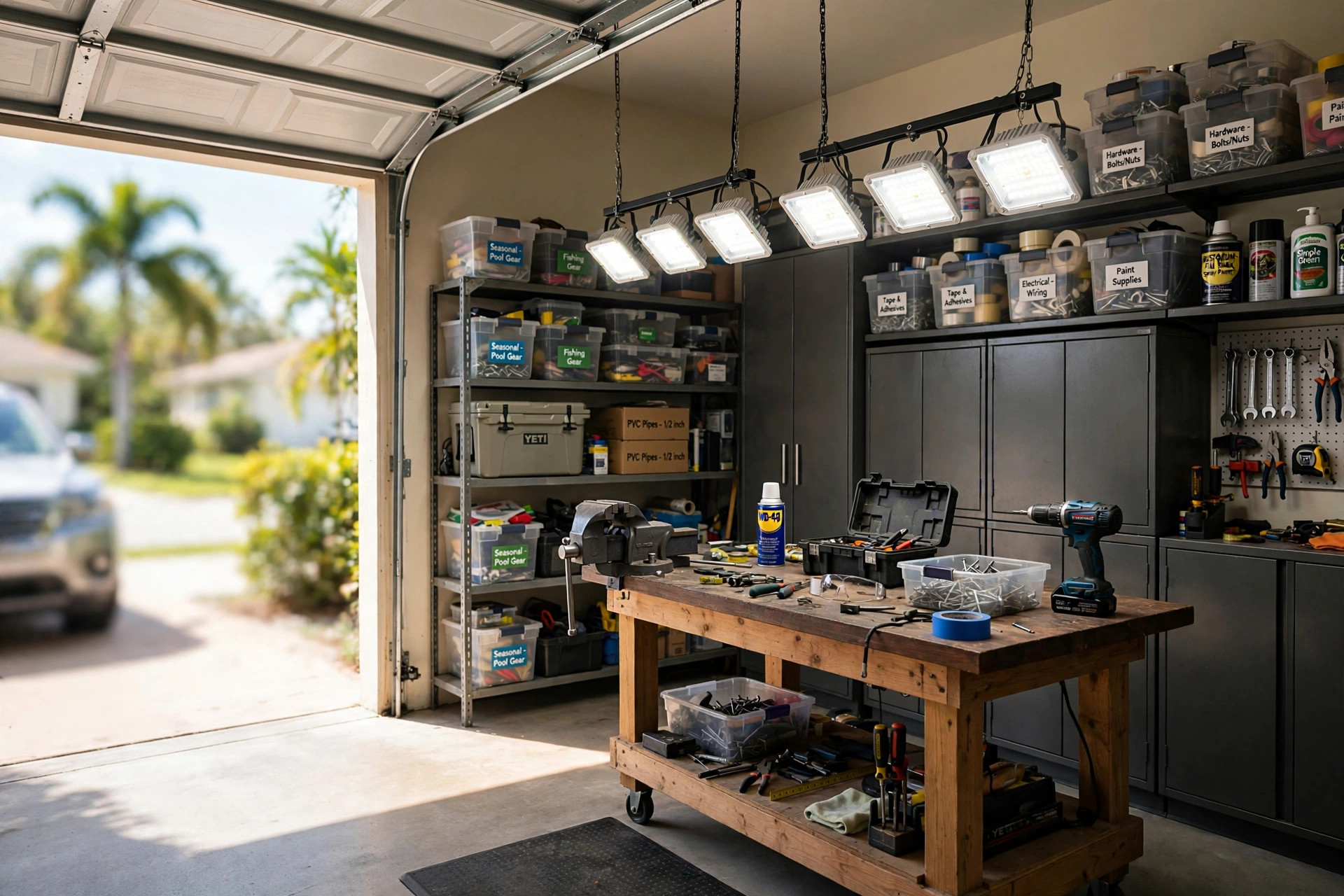

The garage in a Florida home does more than hold a car. It is often a workshop, a storage room, and a place to fix things on a rainy afternoon. Good garage shop lights make all of this easier. They cut shadows, show true colors, and make small parts easy to find. This guide explains how to choose garage shop lights florida homes usa can count on, from brightness to fixtures to the heat of a Florida summer.
Why Garage Shop Lights Matter in a Florida Home
A garage in Florida is different from a garage in a cold state. The sun is strong for most of the year. Rain comes fast in the summer. Many homes have the garage door open for air flow. Bright daylight floods in for a few hours, then the space goes dark as clouds roll past. Good shop lights fill those gaps. They give steady light that does not change with the weather.
Poor lighting in a garage causes real problems. You miss the small screw that fell on the floor. You read a measuring tape wrong in a shadow. You strain your eyes during a long project. Older homes in Florida may still have a single bare bulb on the ceiling. That bulb leaves dark corners and throws hard shadows. Two or three modern shop light fixtures solve this at a modest cost.
Florida heat is another factor. A closed garage can reach 100 degrees or more on a summer day. Older fluorescent tubes lose brightness in high heat. They also flicker. Modern LED shop lights handle heat far better. They run cool. They use less power. They last longer. For garage shop lights florida homes usa shoppers choose, heat tolerance is a true selling point.
There is also the question of insects. Bright white lights near an open garage door draw moths and flying ants in the evening. Warmer color light draws fewer bugs. A smart plan uses cool white lights over the workbench for detail work, and warmer lights near the door. This keeps the work area clear while the evening rush of bugs stays down.
How to Choose Garage Shop Lights: Garage Shop Lights Florida Homes Usa
Measure Your Space First
Start with a tape measure. Note the length and width of the garage. Note the ceiling height. Most Florida garages have ceilings between eight and ten feet. Two-car garages are often twenty feet wide. A one-car garage needs fewer fixtures than a two-car garage. A simple rule works well: one four-foot LED shop light for every fifty square feet of floor space. A twenty by twenty garage is four hundred square feet, so it needs about eight fixtures for bright, even light. Most people are happy with six.
Think About Brightness in Lumens
Brightness is measured in lumens. Lumens tell you how much light a fixture gives. For detailed work like woodwork or car repair, aim for fifty to seventy five lumens per square foot. A four hundred square foot garage then needs twenty thousand to thirty thousand total lumens. A typical four-foot LED shop light gives four thousand to five thousand lumens. Six of them give about twenty seven thousand lumens. That is plenty for a busy workshop.
Do not buy by wattage alone. Wattage tells you how much power a fixture uses, not how much light it gives. An LED fixture uses far fewer watts than an old fluorescent tube for the same light. Look at lumens first. Then check the watts to see how much power you will use. Energy saving matters in Florida, where air conditioning already drives up the power bill. ENERGY STAR rated fixtures are a good place to start when you want proven savings.
Pick the Right Color of Light
Light color is measured in Kelvin. Low numbers look warm and yellow. High numbers look cool and white. For a garage workshop, a color between four thousand and five thousand Kelvin works best. It is close to daylight. It shows true colors. It keeps you alert. Bulbs marked 5000K daylight are a common choice for shop lights. Bulbs marked 3000K warm white feel softer, and they are a fine choice for a garage that is used more for storage and light chores.
Many LED shop lights now let you switch the color with a small toggle on the fixture. This is handy. You can try each setting and keep the one you like. It costs a little more up front. It saves you from buying the wrong color.
Check Heat and Humidity Ratings
Florida air is damp. A garage that is not air conditioned may stay humid for months. Look for fixtures rated for damp locations. The rating is printed on the box. Damp rated fixtures resist rust and moisture. This is one of the most important details for garage shop lights florida homes usa will use year after year. A fixture that is not damp rated may fail early in a Florida garage.
LEDs beat older tubes in heat. Fluorescent tubes lose light output as the garage gets hot. They also take time to reach full brightness after you flip the switch. LEDs reach full brightness at once, even on a cool January morning in North Florida. They run cooler too, which helps in a garage that is already hot.
Types of Garage Shop Lights
LED Shop Light Fixtures
The most popular choice today is the four-foot LED shop light. It hangs from chains or mounts flat on the ceiling. It gives even light over a wide area. Many models link together in a chain from one power outlet. This makes wiring simple. You plug in one fixture and the rest follow in line. Philips and other major brands make reliable versions of these fixtures.
LED Tube Replacements
If your garage already has old fluorescent fixtures, you can swap the tubes for LED tubes. Some LED tubes work with the old ballast in place. Some need the ballast removed and the wiring changed. The second type is called ballast bypass. It takes more work but gives a longer life. If you are not sure about wiring, hire an electrician. A simple guide to recessed lights installation can help you understand the wiring basics used in home lighting.
High Bay Lights
High bay lights hang from tall ceilings. They suit garages with ceilings over twelve feet, or a large shop building behind the house. They throw a wide cone of light down to the floor. In a normal Florida home garage with an eight-foot ceiling, a high bay light would be too strong and too close. Save these for large spaces.
Portable and Plug In Work Lights
A clamp light or a portable LED work light helps with dark corners. You can aim it under a car hood or behind a shelf. These are cheap and useful. They do not replace ceiling fixtures. They add to them. For tasks under the hood at night, a portable light plus good ceiling lights is the best mix.
Motion and Sensor Lights
Some shop lights include a motion sensor. The light turns on when you walk in and turns off after you leave. This is handy when your hands are full of groceries or tools. It also saves power. If you like this feature in the garage, you may also like motion flood lights for the driveway and yard.
Cost and Price
Prices for garage shop lights vary with quality. A basic four-foot LED shop light costs between twenty and forty dollars. Better models with selectable color, linkable design, and damp ratings cost forty to eighty dollars. LED tube replacements cost eight to twenty dollars per tube.
A full upgrade for a two-car garage runs between one hundred fifty and four hundred dollars in materials. This covers six to eight LED fixtures. If you hire an electrician to add outlets or switches, labor adds to the bill. Many Florida homeowners do the hanging and plugging themselves, since most shop lights plug into a standard outlet. Any new wiring should be done by a licensed electrician.
Running costs are low. A four-foot LED shop light uses about forty watts. Six of them use two hundred forty watts, less than many old single fixtures used with fluorescent tubes. The U.S. Department of Energy notes that LEDs use far less energy than older lighting. In a state with high summer power bills, the savings add up over the years.
Care and Upkeep
LED shop lights need little care. They have no bulbs to change for many years. Most last fifty thousand hours. That is more than a decade of normal garage use. Wipe the lens with a dry cloth once or twice a year. Dust and grime cut the light. In a Florida garage, dust mixes with humidity and sticks to fixtures. A quick wipe keeps them bright.
Check the mounting chains or brackets once a year. Humid air can rust cheap metal parts. Replace rusted hooks before a fixture hangs loose. If a fixture flickers or dims, check the outlet and the plug first. LED drivers can fail, but most failures come from loose plugs or bad outlets.
Keep the area around fixtures clear. Do not stack boxes against ceiling fixtures. Heat needs room to escape. This is a small point, but it extends the life of the fixture.
Safety Tips
Electricity and water do not mix. Florida storms can push rain under a garage door. Keep light fixtures and cords away from standing water. If your garage floods in a heavy storm, turn off the breaker before you step in. Dry the floor before you touch any fixture.
Choose fixtures with a proper safety rating. The label should show a listing from a testing lab. This is your proof that the fixture was tested for safe use. Do not buy no-name fixtures with no rating. Saving twenty dollars is not worth a fire risk.
Watch the cords. Linkable shop lights daisy chain from one to the next. Keep cords tight against the ceiling and away from the garage door track. A cord caught in the door opener can pull a fixture down. Use cord clips to hold runs neat.
Ladders are part of the job. Hang fixtures from a steady ladder, not a chair. Have someone hold the ladder if you can. Florida emergency rooms see plenty of ladder falls each year. Take your time.
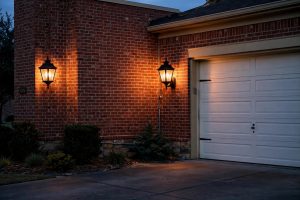
If your garage lights are part of a larger outdoor plan, note that outdoor wall lanterns near the garage door add both safety and curb appeal after dark.
Frequently Asked Questions
How many shop lights do I need for a two-car garage?
Plan for one four-foot LED fixture for every fifty square feet. A twenty by twenty garage is four hundred square feet, so six to eight fixtures give bright, even light. Start with six over the main work areas. Add more if you see dark corners.
Are LED shop lights better than fluorescent in Florida heat?
Yes. LEDs keep their brightness in high heat. Fluorescent tubes lose light and may flicker when the garage is hot. LEDs also start at full brightness at once, with no warm up time. They run cooler, which helps in a hot garage.
What color temperature is best for a garage workshop?
Between 4000K and 5000K works best for detail work. This range looks like daylight and shows true colors. If the garage is used mainly for storage, 3000K warm white feels softer and draws fewer insects in the evening.
Can I install shop lights myself?
Most plug in shop lights are simple to hang. You mount them with chains or screws and plug them into an outlet. You do not need to touch house wiring. Any new outlets, switches, or hardwired fixtures should be done by a licensed electrician. Florida codes are strict about garage wiring.
Do shop lights work in a humid garage?
Yes, if you buy fixtures rated for damp locations. The rating is printed on the box or the fixture. Damp rated fixtures resist moisture and rust. This matters in Florida, where a garage can stay humid for months at a time.
How long do LED shop lights last?
Most are rated for fifty thousand hours. With a few hours of use per day, that is more than ten years. You will likely never change a bulb. Wipe the lenses once or twice a year to keep them bright.
A Final Word
Good garage shop lights are one of the best small upgrades a Florida homeowner can make. They cost a few hundred dollars. They take an afternoon to hang. They turn a dark garage into a useful workshop that works in any weather. Choose LED fixtures, size them to your space, and buy damp rated models for the Florida climate. For more ideas on home lighting, the buying guides at Lowe’s and The Home Depot cover many fixture types, and lighting specialists at Lumens and Lamps Plus can help with harder choices. Retailers like Wayfair carry a wide range of shop lights as well, and The Spruce offers plain buying advice. For project how to articles, Bob Vila is a steady resource. Your garage will thank you the first time you find that dropped screw in seconds instead of giving up and buying a new one.
References
Bob Vila. (n.d.). Home improvement advice. https://www.bobvila.com ENERGY STAR. (n.d.). Energy efficient products. https://www.energystar.gov Lamps Plus. (n.d.). Lighting and home decor. https://www.lampsplus.com Lowe’s. (n.d.). Home improvement products. https://www.lowes.com Lumens. (n.d.). Lighting and ceiling fans. https://www.lumens.com Philips. (n.d.). Lighting products. https://www.philips.com The Home Depot. (n.d.). Home improvement products. https://www.homedepot.com The Spruce. (n.d.). Home and garden advice. https://www.thespruce.com U.S. Department of Energy. (n.d.). Energy efficiency and renewable energy. https://www.energy.gov Wayfair. (n.d.). Furniture and home goods. https://www.wayfair.com
Was this guide helpful?

About Michael Thompson
The My Garden US editorial team writes practical, in-depth home and garden guides for American homeowners — tested advice, no fluff.
You May Also Like

Bedroom Table Lamps Deals Near Me
March 14, 2026 0 views
Kitchen Island Pendants Buying Guide USA: Sizes, Styles, Prices, and Safe Choices
September 27, 2026 0 views
Vanity Light Bars: A Practical Guide for American Homes
June 8, 2026 0 views