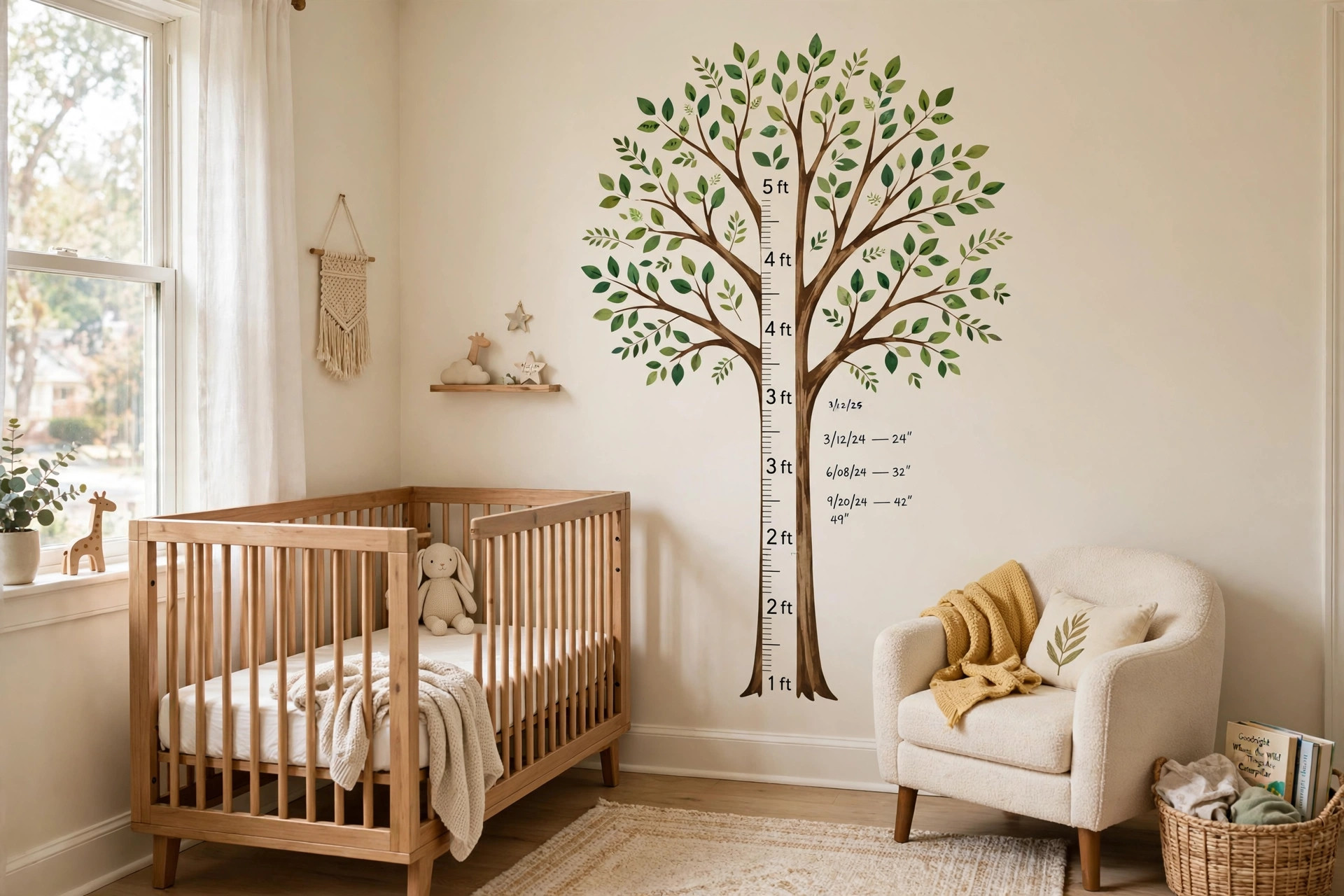

A kids wall decal growth chart for measuring height is one of the simplest ways to decorate a child’s room and keep a record of the years at the same time. It is a large sticker that goes on the wall. It looks like a ruler, a tree, a giraffe, or a rocket. As your child grows, you make a small mark with the date at the height of the child’s head. Years later, those marks become a map of childhood.
Parents used to mark height on a door frame with a pencil. That worked well in a home that the family owned. Renters cannot write on door frames. Families who move often cannot take a door with them. A wall decal solves both problems. It peels off the wall, and many can be moved to a new home or rolled up and saved.
Why a Growth Chart Wall Decal Matters
Children grow fast, and the years pass before parents expect it. A baby who cannot stand today will be five feet tall before long. Small moments of daily life fade from memory. Height marks stay. They give a family a shared story. A child loves to stand against the wall and see how much he or she has grown since last year.
A kids wall decal growth chart for measuring height also works as art. Most nursery walls are plain. A bright chart fills the empty space with color and shape. It gives the room a center point. It can tie the whole room together, from the crib to the curtains. When the child outgrows the nursery, the decal can move to the child’s new room.
The decal is also a gift idea. New parents receive many gifts that are used for a few months and then put away. A growth chart decal is used for many years. Grandparents often buy one as a baby shower gift. It costs little, and it shows thought.
Types and Designs to Choose From: Kids Wall Decal Growth Chart for Measuring Height
Wall decal growth charts come in many styles. Each one fits a different room and a different taste.
Animal and Nature Themes
The most common design shows a tall animal. A giraffe is the favorite. Its long neck is a natural ruler. Zebras, elephants, and monkeys are also popular. Tree designs work well too. A tall tree trunk can hold height marks from one foot to five feet. Some trees come with leaves and small animals on the branches.
Rocket and Space Themes
A rocket ship points straight up, so it makes a fine height chart. Stars and planets sit around it. This theme suits children who love space. It also works for a shared room with boys and girls.
Minimal and Modern Themes
Some parents want a plain look. Minimal charts show only a simple ruler with numbers. They come in soft colors like gray, white, and pale blue. These fit modern nurseries and rooms with calm colors. Many pair well with nursery wall art for baby boy rooms.
Removable and Portable Themes
Most decals today are made to remove cleanly. A few are made to move more than once. These have a thicker backing that can be peeled and stuck again. This type is best for military families and renters who move every year or two. If you rent, look at removable wall decals made for renters alongside your chart choice.
How to Choose the Right One
Choosing a kids wall decal growth chart for measuring height is not hard, but a few details matter.
First, check the height range. Most charts start at one foot and go to five or six feet. Some start at the floor and some start a few inches up. If you want to track a baby from birth, find one that starts low on the wall. Think about where the top of the chart will sit. Measure your wall before you order.
Second, check the material. Good decals use thick vinyl or a woven fabric. Thin, cheap vinyl can stretch when you hang it, and the marks will be wrong. Woven fabric decals feel soft and rarely bubble. Look for words like “removable” and “repositionable” in the description.
Third, think about the marks. Some charts have a clear strip where you write. A plain white strip is best because ink shows well on it. Some charts have dark colors behind the numbers, and marks are hard to see. A good chart leaves open space next to the numbers for dates and notes.
Fourth, match the room. A chart should fit the colors and theme of the room. A pink giraffe looks odd in a navy blue room. Neutral charts work in any room. Many parents pick a chart that will still look right when the child is ten.
Fifth, read the reviews. Other parents say how the decal hung, whether it stuck well, and whether it removed cleanly. Shops like Wayfair and Amazon carry many designs with hundreds of reviews. Big stores like Walmart and Target also stock nursery decals both online and in store.
Hanging and Marking Tips
A growth chart decal is only useful if it hangs straight and at the right height. Take your time with this step.
Clean the wall first. Dust and grease stop the sticker from holding. Wipe the area with a damp cloth and let it dry. Do not hang a decal on fresh paint. Wait at least three to four weeks after painting so the paint cures fully.
Find the right spot. Choose a wall with open floor space in front of it. Your child must stand with the back to the wall and feet flat. A corner or a spot behind furniture will not work. Many parents use the wall next to the closet or the nursery door.
Mark the floor line. Use a tape measure to find where one foot or the first inch of the chart should sit. Draw a light pencil line on the wall. A small level tool helps keep the decal straight. Most charts come in one large piece or a few large pieces. Peel a small part of the backing, press the top edge to the wall, and smooth downward with a soft cloth. Work slowly to push out air bubbles.
Start marking right away. Do not wait for a special day. Stand the child against the wall with heels together and back straight. Lay a flat book on top of the head and make a mark where the book meets the chart. Write the date and the child’s age next to the mark. Use a fine-tip pen that will not bleed. Many parents also write a short note, like a new tooth or a first word.
Keep marks honest. Some children push up on their toes to look taller. Press their heels to the floor and keep the back of the head against the wall for a true reading.
A chart hung at the right height gives years of true marks. Guides at The Spruce and What to Expect offer room setup ideas that pair well with a chart, from crib placement to reading corners.
Cost and Price
A kids wall decal growth chart for measuring height is a low-cost item. Most sell for between five and forty dollars. Simple vinyl ruler decals sit at the low end. Large fabric decals with art and animals sit at the high end. A few hand-painted wooden charts cost more, but those are not decals.
Price does not always match quality. A ten-dollar decal from a trusted brand can last longer than a thirty-dollar decal from an unknown seller. Read reviews before you buy. Look for comments about sticking power and clean removal.
Factor in a small extra cost for tools. You may want a tape measure, a small level, and a fine-tip marker if you do not own them. These cost little and help you hang the chart well.
If you want the chart to match high-end nursery furniture, shops like Pottery Barn Kids and IKEA sell decals and nursery decor that share a style. IKEA pieces in particular fit small rooms and tight budgets.
Care and Upkeep
A wall decal needs little care. Dust it with a dry cloth now and then. Do not scrub it with water or cleaner. Water can lift the edges and blur your ink marks.
Keep the room at a normal temperature. Heat and steam loosen adhesive. Do not hang a growth chart above a radiator or next to a shower. Sunlight can fade bright colors over time. If the wall gets direct sun, hang the chart on a shaded wall instead.
Check the edges once a year. If a corner starts to lift, press it back with a warm cloth. Most decals last five to ten years on the wall. Fabric decals often last longer than vinyl ones.
When you move, removal is simple. Start at a corner and peel slowly at a low angle. Warm the decal with a hair dryer on low heat if it resists. This softens the glue. A hair dryer on low heat also helps when you place a repositionable decal in a new room. If sticky marks stay on the wall, rub them gently with a damp cloth.
Pair the chart with other easy room updates. Blackout curtains for nursery windows help children sleep, and a calm dark room makes a bright chart stand out during the day.
Safety First
Wall decals are safe for most homes, but a few rules keep children safe.
Buy from makers that meet safety rules. In the United States, the Consumer Product Safety Commission sets rules for children’s products. Choose decals sold by known stores rather than unknown sellers. This lowers the risk of harmful inks or glue.
Hang the chart where small children cannot reach and pull it. A peeling edge can tempt a toddler. If a child pulls a large decal off the wall, the child could tear it and put a piece in the mouth. Hang the chart with its lower edge above the reach of a crawling baby.
Watch the inks and markers. Use pens that are non-toxic. Keep markers out of reach when you are not marking. Markers left on a low table will end up on the wall and the floor.
Check for small parts. Some chart kits come with separate sticker pieces, like stars or animals. These pieces can come loose. The American Academy of Pediatrics warns that small loose pieces are a choking risk for children under three. Keep loose stickers high on the wall or skip them until the child is older.
If the decal starts to peel on its own, remove it or press it flat. A half-peeled decal in a child’s room will not last long. Children pick at loose edges.
Frequently Asked Questions
Will a wall decal damage my paint?
A good removable decal should not damage paint. It should peel off cleanly. The risk rises with cheap glue, fresh paint, and heat. Let new paint cure for a month before you hang a decal. Peel slowly at a low angle when you remove it. Test a small corner first if you are unsure.
Can I move the decal to a new house?
Some decals can move, and some cannot. Thin vinyl decals stretch and lose stick after one removal. Thicker fabric decals often move well. Look for “repositionable” on the box. Even then, keep your hopes modest. One move is often the limit.
What should I use to write the marks?
Use a fine-tip permanent marker or a paint pen. Ballpoint pens skip on vinyl. Pencils rub off. Test the pen on a spare corner of the decal first. Write small and neat. Leave room for many years of marks.
How often should I measure my child?
Most families measure once or twice a year. Birthdays are the common choice. Some mark New Year’s Day as well. Do not measure every week. Growth comes in spurts, and weekly checks can disappoint a child who wants to be taller.
My wall is textured. Will a decal stick?
Light texture is fine. Heavy texture, like deep stucco, is a problem. The decal needs flat contact to hold. If your wall has heavy texture, hang the chart on a door or a large board instead. A painted board can lean against the wall and still hold marks for years.
What age range does a growth chart cover?
Most charts run from about one foot to five or six feet. That covers birth through the teen years for most children. A few charts run to seven feet. Check the range on the product page before you buy, and make sure the numbers are easy to read.
A Final Word
A kids wall decal growth chart for measuring height is a small buy with a long life. It decorates a bare wall. It gives a child a fun yearly ritual. It gives parents a record that no photo can replace. Choose a design you will like for a decade. Hang it straight. Mark it with care. The marks will outlast the room, and one day your grown child will stand against that wall and read the story of his or her own childhood in inches and dates.
References
Amazon. (n.d.). Online shopping. https://www.amazon.com American Academy of Pediatrics. (n.d.). HealthyChildren.org. https://www.healthychildren.org IKEA. (n.d.). Home furnishings. https://www.ikea.com Pottery Barn Kids. (n.d.). Kids furniture and decor. https://www.potterybarnkids.com Target. (n.d.). Retail store. https://www.target.com The Spruce. (n.d.). Home and garden advice. https://www.thespruce.com U.S. Consumer Product Safety Commission. (n.d.). Product safety information. https://www.cpsc.gov Walmart. (n.d.). Everyday low prices. https://www.walmart.com Wayfair. (n.d.). Furniture and home goods. https://www.wayfair.com What to Expect. (n.d.). Pregnancy and parenting guidance. https://www.whattoexpect.com
Was this guide helpful?

About Jennifer Lee
The My Garden US editorial team writes practical, in-depth home and garden guides for American homeowners — tested advice, no fluff.
You May Also Like

Kids Bedroom Blackout Shades for Better Sleep
March 8, 2026 0 views
The Crib Canopy Net for Mosquito Protection USA Parents Trust
April 16, 2026 0 views
Toddler Bedding Set with Pillow for Crib: A Plain Guide for Parents
August 4, 2026 0 views