---
Table of Contents
Table of Contents
- Level a Sunken Paver Patio: Why Pavers Sink
- Tools and Materials You Need
- Step 1: Mark the Low Area
- Step 2: Lift the Sunken Pavers
- Step 3: Inspect What Is Underneath
- Step 4: Fix the Base
- Step 5: Add Fresh Bedding Sand
- Step 6: Reset the Pavers
- Step 7: Lock the Joints With Sand
- Step 8: Fix the Cause So It Stays Fixed
- How Much Sand Do You Need
- When to Call a Professional
- Keeping the Patio Level Year After Year
- References
A paver patio should feel solid under your feet. Every block should sit flat. Chairs should not wobble. Water should run off instead of pooling in low spots. But soil moves. Bases settle. Roots push up. Over time, a section of your patio can sink and leave you with an ugly dip that trips people and collects rain. This guide covers level a sunken paver patio in plain steps.
The good news is that pavers are made to be fixed. Unlike a poured concrete slab, each paver is a separate piece. You can lift the sunken ones, fix the base under them, and set them back down. Sand is the key material in the whole job. This guide walks you through how to level a sunken paver patio with sand, from finding the cause to finishing the repair so it lasts.
Level a Sunken Paver Patio: Why Pavers Sink
When it comes to level a sunken paver patio, getting the details right makes all the difference.
Many homeowners find that level a sunken paver patio is easier than they expected once they know the basics.
Pavers do not sink on their own. Something under them changed. Knowing the cause keeps the repair from failing again.
Poor compaction. When a patio is built, the crushed stone base must be packed down hard in thin layers. If the builder rushed this step, the base keeps settling under foot traffic and rain. Low spots show up within a few seasons.
Water trouble. Water is the top enemy of a paver base. A downspout that dumps beside the patio, a broken sprinkler head, or a yard that slopes toward the patio can wash the bedding sand out from under the blocks. Once the sand is gone, the pavers drop into the empty space.
Rotting matter. Old tree roots, stumps, or buried wood left under the base will rot away. When they do, they leave voids. The pavers above fall into those holes.
Edge failure. Pavers are held in by edge restraints, usually plastic or metal strips pinned into the ground. If the edging breaks or pulls loose, the outer pavers creep outward and the field of pavers loosens and sinks.
Freeze and thaw. In cold climates, water in the base freezes and expands, then thaws and contracts. This cycle can pump fine sand out of the joints and shift pavers a little each winter.
The repair steps below work for all of these causes. But if water is washing your base away, fix the water problem first. Rebuilding a base that will wash out again is wasted work. If your whole yard stays soggy, read our guide to lawn drainage solutions for soggy yards before you start.
Tools and Materials You Need
Many homeowners find that level a sunken paver patio is easier than they expected once they know the basics.
The key to level a sunken paver patio is choosing the right approach for your space and budget.
Gather everything before you lift the first paver. A repair like this goes fast when you are not running to the store mid-job.
- Flat pry bar or two flat screwdrivers
- Rubber mallet
- Four foot level and a small torpedo level
- Straight two-by-four for screeding
- Hand tamper or a rented plate compactor for bigger areas
- Stiff push broom
- Wheelbarrow and shovel
- Garden hose with a spray nozzle
- Coarse bedding sand (often sold as paver sand or concrete sand)
- Joint sand or polymeric sand for the joints
- Crushed stone or paver base gravel if the base itself needs rebuilding
- New pavers if any are cracked (take one to the store to match)
- Work gloves and safety glasses
- Knee pads
Do not use play sand or fine beach sand. It is too soft and washes out fast. Coarse concrete sand with angular grains locks together and stays put. Product data sheets from paver sand makers describe the difference between base sand and jointing sand and how each one is meant to be used. A good primer on the repair itself is the Money Pit guide to fixing a loose brick sidewalk paver, which covers the same lift, re-bed, and reset method on a smaller scale.
Step 1: Mark the Low Area
The key to level a sunken paver patio is choosing the right approach for your space and budget.
With a little planning, level a sunken paver patio can fit even a busy schedule.
Walk the patio and find every sunken spot. Set a straight board across the area and slide it around. Mark the low pavers with chalk or tape. Include a border of good pavers around the bad area, at least one full row past where the dip ends. You will lift this whole section so the repair blends into the flat patio.
Step 2: Lift the Sunken Pavers
With a little planning, level a sunken paver patio can fit even a busy schedule.
Before you start, it helps to understand how level a sunken paver patio works in real homes.
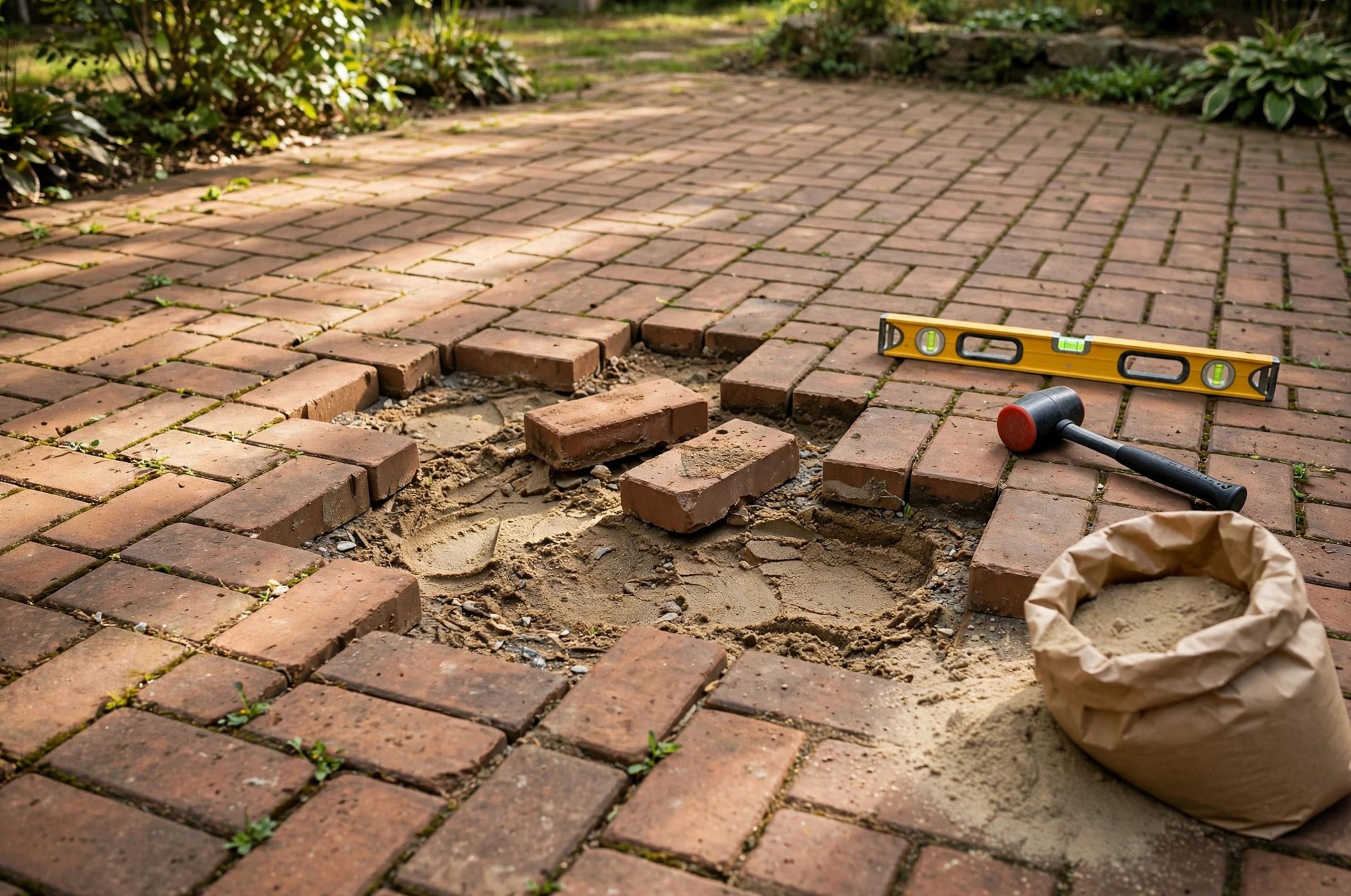
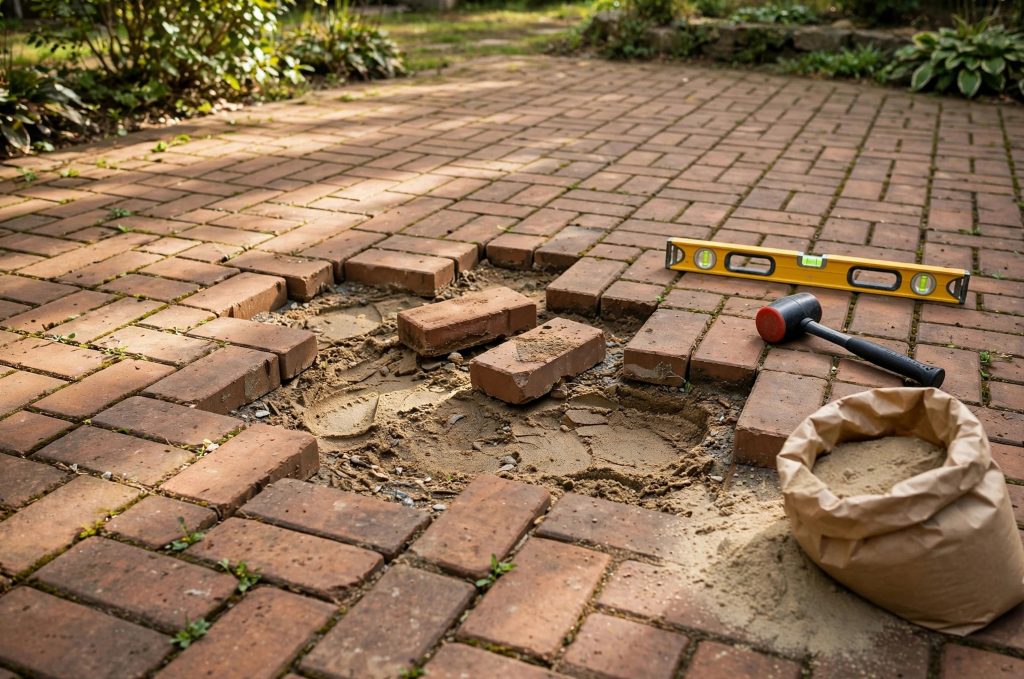
Start at the edge of the marked area where pavers are loosest. Slide two flat screwdrivers into a joint and pry the first paver up. Once the first one is out, the rest lift easily by hand.
Stack the pavers nearby in the order you removed them. If the patio has a pattern, snap a photo first or number the backs with chalk. Keep the stack out of your work path.
Step 3: Inspect What Is Underneath
Before you start, it helps to understand how level a sunken paver patio works in real homes.
A good plan for level a sunken paver patio saves time, money, and frustration.
Scrape out the old bedding sand and look at the crushed stone base. A good base feels hard as rock when you poke it with a screwdriver. If your screwdriver sinks in, the base is weak and needs rebuilding.
Look for the cause while you are down there:
- Soft or hollow spots mean the base was never compacted well or has washed out.
- Standing water or mud means drainage is the real problem.
- Roots or rotten wood must be dug out completely.
- Broken edge restraint must be replaced or re-pinned.
The Money Pit has a clear walkthrough of how to repair a sinking paver patio that stresses rebuilding only the damaged section instead of tearing out the whole patio.
Step 4: Fix the Base
A good plan for level a sunken paver patio saves time, money, and frustration.
For most people, level a sunken paver patio comes down to a few smart choices.
If the base is only a little soft, add a few inches of fresh crushed stone. Spread it in layers no thicker than two inches. Tamp each layer hard with a hand tamper until it barely moves. For a section bigger than a few square feet, rent a plate compactor. The vibration packs the stone tight in a way a hand tamper cannot match.
If the base is solid and only the sand washed out, skip the stone. Just clean out the loose material and move on.
Check your pitch while you work. A patio should slope away from the house so water runs off. About a quarter inch of drop per foot of patio is the standard target. Set your level on the base and check.
Step 5: Add Fresh Bedding Sand
For most people, level a sunken paver patio comes down to a few smart choices.
If you are new to level a sunken paver patio, start with the simplest option and build from there.
Spread coarse bedding sand over the repaired base, about one inch thick. Do not compact it. Loose sand lets each paver settle into its final seat.
Screed the sand flat. Lay two straight pipes or boards on the base as rails, pour sand between them, and drag your two-by-four across the rails. The result is a flat, even bed. Pull the rails out and fill the small grooves with a trowel.
Keep the sand dry while you work. Wet sand clumps and will not screed smooth.
Step 6: Reset the Pavers
If you are new to level a sunken paver patio, start with the simplest option and build from there.
Set the pavers back in their pattern, starting from one corner. Leave even joint gaps, about an eighth of an inch. Tap each paver down with the rubber mallet until it sits flush with the surrounding patio. Check with your level in both directions as you go.
It helps to stand back every few rows and sight down the surface. Your eye will catch a high or low paver faster than a level will.
Step 7: Lock the Joints With Sand
When it comes to level a sunken paver patio, getting the details right makes all the difference.
Sweep joint sand over the whole repaired area. Work it into every crack with the broom, going in several directions. Then tamp the pavers lightly or walk over them to settle the sand down into the joints. Sweep more sand in and repeat until the joints will not take any more.
Mist the area lightly with the hose to help the sand settle. Do not blast it with a hard stream or you will wash the sand right back out. Sweep off the extra sand when the surface is dry.
Many homeowners finish with polymeric sand instead of plain joint sand. It has a binder that hardens when wet, which resists weeds, ants, and washout. The trade-off is that it costs more and is harder to remove if you ever need to lift the pavers again. For a good overview of the removal and replacement process, see this step-by-step guide to how to repair a paver patio.
Step 8: Fix the Cause So It Stays Fixed
Many homeowners find that level a sunken paver patio is easier than they expected once they know the basics.
A level patio that sinks again is no fix at all. Take care of the root cause now.
- Move the water. Extend downspouts away from the patio with solid pipe. Regrade the soil beside the patio so the yard slopes away.
- Fix the edging. Re-pin loose edge restraints with long landscape spikes. Replace cracked plastic edging.
- Kill the roots. Cut back roots that are pushing up pavers, and dig out any rotten wood under the base.
- Seal the joints. A paver sealer keeps joint sand from washing out and slows weed growth. Apply it after the repair has had a week or two to settle.
If puddles form on your patio after every rain, the slope may be wrong across the whole patio, not just the repaired spot. That is a bigger job, and it may be worth getting a hardscape contractor to look at it.
How Much Sand Do You Need
The key to level a sunken paver patio is choosing the right approach for your space and budget.
A fifty pound bag of paver sand covers roughly a small repair area at one inch thick. For planning, figure that one ton of sand covers about one hundred square feet at one inch deep. Most single dip repairs need only a few bags. Buy a little extra. Leftover sand stores fine in a dry shed and comes in handy for touch-ups.
When to Call a Professional
With a little planning, level a sunken paver patio can fit even a busy schedule.
Most sunken spots are a fine weekend project. Call a pro when:
- More than a third of the patio has sunk
- The whole patio slopes toward the house
- The base is deep mud and keeps washing out
- You find a broken buried pipe or a sinkhole forming
- The pavers are set in mortar instead of sand
A contractor with a plate compactor and a load of base stone can rebuild a failed patio in a day or two. Get the drainage fixed as part of the job.
Keeping the Patio Level Year After Year
Small habits keep a patio flat for decades. Sweep the joints clear of dirt a few times a season so weeds cannot take root and push pavers apart. Top up joint sand when you see gaps opening. Keep the edge restraint buried and pinned. And walk the patio each spring with a level to catch new dips while they are still small.
If you enjoy outdoor projects, you may also like our guide on how to level patio furniture on grass and our look at stamped concrete patio cost per square foot for comparing patio options. For patios in hot climates, see best tile for outdoor patio in Texas. With these steps, level a sunken paver patio stays simple and safe.
References
- Family Handyman. (n.d.). Paver patio repair and maintenance guides. https://www.familyhandyman.com
- Money Pit. (n.d.). How to repair a sinking paver patio. https://www.moneypit.com/how-repair-sinking-paver-patio/
- Outback Landscape. (n.d.). How to repair a paver patio. https://www.outbacklandscapeinc.com/blog/how-to-repair-a-paver-patio
- Money Pit. (n.d.). Loose brick sidewalk paver: How to fix. https://www.moneypit.com/loose-brick-sidewalk-paver-how-fix/
- This Old House. (n.d.). Walkway and patio project guides. https://www.thisoldhouse.com
- U.S. Environmental Protection Agency. (n.d.). What you can do to soak up the rain. https://www.epa.gov/soakuptherain/what-you-can-do-soak-rain
- Vocal Media. (n.d.). The hidden physics of sinking pavers: What is happening beneath your feet. https://vocal.media/lifehack/the-hidden-physics-of-sinking-pavers-whats-happening-beneath-your-feet
Was this guide helpful?

About My Garden US
The My Garden US editorial team writes practical, in-depth home and garden guides for American homeowners — tested advice, no fluff.
You May Also Like

Cheap Sod Installation Cost Per Pallet: A Plain Guide for Homeowners
March 16, 2026 17 views
Stump Killer for Tree Stumps Reviews: What Buyers Should Know
July 22, 2026 15 views
The Best Electric Lawn Mower for Seniors: A Practical Guide for Older Homeowners
March 10, 2026 25 views