
Learning how to hang a hammock without trees is easier than most people think. For years, the hammock belonged to the shady backyard with two old oaks standing just the right distance apart. But many homes have no trees at all. Some have small patios. Some have only a deck or a narrow side yard. The good news is that a tree is only one kind of anchor. A hammock needs two strong points, set at the right height and distance. Once you know how to build or buy those points, you can hang a hammock almost anywhere.
Why It Matters
A hammock is one of the simplest pieces of outdoor furniture a person can own. It costs less than most patio chairs. It takes up little space. It gives a place to read, to rest, or to take a short nap on a warm afternoon. For people with no trees, though, the dream often stops before it starts. They look at their yard, see no branches, and give up.
That is a shame, because the solutions are plain and well tested. Carpenters and do-it-yourself builders have hung hammocks between posts, beams, and walls for a very long time. Retailers sell stands and hardware made for this exact purpose. With a little care in choosing anchors and setting heights, a treeless yard can hold a hammock as safely as any wooded lot.
Methods That Work: How to Hang Hammock Without Trees
There are six common ways to hang a hammock without trees. Each one fits a different kind of space and budget. Read through them and pick the one that matches your home.
Wooden Posts Set in Concrete
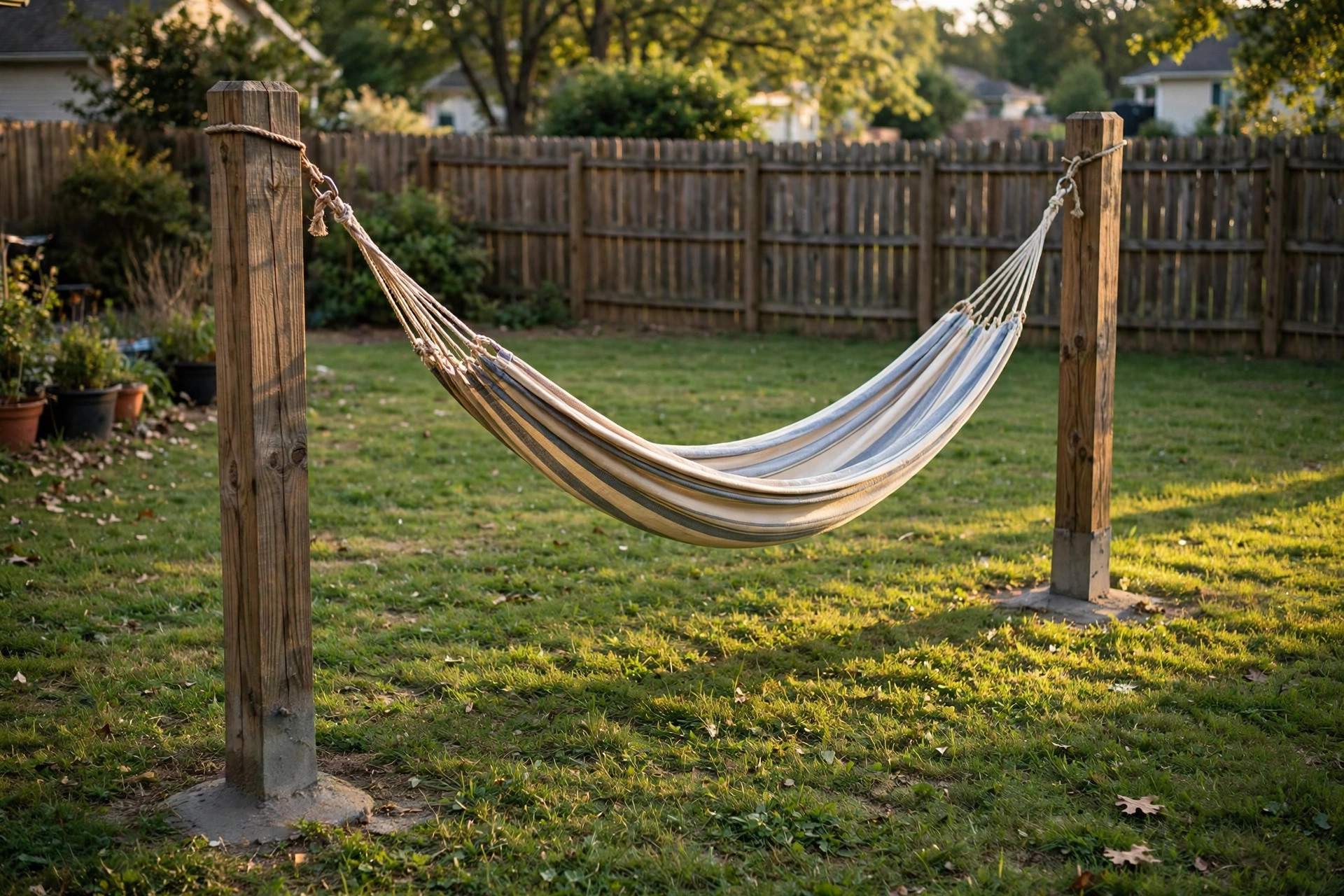
Two wooden posts, set in concrete footings, are the most solid and lasting option. Buy two pressure-treated 4×4 posts, each at least 8 feet long. Mark two spots on the ground. The distance between them should match your hammock’s hang distance, usually 12 to 15 feet. Dig a hole at each mark, about 2 to 3 feet deep and a foot wide.
Set a post in each hole. Check with a level that it stands straight. Pour in concrete mix and water, or use ready-mixed bags from a store like Home Depot. Let the concrete cure for at least two full days before you hang anything. When you attach the hammock, use heavy eye bolts or lag screws with washers, driven into the side of each post at about 4 to 5 feet high.
This method costs little and lasts for many years. It also lets you choose the exact spot, the exact height, and the exact direction your hammock faces. Many homeowners pair their posts with a few outdoor lights for evening use.
A Freestanding Hammock Stand
A metal or wood stand is the fastest answer. You buy it, put it together in about half an hour, and hang your hammock. There is no digging and no concrete. This is the best choice for renters and for people who want to move the hammock with the seasons.
Measure your hammock first, then buy a stand that matches its length. A gathered-end hammock needs a different stand than a spreader-bar one. If you expect two people to share it, look at an outdoor hammock stand for two people and check its weight limit before you buy. Stands made of powder-coated steel resist rust well. Wooden stands look warmer and fit nicely with natural gardens.
One word of care: a stand must sit on level ground. A wobbly stand is an unsafe stand. Set it on flat ground or on a solid patio surface.
A Hammock Between Two Walls or Fence Posts
If your yard has a strong fence, a garage wall, or the side of a shed, you may already have your anchors. Solid masonry walls, like brick or concrete block, can hold special masonry anchors rated for heavy loads. Wood fence posts can work too, but only if the posts are thick, set deep, and in good shape. A rotted or loose post is not safe for this job.
Use heavy-duty eye bolts and through-bolts rather than plain screws. Spread the load with a backing plate on the far side of the post. Test the anchors by leaning on them hard before you trust them with your full weight. Sites such as Bob Vila and The Spruce carry practical guidance on hardware and load ratings.
Porch Beams, Pergolas, and Deck Frames
A covered porch, a pergola, or a strong deck frame already has the structure you need. Many porches have posts or beams set at handy distances. A pergola’s upright posts, if they are thick and well joined, can hold a hammock too. Some owners drill into the heavy beam over a porch and hang the hammock from above, which frees all floor space beneath.
Before you drill into any beam, find out what it carries. A decorative trim board is not a support beam. If you are unsure, ask a carpenter. The Consumer Reports buying guides and the how-to articles on The Spruce are good places to read about load ratings and safe hardware.
A Hammock Chair With a Stand
If your space is very small, think about a hanging chair instead of a full hammock. A hammock chair hangs from a single point, so it needs only a small floor area. Many come with their own C-shaped stand. A best hammock chair with stand indoors search will show models that work on a balcony, a small patio, or even in a living room corner. The comfort is different from a full hammock, but the gentle sway is the same.
Ground Anchors and Heavy Bases
For camping-style hammocks, some people use ground screw anchors or weighted bases. Screw anchors twist deep into firm soil and hold the end ropes low to the ground. They work best in dense soil and for lighter hammocks. Weighted bases, such as large planters filled with concrete, can hold a hammock on a patio where you cannot drill or dig. They are less common, but they solve real problems for renters with strict rules.
What to Look for When You Choose
Start with your space. Measure the area where the hammock will go. Note the length and width you have. A full-size hammock needs about 13 feet of length and 5 feet of width for safe swinging. A chair needs far less.
Next, think about the ground. Soft grass suits posts and stands. A concrete patio suits a stand or wall mounts. A wooden deck may suit beam mounts if the frame is strong.
Then think about permanence. Posts in concrete are a lasting change to the yard. A stand can be folded and stored for winter. Wall anchors are a middle path: they stay, but they are small.
Hardware matters more than people expect. Use stainless steel or galvanized parts so rain does not rust them. Ropes stretch over time, so many owners prefer chains or polyester straps, which hold their length. Check the weight rating on every part: ropes, hooks, bolts, and the hammock itself. The weakest part sets the limit for the whole setup.
Finally, think about comfort details. A best solar patio lights for ambiance set near the hammock makes evening rest much nicer. A small side table holds a book and a glass of lemonade. Retailers such as Frontgate and Article sell outdoor pieces that pair well with a hammock corner.
Cost and Price
Costs vary by method, and most are modest. A freestanding steel stand usually runs between 80 and 200 dollars, depending on size and finish. Wooden posts, concrete, and hardware for the two-post method often total 60 to 120 dollars. Masonry anchors and heavy eye bolts for a wall mount cost 20 to 50 dollars. A pergola mount may cost nothing at all if you already own the pergola and only need the hardware.
The hammock itself is a separate cost. Simple cotton or polyester hammocks start around 30 dollars. Larger quilted or Brazilian-style hammocks run 80 to 150 dollars. Buying the stand and hammock together as a set often saves money. Compare prices at Lowe’s and Polywood as well as local garden centers.
Care and Upkeep
A hammock hung without trees needs the same care as any outdoor fabric. Take the fabric down during heavy storms and for the winter in cold climates. Wash it by hand with mild soap and let it dry fully before storage. Sunlight fades fabric over time, so a spot with afternoon shade lasts longer.
Check the anchors twice a year. Look at posts for rot at the ground line. Tighten bolts that have worked loose. Check ropes and chains for wear, fraying, or rust. Replace any part that looks tired. Five minutes of inspection each spring and fall prevents most accidents.
Wooden posts last longest when the tops are capped or cut at an angle so water runs off. A coat of outdoor wood sealer every few years helps too. Metal stands benefit from a touch of rust-proof paint on any chips in the coating.
Safety
Safety is the heart of this topic. A hammock holds your full weight several feet off the ground, so every anchor must be strong enough for the job.
Hang the hammock so the lowest point sits 18 to 24 inches above the ground. This height makes getting in and out easy and keeps falls short. Keep the hang angle near 30 degrees from horizontal. A hammock pulled too tight puts huge force on the anchors and feels like a stiff board. A hammock hung too loose drops you close to the ground.
Never hang a hammock from a dead or weak post, a thin fence rail, or a gutter. Never use plain wood screws in an end-grain post; use through-bolts with washers and nuts. Read the weight limit on your hammock and stay under it. Children should be taught to sit in the center and not to stand or swing wildly in the hammock.
If you mount to a house wall, avoid drilling into siding alone. Anchor into the solid framing behind it. When in doubt, hire a handyman for an hour. It is a small price for peace of mind.
FAQ
Can I hang a hammock between two fence posts? Yes, if the posts are strong. They should be thick 4×4 posts or larger, set deep in concrete, and free of rot. Weak or leaning posts are not safe. Reinforce them with backing plates and through-bolts, and test them before use.
What is the cheapest way to hang a hammock without trees? Two wooden posts set in concrete are usually the cheapest lasting method, often under 100 dollars in materials. A basic steel stand is the cheapest no-dig option.
How far apart should the anchors be? Most gathered-end hammocks need 12 to 15 feet between anchor points. Check your hammock’s instructions for its exact hang distance, and set your anchors to match.
Can I hang a hammock on my apartment balcony? A full hammock rarely fits a balcony, but a hammock chair with a stand often does. It needs only a small floor area and one overhead point on its own frame. Check your lease and your balcony’s weight rules first.
Will a hammock damage my house if I mount it to a wall? It can, if done poorly. Drill into solid framing or masonry, use rated anchors, and seal the holes against water. Done well, a wall mount leaves only two small anchor points.
How do I stop the hammock from flipping? Sit in the center, keep your weight low, and enter by sitting first and then swinging your legs in. A proper 30-degree hang angle also keeps the hammock stable.
A Short Final Word
Not having trees should never stop you from owning a hammock. Two posts, a good stand, a strong wall, or a sturdy porch beam will do the job just as well. Pick the method that fits your space and your budget, use strong hardware, and check your anchors now and then. Then all that is left is to lie back, feel the sway, and enjoy the quiet part of the day.
References
Article. (n.d.). Modern furniture. https://www.article.com Bob Vila. (n.d.). Home improvement advice. https://www.bobvila.com Consumer Reports. (n.d.). Product reviews and ratings. https://www.consumerreports.org Frontgate. (n.d.). Outdoor furniture and decor. https://www.frontgate.com HGTV. (n.d.). Home and garden ideas. https://www.hgtv.com Lowe’s. (n.d.). Home improvement products. https://www.lowes.com Polywood. (n.d.). Outdoor furniture. https://www.polywood.com The Home Depot. (n.d.). Home improvement products. https://www.homedepot.com The Spruce. (n.d.). Home and garden advice. https://www.thespruce.com Wayfair. (n.d.). Furniture and home goods. https://www.wayfair.com
Was this guide helpful?

About Jennifer Lee
The My Garden US editorial team writes practical, in-depth home and garden guides for American homeowners — tested advice, no fluff.
You May Also Like
Why an Outdoor Drink Table Set of Two Is the Smallest Upgrade That Changes Everything
August 1, 2026 0 views
Best Fire Pit Chat Set for Backyard: A Plain Guide to Choosing the Right One
July 10, 2026 0 views
Best Patio Chair Cushions Thick Reviews: A Buyer Guide
August 12, 2026 0 views