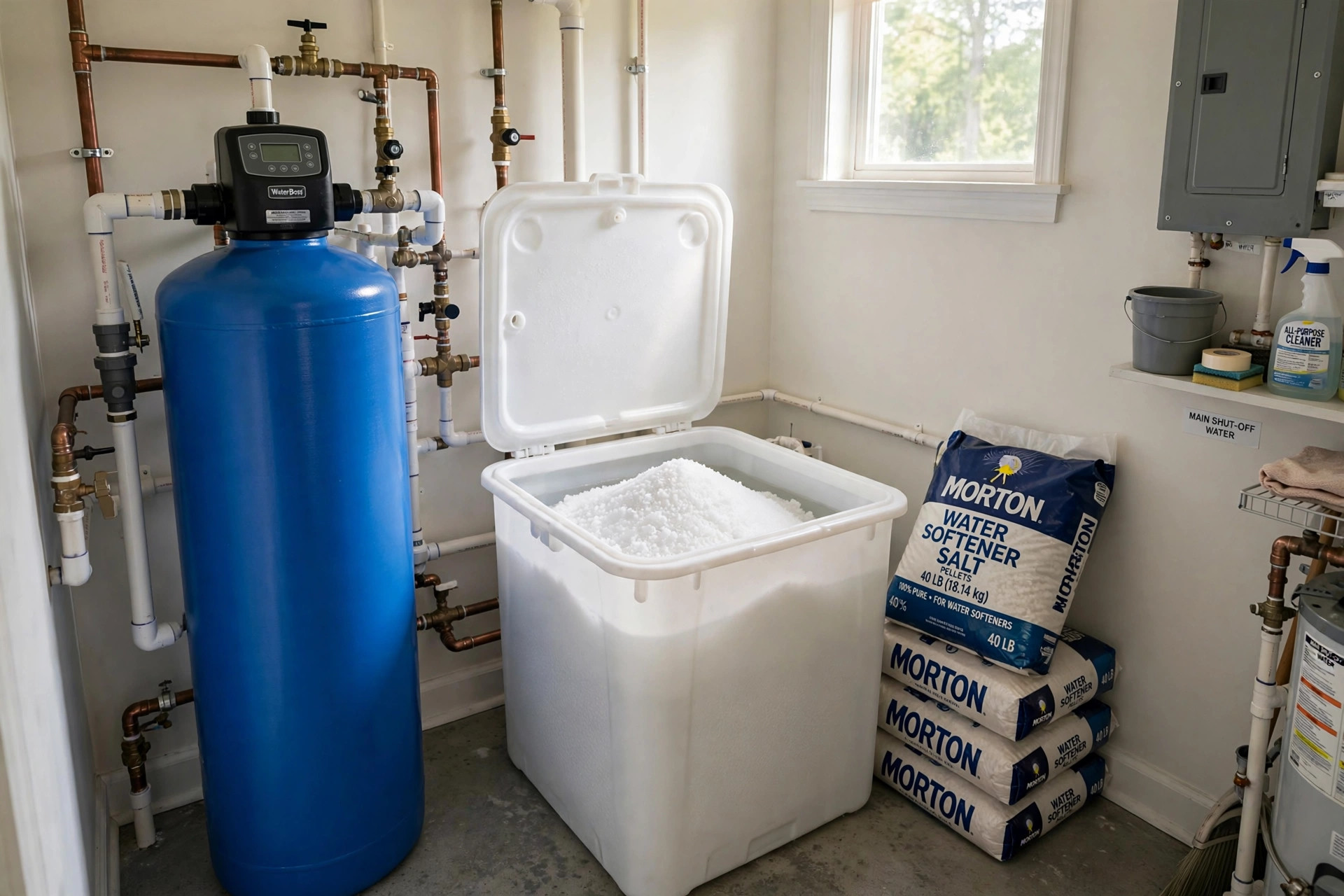

How much water softener salt per month usa homeowners need is one of the most common questions about these systems. The short answer is that most homes use between 40 and 100 pounds of salt each month. A small home with mild water may use less than one 40-pound bag per month. A large home with very hard well water may use two or three bags per month. The true amount depends on water hardness, household size, softener size, and the system settings.
Why Salt Usage Matters to Your Home
A water softener removes calcium and magnesium from the water before it reaches your taps. These minerals make water hard. Hard water leaves white spots on dishes, scale in pipes, and soap scum in tubs. It also shortens the life of water heaters and washing machines. Over time, scale raises energy bills because heaters must work harder through a crust of minerals.
Salt is the fuel for this work. The softener holds tiny resin beads that trap hard minerals. When the beads are full, the system flushes them clean with a strong salt water mix. This step is called regeneration. If the brine tank runs out of salt, the flush fails and hard water flows into the home.
Salt use also affects the budget and the land. Salt is cheap per bag, but it adds up over a year. Used salt leaves the home in the drain water, and some local rules limit how much a home system may send into septic tanks or sewers.
How a Water Softener Uses Salt: How Much Water Softener Salt Per Month Usa
A salt-based softener has two main parts. The resin tank holds the beads that catch minerals. The brine tank holds dry salt and water. During regeneration, the control valve pulls salty brine through the resin tank. The brine washes the trapped minerals off the beads and sends them down the drain. The valve then rinses the beads with fresh water and refills the brine tank.
Most softeners regenerate on a metered schedule. They count the gallons used and clean the resin only when it is full. Older clock models regenerate on fixed days, even after a week of low use. A metered system uses less salt over a year.
Each regeneration uses a set amount of salt, called the salt dose. A common dose is 6 to 8 pounds of salt per cubic foot of resin. The number of cycles per month sets the monthly salt total.
The Average Monthly Amount
For a typical American home, monthly use falls in a clear range. City water with moderate hardness and a family of three or four usually calls for 40 to 80 pounds of salt per month. That is one to two 40-pound bags. Well water is often much harder. A well-water home may need 80 to 120 pounds per month, or two to three bags. In rare cases with very hard water and high use, a home can pass 150 pounds per month.
One 40-pound bag per month is the low end of normal. Two bags is the middle. Three bags means the water is hard, the home is large, or the settings are off. Steady use above three bags per month is a sign to recheck the settings or test the water again.
These figures cover common salt-based systems. Salt-free conditioners use no salt at all. You can compare the two approaches in our piece on salt free water softener reviews for hard water. If you have no softener yet, our guide on water softener installation cost near me explains what a new system costs.
What Decides How Much Salt You Need
Four main factors set the monthly salt total. Each one can raise or lower the number of bags you buy.
Water Hardness
Hardness is measured in grains per gallon. One grain per gallon is mild. Seven to ten is hard. Above ten is very hard. City water in the Midwest and Southwest often tests at 10 to 20 grains per gallon. Well water can test at 20, 30, or even 40. Harder water fills the resin beads faster, so the system regenerates more often. A home at 5 grains per gallon might regenerate once a week. The same home at 25 grains per gallon might regenerate three times a week.
A simple water test gives the hardness number. Hardware stores sell test strips, and many dealers offer free tests. The U.S. Environmental Protection Agency publishes drinking water information that helps homeowners understand what is in their water. A correct hardness number is the most useful fact for setting up a softener.
Household Size and Daily Water Use
More people means more water. The average American uses about 80 to 100 gallons of water per day. A family of four may use 300 to 400 gallons per day. Every gallon through the resin counts toward the next regeneration. Long showers, frequent laundry, and watering lawns with softened water all raise salt use. Some homes plumb outside taps to bypass the softener, which can cut monthly salt use by a large margin.
Softener Size and Type
A softener must be sized to the home. An undersized unit regenerates too often and wastes salt. The size is set by the hardness number times the daily water use. Retailers such as Lowe’s cover sizing in their project guides.
Metered softeners beat clock-based models for salt economy. A metered valve regenerates only when the resin is full. A clock valve regenerates on fixed days and may clean a resin bed that is only half used. Replacing a clock control head with a metered valve can cut salt use by a third.
System Settings
Two settings have the largest effect on salt use. The first is the salt dose per regeneration. Many systems ship set at a high dose for safety. A lower dose still cleans the resin well for most homes and uses less salt per cycle. The second is the hardness setting on the control head. If this number is set higher than the true hardness, the system regenerates too often. Both settings should match the real water test and the resin size. The project guides at The Home Depot and This Old House walk through these adjustments in plain terms.
Types of Water Softener Salt
American stores sell three main kinds of water softener salt. All three work, but they differ in purity and price.
Rock salt is the cheapest. It is mined from the ground and sold in rough crystals. It holds mineral matter that does not dissolve, which can build up as sludge in the brine tank.
Solar salt is made by drying sea water or brine in open ponds under the sun. It is purer than rock salt and costs a little more. It dissolves cleanly and leaves less sludge.
Evaporated salt is the purest form, made by boiling brine until only clean crystals remain. Pellets dissolve fast and leave almost no sludge. They cost the most per bag but keep the brine tank cleanest.
Most bags hold 40 pounds and cost about 5 to 10 dollars, depending on the type and the store. Big box stores and farm supply shops sell salt in bulk at lower prices per bag.
Cost of Salt Per Month
The monthly cost is simple to work out. Take the number of bags used and multiply by the price per bag. A home that uses one 40-pound bag per month at 7 dollars per bag spends about 84 dollars per year. Two bags per month costs about 168 dollars per year. Three bags per month costs about 250 dollars per year.
These numbers cover salt only. The system also uses a small amount of water and power for each regeneration. Over ten years, the salt cost of a well-tuned system can be hundreds of dollars lower than that of a poorly set one.
How to Check Your Salt Level
A monthly check takes only a minute. Open the brine tank lid and look inside. The salt should cover the water by several inches. If you see water with little salt above it, add a bag. Some owners mark the inside of the tank at the half-full point and add a bag when salt drops to the line. Never let the tank run empty. An empty tank means the next regeneration fails, and hard water enters the home.
Do not fill the tank to the very top. An overfilled tank can bridge, forming a hard crust of salt above the water. The system then acts as if it has no salt. If you suspect a bridge, push a broom handle gently into the salt to break the crust.
Once a year, check for sludge at the bottom of the tank. If a thick layer has built up, scoop out the salt, rinse the tank with plain water, and refill it. Homes that use high-purity pellets may go years without a cleaning.
Simple Ways to Use Less Salt
First, get a real hardness test and set the control head to match it. Many systems are set too high by default. A correct setting may cut one regeneration per week.
Second, lower the salt dose if your manual allows it. A dose of 6 pounds per cubic foot of resin suits many homes, and each cycle uses less salt.
Third, switch to a metered valve if you have an old clock model. The upgrade often pays for itself in salt savings within a year or two.
Fourth, bypass outside taps. Lawn and garden water does not need to be soft. A simple bypass valve keeps hundreds of gallons per month out of the softener.
Fifth, fix leaks fast. A running toilet sends water through the softener day and night and triggers extra regenerations.
Sixth, use high-purity salt. Clean pellets dissolve fully, so each bag does more work and leaves less sludge.
Seventh, keep the system maintained. A yearly check of the valve, seals, and injector keeps regeneration efficient. The repair guides at Family Handyman show the basic steps for common valve types.
Homeowners on well water face the hardest water and the highest salt bills. Our guide to the best water softener for well water usa covers systems built for those conditions. Product overviews are also available from makers such as Moen, Kohler, and Delta Faucet, and from water specialists like Aquasana.
Care and Upkeep Through the Year
A softener needs little care, but a short yearly routine keeps it running well. In spring, check the salt level and confirm the hardness setting still matches a fresh test, since well water can change with the seasons. In summer, watch water use, since guests and gardens raise demand. In fall, stock up on salt before winter prices rise.
Listen to the system now and then. A healthy regeneration makes steady sounds of water moving through the valve. Loud banging or long hissing may point to a worn part. Catching a small fault early is cheaper than replacing a resin bed later.
Safety Around Salt and Softeners
Water softener salt is plain salt, but a few safety points apply. Keep bags dry and off the floor so they do not tear and spill. Store bags where children and pets cannot tear them open. A dog that eats a large amount of salt can become ill.
The discharge water from regeneration is very salty. Do not run the drain line onto garden beds or near trees, since salt kills plants and harms soil. Homes on septic systems should check local rules. Some counties limit softener discharge into septic tanks because the extra water and salt can upset the tank’s balance.
Softened water holds a small amount of added sodium. For most people this is not a health issue. People on strict low-sodium diets may keep one unsoftened tap for drinking water. A doctor can give personal advice on this point.
Frequently Asked Questions
How many bags of salt does a family of four use per month?
A family of four on city water with moderate hardness usually uses one to two 40-pound bags per month.
Can I use too much salt in my softener?
Yes. Overfilling the brine tank can cause salt bridging, where a hard crust forms above the water. Keep the salt a few inches above the water line and below the top of the tank.
Does a water softener raise my water bill?
A softener uses 30 to 60 gallons of water per regeneration. A home that regenerates twice a week adds roughly 250 to 500 gallons per month. A metered system uses less because it regenerates only when needed.
How long does a 40-pound bag of salt last?
In a home that uses 40 pounds per month, one bag lasts a full month. In a home that uses 80 pounds per month, one bag lasts about two weeks.
Is softened water safe to drink?
Yes, for most people. The process adds only a small amount of sodium. People on strict low-sodium diets should talk to a doctor and may keep a separate drinking tap.
What happens if I forget to add salt?
The resin beads stay full of hard minerals after the next failed regeneration. Hard water then flows into the home. Add salt and run a manual regeneration to bring the system back.
A Final Word
Most homes use 40 to 100 pounds of salt per month, which is one to two and a half 40-pound bags. Hard well water pushes the number higher. The best way to find your number is to test the water, size the system right, set the controls to match, and check the tank once a month. Small habits such as bypassing outside taps and fixing leaks trim the total further. With a well-tuned system, salt stays a small and steady part of the home budget, and the softener quietly protects pipes, heaters, and appliances for years.
References
Aquasana. (n.d.). Water filtration systems. https://www.aquasana.com Delta Faucet. (n.d.). Kitchen and bathroom faucets. https://www.deltafaucet.com Family Handyman. (n.d.). DIY home repair and maintenance. https://www.familyhandyman.com Kohler. (n.d.). Bathroom and kitchen fixtures. https://www.kohler.com Lowe’s. (n.d.). Home improvement products. https://www.lowes.com Moen. (n.d.). Faucets and plumbing fixtures. https://www.moen.com The Home Depot. (n.d.). Home improvement products. https://www.homedepot.com This Old House. (n.d.). Home renovation guidance. https://www.thisoldhouse.com U.S. Environmental Protection Agency. (n.d.). Protecting human health and the environment. https://www.epa.gov
Was this guide helpful?

About Michael Thompson
The My Garden US editorial team writes practical, in-depth home and garden guides for American homeowners — tested advice, no fluff.
You May Also Like

Pressure Assisted Toilet Pros Cons USA: What Every Homeowner Should Know
May 30, 2026 0 views
Potassium Chloride vs Sodium Softener Salt: Which One Should You Use?
April 18, 2026 0 views
SharkBite vs Soldered Copper: A Plain Comparison for American Homes
August 29, 2026 0 views