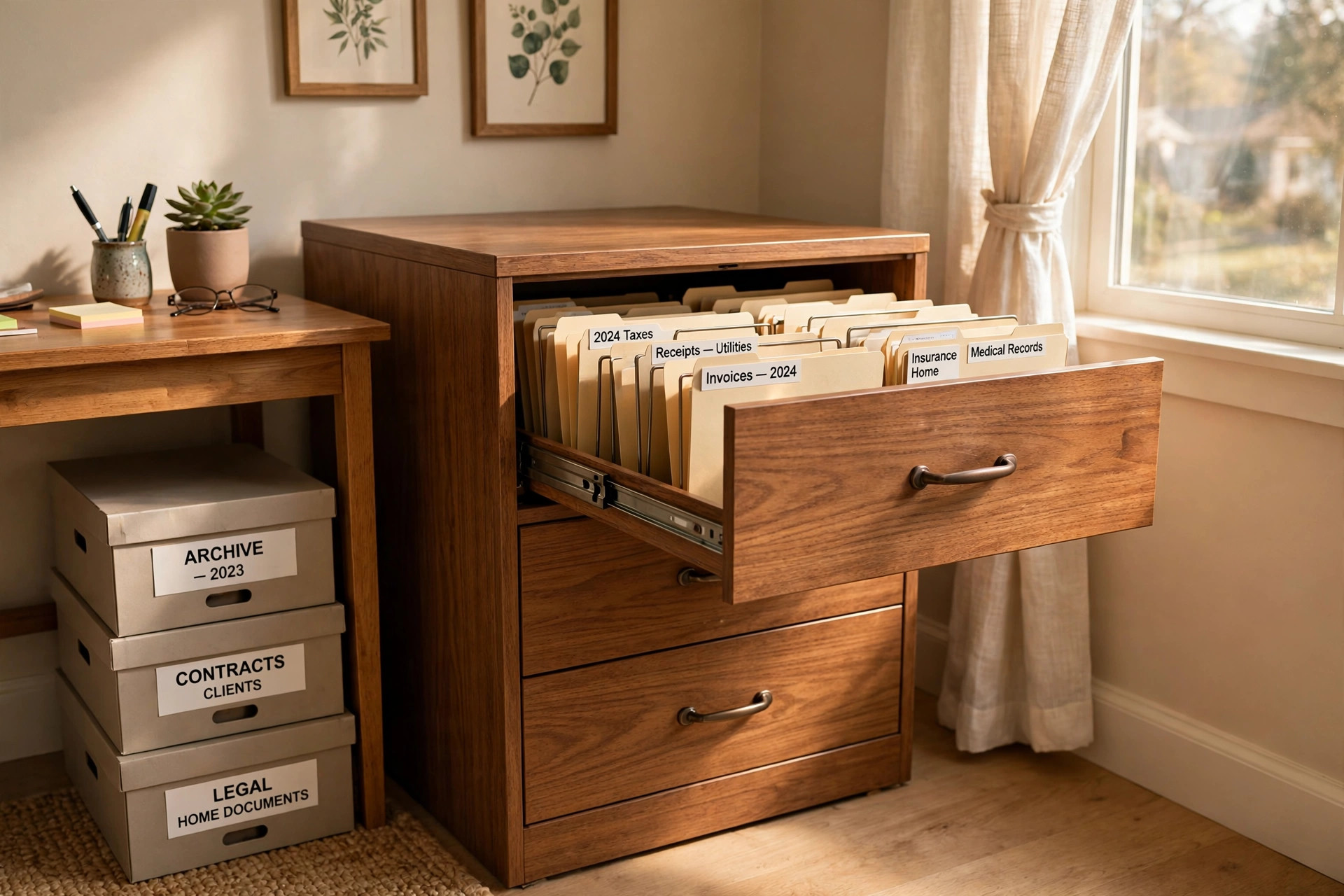

This home office filing systems reviews and buying guide is written for anyone who works from home and feels buried in paper. Bills, tax forms, school papers, manuals, and receipts pile up fast. A good filing system ends the pile-up. It gives every paper a home. It lets you find what you need in seconds, not minutes. This guide walks you through the main types of filing systems, what each one costs, how to pick one that fits your room and your habits, and how to keep it running year after year.
Why a Filing System Matters
A home office without a filing system is a desk under paper. Important letters get mixed with junk mail. Tax documents hide inside magazines. You waste time. You also lose money. Late bills bring late fees. Lost receipts mean lost tax deductions. Lost warranties mean paying for repairs you should not pay for.
A filing system changes all of this. It is simple on the surface. It is a set of drawers, boxes, or folders, plus rules about what goes where. But the effect is large. Studies of home offices done in the late 1980s found that the average worker lost several hours a month to searching for paper. A set of drawers and hanging folders cut that time to almost nothing. The same is true today, even in a world with email and cloud storage. Paper has not gone away. Leases, insurance policies, medical records, and school documents still arrive in envelopes. You need a place for them.
A filing system also calms the mind. A clean desk lowers stress. You can see your work. You can think clearly.
How to Choose the Right System: Home Office Filing Systems Reviews and Buying Guide
Choosing a filing system is not hard. You only need to answer three questions. How much space do you have? How much paper do you keep? And how do you like to work? Answer those, and the right type picks itself.
Measure Your Space
Start with a tape measure. Note the floor space where a cabinet could stand. Note the wall length for shelving. Note the width of any closet door, since closets make fine filing rooms. A standard two-drawer vertical cabinet is about 18 inches wide and 25 inches deep. It fits in most closets. A two-drawer lateral cabinet is about 30 to 36 inches wide. It needs a wall.
Small rooms favor tall, narrow cabinets. Large rooms can hold wide lateral files that double as printer stands. The pros at Apartment Therapy show filing setups squeezed into hallways and under stairs, which proves that even a closet corner can hold a full system. If your space is truly tight, look at rolling carts.
Count Your Paper
Next, look at the paper you actually keep. Pull out every pile. Sort it into stacks: bills, taxes, medical, insurance, home, work, school, and personal. Measure each stack in inches. This tells you how much drawer space you need. Most people need far less than they think. Two drawers of letter-size space hold about two years of a typical household. One drawer holds about 1,800 to 2,000 sheets.
Be honest here. Half of most paper piles is junk. Throw out old coupons, catalogs, and manuals you can find online. Shred old bills you no longer need. What is left is what you buy storage for.
Know Your Habits
Some people file paper the moment it arrives. Others file once a month. If you file at once, you need a cabinet close to your desk. If you file in batches, you need an inbox tray where paper waits safely until filing day. The best filing system is the one you will actually use.
Types of Home Office Filing Systems
There are five main types. Each suits a different home and budget. The sections below review each one like a buyer would: what it is, what it costs, and who it fits.
Vertical File Cabinets
The vertical cabinet is the classic. It stands tall and narrow. Drawers pull out toward you. Folders hang front to back. Two-drawer and four-drawer models are the most common. A two-drawer unit holds about 3,500 sheets. A four-drawer unit doubles that.
Steel cabinets are the workhorses. They cost about 80 to 200 dollars for a two-drawer model and 150 to 350 for a four-drawer. They last for decades. They lock, which matters for tax and medical papers. Wood cabinets cost more, often 200 to 600 dollars, but they look like furniture. Shoppers who compare prices at Lowe’s and The Home Depot will see both steel and wood options side by side, which makes choosing easier.
Vertical cabinets fit closets, corners, and narrow walls. They are the best choice for homes short on floor space. Their weak point is the drawer. A full drawer is heavy and can tip a tall cabinet forward if a second drawer is opened too. Buy models with an anti-tip lock, or bolt the unit to the wall.
Lateral File Cabinets
Lateral cabinets are wide and low. Folders hang side to side, so you can read every label at once. Two-drawer lateral models are the most popular for home offices. They stand about 30 inches tall, so a printer or lamp can sit on top.
Prices run higher than vertical cabinets. Expect 150 to 400 dollars for a two-drawer lateral file in steel, and 300 to 800 in wood or laminate. Reviews on sites like Wayfair often praise lateral files for looking like real furniture while still holding full-size folders.
Lateral cabinets suit people who file often and want fast access. They need more wall width, but they give back surface space on top. They are also more stable than tall vertical units.
Open Shelving and File Boxes
Some people do better without drawers. Open shelving with magazine holders, bins, and labeled file boxes keeps everything visible. A banker’s box costs three to five dollars and holds about 1,000 sheets. A set of six sturdy boxes costs under 30 dollars. That is the cheapest system of all.
Open storage works well in closets and pantries. It also works for bulky items that do not fit in drawers: rolled plans, binders, and thick manuals. The Container Store sells deep bins, clear boxes, and label holders made exactly for this style. The risk is mess. Open shelves fill up fast if you do not weed them yearly.
For homes that need matching outdoor storage too, see our guide to deck storage boxes for a similar open-storage approach outside the house.
Mobile File Carts
A mobile cart is a small rolling frame that holds hanging folders. It slides under a desk or into a closet. Prices run 30 to 80 dollars. It is the best choice for renters and for people whose office moves around the house.
Carts hold less than cabinets, usually one drawer of folders. That is enough for an active file set: current bills, this year’s taxes, and work projects. Pair a cart with one or two archive boxes on a shelf, and you have a complete system in under 100 dollars. Shoppers browsing IKEA will find small rolling drawer units that fit a home desk.
Paperless and Hybrid Systems
The paperless system is not furniture. It is a scanner, a naming rule, and a folder plan on your computer. You scan each paper, save it with a clear name like “2026-electric-bill-january,” and store it in matching folders. A good desktop scanner costs 200 to 400 dollars. Phone scanning apps cost little or nothing and work fine for receipts. Top-rated small scanners and shredders at Staples are popular exactly because the hybrid habit starts with two cheap machines.
Few people go fully paperless. The hybrid system is more common. You keep one small cabinet for originals you must hold in paper form: deeds, titles, birth records. Everything else gets scanned and shredded. This cuts a four-drawer cabinet down to one drawer.
If your paperwork includes cosmetics receipts, product inserts, or other small items, our guide to makeup and cosmetics organizers shows small-compartment storage that uses the same sorting logic on a smaller scale.
Cost and Price
Total cost depends on the type you pick. Here is a plain summary of what most home buyers pay in the United States today.
A basic two-drawer steel cabinet runs 80 to 200 dollars. Hanging folders add about 10 dollars per 25 folders. A label maker costs 25 to 50 dollars. All in, a simple steel setup costs under 250 dollars.
A two-drawer lateral cabinet in wood-look laminate runs 250 to 500 dollars. Add folders and labels, and the total stays under 550 dollars. Real wood models can reach 800 dollars or more, but they look like fine furniture and last a lifetime.
An open-shelf system built from banker’s boxes costs 30 to 80 dollars. A mobile cart setup costs 40 to 100 dollars. A hybrid paperless setup with a scanner and shredder costs 250 to 500 dollars, plus one small cabinet for originals.
Do not forget small extras. Extra drawer dividers, folder tabs, and a small fire-safe box for originals add 50 to 100 dollars. Even so, a complete home office filing system costs less than most office chairs. Price trackers at Office Depot show that mid-range cabinets hold their price year round, so there is rarely a reason to wait for a sale.
Care and Upkeep
A filing system only works if it stays current. Set up three simple habits and it will serve you for years.
First, touch each paper once. When mail arrives, open it over the trash. Toss junk at once. File keepers in their folders or in your inbox tray. Papers that wait on the counter multiply.
Second, hold a monthly filing session. Pick one date, like the first Sunday of the month. Empty the inbox tray. File each paper. Shred what has expired. The whole job takes twenty minutes when done monthly.
Third, weed yearly. Each January, pull the tax folder and close it. Move it to archive storage. Shred bank statements older than one year if you keep digital copies. Shred utility bills older than one year. Keep tax returns for at least seven years. Keep home purchase records as long as you own the house. Family Handyman publishes simple build-and-organize plans each year, and their yearly storage checklists pair well with this habit.
Clean the cabinet itself once a year. Dust the drawers. Check that drawer slides run smooth. Tighten loose handles. A steel cabinet lasts 20 years or more with this care. A wood cabinet lasts even longer.
Safety
Safety matters in two ways: fire and theft. Paper burns. Important originals deserve a small fire-rated safe or a fire-resistant file chest. These cost 80 to 250 dollars. Keep deeds, titles, passports, and birth records inside. The safe should sit inside or near the filing cabinet so papers move straight from drawer to safe.
Locking drawers protect against theft. If repair workers or guests enter your home office, a locked cabinet keeps tax forms and bank papers private. Most steel cabinets include a lock. For wood cabinets, add a small hasp and padlock or buy a model with a built-in lock.
Weight is a third safety point. A full four-drawer vertical cabinet can weigh over 200 pounds. Place it on solid flooring. On carpet, set it on a hard mat so drawers slide freely. Anchor tall cabinets to a wall stud with a simple strap. This is a must in homes with children or in earthquake zones. Shoppers comparing models at Lowe’s can filter for anti-tip features, which are worth paying for.
Frequently Asked Questions
How many drawers do I need for a home office? Most households need two to four drawers of letter-size space. Count your paper first. Two drawers hold about 3,500 sheets, which covers two years of bills, taxes, and records for a typical family. If you scan and shred, one drawer is often enough.
Is a lateral or vertical filing cabinet better for a home office? It depends on your room. Vertical cabinets fit narrow spaces and closets. Lateral cabinets fit wide walls and give you a usable top surface for a printer. If you file often and want to read labels at a glance, lateral wins. If floor space is tight, vertical wins.
Should I buy letter or legal size? Buy letter size unless you handle legal-size papers often. Letter cabinets are smaller, cheaper, and fit standard folders. Most home papers are letter size. If you do handle legal documents, buy a cabinet marked letter/legal, which fits both.
How long should I keep tax and bank papers? Keep tax returns and their supporting papers for at least seven years. Keep monthly bank and credit card statements for one year if you have digital copies, or seven years if you do not. Keep home purchase and sale records as long as you own the home, plus seven years after the sale.
Can I go fully paperless instead of buying a cabinet? Most people cannot. Deeds, titles, and some court papers need paper originals. The hybrid system works best: one small cabinet or safe for originals, and a scanner for everything else. This cuts paper volume by 80 percent or more.
Where can I find matching organizers for the rest of the house? Filing is one part of home order. Our guide on where to buy under sink organizers in Texas shows how the same label-and-zone method works under kitchen and bath sinks.
A Final Word
A home office filing system is a small buy with a large return. It ends lost papers. It cuts wasted time. It protects the documents that protect your money. Pick the type that fits your space, count your paper before you shop, and set up a monthly filing habit. Do those three things, and your office will stay in order for years.
References
Apartment Therapy. (n.d.). Home design ideas and inspiration. https://www.apartmenttherapy.com Family Handyman. (n.d.). DIY home repair and maintenance. https://www.familyhandyman.com IKEA. (n.d.). Home furnishings. https://www.ikea.com Lowe’s. (n.d.). Home improvement products. https://www.lowes.com Office Depot. (n.d.). Office supplies and furniture. https://www.officedepot.com Staples. (n.d.). Office supplies and furniture. https://www.staples.com The Container Store. (n.d.). Storage and organization products. https://www.containerstore.com The Home Depot. (n.d.). Home improvement products. https://www.homedepot.com Wayfair. (n.d.). Furniture and home goods. https://www.wayfair.com
Was this guide helpful?

About Robert Taylor
The My Garden US editorial team writes practical, in-depth home and garden guides for American homeowners — tested advice, no fluff.
You May Also Like
Best Pantry Shelving Units for Humid Climates
July 29, 2026 0 views
Dresser Drawer Dividers Reviews and Buying Guide
July 15, 2026 0 views
Patio Cushion Storage Bags: A Price Comparison Across the USA
September 17, 2026 0 views