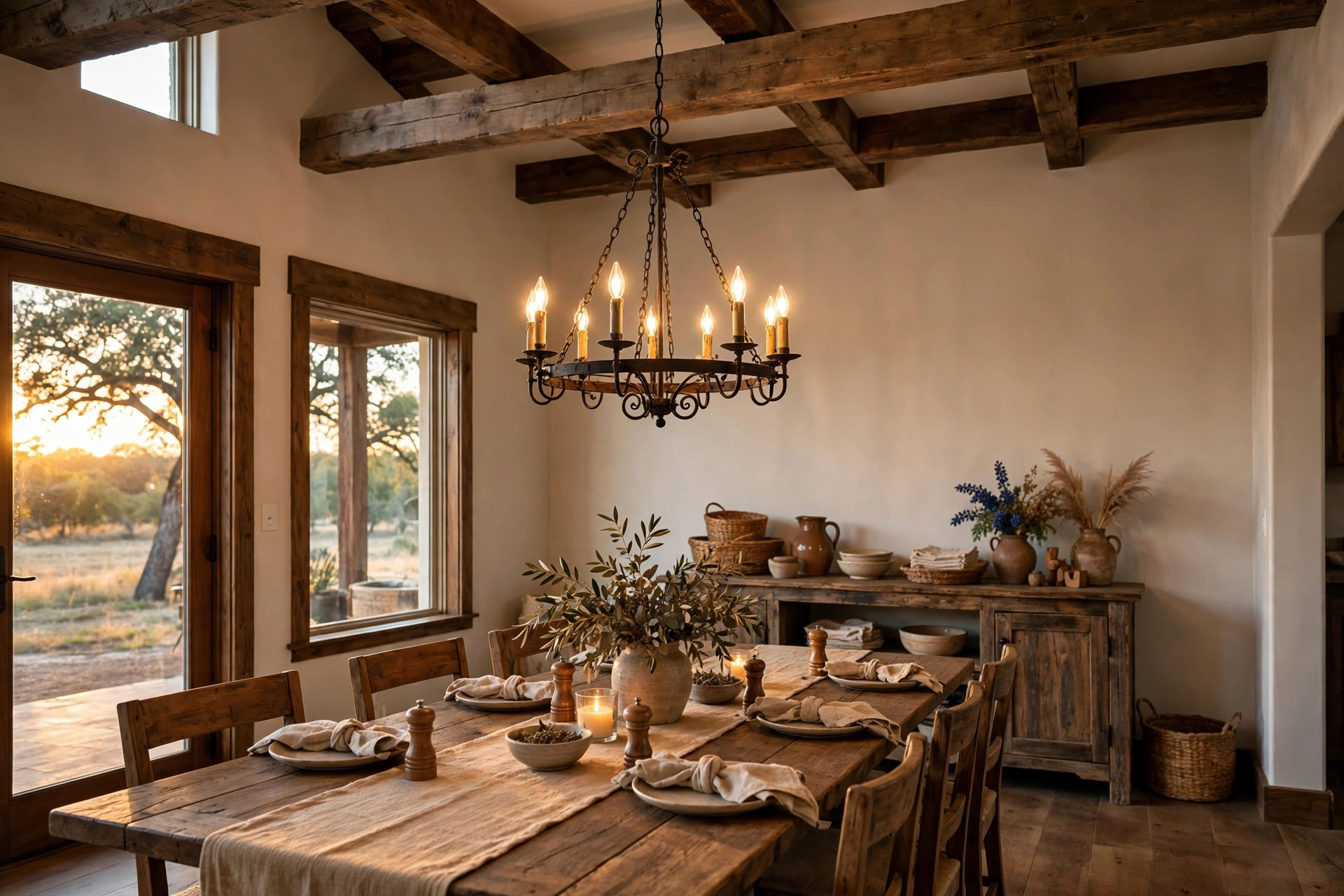
The dining room chandelier is the heart of the dining room. When guests walk into the room, the first thing they see is the light above the table. For many families, choosing dining room chandeliers Texas homes USA can use well is a big step. Texas homes are warm. Ceilings are often high. Rooms are often large and open. A good chandelier must fit the room, give enough light, and suit the style of the house.
Texas houses differ from houses in colder states. Many Texas homes have tall ceilings, nine or ten feet high, and some have vaulted or open-beam ceilings that rise even higher. Heat is a fact of life for much of the year, so many owners want lighting that gives warmth without adding too much heat. The right chandelier does both. It lights the table for supper and family talks. It also adds a look of care to the room.
This guide keeps things plain. It explains why the chandelier matters, what to look for, the main types, what they cost, and how to keep them safe. It is written for owners of homes across Texas, from Dallas to Houston, from San Antonio to El Paso, and from small towns to new suburbs.
Why the Chandelier Matters
A dining room without a strong center light can feel flat. The table is where families eat, where guests sit, and where children do homework on weekends. Light above the table shapes the mood. Too dim, and the room feels dull. Too harsh, and the room feels cold.
Good light also changes how food looks. Warm light makes dishes look fresh and rich. Cool, harsh light can make the same meal look pale. For a dining room, most experts suggest warm white light, around 2700 to 3000 Kelvin. This range gives a soft, golden glow much like candlelight. If you want to learn the basics of selecting one, see our dining room chandeliers buying guide.
What to Look For: Dining Room Chandeliers Texas Homes Usa
Size and Scale
The first rule is size. A chandelier that is too small gets lost in a large room. A chandelier that is too big crowds the table. There is a simple old rule used by designers for years. Add the length and width of the room in feet. That total, in inches, is a good starting width for the chandelier.
For example, a dining room that is 12 feet by 14 feet gives 26. A chandelier about 26 inches wide will fit well. For the table itself, the chandelier should be about one-half to two-thirds the width of the table. A 60-inch table takes a chandelier 30 to 40 inches wide.
Texas homes often have rooms larger than the national average. New builds in the suburbs of Houston and Dallas often have great rooms that flow into the dining area. In these open plans, measure the dining zone only, not the whole open space. This keeps the chandelier in scale with the table it serves.
Height and Hanging
Height matters as much as width. The bottom of the chandelier should hang about 30 to 34 inches above the table surface. This is low enough to light the table well and high enough that no one hits their head. It also keeps the light out of the line of sight when people sit across from each other.
With tall Texas ceilings, a standard chain or rod may be too short. Measure from the ceiling to the table before you buy, and add the length of the chandelier body itself. In rooms with vaulted ceilings, you may need a sloped-ceiling adapter so the chandelier hangs straight down.
Light Output
Check how many bulbs the chandelier takes and what type they are. Older chandeliers use many small candle-style bulbs. Newer ones use LED bulbs or built-in LED strips. LEDs use less power and make less heat, which matters in a Texas summer. Look for a chandelier that gives enough total light for the room. A small dining room needs about 3,000 to 4,000 lumens. A large one may need 5,000 or more.
A dimmer switch is a smart add-on. With a dimmer, you can turn the light down for a quiet supper and turn it up for homework or card games. Make sure the bulbs you buy work with dimmers if you plan to use one. Guidance on efficient bulbs and fixtures can be found through Energy Star lighting resources.
Style and Finish
Style is a matter of taste, but it should match the house. Texas homes show many styles. Ranch homes look fine with wrought iron or wood-beam chandeliers. Mediterranean and stucco homes pair well with Spanish-style fixtures with scrollwork. Modern farmhouses take black metal or mixed wood and metal designs. City apartments in Dallas or Austin often suit clean, simple shapes in brass or nickel.
Finishes also matter in a warm, humid climate. Near the Gulf Coast, in places like Houston and Galveston, moist air can wear down cheap finishes. Look for fixtures with a good seal and a finish rated for damp or humid rooms. Powder-coated metals hold up well. Raw iron without a seal may rust over time.
The Texas Heat Factor
Texas heat shapes every home choice, and lighting is no exception. Old-style incandescent bulbs throw off a lot of heat. Over a dining table in August, that extra heat is unwelcome. LED bulbs run far cooler. They also last much longer, which saves trips up a ladder to change bulbs in a tall-ceilinged room. The U.S. Department of Energy offers plain facts on how efficient lighting cuts both power use and heat.
Types and Options
Traditional Candle-Style Chandeliers
These are the classic shape. Arms curve out from a center column, and each arm holds a bulb shaped like a candle flame. They suit colonial, traditional, and ranch homes. Many come in bronze, iron, or brass finishes. They give a warm, old-world look that fits many Texas dining rooms.
Modern and Contemporary Chandeliers
Modern chandeliers use simple lines, open frames, and geometric shapes. Some use rings of light. Some use thin metal arms with small LED tips. They fit new builds and remodeled rooms. They often pair well with the clean lines of modern farmhouse and contemporary Texas homes.
Rustic and Farmhouse Chandeliers
Rustic chandeliers use wood, rope, antler shapes, or distressed metal. They are popular in Texas Hill Country homes and ranch properties. A wagon-wheel chandelier over a long wood table is a classic Texas look. These fixtures are often large, so check the room size rule before you buy.
Crystal Chandeliers
Crystal chandeliers add sparkle. They suit formal dining rooms and older homes with classic trim. True crystal costs more than glass look-alikes, but it throws light in a way glass cannot match.
Linear and Island Chandeliers
Some dining rooms have long, narrow tables. A round chandelier may look wrong over them. Linear chandeliers, long bars with lights along their length, fit these tables better. If your dining table seats eight or ten in a row, look at linear shapes.
Smart and Connected Options
Some new chandeliers work with smart bulbs or smart switches. You can dim them from a phone or set them to turn on at supper time. Pairing a chandelier with indoor wall sconces on the same smart dimmer can give the whole room one-touch control.
Cost and Price
Prices for dining room chandeliers Texas homes USA shoppers will find range widely. A simple fixture from a big-box store may cost 80 to 200 dollars. Mid-range chandeliers with better finishes and design run 250 to 800 dollars. High-end or large fixtures, especially crystal or hand-forged iron, can cost 1,000 dollars or much more.
Set a budget before you shop. Then add the cost of installation. If an electrician must run a new box or add a dimmer, that can add 150 to 400 dollars. In older Texas homes, the ceiling box may not be rated to hold a heavy fixture. Heavy chandeliers, over 50 pounds, need a box rated for heavy fixtures, and sometimes a brace between joists.
You can compare prices and read reviews at large retailers such as The Home Depot and Lowe’s, and specialty lighting shops like Lamps Plus and Lumens.
Do not forget the dimmer. A good dimmer switch costs 20 to 60 dollars. It is one of the cheapest ways to make a dining room feel better. Have it installed by someone who knows wiring if you are not sure of the work.
Care and Upkeep
A chandelier needs only simple care, but it needs it on a schedule. Dust builds up fast, and Texas dust is a fact of life. In West Texas and the Panhandle, fine dust blows in through every crack. A dusty chandelier gives less light and looks dull.
Cleaning
Turn off the power before you clean. For most fixtures, a soft dry cloth or a feather duster is enough. Work from the top down. For crystal, wipe each piece with a cloth dampened with a mix of water and a drop of mild dish soap, then dry at once.
Clean the bulbs too. A dusty bulb can lose a good share of its light. When bulbs are cool, wipe them with a dry cloth.
Bulb Changes
With tall ceilings, changing bulbs is a chore. This is one more reason to use long-life LEDs. When you do change bulbs, note the type and wattage on the old one, or take it to the store. Never put in a bulb with a higher wattage than the fixture allows. The rating is printed on a small label inside the fixture, usually near the socket.
Seasonal Checks
Once a year, check the chain, rod, and canopy. Make sure screws are tight and the fixture does not sway more than it should. In homes near the coast, check for rust spots on the finish and touch up small spots with paint made for metal before they spread.
When to Call a Professional
Call an electrician if the chandelier hums, if the breaker trips when you turn it on, or if you smell heat near the fixture. Also call a professional if you want to hang a very heavy fixture or move the electrical box. Practical how-to guidance for home projects appears on sites like Bob Vila and This Old House, but electrical work beyond a simple swap belongs to a licensed worker.
Safety
Safety starts with the ceiling box. Every chandelier must hang from a box rated to hold its weight. Old boxes in older Texas homes were often made for a simple light, not a heavy chandelier. If you are not sure, have an electrician look before you hang the new fixture.
Turn off the breaker, not just the wall switch, before you touch any wiring. Test with a non-contact voltage tester to be sure the power is off. Keep a steady ladder on a flat floor. Have a helper hold the fixture while you make the wire connections. Chandeliers are awkward to hold and wire at the same time.
Keep fabric shades and drapes away from hot bulbs. LED bulbs run cooler, but old-style bulbs get very hot. Check the fixture label for the maximum bulb wattage and never go above it.
For general home lighting ideas and room-by-room advice, The Spruce and HGTV both keep large lighting sections worth a look. For bulb technology and smart lighting, Philips publishes clear product guides.
Frequently Asked Questions
How big should a chandelier be for a Texas dining room?
Add the room’s length and width in feet. That number in inches is a good width for the fixture. Texas dining rooms often run large, so do not be shy about a bigger fixture. The chandelier should also be about one-half to two-thirds as wide as the table.
How high should I hang it?
Hang the bottom of the chandelier 30 to 34 inches above the table. In rooms with very tall ceilings, you may need a longer chain or rod to reach the right height. Do not hang it higher just because the ceiling is high. The light needs to sit close to the table to do its job.
Are LED bulbs fine for chandeliers?
Yes. LED bulbs work well in most chandeliers. They use less power, make less heat, and last much longer than old bulbs. Just make sure the LED bulbs fit the sockets and work with your dimmer if you have one.
What style suits a Texas home best?
It depends on the house. Ranch and farmhouse homes suit rustic iron or wood designs. Mediterranean homes suit Spanish-style fixtures. Modern homes suit clean, simple shapes. Match the chandelier to the home’s style and to the other fixtures in nearby rooms so the whole house feels planned.
Can I install a chandelier myself?
If you are only swapping one fixture for another on an existing rated box, many owners do it themselves. Turn off the breaker and get a helper. If you need a new box, a heavier box, new wiring, or a dimmer added, call a licensed electrician.
How do I light a dining room with no ceiling box?
Some Texas homes, especially older ones, have dining rooms with no ceiling fixture. An electrician can add a box and run wire, often through the attic. As a short-term fix, a plug-in pendant or a tall arc floor lamp can light the table. See our guide to reading floor lamps for floor-based options that can fill in until wiring is added.
A Short Final Word
Choosing dining room chandeliers Texas homes USA owners will love for years comes down to a few plain steps. Measure the room and the table. Hang the fixture at the right height. Pick warm, efficient light. Match the style to the house. Keep it clean and check it once a year.
References
Bob Vila. (n.d.). Home improvement advice. https://www.bobvila.com ENERGY STAR. (n.d.). Energy efficient products. https://www.energystar.gov HGTV. (n.d.). Home and garden ideas. https://www.hgtv.com Lamps Plus. (n.d.). Lighting and home decor. https://www.lampsplus.com Lowe’s. (n.d.). Home improvement products. https://www.lowes.com Lumens. (n.d.). Lighting and ceiling fans. https://www.lumens.com Philips. (n.d.). Lighting products. https://www.philips.com The Home Depot. (n.d.). Home improvement products. https://www.homedepot.com The Spruce. (n.d.). Home and garden advice. https://www.thespruce.com This Old House. (n.d.). Home renovation guidance. https://www.thisoldhouse.com U.S. Department of Energy. (n.d.). Energy efficiency and renewable energy. https://www.energy.gov
Was this guide helpful?

About Jennifer Lee
The My Garden US editorial team writes practical, in-depth home and garden guides for American homeowners — tested advice, no fluff.