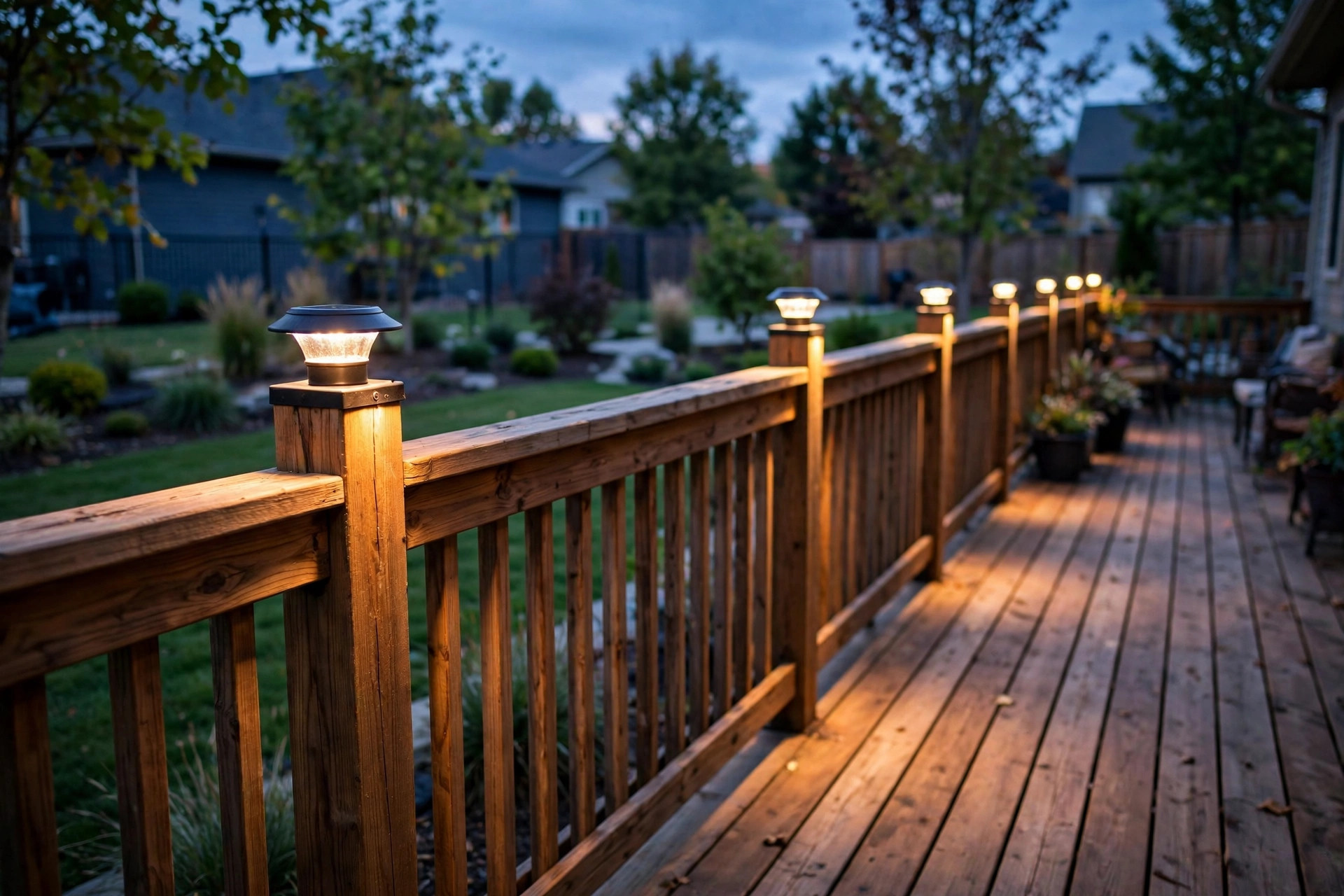

This deck cap lights buying guide USA is for the American homeowner who wants a deck that looks fine and stays safe after dark. Deck cap lights sit on top of the posts on a deck railing. They cast light down along the posts and the deck floor. They mark the edge of the deck. They make stairs easier to see. They also give the whole backyard a warm, finished look.
This guide walks you through what cap lights are, what kinds exist, what they cost, and how to pick the right set for your home.
Why Deck Cap Lights Matter
A deck is an outdoor room that most families use in the evening. When the sun sets, it goes dark fast. A single porch light on the house wall leaves deep shadows at the far rail. Those shadows are where accidents happen. A missed step on the stairs can mean a sprained ankle or worse.
Deck cap lights fix this problem at its source. Each light sits on a post cap. The light shines down in a small circle. With lights on every post, the whole rail line becomes visible. The edge of the deck is easy to see. Stairs glow softly. People can move with confidence.
There is a second reason to buy them. They look good. A deck with lit posts has a finished feel that a dark deck lacks. A set of cap lights is one of the cheapest ways to make a backyard look cared for.
Cap lights also add a layer of security. A lit deck tells a visitor that someone lives here and pays attention. For more on lighting the rest of your yard, see our guide to outdoor wall lanterns for American homes.
How to Choose the Right Cap Lights: Deck Cap Lights Buying Guide Usa
Buying the right set starts with three questions. What size are your posts? How much light do you want? And how will the lights get their power? Answer these first, and the rest of the choice becomes simple.
Size and Fit
Deck posts in the United States are most often made from 4×4 or 6×6 lumber. Note that a “4×4” post is really about 3.5 inches square once the wood is planed and dried. A “6×6” post is about 5.5 inches square. Cap lights are made to fit these sizes. Measure the top of your posts with a tape measure before you order.
Most cap lights come in 4×4 and 6×6 sizes. Some are adjustable and fit both. Check the product listing for the inside measurement, not just the label on the box. A cap that is a half inch too small will not go on. A cap that is much too large will sit loose and may blow off in a storm.
Also think about how the cap attaches. Some snap on with friction. Some screw down through small holes in the side. Screwed caps stay put in high wind. If your deck faces open land or a lake, choose screw-down caps. A look at the outdoor lighting selection at Lumens shows the common shapes and sizes sold today.
Brightness and Color
Cap lights are not meant to flood the deck with light. They are accent lights. Most put out between 10 and 40 lumens each. That sounds small, but it is enough to mark posts and steps when you have one light on each post. For general guidance on how light levels work outdoors, the lighting basics from ENERGY STAR are a good reference.
Color temperature matters more than most buyers expect. Warm white light, around 2700K to 3000K, looks like an old-fashioned porch bulb. It is easy on the eyes and suits wood decks. Cool white light, around 4000K to 5000K, looks blue and harsh on wood. Stick with warm white unless your whole landscape plan uses cool light.
Color-changing caps cost more. Plain warm white is the safe pick for most decks.
Types of Deck Cap Lights
Three main types are sold in the USA. Retailers like Lamps Plus carry all three. Your choice depends on your budget, your deck, and how much work you want to do.
Solar Deck Cap Lights
Solar cap lights are the most popular type. Each cap holds a small solar panel and a rechargeable battery. The panel charges all day. At dusk, a sensor turns the light on, and it fades as the battery runs down.
The big advantage is simple installation. There is no wiring. You set the cap on the post and walk away. The cost is low, often the cheapest option per light.
The drawback is that solar lights depend on sun. A shaded deck may not charge the panels well. In northern states, winter days are short and the lights may burn out by midnight. Snow can cover the panels. If your deck gets less than six hours of direct sun, look at the wired types below instead. For ideas on mixing solar lights with other outdoor lights, the outdoor lighting guides at The Spruce show many real-yard examples.
When you buy solar caps, look for replaceable batteries. Cheap units seal the battery inside, so when it dies after a year or two, the whole light is trash. Units with a small access door let you swap in a fresh rechargeable battery and keep the light for years.
Low-Voltage Wired Cap Lights
Low-voltage systems run on 12 volts from a transformer plugged into an outdoor outlet. Thin wire runs along the deck frame to each post. Each cap light connects to the wire. A timer or light sensor on the transformer controls when the lights come on.
These lights are brighter and more reliable than solar. They shine all night at full strength and work in shade and winter. You can mix cap lights with step lights and path lights on the same transformer, which gives a matched look across the whole yard.
The cost is higher. You need the transformer, the wire, and the lights. Installation takes an afternoon. Running wire under a deck is not hard, but it is work. If the deck is already built with no access underneath, hiding the wire gets tricky.
Low-voltage wiring is safe for a careful homeowner to install. Still, keep connections dry and follow the maker’s guide. The home energy site at Energy.gov has plain facts on low-voltage outdoor lighting and how little power it uses.
Battery-Powered Cap Lights
A third type runs on standard batteries, often AA or C cells. They suit a shaded deck where solar fails and where running wire is too much work. The downside is upkeep. You must change the batteries every few weeks or months, and the yearly battery cost adds up. Rechargeable cells cut this cost but need regular charging. For most buyers, the real choice is between solar and low-voltage wired.
Cost and Price
Prices vary widely, so it helps to think in ranges. A single solar deck cap light usually costs between 8 and 25 dollars. A set of six often costs 40 to 120 dollars. Wired low-voltage cap lights run higher, about 15 to 40 dollars each, and you must add the transformer and wire, which can add 50 to 150 dollars to the project.
Installation cost depends on the type. Solar caps cost nothing to install beyond your time. Low-voltage systems can be a do-it-yourself job with basic tools. Hiring an electrician or a deck contractor to wire a deck may cost 200 to 500 dollars depending on the size of the deck and local labor rates.
To set a budget, count your posts first. A deck with ten posts needs ten caps. Ten solar caps at 15 dollars each come to 150 dollars. The same deck wired might come to 300 to 450 dollars with parts. Cheap caps fade, crack, and die early. Mid-priced caps from known makers last much longer. You can compare current prices on deck cap lights at Lowe’s and outdoor deck lighting at Home Depot before you shop.
Installation Basics
Solar cap lights need no tools. Clean the top of the post, set the cap in place, and drive the small screws by hand if it screws down.
Low-voltage installation takes more steps. First, mount the transformer near an outdoor outlet, out of the weather. Run the main wire along the deck joists or under the rim board, off the ground. At each post, cut the wire and connect the cap light with the waterproof connectors in the kit. Test each light before you fasten the caps down for good.
Keep these tips in mind for any type. Space the lights evenly. Put a cap on every post, not every other post, so the rail line looks even. Aim the glow downward. Upward light wastes power and annoys neighbors. If your caps came with a light sensor, shade it from the house porch light so it can tell dusk from dawn. If you are also updating indoor lights, see our guide to ceiling fan lights for California homes.
Care and Upkeep
Deck cap lights live outside all year. A little care keeps them bright for years.
Wipe solar panels clean a few times a year. Dust, pollen, and bird droppings cut the charge. A damp cloth is enough. Do not use harsh cleaners on the plastic lens. They can cloud the surface and dim the light.
Check wired connections each spring. Look for green crust on the connectors, which means corrosion. Clean it off and reconnect. Make sure the transformer still works after winter. For safety facts on what certified outdoor lights are built to withstand, see Philips on LED lighting.
For solar lights, replace the rechargeable batteries every one to two years. Most use AA or AAA nickel-metal hydride cells. New cells cost little and bring old lights back to full brightness. If a light still looks dim with fresh batteries, the LED or the panel has worn out. Replace the unit.
In fall, clear leaves off the caps. Wet leaves trap moisture against the plastic and can stain it. In regions with heavy snow, brush snow off solar caps so the panels can catch winter sun.
Safety
Outdoor lighting is safe equipment when it is bought and installed with care. Still, a few rules apply.
Buy lights rated for outdoor use. Look for a UL or ETL mark on the box or listing. This mark means an independent lab tested the product. Lights without it may have thin wire, weak seals, or batteries that can leak.
Keep wired connections above the deck boards or fastened to the frame. Wire lying loose on the ground gets cut by mowers and trimmers. Do not bury low-voltage wire deep. It is not rated for burial like house wire.
Do not mix old and new batteries in solar or battery lights. Old cells can leak and ruin the contacts. Take spent batteries to a recycling drop-off. Many hardware stores take them free.
For solar lights, keep the panels clear of snow and ice in winter. Do not pour hot water on a frozen panel. The sudden heat can crack the plastic. Brush the snow off gently.
Finally, check local rules. Some towns limit how bright outdoor lights can be or require lights to point down. A quick call to the town office will tell you if your town has such rules. If you are lighting the rest of the house too, see our guide to ceiling fan lights for American homes.
Frequently Asked Questions
How many deck cap lights do I need?
Count your deck posts and buy one cap light per post. Skipping posts leaves dark gaps along the rail. Stairs may need an extra light at the top and bottom if the caps do not reach them.
Do solar deck cap lights work in winter?
They work, but they run shorter. In southern states they may run most of the night. In northern states they may fade by midnight. If winter light matters, choose low-voltage wired caps instead. They run at full strength all year.
Will cap lights fit my existing post caps?
Many cap lights are built to replace a plain post cap. Measure your post top and compare it with the light’s inside size. When in doubt, buy one light first and test the fit before you order the full set.
How long do deck cap lights last?
Solar caps usually last two to four years before the battery or panel wears out. Replaceable batteries stretch this to five years or more. Wired low-voltage caps often last seven to ten years, because the LEDs get steady power and there is no battery to fail. Plastic housings fade in strong sun. Metal housings last longer but cost more.
Can I install low-voltage deck lights myself?
Most homeowners can. The system runs on 12 volts, which is safe to handle. You need a drill, wire cutters, and the kit’s connectors. The maker’s guide shows each step. If you are not comfortable with any wiring work, hire an electrician. The job is small and should not cost much.
Are deck cap lights worth the money?
For most decks, yes. They are one of the cheapest ways to make a deck safer and better looking at night. Solar sets cost little and install in minutes. Wired sets cost more but last longer.
A Short Final Word
Deck cap lights are a small purchase with a large effect. Measure your posts. Pick solar for ease or wired for steady light. Choose warm white, and buy one light per post.
References
ENERGY STAR. (n.d.). Energy efficient products. https://www.energystar.gov Lamps Plus. (n.d.). Lighting and home decor. https://www.lampsplus.com Lowe’s. (n.d.). Home improvement products. https://www.lowes.com Lumens. (n.d.). Lighting and ceiling fans. https://www.lumens.com Philips. (n.d.). Lighting products. https://www.philips.com The Home Depot. (n.d.). Home improvement products. https://www.homedepot.com The Spruce. (n.d.). Home and garden advice. https://www.thespruce.com U.S. Department of Energy. (n.d.). Energy efficiency and renewable energy. https://www.energy.gov
Was this guide helpful?

About Emily Rodriguez
The My Garden US editorial team writes practical, in-depth home and garden guides for American homeowners — tested advice, no fluff.
You May Also Like
Outdoor Wall Lanterns Deals Near Me: How to Find the Best Prices
September 28, 2026 0 views
Kitchen Island Pendants for Florida Homes: A Plain Buyer’s Guide
July 3, 2026 0 views
Outdoor Wall Lanterns for California Homes USA: A Plain Guide
August 8, 2026 0 views