When you buy arched window shades online in the USA, you save time and often money. Arched windows are lovely. They are also hard to cover. Local stores may carry few choices. The web offers a much wider range. This guide explains what arched shades are. It shows the main types. It tells you how to measure your window. It lists typical prices. It also warns you about common mistakes. By the end, you will know how to order the right shade. You will also know how to keep it in good shape for years.
Why Arched Windows Need Special Shades
An arched window has a curved top. It may be a half circle. It may be a quarter circle. It may be a long eyebrow shape. Standard square shades do not fit these shapes. A flat shade leaves gaps. Gaps let in light where you do not want it. They also let in heat.
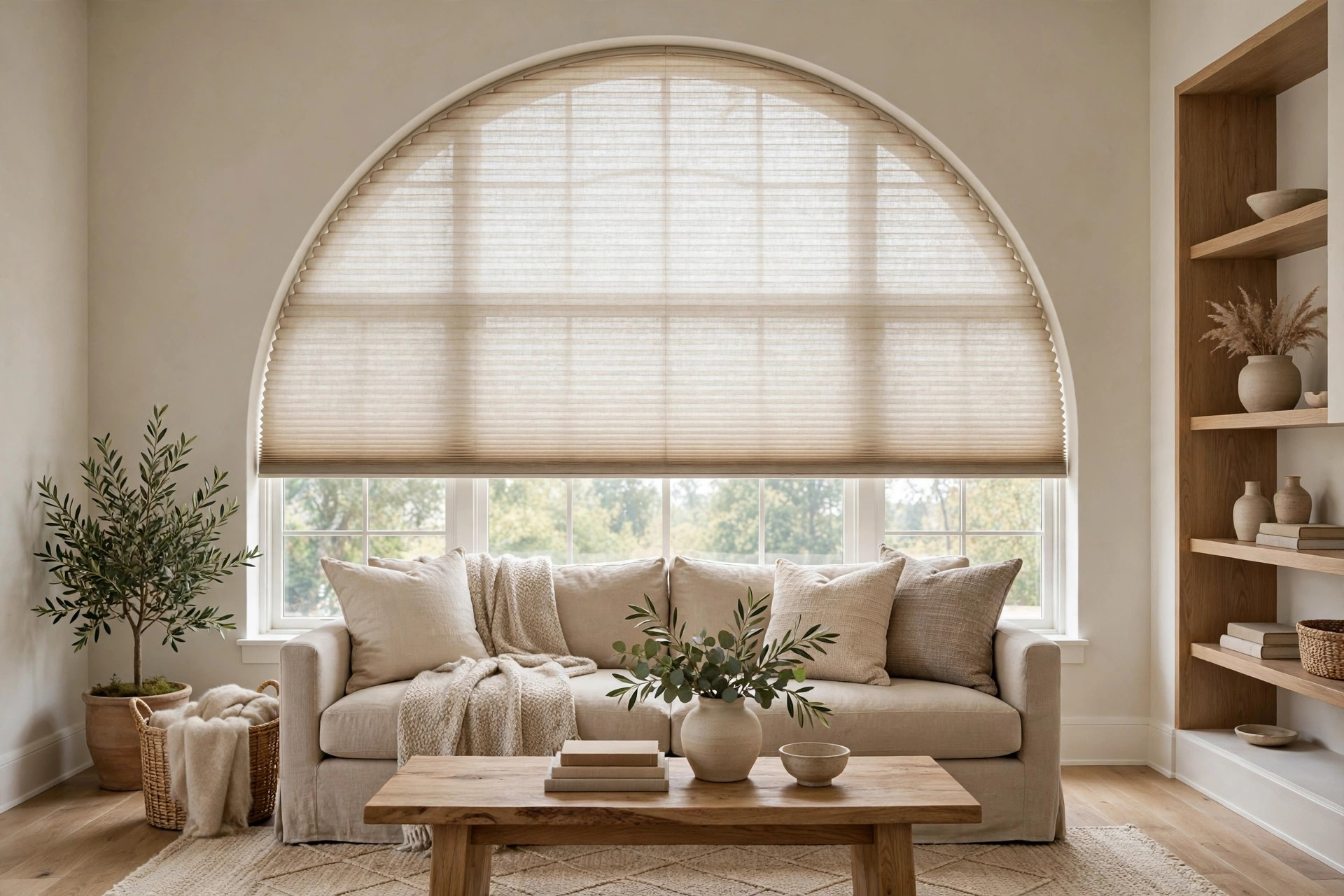
Special arched shades follow the curve of the glass. They sit inside the frame. They cover the full opening. This gives you real privacy. It also gives you real light control.
Sun control matters a great deal with arches. Many arches sit high on a wall. The sun hits them all morning or all afternoon. Without a cover, the room grows hot. Fabrics and wood floors can fade. A good shade blocks harsh rays. It still lets the room feel bright and open.
Heat loss matters in winter too. Glass is a poor insulator. A cellular shade traps air in its pockets. That layer of air slows heat loss. The U.S. Department of Energy explains that window coverings can cut heat loss and heat gain in clear terms. For a tall arched window, the saving adds up.
Looks matter as well. An arch is often the focal point of a room. A bare arch can look unfinished. The right shade adds polish. It softens the hard line of the glass. Many owners pair an arched shade with side drapes. This gives a classic, finished look.
What to Look For When You Buy Online: Buy Arched Window Shades Online in the Usa
Buying online works well if you do the groundwork first. Use this checklist before you place an order.
Exact measurements. Arched shades are made to fit. Even a half inch of error can ruin the fit. Measure twice. Write each number down. Many sellers ask for the width at the base and the height at the center. Some ask for a paper template. Keep reading for full measuring steps.
Fixed or movable. Many arched shades are fixed in place. They open and close like a fan, or they do not move at all. Some can raise and lower. Decide what you need. A fixed shade suits a high window you never touch. A movable shade suits a window you adjust each day.
Inside mount or outside mount. An inside mount sits within the frame. It needs enough depth in the frame. An outside mount covers the wall around the window. Outside mounts hide odd shapes better. They also block more light at the edges.
Light control. Do you need blackout, light filtering, or sheer? Bedrooms often need blackout. Living rooms often do best with light filtering. Check the fabric rating before you buy. Consumer Reports tests window treatments and rates how well they block light.
Material. Cellular fabric gives insulation. Pleated fabric is light and crisp. Woven wood adds texture but lets in more light. Pick the material that matches your main goal: privacy, insulation, or style.
Color. Light colors reflect sun and keep rooms cool. Dark colors hide soil but absorb heat. Hold a swatch near your wall paint. Online sellers mail free swatches. Order them before you commit.
Cord or cordless. Cordless shades are safer for homes with kids and pets. Motorized shades cost more but are easy to use on high windows. The U.S. Consumer Product Safety Commission warns that loose cords on window coverings can strangle young children. Cordless or motorized designs remove that risk.
Return policy. Custom shades are rarely returnable. Stock shades often are. Read the fine print. Check who pays return shipping. Check the warranty length.
Main Types of Arched Window Shades
Several styles cover arched tops. Each has strengths and limits.
Fixed Arched Shades
These are the simplest. The shade is cut to the shape of your arch. It mounts inside the frame and stays put. Many are cellular or pleated. They open like a hand fan during install, then lock in place. They suit high windows that you never need to open. They are also the cheapest custom option.
Operable Arched Shades
These can move. Some slide up from the base of the arch. Some stack to one side like a fan. You can adjust them for sun or privacy. They cost more than fixed shades. They need smooth tracks and good hardware. Buy them only from sellers with strong reviews for operable designs.
Cellular Arched Shades
Cellular shades have honeycomb pockets. The pockets trap air. This gives the best insulation of any fabric shade. They come in single, double, and triple cell depths. They work well as fixed arched shades. They also come in operable models. If energy saving is your goal, start here.
Pleated Arched Shades
Pleated shades use a single layer of crisp fabric. They are lighter than cellular shades. They cost less. They give less insulation. They still look clean and sharp. They are a good pick for rooms where looks matter more than heat control.
Specialty Shapes
Not every arch is a true half circle. Quarter circles, elongated arches, and eyebrow windows need custom cutting. Measure the full curve. Some sellers accept a traced template. Others use a list of points along the curve. Ask the seller which method they prefer before you start.
Stock Versus Custom
Stock shades come in set sizes. They fit only common arch sizes. Custom shades are cut to your numbers. Most arched windows need custom shades. Custom work takes longer. It also costs more. For a perfect fit, the extra cost is worth it.
How to Measure Your Arched Window
Good measuring is the heart of a good order. Take your time.
You need a steel tape measure, a pencil, paper, and a step stool. A helper makes the job easier.
1. Measure the width at the very base of the arch. Measure inside the frame from one side to the other. Write it down. 2. Measure the height at the center. Run the tape from the base line to the top of the curve. Write it down. 3. Measure the frame depth. This tells you if an inside mount will fit. Most shades need at least one to two inches of depth. 4. Check if the arch is a true half circle. Measure from the center of the base to the top. In a true half circle, this equals half the width. If not, note the difference. 5. Take each measurement twice. Use the smaller number when the two differ. 6. Ask the seller if they want a template. Some sellers mail a template kit. You trace the arch on paper and mail it back. This is the safest method for odd shapes.
Photograph the window from straight on. Include a tape measure in the shot for scale. Keep the photo with your notes. Many home improvement guides show measuring diagrams that match these steps.
Cost and Price Ranges
Prices vary with size, material, and options. Use these ranges as a guide.
Stock fixed arched shades often run from about thirty to ninety dollars. They fit only standard sizes. Choice of color is limited.
Custom fixed cellular arched shades often run from about one hundred fifty to four hundred dollars per window. Large arches cost more. Double cell fabric costs more than single cell.
Operable arched shades often run from about three hundred to seven hundred dollars per window. Complex shapes push the price higher.
Motorization adds about one hundred fifty to three hundred dollars per shade. It also needs a power source or batteries. For a window you cannot reach, this money is well spent.
Shipping for custom shades is often free. Delivery takes two to four weeks. Rush service costs extra. Installation by a pro runs about seventy-five to one hundred fifty dollars per window. Many owners install fixed shades themselves in under an hour.
Compare total cost, not just the shade price. A cheap shade with costly shipping and no warranty may cost more in the end. Sites like Blinds.com and Wayfair list full prices with shipping before checkout. Lowe’s and IKEA also sell window coverings with clear in-store and online pricing.
Care and Upkeep
Arched shades last longer with simple care.
Dust them each month. Use a soft brush or a vacuum with a brush head. Work from the top down. For cellular shades, use low suction so you do not crush the cells.
Spot clean stains at once. Blot, do not rub. Use a damp cloth with mild soap. Test the soap on a hidden spot first. Let the fabric dry fully before you close the shade.
Check the hardware twice a year. Tighten any loose brackets. Make sure operable shades move smoothly. A drop of silicone spray on tracks helps stiff sliders. Do not use oil. Oil attracts dust.
Keep shades dry. Bathrooms and kitchens make steam. Steam can warp some fabrics. Pick moisture-safe materials for those rooms.
Small tears can be mended with clear fabric glue. Large tears or broken cords need pro repair. Many makers sell repair kits for their own shades. Keep your order number. It makes reordering parts easy.
Safety Notes
Window covering safety is not a small matter. Follow these rules.
Keep all cords out of reach of children and pets. Use cord cleats to wrap long cords high on the wall. Better yet, choose cordless shades. The U.S. Consumer Product Safety Commission has pushed the industry toward safer designs for years.
Mount brackets into studs or use proper anchors. An arched shade can be heavy. A weak mount can pull free and fall. This is a real risk on high windows above beds or cribs.
If you hire an installer, check that they are insured. Ask how they anchor into your wall type. Plaster, brick, and drywall each need different hardware. Family-run guides at The Spruce explain anchor choices in plain language.
Motorized shades need safe wiring. Battery models are simplest. Hardwired models should be installed by an electrician. Keep remotes where children cannot reach them. A moving shade can trap small fingers.
Frequently Asked Questions
Can arched window shades open and close? Some can. Operable models slide or fan open. Most fixed models stay in place. Decide before you order. Changing your mind later means buying a new shade.
How do I measure an arch that is not a perfect half circle? Measure the width at the base and the height at the center. Then measure the height at several points along the curve. Many sellers accept these points. Some sellers mail a template kit. A template is the safest choice for odd shapes.
Are custom arched shades worth the cost? For most arches, yes. Stock shades fit only common sizes. A poor fit looks bad and leaks light. A custom shade fits like it was built with the house. Given that arches are often a room’s focal point, the fit shows.
How long does delivery take? Stock shades ship in a few days. Custom shades take two to four weeks. Some sellers offer rush service for a fee. Order early if you need shades by a set date.
Can I install an arched shade myself? Fixed shades are a fair do-it-yourself job. You need a drill, a level, and a steady ladder. Operable and motorized shades are harder. If the window is very high, hire a pro. Safety comes first.
What if I also want curtains on the same window? Many owners hang drapes on the sides of an arch. They leave the arch itself to the shade. This layered look is classic. For tieback ideas, see our guide to custom curtain tiebacks and holdbacks for southern states. If you need washable fabrics for lower windows, read where to buy machine washable curtains in florida. For kids’ rooms, best kids room blackout curtains for southern states covers darkening options.
A Final Word
A good arched shade is a quiet upgrade. It tames the sun. It trims heat bills. It finishes the room. The online market gives you more choice than any local store. Measure with care. Pick the right type for your needs. Read the return policy before you pay. Do those three things and you will be pleased with the result for years. For more decorating ideas, browse HGTV for room tours that show arches done well.
References
Blinds.com. (n.d.). Window blinds, shades, and shutters. https://www.blinds.com Consumer Reports. (n.d.). Product reviews and ratings. https://www.consumerreports.org HGTV. (n.d.). Home and garden ideas. https://www.hgtv.com IKEA. (n.d.). Home furnishings. https://www.ikea.com Lowe’s. (n.d.). Home improvement products. https://www.lowes.com The Home Depot. (n.d.). Home improvement products. https://www.homedepot.com The Spruce. (n.d.). Home and garden advice. https://www.thespruce.com U.S. Consumer Product Safety Commission. (n.d.). Product safety information. https://www.cpsc.gov U.S. Department of Energy. (n.d.). Energy efficiency and renewable energy. https://www.energy.gov Wayfair. (n.d.). Furniture and home goods. https://www.wayfair.com
Was this guide helpful?

About James Carter
The My Garden US editorial team writes practical, in-depth home and garden guides for American homeowners — tested advice, no fluff.