
A small button can carry a large idea. When you are searching for the best button maker machine for crafts business use, you are not only buying a tool. You are buying the heart of a small enterprise that can sell at markets, school events, gift shops, and online stores.
Pin-back buttons have a long history. People wore them to support causes, to show team spirit, and to carry art on a jacket or bag. Today they remain a strong product for home crafters. The cost to make each button is low. The selling price is fair. And the machine itself is simple to learn.
This guide will walk you through what a button maker is, how to choose one, what sizes to offer, how much to charge, and how to keep the machine in good shape for years.
Why a Button Maker Matters for Your Craft Business
A button maker turns flat paper designs into finished pins in less than a minute. That speed matters when you run a small business. You can fill orders of fifty or five hundred buttons without outside help.
The start-up cost is also modest. Many craft machines demand large investments and a dedicated room. A button maker, by contrast, fits on a desk. You can store it in a closet when the workday ends. A good craft table with storage keeps the machine and supplies in one place.
Buttons also have a wide market. Schools buy them for clubs and teams. Couples order them for weddings. Bands sell them at shows. Local shops stock them as impulse items. A single machine lets you serve all these buyers with the same simple process.
How a Button Maker Works: Best Button Maker Machine for Crafts Business
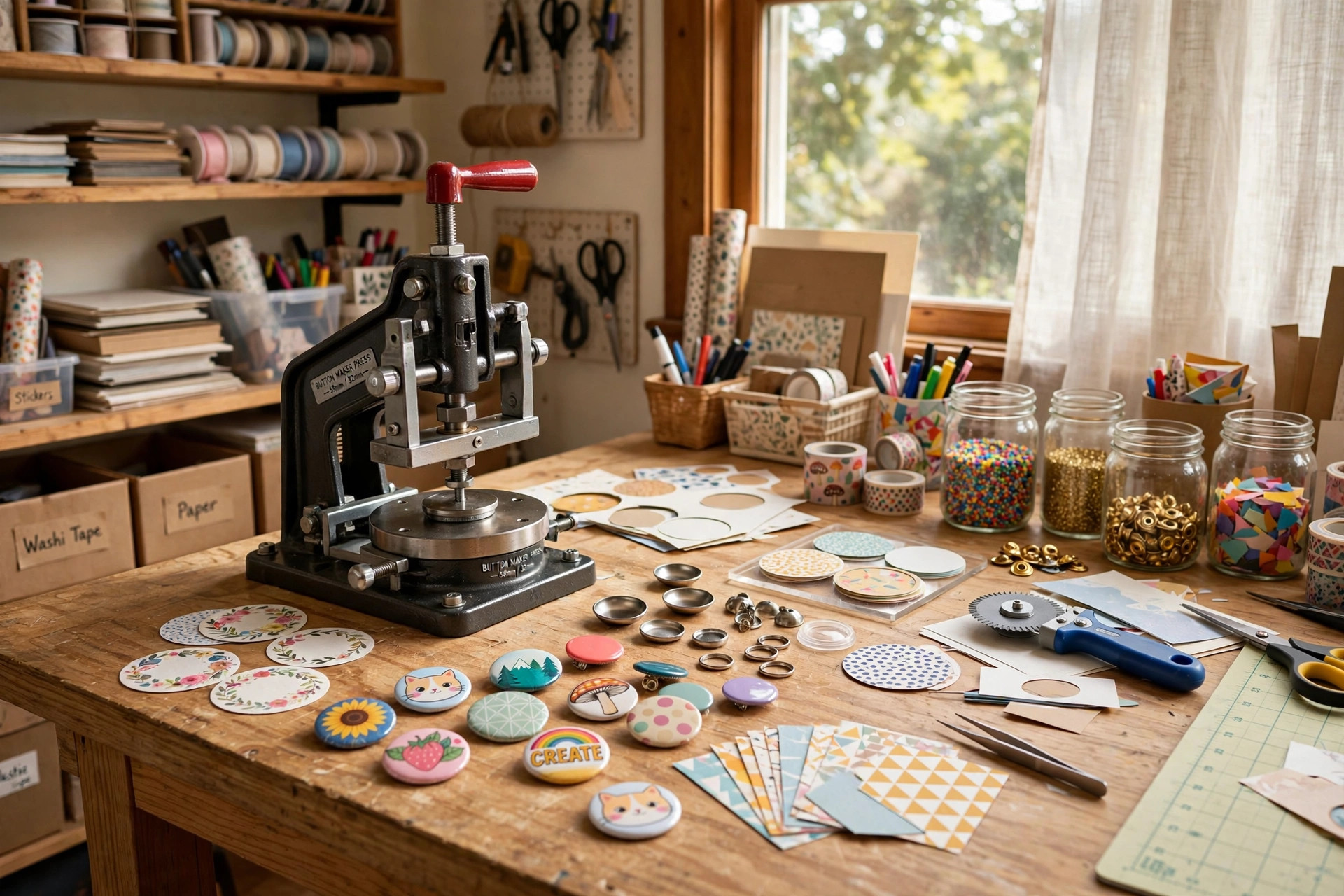
A pin-back button has five parts. The front shell is a thin metal cup. Your paper design sits inside it. A clear plastic film, called mylar, covers the paper to protect it. A metal back holds the pin. The pin itself is attached to that back.
The machine presses these parts together in two steps. First you place the front shell, paper, and mylar into a die and press. Then you place the pin back into the other die and press again. The two halves lock into a finished button.
Most machines use two dies on a rotating plate. You swing the plate from one position to the next. The handle pulls down with even force. With practice, each button takes about twenty seconds.
Types of Button Maker Machines
There are three main types. Each has its own price and purpose.
Handheld Button Makers
Handheld models are small and light. You squeeze them like a pair of pliers. They are cheap and easy to carry to a live event. But they are slow. Your hands tire after fifty buttons. They suit a crafter who sells only a few dozen buttons at a time.
Manual Press Machines
Manual press machines are the standard choice for a home business. They sit on a table and use a long lever. You can make hundreds of buttons in a day. Most kits include one die size. Extra dies let you make other sizes with the same machine. This is the type most crafters buy first.
Electric Button Makers
Electric models press with a motor instead of a hand lever. They are fast and easy on the hands. They cost more, often several times the price of a manual press. They suit a growing business that fills large orders each week. For a new seller, a manual press is usually enough.
Choosing the Right Machine for Your Business
Button Size
Buttons come in many sizes. Common ones include 1 inch, 1.25 inch, 1.5 inch, 2.25 inch, and 3 inch. Smaller buttons work well as lapel pins and bag flair. Larger ones suit campaign buttons and bold art.
When you buy, pick the size you plan to sell most. A 2.25-inch button is a common all-around choice. It shows a clear design and sells at a good price. If you want variety, buy a machine that accepts changeable dies so you can add sizes later.
Build Quality
Look for a solid metal frame. Cast iron and steel parts last far longer than plastic. Check that the lever moves smoothly and that the dies line up well. A poorly lined die makes crooked buttons and wastes parts.
Read the product details on a trusted retailer page before you buy. A store like JOANN lists parts and kits for crafters. A big-box store like The Home Depot can supply the workbench or shelving for your small studio.
Kit Contents
Many machines come as kits. A good kit includes the press, one die set, a paper cutter or circle punch, and starter parts for one hundred buttons or more. Starter parts let you practice without buying more supplies right away.
Compare kits carefully. Some cheap kits have few parts, so the real cost is higher than it looks. Some fine-art supply shops, such as Blick Art Materials, carry paper and tools that raise the quality of your finished buttons.
Budget
A basic handheld maker may cost under fifty dollars. A solid manual press kit often costs between one hundred and three hundred dollars. Electric machines start higher. Plan your budget around how many buttons you will make each month.
What to Look For: Key Features
The press should stand steady on the table. Rubber feet or bolt holes help. The handle should feel balanced, not loose. The die set should slide or swing without sticking.
Check how the paper cutter works. A good circle cutter or punch makes clean round designs every time. Ragged edges show on the finished button. A precise cutter saves time and cuts waste.
Also check the supply of parts. You will need shells, backs, pins, and mylar film. Buy from a maker or shop that sells refills in the size you chose. Running out of parts in the middle of an order is a costly mistake.
Cost and Pricing for Your Button Business
Machine and Supply Costs
Let us count the costs. A manual press kit with one die set costs roughly one hundred to three hundred dollars. A pack of one thousand button parts costs about thirty to eighty dollars, based on size. A circle cutter costs twenty to fifty dollars. Design software can be free if you use basic tools on your computer.
Cost Per Button
Each button uses one shell, one back, one pin, one mylar circle, and one paper circle. The parts cost for one 2.25-inch button is often under twenty cents. Paper and ink add a few more cents. So each finished button costs about a quarter of a dollar to make.
Setting Your Price
Many crafters sell buttons for two to five dollars each, based on size and design. At three dollars each and a cost of twenty-five cents, the profit per button is strong. Large orders get a lower price per button, which still leaves a fair margin.
Price lists should be simple. For example: 1-inch buttons at two dollars, 2.25-inch at three dollars, 3-inch at four dollars. Offer a discount for orders over one hundred. Buyers like clear numbers.
Materials and Supplies You Will Need
Good supplies make good buttons. You need metal shells, pin backs, mylar film, and paper. Most crafters use a medium-weight glossy or matte photo paper. It should be thick enough to press well but thin enough to fold at the edge.
You also need a paper cutter or punch that matches your button size. A steady table helps too. A sturdy bench from a craft chain such as Michaels gives you room to lay out parts in order.
Keep spare parts on hand. Order refills before you run out. A small parts organizer keeps shells, backs, and mylar apart so you never mix sizes.
Setting Up Your Button Business
Design and Printing
Your designs make the sale. Simple bold art with clear words sells best. Avoid tiny text that no one can read on a small button. Test print your designs on plain paper first. Cut them out and check the size inside the button before you print a full run.
Use a good home printer with fresh ink. Print a little darker than looks right on screen, since the mylar film softens colors a touch. Let the ink dry fully before you press.
Workflow
Set up your table like a small factory. Put the shells on the left, the papers in the middle, and the backs on the right. Press all the front halves first. Then switch the plate and press all the backs. This rhythm is faster than making each button one at a time.
Where to Sell
Craft fairs and farmers markets are natural places to sell buttons. Schools and clubs are steady buyers. Online shops reach far more people. A marketplace like Etsy is home to many button sellers and lets you study what others charge. Big online stores like Amazon and Walmart are useful for comparing machine prices before you buy.
Buttons also pair well with other craft products. If you sell shirts, a vinyl cutter for a t-shirt business at home can expand your line. If you do embroidery, an embroidery machine for home business beginners opens new designs. A heat press for home t-shirts lets you print matching shirts for button orders.
Care and Upkeep
A button maker is a simple machine, and it lasts long with basic care. Wipe the dies with a dry cloth after each work session. Keep dust out of the press. A light drop of oil on moving joints once or twice a year keeps the action smooth.
Store the dies in a dry place. Metal parts can rust in damp air. Keep spare parts in sealed bags or boxes. If a die gets bent, replace it. A bent die makes poor buttons and slows your work.
Check the handle and bolts now and then. Tighten what is loose. A steady press makes steady buttons. Guides for small-shop care appear on do-it-yourself sites such as Family Handyman, This Old House, and Bob Vila.
Safety
Button makers are safe when used with care, but they are still presses. Keep fingers away from the die when you pull the lever. The press force is strong enough to pinch hard.
Metal button shells have sharp edges. Wear light gloves when you handle loose parts if your skin is sensitive. Keep small parts away from young children, since they can be a choking hazard.
Set the machine on a stable table. Bolt it down if it rocks. Work at a comfortable height so your back and arms do not tire. Take breaks during long runs. A calm, steady pace beats a rushed one.
Frequently Asked Questions
How much does a good button maker cost?
A good manual press kit costs about one hundred to three hundred dollars. It usually includes the press, one die set, a cutter, and starter parts. Handheld models cost less. Electric models cost more.
Which button size should I start with?
Start with 2.25 inches. It is the most common size for craft sales. It shows art clearly and sells at a good price. Add smaller or larger dies once you know what your buyers want.
How long does it take to learn?
Most people learn in under an hour. The steps are simple: place parts, press, swing the plate, press again. After twenty buttons, your hands know the rhythm. Practice on plain paper before you use your best designs.
Can I use my own photos on buttons?
Yes. Print your photos as circles in the right size. Many crafters sell photo buttons for weddings, birthdays, and memorials. Use good photo paper and let the ink dry before pressing.
How many buttons can I make per hour?
A practiced crafter makes about one hundred to one hundred fifty buttons per hour on a manual press. Handheld models are slower. Electric models are faster. Your speed grows with practice.
Do I need a business license to sell buttons?
Rules differ by place. Many areas require a simple business license for market sales. Some events ask for proof of insurance. Check your local city or county office before you sell at public events.
A Final Word
The best button maker machine for crafts business use is the one that fits your budget, your space, and your sales plan. Start with a solid manual press, one popular size, and a small stock of parts. Learn the rhythm. Print bold designs. Sell where your buyers gather.
A button business grows by small steps. One fair order leads to the next. Keep your costs low, your designs fresh, and your machine clean. In time, that small press on your table can become a steady source of income and a craft you are proud to share.
References
Amazon. (n.d.). Online shopping. https://www.amazon.com Blick Art Materials. (n.d.). Art and craft supplies. https://www.dickblick.com Bob Vila. (n.d.). Home improvement advice. https://www.bobvila.com Etsy. (n.d.). Handmade and craft marketplace. https://www.etsy.com Family Handyman. (n.d.). DIY home repair and maintenance. https://www.familyhandyman.com JOANN. (n.d.). Fabric and craft supplies. https://www.joann.com Michaels. (n.d.). Arts and crafts supplies. https://www.michaels.com The Home Depot. (n.d.). Home improvement products. https://www.homedepot.com This Old House. (n.d.). Home renovation guidance. https://www.thisoldhouse.com Walmart. (n.d.). Everyday low prices. https://www.walmart.com
Was this guide helpful?

About James Carter
The My Garden US editorial team writes practical, in-depth home and garden guides for American homeowners — tested advice, no fluff.
You May Also Like
The Best Hot Glue Gun for Craft Projects Home Makers Can Trust
May 7, 2026 0 views
The Best Watercolor Brush Pens for Lettering Art
February 12, 2026 0 views
The Best Craft Organizer Tote for On the Go
March 1, 2026 0 views