
Choosing bathroom sink vanities for California homes usa buyers face one of the most common and most rewarding projects in the house. The vanity sits at the center of the bath. It holds the sink, stores the daily supplies, and sets the tone for the whole room. In California, where water rules, building codes, and home styles all differ by region, the right choice takes a little thought. This guide walks through the whole process in plain terms, from size and style to cost, care, and safety.
Why the Vanity Matters So Much
The bathroom sink vanity is the hardest-working piece of furniture in the home. It carries the weight of the sink and the faucet, it endures splashing water every day, and it opens and closes hundreds of times a year. A weak cabinet soon shows its age. Doors sag, hinges rust, and swollen particleboard tells the story of every leak. A well-made vanity, on the other hand, serves for decades with little more than a wiped surface and tightened hardware.
In California this matters even more. Many homes in the state were built between the 1950s and the 1980s, and their baths are small by modern standards. A smart vanity choice can make a tight bath feel open. The right cabinet also helps meet the state plumbing rules, which limit how much water faucets may use. When the vanity, the sink, and the faucet are chosen together, the whole bath works better and costs less to run.
Resale value is another reason to care. Real estate guides have long noted that a clean, updated bath ranks near the top of buyer wish lists. A tired bath turns buyers away. A fresh vanity with a solid top and a new faucet gives the strongest first impression for the money spent.
What to Look for When Choosing a Vanity: Bathroom Sink Vanities California Homes Usa
Start with the room itself. Measure the wall where the vanity will sit, note the position of the plumbing, and check the door swing. A vanity that is too deep blocks foot traffic. One that is too wide crowds the toilet or the shower door. Standard bath vanities run from 24 inches to 72 inches wide, and 18 to 21 inches deep. In older California tract homes, a 30-inch or 36-inch single-sink unit often fits best. In master baths, a 60-inch or 72-inch double-sink vanity gives two people room to work.
Next, study the cabinet material. Solid wood and plywood stand up to bath humidity far better than plain particleboard. Many stock cabinets now use furniture board with sealed edges, which performs well if kept dry. Look for soft-close hinges and full-extension drawers. These small details decide how the piece feels each day. A drawer that glides shut on its own is a pleasure that never wears out.
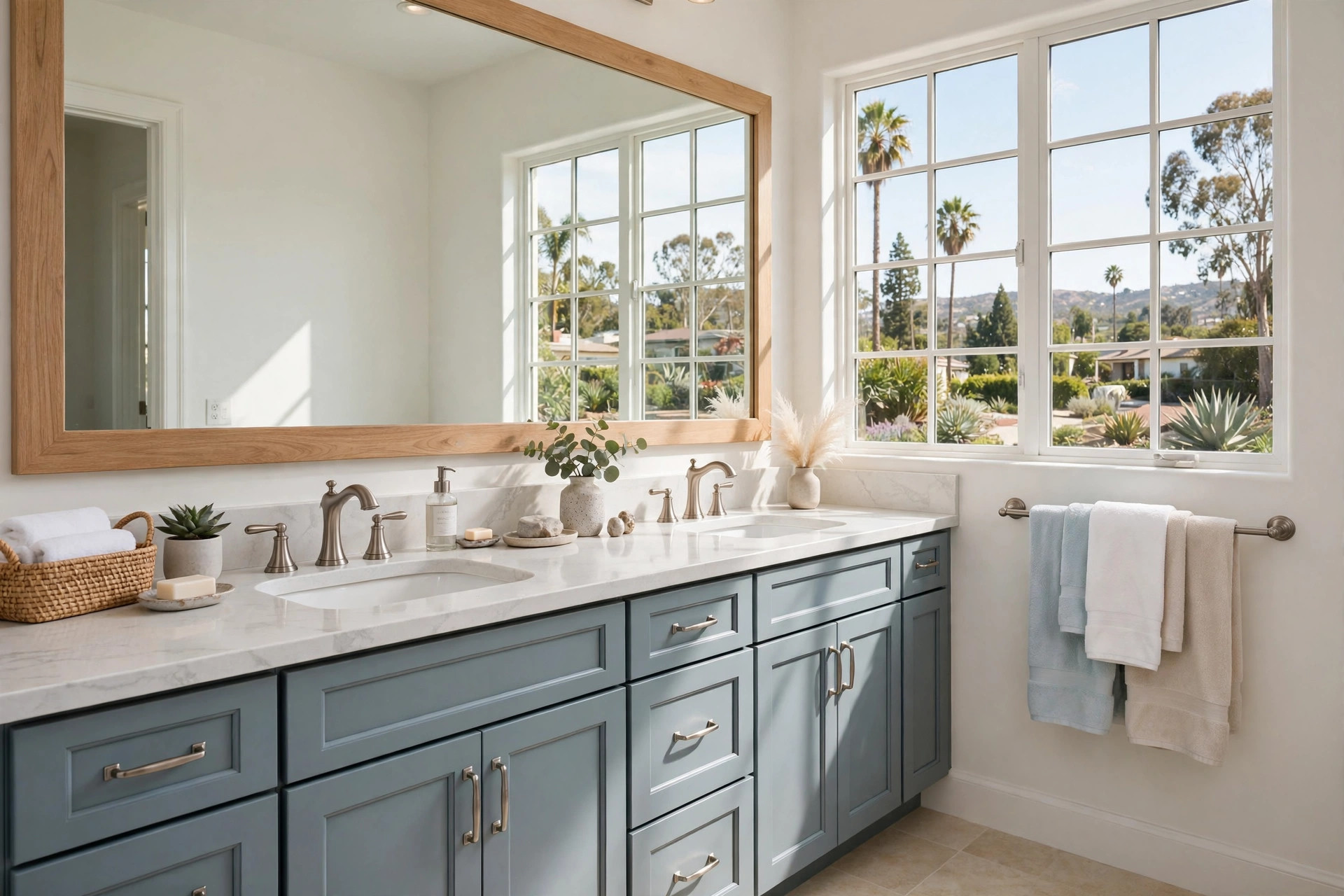
The finish deserves care in a California bath. Bright coastal sun pours through bath windows in San Diego and Orange County homes, and strong light fades cheap finishes. Painted finishes in white, light gray, or soft blue suit the common coastal look. Stained wood in oak or walnut warms the mountain homes near Lake Tahoe and the craftsman bungalows of Pasadena. Seal all edges, and keep caulk sound where the cabinet meets the floor and the wall.
Types and Options
Bath vanities come in four main families, and each suits a different home.
Freestanding vanities stand on legs or a plinth and anchor to the wall. They are the most common choice, sold in every home center in the state. Prices run wide, and styles range from plain shaker fronts to furniture looks with turned feet. For a quick remodel, a freestanding unit from a big retailer is the simple path. Home centers such as Home Depot and Lowe’s stock sizes from 24 to 72 inches, which covers nearly every California bath.
Floating, or wall-mounted, vanities hang from blocking in the wall. They leave the floor clear, which makes a small bath look larger and makes mopping easy. They suit the clean lines of new condos in Los Angeles and San Francisco. They must be bolted to studs or solid blocking, since a stone top with two sinks is heavy. This is not a job for drywall anchors alone.
Vessel-sink vanities pair a lower cabinet with a bowl that sits on top of the counter. The look is striking and spa-like. But vessel sinks splash more, and they raise the rim height, which matters for children and for older users. Many California plumbers suggest undermount sinks instead, because the smooth counter wipes straight into the bowl and cleaning is easier.
Custom and semi-custom vanities fill odd spaces. A bath with a sloped ceiling in a Cape Cod style home, or a narrow bath in a San Francisco flat, may need a cabinet cut to fit. Semi-custom lines let the buyer pick width, door style, and finish. True custom work from a local cabinet shop costs more but solves any layout. This Old House offers steady guidance on fitting custom cabinets into older homes.
Sink Styles
Undermount sinks give the cleanest counter and the easiest care. Drop-in sinks install fast and cost less. Integrated tops, where the sink and the counter are one molded piece, remove all seams and suit rental units and busy family baths. Porcelain and vitreous china stay bright for years. Cultured marble costs less but dulls with harsh cleaners. Solid surface and quartz cost more up front and reward the owner with long life.
Faucet Pairings
The faucet is half of the vanity story. California law has long limited bath faucets to 1.2 gallons per minute, and many homeowners now choose 1.0 or even 0.5 gallon models with fine aerators. Major fixture makers such as Moen, Delta, Kohler, and American Standard all sell WaterSense-labeled bath faucets in finishes from chrome to brushed brass. Match the faucet finish to the cabinet hardware for a settled look. A brushed nickel faucet with brushed nickel pulls reads as one decision, not two.
Cost and Price
A bathroom sink vanity for a California home can cost as little as two hundred dollars or as much as several thousand. A stock 30-inch unit with a cultured marble top often lands between 300 and 700 dollars. A 48-inch semi-custom cabinet with a quartz top and slow-close drawers runs 1,200 to 2,500 dollars. A 72-inch double-sink setup with stone and quality faucets can reach 3,000 to 5,000 dollars before labor.
Labor adds its own line. A plumber in California commonly charges 150 to 300 dollars to swap a like-for-like vanity, and more if supply lines or the drain must move. Tiling, painting, and new light bars add to the total. Homeowners who keep the plumbing in place save the most. Moving a drain even a few inches turns a one-day job into a multi-day one.
Budget with care. A sound rule is to spend most of the budget on the cabinet box and the faucet, since these are hard to change later, and less on the mirror and the medicine cabinet, which are easy to upgrade. Buy the best hinges and drawer slides the budget allows. These wear parts decide how long the piece feels new.
Care and Upkeep
Daily care is simple. Wipe splashes from the top and the front of the cabinet. Water left standing on a wood edge works its way in. Use a soft cloth and a mild cleaner. Strong bleach and abrasive powders dull finishes and etch stone. For quartz and solid surface, warm water and dish soap do the job. For cultured marble, use a non-abrasive bath cleaner and reseal once a year if the maker advises it.
Check the plumbing twice a year. Open the cabinet doors, look at the supply lines and the drain trap, and feel for dampness. A slow drip under a sink ruins a cabinet in months. Many California homes sit on slabs, where a hidden leak shows first as a warped cabinet floor. Catch it early and the fix is small. Tighten the faucet mounting nuts if the faucet rocks. A rocking faucet cracks caulk and lets water under the rim.
Caulk is the quiet guard of the bath. Run a bead of silicone where the top meets the wall and where the sink meets the top. Replace it when it pulls loose or grows dark. In humid coastal baths, vent the room with the exhaust fan during and after showers. Dry cabinets last. Damp ones do not.
Safety
A vanity must be anchored. A tall linen tower or a heavy stone top can tip if a child climbs. Bolt the cabinet to wall studs with proper screws. Keep medicines, razors, and cleaning products in a locked drawer or a high cabinet, out of reach of small children. HGTV and Bob Vila both publish plain safety checklists for family baths.
Burn safety matters at the sink. Set the water heater to 120 degrees to prevent scalds, and test the tap after any plumbing work. Choose faucets with clear hot and cold marks. In homes with older residents, a single-lever faucet is easier on stiff hands than two small knobs, and a comfort-height vanity near 34 inches reduces bending.
Electrical safety counts too. Bath outlets must be GFCI protected by code. Keep hair dryers and electric razors away from the sink edge, and never run a cord across a wet counter. If new lights go in over the vanity, let a licensed electrician make the connections. The Spruce keeps a clear library of bath safety basics for homeowners.
FAQ
What size vanity fits a typical California hall bath? Most hall baths in California tract homes take a 30-inch or 36-inch single-sink vanity. Measure the wall, allow room for the door swing, and leave at least 15 inches of clear space from the center of the toilet to the cabinet side.
Do I need a water-saving faucet with a new vanity? Yes, in practice. California standards limit bath faucets, and WaterSense models save real money on water and energy bills. Pair any new vanity with a 1.2 gallon per minute faucet or lower for the best result.
Can I install a floating vanity in an older home? Often yes, but the wall must carry the load. Open the wall or use a stud finder to confirm solid framing, and add blocking between studs if needed. A pro can do this in a few hours before the cabinet arrives.
How long does a bath vanity last? A plywood or solid-wood cabinet with sealed edges commonly lasts 20 years or more. Budget particleboard units in damp baths may fail in under ten. The faucet usually needs washers or a cartridge long before the cabinet wears out.
Should the vanity match the rest of the bath? It should relate, not match exactly. Pick up one finish or color from the tile or the floor, and let the cabinet be its own statement. Too much match reads flat. One shared tone keeps the room calm.
Is a double sink worth it in a master bath? For two adults sharing a morning routine, yes. A 60-inch double-sink vanity ends the daily wait and adds resale appeal. In a small master, a single wide sink with generous counter space serves better than two cramped bowls.
A Final Word
The right bathroom sink vanity for a California home is not the dearest one on the showroom floor. It is the one that fits the room, stands up to daily water, respects the state water rules, and pleases the eye each morning. Measure twice, buy the best cabinet box the budget allows, anchor it well, and pair it with a water-wise faucet. Do that, and the bath will serve the household quietly for a very long time.
References
American Standard. (n.d.). Bathroom and kitchen products. https://www.americanstandard.com Bob Vila. (n.d.). Home improvement advice. https://www.bobvila.com Delta Faucet. (n.d.). Kitchen and bathroom faucets. https://www.deltafaucet.com HGTV. (n.d.). Home and garden ideas. https://www.hgtv.com Kohler. (n.d.). Bathroom and kitchen fixtures. https://www.kohler.com Lowe’s. (n.d.). Home improvement products. https://www.lowes.com Moen. (n.d.). Faucets and plumbing fixtures. https://www.moen.com The Home Depot. (n.d.). Home improvement products. https://www.homedepot.com The Spruce. (n.d.). Home and garden advice. https://www.thespruce.com This Old House. (n.d.). Home renovation guidance. https://www.thisoldhouse.com
Was this guide helpful?

About Robert Taylor
The My Garden US editorial team writes practical, in-depth home and garden guides for American homeowners — tested advice, no fluff.
You May Also Like

LED Bathroom Mirrors: Where to Buy Them in the USA
October 2, 2026 0 views
Mirrored Medicine Cabinets in Texas Homes: A Plain Buyer’s Guide
February 25, 2026 0 views
Frameless Shower Doors Texas Homes USA: A Complete Buying Guide
July 13, 2026 0 views