A shower is one of the most slippery places in the home. Wet tile, soap film, and warm steam make every step a risk. A grab bar is a simple metal handle fixed to the wall. It gives you something firm to hold when you step in, wash, or step out. This shower grab bars reviews buying guide usa is written to help American shoppers compare the choices: the bar types on the market, the features that matter, the prices you can expect, and how to install and care for a bar once it is home.
Why Shower Grab Bars Matter
Falls in the bathroom are common. They happen to older adults, to people who have had surgery, and to anyone who is unsteady on a wet floor. The Centers for Disease Control and Prevention has long listed the bathroom as a high-risk area for falls at home. A grab bar does not remove every risk, but it gives a reliable handhold at the moment balance fails.
Many shoppers look first at bathroom safety bars for seniors. Older adults are the largest group of buyers, and bars are often installed for a parent or a spouse. Yet grab bars are useful well beyond that group. Pregnant women and people with bad knees benefit too, as does anyone who likes a firm grip in a large walk-in shower.
A good review of any grab bar asks one question first: will it hold firm when a person leans on it with full weight? Everything else — finish, style, price — comes after strength.
What to Look For When You Buy a Shower Grab Bar: Shower Grab Bars Reviews Buying Guide Usa
Not all bars are alike. Reviewers and buyers in the United States pay close attention to a few details. These are the features that separate a bar you can trust from one you cannot.
Length and Diameter
Grab bars are sold in set lengths. Common sizes are 12, 16, 18, 24, 32, and 42 inches. Short bars suit small spots, such as the wall by a faucet or the edge of a tub. Long bars give support along a whole shower wall. Many buyers install two bars: a short one at the entry and a long one along the back wall.
The tube diameter matters for the grip. Most bars are 1.25 inches or 1.5 inches across. The smaller size fits most hands and meets the standard used in many building codes. A 1.5-inch bar is easier for large hands and for people with arthritis. If the buyer has trouble gripping, the larger size is the better choice.
Material and Finish
Stainless steel is the most common material. It resists rust and cleans with ease. A stainless steel shower grab bar 24 inch model is one of the most reviewed sizes in American stores because it fits a standard shower wall and holds up for years.
Other bars are made of chrome-plated brass or coated steel. Chrome looks bright and matches many faucets. Powder-coated bars add color and a softer feel. Some bars have a peened or knurled texture on the grip. That texture helps wet hands hold on, and it is worth seeking out for a bar that will be used every day.
Finishes include polished chrome, brushed nickel, oil-rubbed bronze, and white. Moen and Delta both sell grab bars in finishes that pair with their faucet lines, which makes it easy to keep one look through the room.
Mounting Type
This is the most important choice. There are two main kinds of mounts.
Screw-mounted bars bolt through the wall into a stud or a solid backing. This is the strong and safe way. A bar fixed into a stud can hold 250 to 500 pounds when it is installed right. Most reviews give the highest marks to screw-mounted bars for this reason.
Suction-cup bars press onto smooth tile and hold by vacuum. They are easy to place and easy to move. They are also weaker. Suction cup shower grab bars are best seen as a helper for balance, not as a device that will catch a falling person. They must be checked often, and the surface must be smooth and clean for them to hold at all. On textured tile or fiberglass, they do not hold well.
Some bars use adhesive mounts. These are stronger than suction cups but weaker than screws. They suit renters who cannot drill into tile. Even so, the adhesive must cure fully, and the bar should be tested before anyone trusts it with weight.
Weight Rating
Every bar sold in the United States should list a weight rating. Look for a bar rated to at least 250 pounds. Bars that meet the American with Disabilities Act guidelines are tested to 250 pounds, and many brands test higher. Kohler and American Standard list ratings plainly in their product details, which makes comparison easy.
Concealed or Exposed Screws
Bars with exposed screws show the screw heads at each end. Bars with concealed screws hide the mounts under a cover plate. The concealed style looks cleaner and is easier to wipe down. The exposed style is simpler to install. Both are safe when the bar is fixed to a stud. Reviewers often prefer the concealed style for a master bath and the exposed style for a quick, low-cost job.
Types of Shower Grab Bars
Straight bars are the classic shape. They run in one line and are sold in every length. Most buyers start here.
L-shaped bars turn a corner. One arm runs along the back wall while the other runs up the side wall, which suits corner showers.
Angled bars tilt at 45 degrees or curve in a wave. Some users find the angle more natural for a rising grip. These bars are popular in showers used by people who have trouble standing from a bench.
Grab bars with shelves are a newer style. A small shelf sits on top of the bar and holds soap while the bar below holds the hand. The bar must still be mounted with screws to be safe.
Curved and decorative bars try to look like towel bars. They blend into the room and do not look like safety gear. HGTV design features often show these styles in remodeled baths. They cost more, but buyers who want a spa look choose them.
Shower Grab Bar Prices in the USA
Prices are modest compared with most bath fixtures. A basic straight bar in chrome, 12 to 18 inches long, often costs between 15 and 30 dollars. A 24-inch stainless steel bar from a known brand runs 25 to 60 dollars. Long bars of 32 to 42 inches cost 40 to 90 dollars. Designer finishes such as oil-rubbed bronze or matte black add 10 to 30 dollars to the price.
Suction-cup bars are cheaper, often 10 to 25 dollars. L-shaped bars and bars with shelves run 50 to 120 dollars. Professional installation adds cost. A handyman may charge 75 to 150 dollars per bar if studs are easy to find. If the wall needs to be opened to add backing, the cost rises.
Large retailers carry a wide range. Shoppers can compare models at The Home Depot and Lowe’s, where buyer reviews list the strong and weak points of each bar.
Installation Basics
Good installation matters more than the brand. A strong bar fixed badly is not safe. A plain bar fixed into a stud is very safe.
Find the studs first. A stud finder is the usual tool. Mark the stud edges with a pencil. The bar ends must land on solid wood. If the bar length does not match the stud spacing, use a mounting board or choose a bar length that does match. Standard stud spacing in American homes is 16 inches on center.
Drill pilot holes through the tile with a masonry bit so the surface does not crack. Drive the screws deep into the stud.
On a fiberglass or acrylic shower, the wall behind the panel must have blocking. In that case, a special through-bolt kit or a contractor may be needed. This Old House has detailed guides on finding solid backing behind bath walls, and Bob Vila covers tile drilling without cracks.
After mounting, test the bar. Pull on it hard with your full weight. If it moves at all, the screws missed the stud and the job must be redone. A bar that feels loose on day one will only get looser.
Care and Upkeep
Grab bars need little care. Wipe them down with the rest of the bath. A soft cloth and a mild cleaner are enough. The Spruce lists mild cleaners that are safe on chrome and nickel finishes. Do not use harsh acids or abrasive pads, which can dull the finish and roughen chrome.
Check the bar every few months. Grab each end and pull. Look for wobble or a gap at the mount. Tighten any screw that has worked loose. In a home with hard water, wipe the bar dry after showers to slow mineral spots.
Suction-cup bars need more care. Take them off the wall each month, clean the cups and the tile, and press them back on. Never trust a suction bar that slips when you tug it.
If you are planning a wider bath update, it helps to think about the room as a whole. A quiet fan keeps steam off the mirrors and the bars, and our guide on quiet exhaust fans for sale usa covers that choice. Matching fixtures also matter, as our look at brushed nickel faucets american homes guide explains. And if warmth underfoot is on the list, see heated floor kits where to buy usa.
Safety Notes
A grab bar is a support, not a towel hook. Never hang heavy bags or a shower caddy full of bottles from a bar. The extra weight can loosen the mounts over time.
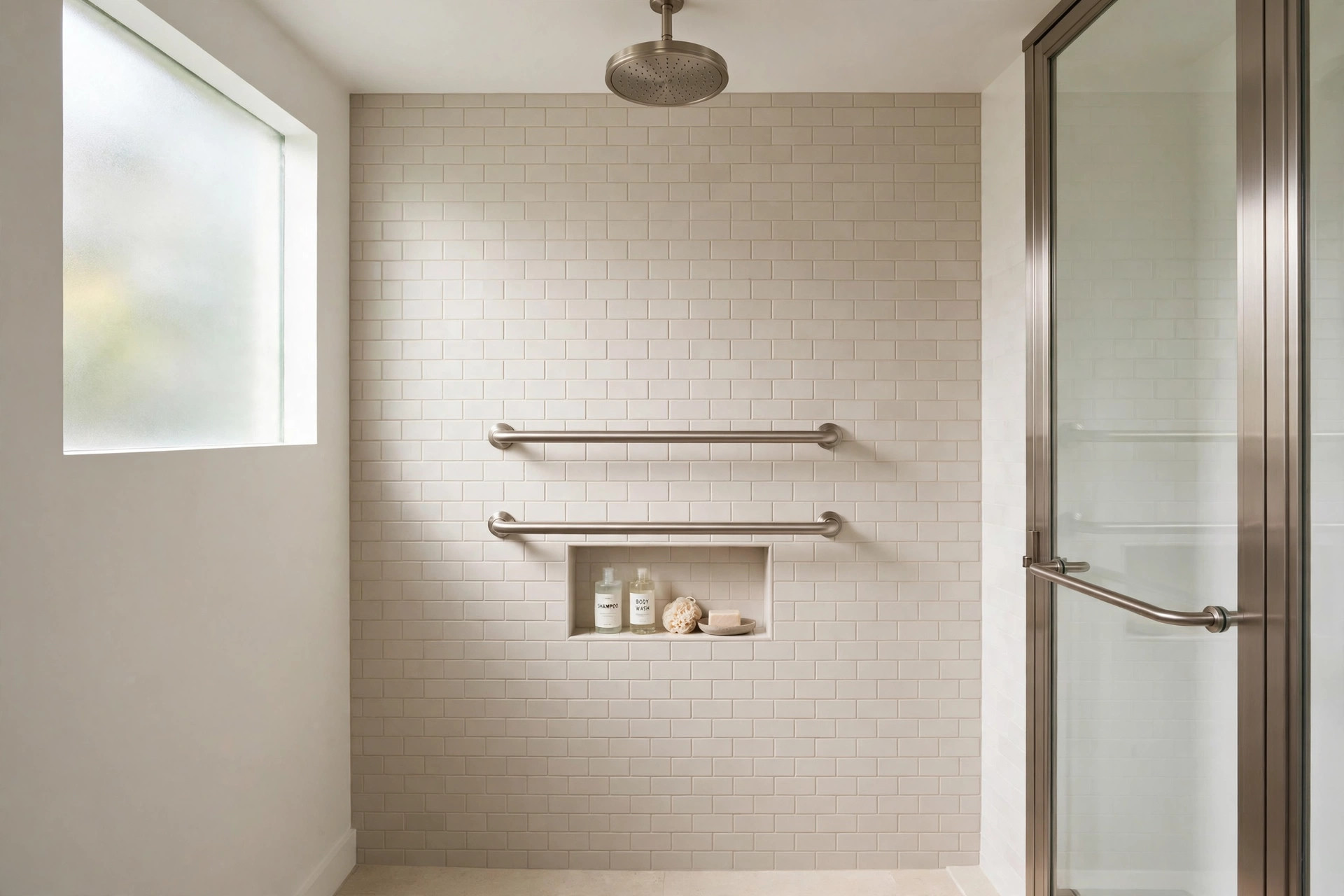
Place bars where hands naturally reach. The entry wall, the back wall, and the wall near the controls are the usual spots. In a tub-shower combo, one bar on the back wall and one vertical bar at the entry cover most needs.
Keep the floor safe too. A non-slip mat inside the shower and a dry rug outside it work with the bar, not instead of it. Good light helps as well. A dim bath hides wet spots and trip edges.
If the bar is for a person with a medical need, ask a doctor or an occupational therapist about placement. They can mark the best height and spots for that person’s reach and strength. The usual mounting height is 33 to 36 inches above the shower floor, but a therapist may set a different height for a wheelchair user or a tall person.
Frequently Asked Questions
How many grab bars does a shower need?
Most showers need at least two. One bar goes on the wall you face when you step in, and one goes on the side wall near the controls. A large walk-in shower may need three. A small shower stall may do with one well-placed bar, but two is the safer choice.
Can I install a grab bar on tile without cracking it?
Yes, with the right bit and a slow drill speed. Use a diamond or carbide tile bit. Tape the spot with painter’s tape to stop the bit from skating. Drill without the hammer setting. Once through the tile, switch to a wood bit for the stud behind. Many American DIYers do this job in under an hour.
Are suction grab bars safe for seniors?
They are a help, not a safeguard. A suction bar can steady a hand on smooth tile, but it cannot be trusted to catch a fall. For a senior who may lean hard on the bar, a screw-mounted bar into a stud is the right choice. Check suction bars before every use.
What length grab bar is best for a shower?
The 24-inch bar is the most popular all-round size. It fits most shower walls and gives a long handhold. Use 16 or 18 inches for tight spots near the faucet. Use 32 or 42 inches on a long back wall where a person may walk along the shower. Measure the wall and the reach of the user before you buy.
Do grab bars rust?
Good stainless steel bars resist rust for many years. Chrome-plated bars can pit if the plating is thin and the bath stays damp. Wiping the bar dry and keeping the fan on after showers slows rust. If rust spots appear on a cheap bar, replace it rather than sand it, since sanding can weaken the mount area.
Can a renter install a grab bar without drilling?
A renter can use a suction-cup bar or an adhesive bar. Neither is as strong as screws. Check the lease first, since some leases allow small holes that are patched at move-out. An adhesive bar that is rated for the job and left to cure fully is the middle choice for renters who cannot drill.
A Short Final Word
A shower grab bar is a small purchase with a large payoff. It costs less than most bath fixtures, it installs in an hour, and it stands ready every time someone steps onto a wet floor. Buyers in the United States have a wide field to choose from, from plain chrome bars to designer pieces that hide their purpose. Use this shower grab bars reviews buying guide usa as a checklist: pick the right length, choose stainless steel or a trusted finish, mount with screws into a stud, and test the bar before anyone leans on it. Done right, the bar will serve the household quietly for years.
References
American Standard. (n.d.). Bathroom and kitchen products. https://www.americanstandard.com Bob Vila. (n.d.). Home improvement advice. https://www.bobvila.com Delta Faucet. (n.d.). Kitchen and bathroom faucets. https://www.deltafaucet.com HGTV. (n.d.). Home and garden ideas. https://www.hgtv.com Kohler. (n.d.). Bathroom and kitchen fixtures. https://www.kohler.com Lowe’s. (n.d.). Home improvement products. https://www.lowes.com Moen. (n.d.). Faucets and plumbing fixtures. https://www.moen.com The Home Depot. (n.d.). Home improvement products. https://www.homedepot.com The Spruce. (n.d.). Home and garden advice. https://www.thespruce.com This Old House. (n.d.). Home renovation guidance. https://www.thisoldhouse.com
Was this guide helpful?

About Robert Taylor
The My Garden US editorial team writes practical, in-depth home and garden guides for American homeowners — tested advice, no fluff.