
A stitcher who owns more than a dozen colors soon faces a small but real problem. Skeins tangle. Labels fade. Drawers turn into a knot of thread. The best embroidery floss organizer for thread storage solves this problem before it grows. It keeps each color apart, each label readable, and each skein ready to use.
This guide explains the main types of organizers, what to look for when you shop, what they cost, and how to keep them in good order. The advice suits beginners with a first kit as well as stitchers with hundreds of colors. Every home is different, so the guide covers options for small rooms, large craft rooms, and stitchers who travel.
Why a Good Organizer Matters
Embroidery floss is cheap by the skein, but it is not cheap by the hour. A stitcher spends hours with thread in hand. When thread is tangled, work slows and the mood suffers. When thread is sorted, stitching moves along with a steady rhythm.
A good organizer saves money too. Skeins that stay clean and dry last for years. Skeins that live in a pile pick up dust and pet hair. They snag, fade, and get thrown away. The best craft storage organizer for small rooms can often hold floss alongside hoops, needles, and patterns, so one purchase serves many needs.
There is also the matter of color. Needlework depends on shade. A missing number on a label can ruin a pattern. Organizers that keep labels with each bundle protect the color record. This matters most for projects that span weeks or months, when a stitcher must find the same color again.
What to Look For When You Shop: Best Embroidery Floss Organizer for Thread Storage
Capacity
Count your colors first. A beginner with thirty skeins needs far less space than a stitcher with four hundred. Choose an organizer that holds what you own today plus room for fifty more. Buying twice costs more than buying once with headroom.
Visibility
You should be able to see your colors at a glance. Clear boxes, open rings, and labeled bobbins all help. Avoid systems that hide the thread inside closed sleeves with no window. A label on the outside of each row makes restocking simple.
Material
Plastic boxes are light and cheap. Wood boxes look fine on a shelf but cost more. Fabric cases protect thread from sun but hide the colors. Sturdy plastic with a tight lid is the workhorse choice for most homes. It keeps dust out and survives a fall from the table.
Portability
If you stitch at a friend’s house, at a guild meeting, or in the car, pick a case with a handle and a latch. Small bags that hold rings of bobbins are easy to carry. If you never move your thread, a fixed drawer system may serve you better.
Labeling
The best systems use the standard thread number from the maker. Write the number on each bobbin in pencil or with a small printed label. Ink can fade or bleed. Many stitchers keep a master list taped inside the box lid, so a missing bobbin is noticed at once. Advice on labeling craft supplies is easy to find on the how-to pages at This Old House, where simple home projects get plain treatment.
Main Types of Floss Organizers
Plastic Bobbin Boxes
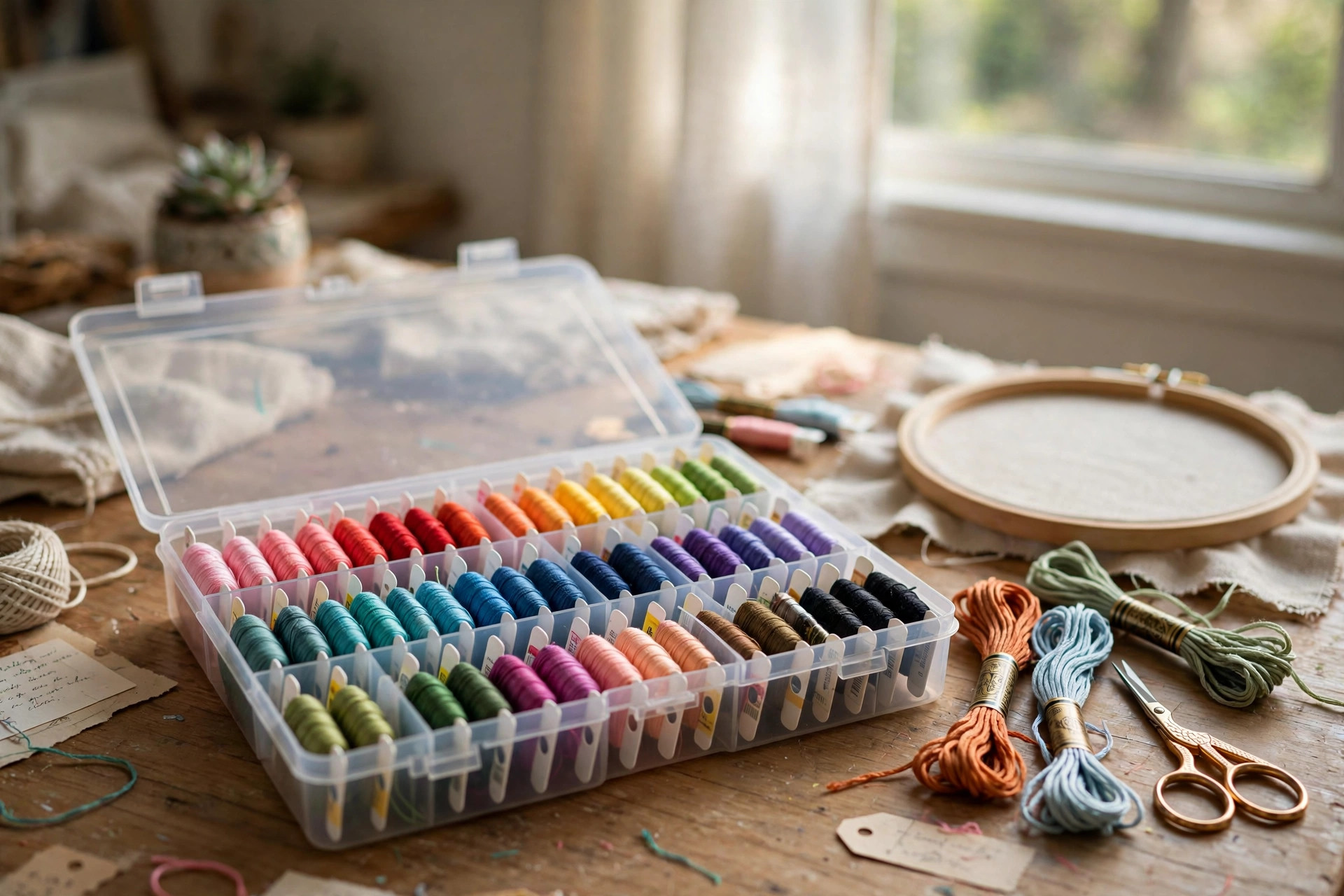
The classic choice is a flat plastic box with slots for cardboard or plastic bobbins. Each bobbin holds one wound skein, with the color number written on the tab. Boxes commonly hold fifty bobbins. Stack two or three boxes and you have a full library.
The strength of this system is order. Every color has a fixed place. The weakness is the winding work. Filling two hundred bobbins takes an afternoon. Many stitchers wind a little at a time, when new thread comes home. Large craft retailers such as Michaels stock bobbins, boxes, and winding tools in one aisle, which makes the first setup simple.
Ring and Floss Drop Systems
In this system, each skein stays in its wrapper and hangs from a metal or plastic ring by its paper band. A small paper tag carries the color number. Rings can be sorted by color family or by project.
Rings are fast. There is no winding. They hang on a hook or lie flat in a tray. The drawback is bulk. Three hundred skeins on rings fill a large bag. For a small stash, though, rings are hard to beat. The craft retailer JOANN carries rings, tags, and sorting bags for this method.
Drawer and Tray Systems
Small plastic drawers, the kind sold for hardware or beads, hold one or two colors each. The drawers pull out and the color shows through the front. This system suits a permanent craft room with desk space to spare.
Trays with dividers work much the same way. Skeins lie flat in rows. A label strip across the front of each row keeps the numbers in order. Drawer systems cost more than boxes, but they hold thread in its original form, which many stitchers prefer. For thoughts on setting up a tidy craft station, the project guides at Bob Vila cover small-space storage with care.
Travel Bags and Cases
Soft cases with zip pockets hold bobbins, needles, scissors, and a small hoop. They are made for stitchers on the move. A good case closes flat and fits in a tote bag. Look for one with a rigid core so the bobbins do not crush.
Cases also suit stitchers who work one project at a time. Load the case with the colors for the current piece, and the rest of the stash stays home in boxes. When the piece is done, the colors go back to their bobbins. The best embroidery hoop set for wall art diy often comes with a small pouch that can double as a travel holder for a few colors.
Wall-Mounted and Shelf Storage
Pegboards, wall racks, and clear wall pockets turn a stash into wall art. Skeins hang in rows by color. This method is lovely to look at and very fast to use. It needs wall space and a room away from direct sun, since light fades thread over time.
Shelf cubbies with labeled bins serve the same idea in less space. Each bin holds a color family: reds, blues, greens, neutrals. This is a loose system, best for stitchers who know their stash by sight. Fine art suppliers like Blick sell the bins, jars, and drawer units that suit this approach.
Cost and Price Range
Prices are modest. A pack of one hundred cardboard bobbins costs a few dollars. A fifty-slot plastic box costs about the same as a paperback book. A full setup for a mid-size stash often runs between twenty and fifty dollars.
Ring systems cost a little more because of the metal rings and tags. Drawer units are the dearest, with a bank of sixty small drawers costing as much as a nice dinner out. Wall systems vary widely; a simple pegboard is cheap, while a finished wooden thread cabinet is a real piece of furniture.
Buying in stages keeps the cost down. Start with bobbins and one box. Add a second box when the first fills. This is wiser than buying a huge system before you know your habits. Home centers such as Home Depot and the project library at Family Handyman both carry the bins and small drawer units that many stitchers adapt for thread.
Care and Upkeep
Thread storage is not a job you finish once. A few habits keep the system working.
Dust the boxes now and then. A soft cloth or a quick pass with a dry brush is enough. Keep the boxes out of direct sun. Windows are the enemy of color; even a few months of afternoon light can fade the top row of a clear box.
Check for damp. Basements and garages can grow mold on paper bobbins. If a box smells musty, move it upstairs and let it air. Switch to plastic bobbins in damp rooms, since plastic does not feed mold.
Restock with care. When you buy new skeins, wind and label them the same day. A small pile of loose skeins is how order breaks down. Keep a short shopping list of colors that run low, so you buy before a project stalls.
Once a year, walk through the whole stash. Toss thread that is dirty, faded, or beyond untangling. Check that every bobbin still has its number. This yearly pass takes less than an hour and keeps the system honest. A cross stitch kit for beginners adults patterns is a fine excuse for this review, since a new project reveals which colors are missing.
Safety in the Craft Room
Thread storage is low risk, but a few points matter. Keep small metal rings, needles, and pins away from small children and pets. A closed box with a latch is safer than an open tray in a home with toddlers.
Heavy drawer units should sit on a stable surface. A tall bank of drawers can tip if a child climbs it, so anchor it to the wall or keep it low. Wall-mounted racks should be fixed to studs, not just drywall, when they hold real weight.
If you wind bobbins with a small electric winder, unplug it when done. Keep cords off the floor where feet catch them. These are plain household habits, but they belong in any craft room guide.
Frequently Asked Questions
How many bobbins do I need to start? Start with one hundred. That covers a beginner stash with room to grow. Buy more only when the first pack runs out.
Should I keep the paper bands from the skeins? Yes, for a while. The band carries the color number and the dye lot. If you use bobbins, write the number on the bobbin and keep the bands in an envelope until you are sure the system works for you.
What is the fastest way to wind bobbins? Use a simple hand winder, a small plastic tool that turns the bobbin for you. It costs little and cuts the work in half. Some stitchers wind while watching television, a few skeins a night.
Can I mix thread brands in one organizer? You can, but label each bobbin with the brand as well as the number. Color numbers differ between makers. A number from one brand means nothing in another. Many stitchers keep brands in separate boxes to avoid mix-ups. Handmade storage ideas also abound on marketplaces like Etsy, where small shops sell labeled wooden boxes.
How do I store thread for a single project? Pull the colors for that project onto one ring or into one small bag. Keep the project bag with the pattern and hoop. When the piece is done, return each color to its home in the main system.
Is sunlight really a problem for floss? Yes. Direct sun fades dyed cotton over months, not days, so the harm is slow and easy to miss. Store boxes in a closet or on a shelf away from windows. General home care references such as The Spruce note the same rule for all dyed textiles.
A Final Word
The best embroidery floss organizer for thread storage is the one you will actually use. A simple box of labeled bobbins beats a fancy cabinet that never gets filled. Start small, keep the numbers on every bundle, and put new thread away the day it arrives. Your future self, mid-project and hunting for one last shade of green, will be glad you did.
References
Blick Art Materials. (n.d.). Art and craft supplies. https://www.dickblick.com Bob Vila. (n.d.). Home improvement advice. https://www.bobvila.com Etsy. (n.d.). Handmade and craft marketplace. https://www.etsy.com Family Handyman. (n.d.). DIY home repair and maintenance. https://www.familyhandyman.com JOANN. (n.d.). Fabric and craft supplies. https://www.joann.com Michaels. (n.d.). Arts and crafts supplies. https://www.michaels.com The Home Depot. (n.d.). Home improvement products. https://www.homedepot.com The Spruce. (n.d.). Home and garden advice. https://www.thespruce.com This Old House. (n.d.). Home renovation guidance. https://www.thisoldhouse.com
Was this guide helpful?

About Lisa Anderson
The My Garden US editorial team writes practical, in-depth home and garden guides for American homeowners — tested advice, no fluff.
You May Also Like
Best Yarn Winder for Crochet and Knitting
July 17, 2026 0 views
Knitting Needles Set for Beginners: A Plain Guide to Bamboo Sets in the USA
August 19, 2026 0 views
Needle Felting Kit for Beginners: Animals DIY
July 12, 2026 0 views