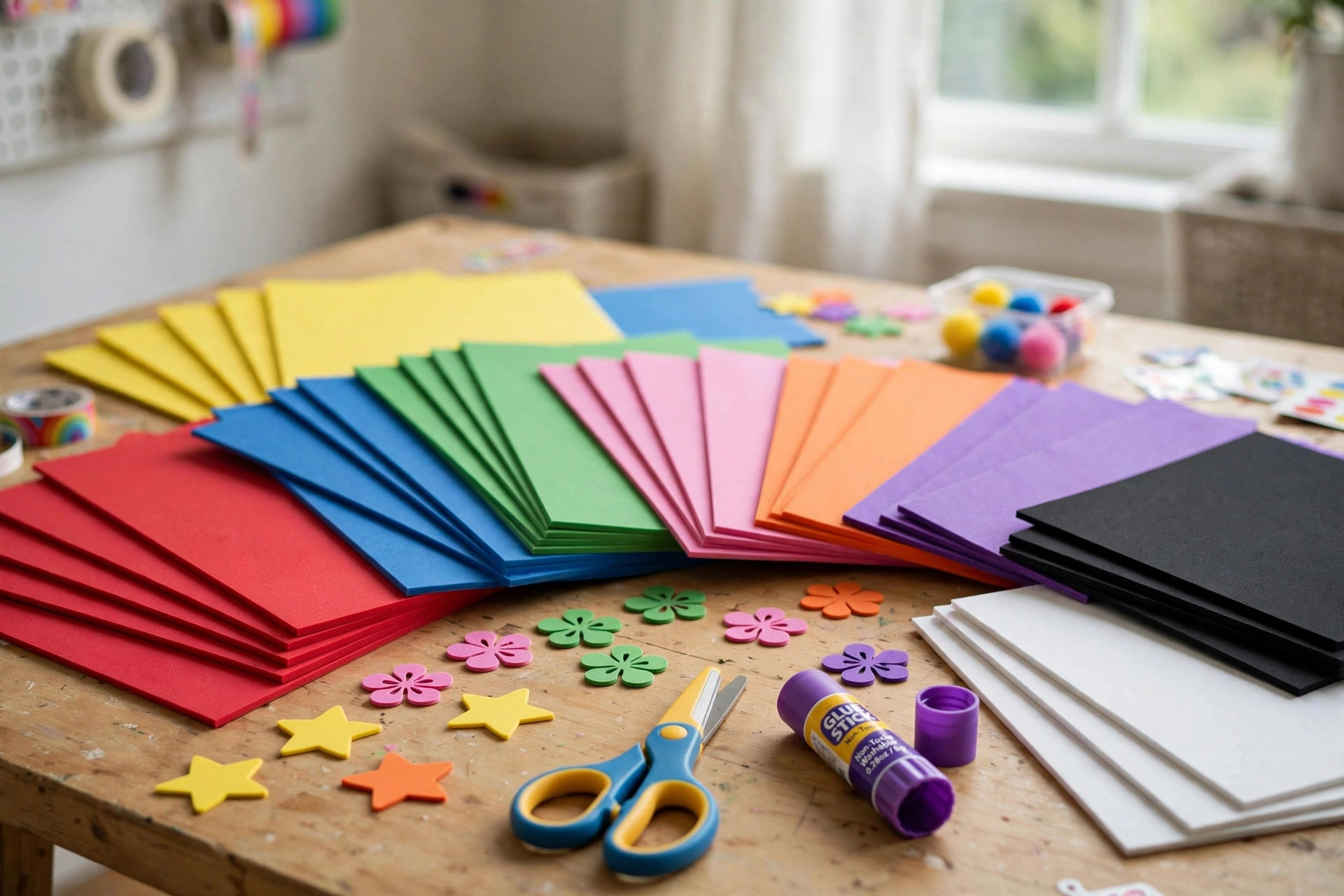

Craft foam sheets have a firm place in the world of children’s art. They are light, soft to the touch, and easy to cut. A child with a pair of blunt scissors can turn a flat sheet into a flower, a mask, or a puppet in minutes. The best craft foam sheets for kids projects are the ones that cut cleanly, hold their shape, and come in colors that stay bright. This guide explains what foam sheets are, how to pick them, what they cost, and how to use them well.
Why Craft Foam Sheets Matter for Kids Projects
Children learn with their hands. When a child cuts, glues, and bends material, the work trains small muscles and sharpens the eye. Craft foam sheets suit this kind of learning better than most art supplies. Paper tears too fast and does not hold a shape. Felt is soft but frays at the edges. Wood is hard and needs tools that are not safe for small hands. Foam sits in the middle. It is firm enough to stand up and soft enough to cut with ease.
Foam sheets also forgive mistakes. A crooked cut in paper often ruins the piece. A crooked cut in foam can be trimmed or hidden under glue. This makes foam kind to beginners, and early success keeps the child working.
Teachers like foam for a second reason: it is quiet. Scissors on foam make little sound, which matters when thirty children cut at once in a classroom or an after-school program.
A third reason is color. Foam sheets come in packs of twenty or more colors, and the color runs through the whole sheet, so a cut edge shows the same bright red or yellow as the face. Finished projects look tidy even when the cutting is rough.
What to Look For When You Choose Foam Sheets: Best Craft Foam Sheets for Kids Projects
Thickness
Foam sheets are sold in thicknesses measured in millimeters. The common sizes are 1.5 mm, 2 mm, and 3 mm. For most kids projects, 2 mm is the right choice. It is thick enough to hold a bend and thin enough to cut with blunt children’s scissors, and every craft chain stocks it in full color ranges. Sheets of 1.5 mm feel flimsy and tear when a child pulls hard. Sheets of 3 mm are sturdy but hard for small hands to cut, and glue takes longer to hold them.
If you buy one thickness for a mixed-age group, choose 2 mm. It suits children from about age four up through the upper grades of elementary school.
Size of the Sheet
Most packs hold sheets that measure 9 by 12 inches, the size of a standard sheet of construction paper. This size fits school cubbies and craft bins. Larger sheets, 12 by 18 inches, are useful for banners, costumes, and big classroom displays. Check the size before you buy. A low price per pack means little if the sheets are half the normal size.
Color Range
A good pack holds at least twelve distinct colors. The best packs hold twenty or more. Look for packs that include both bright colors and a few dark ones, such as black, brown, and dark green. Dark sheets are needed for outlines, eyes, tires, and night skies.
Some sheets are glitter foam, with a sparkle face on one side. Children love glitter foam, and it is fine for special projects. Note that the glitter face does not take glue well, and glitter can flake off onto tables and clothes. Keep a separate pack of glitter foam for decoration rather than for the main build. When you do need a firm bond, a hot glue gun grips glitter foam better than school glue.
Adhesive Backing
Many foam sheets come with a peel-and-stick back. The child peels off a paper layer and presses the foam where it belongs. This removes the need for glue and keeps tables clean. Adhesive foam is excellent for younger children and for car trips or waiting rooms, where glue would make a mess.
The drawback is that the bond is weak. Stuck foam peels off smooth surfaces after a day or two, and it will not hold foam to foam for long. For projects that must last, plain foam plus hot glue works better. Many families keep both kinds on hand: sticky-back foam for quick fun and plain foam for lasting work.
Texture and Density
Foam quality varies between brands. Cheap sheets feel spongy and stretch when pulled. Better sheets feel firm and spring back to flat. Firm foam cuts in a clean line and keeps a crease when folded. If you can, buy one small pack first and press your thumb into a sheet. If the dent stays, the foam is too soft for good projects.
Types of Foam Sheets and Foam Options
Standard EVA Foam Sheets
Most craft foam is EVA, short for ethylene-vinyl acetate. It is a soft plastic foam made for crafts. Standard EVA sheets in 2 mm are the workhorse of kids projects. They come in every color, cost little, and are sold at every craft store. For general use, this is the type to buy.
Glitter Foam Sheets
Glitter foam has the same EVA base with a glitter layer bonded to one side. It is best used as an accent: stars on a night sky, scales on a fish, a crown for a princess. One pack of glitter foam will last a long time because a little goes a long way. As noted above, the glitter side resists glue, so plan to attach glitter pieces with the plain side down or use a hot glue gun which grips better than school glue.
Foam Shapes and Pre-Cut Pieces
Shops also sell bags of pre-cut foam shapes: circles, stars, hearts, letters, and animals. These are handy for very young children who cannot yet cut on their own, and most art supply stores carry them in the kids’ craft aisle. A three-year-old can peel and stick foam stars onto a card and feel proud of the result. Pre-cut shapes cost more per piece than plain sheets, so they work best as a supplement rather than the main supply.
Foam Rolls
Foam is also sold in rolls, usually 2 mm thick and several feet long. Rolls suit big projects such as banners or costumes, but they are harder to store and for children to cut, so an adult should cut flat pieces from the roll first.
Cost and Price: What to Expect
Craft foam is one of the cheapest art supplies. A pack of forty 9-by-12-inch sheets in mixed colors often costs between three and six dollars at a large craft store. That works out to well under twenty cents a sheet. Bulk packs of one hundred sheets bring the price lower still.
Glitter foam costs more, often twice the price of plain foam for the same count. Sticky-back foam also costs more than plain. Pre-cut shapes are the most expensive per piece.
For a classroom, a teacher can stock a year of foam projects for less than twenty dollars. For a home craft box, one forty-sheet pack plus one small glitter pack will cover months of projects.
When you compare brands, compare the price per sheet, not the price per pack. Divide the pack price by the number of sheets. Also check the sheet size. A pack that looks cheap may hold smaller sheets or thinner foam.
Simple Project Ideas That Work Well
Foam sheets suit a wide range of projects. Here are ideas grouped by age, each tested in homes and classrooms.
Ages 3 to 5
At this age, keep projects to sticking and layering. Foam stickers and pre-cut shapes are ideal. Children can press foam shapes onto paper to make scenes: a sun, clouds, and a house on blue paper. Simple masks are another favorite. An adult cuts the mask shape and the eye holes, and the child decorates it with sticky-back foam pieces.
Pair foam time with other simple supplies the child already knows, such as crayons and modeling clay, to build scenes with mixed textures.
Ages 6 to 8
Children in this range can cut foam on their own with blunt scissors. They can make bookmarks, door hangers, and simple puppets. A bookmark needs only a strip of foam, a hole punch, and a ribbon. A door hanger starts with a rectangle and a cut circle for the knob. Puppets made from two foam shapes glued at the edges, with the bottom left open for fingers, keep children busy for an hour.
Foam flowers are a classic at this age. Cut petal shapes from colored foam, glue them in a ring around a yellow circle, and add a green stem.
Ages 9 to 12
Older children can handle layered and three-dimensional work. They can build foam picture frames, boxes, and simple models. Foam mosaics teach patience: small foam squares glued in a pattern to fill an outline drawing. Dioramas in shoeboxes, with foam trees, animals, and backdrops, make strong school projects. At this age children can also try foam stamping. Cut a shape, glue it to a wood block or a bottle cap, press it on an ink pad, and stamp cards and wrapping paper. A birdhouse kit for kids also pairs well with foam, giving older children a wood base to decorate with foam shapes and trim.
Care and Upkeep of Foam Sheets and Finished Projects
Foam sheets need little care. Store them flat, not rolled, so they do not take a curl. Keep them out of strong sun, which fades bright colors over a few months. Heat is the real enemy: foam softens and warps near radiators, in hot cars, and close to lamps.
Finished foam projects last well indoors. Dust them with a dry cloth. If a piece gets dirty, wipe it with a damp cloth and a drop of mild soap, then let it air dry. Do not soak foam in water. The color may bleed, and the sheet can warp as it dries.
Glue joints need a day to reach full strength. Tell children not to pull at a project right after gluing. White school glue on foam takes several hours to set. A hot glue gun sets in under a minute, but hot glue is a job for an adult, never for small children alone.
Safety Notes for Parents and Teachers
Craft foam sold for children is generally safe, but a few rules keep projects trouble-free. Watch small children with small cut pieces, since foam bits are a choking hazard for children under three. Keep foam work for toddlers to large pieces only, and pick up scraps at the end.
Take care with cutting tools. Blunt-tip children’s scissors are right for foam up to 2 mm. Craft knives cut foam neatly, but they belong in adult hands only. An adult should do all knife cutting before the children sit down.
Use glue with care. School glue and glue sticks are safe for all ages. Hot glue guns can burn, so an adult should run the glue gun while the child places the pieces. Spray adhesives should be used outdoors or not at all around children, since the fumes are strong.
Check labels if a child has skin or breathing sensitivities. Most craft foam is latex-free, but labels differ by brand. When in doubt, choose a major craft brand with clear labeling, such as those sold through large craft retailers.
Keep foam away from open flame. Foam is a plastic product and will melt and burn if it touches a candle or a stove burner. This matters most for holiday crafts near candles. Use battery lights instead of real candles near any foam decoration.
Frequently Asked Questions
What is the best thickness of foam sheet for kids?
Two millimeters is the best all-round thickness. It cuts easily with children’s scissors, holds its shape, and takes glue well. Thinner sheets tear too easily, and thicker sheets tire small hands.
Are craft foam sheets washable?
Lightly, yes. Wipe foam with a damp cloth and mild soap, then air dry. Do not soak foam or put it through a washing machine. Soaking can warp the sheet and bleed the color.
Can you iron craft foam sheets?
No. Heat warps and melts foam. If a sheet curls, flatten it under a stack of books for a day instead.
What glue works best on foam?
White school glue works for paper-to-foam and light foam-to-foam joints if you give it time to dry. Tacky craft glue grips faster and holds better, and craft guides recommend it for foam-to-foam joints. A hot glue gun gives the strongest bond and sets in seconds, but an adult must handle it. Avoid super glue around children.
Where can I buy craft foam sheets in bulk?
Large craft chains sell bulk packs of fifty to one hundred sheets at a low price per sheet. Warehouse clubs and online craft sellers also carry bulk packs. Compare the price per sheet and check the sheet size before you order, since both vary.
Do foam sheets work for outdoor projects?
Foam holds up poorly outdoors. Sun fades the color, rain can warp thin sheets, and wind tears light pieces. For a short outdoor event, such as a party decoration for one afternoon, foam is fine. For anything meant to last outside, choose a sturdier material. Project guides from home improvement sources and craft how-to sites agree that foam is an indoor material.
A Final Word
The best craft foam sheets for kids projects are not the fanciest or the most costly. They are the plain, firm, brightly colored 2 mm sheets that cut cleanly and cost only pennies each. Stock a craft box with a mixed-color pack, a small glitter pack for accents, safe scissors, and good glue, and a child has months of projects waiting. Start simple, let the child lead, and keep the scraps. Some of the best foam art begins as a leftover piece and an idea.
References
Amazon. (n.d.). Online shopping. https://www.amazon.com Blick Art Materials. (n.d.). Art and craft supplies. https://www.dickblick.com Bob Vila. (n.d.). Home improvement advice. https://www.bobvila.com Family Handyman. (n.d.). DIY home repair and maintenance. https://www.familyhandyman.com JOANN. (n.d.). Fabric and craft supplies. https://www.joann.com Michaels. (n.d.). Arts and crafts supplies. https://www.michaels.com The Home Depot. (n.d.). Home improvement products. https://www.homedepot.com This Old House. (n.d.). Home renovation guidance. https://www.thisoldhouse.com Walmart. (n.d.). Everyday low prices. https://www.walmart.com
Was this guide helpful?

About James Carter
The My Garden US editorial team writes practical, in-depth home and garden guides for American homeowners — tested advice, no fluff.
You May Also Like
Best Rotary Tool for DIY Crafts and Jewelry: A Complete Buying Guide
June 27, 2026 0 views
A Calligraphy Pen Set for Beginners Lettering: A Simple Guide
August 26, 2026 0 views
A Candle Wick Kit for Soy Candle Making Home Candle Makers
September 25, 2026 1 views