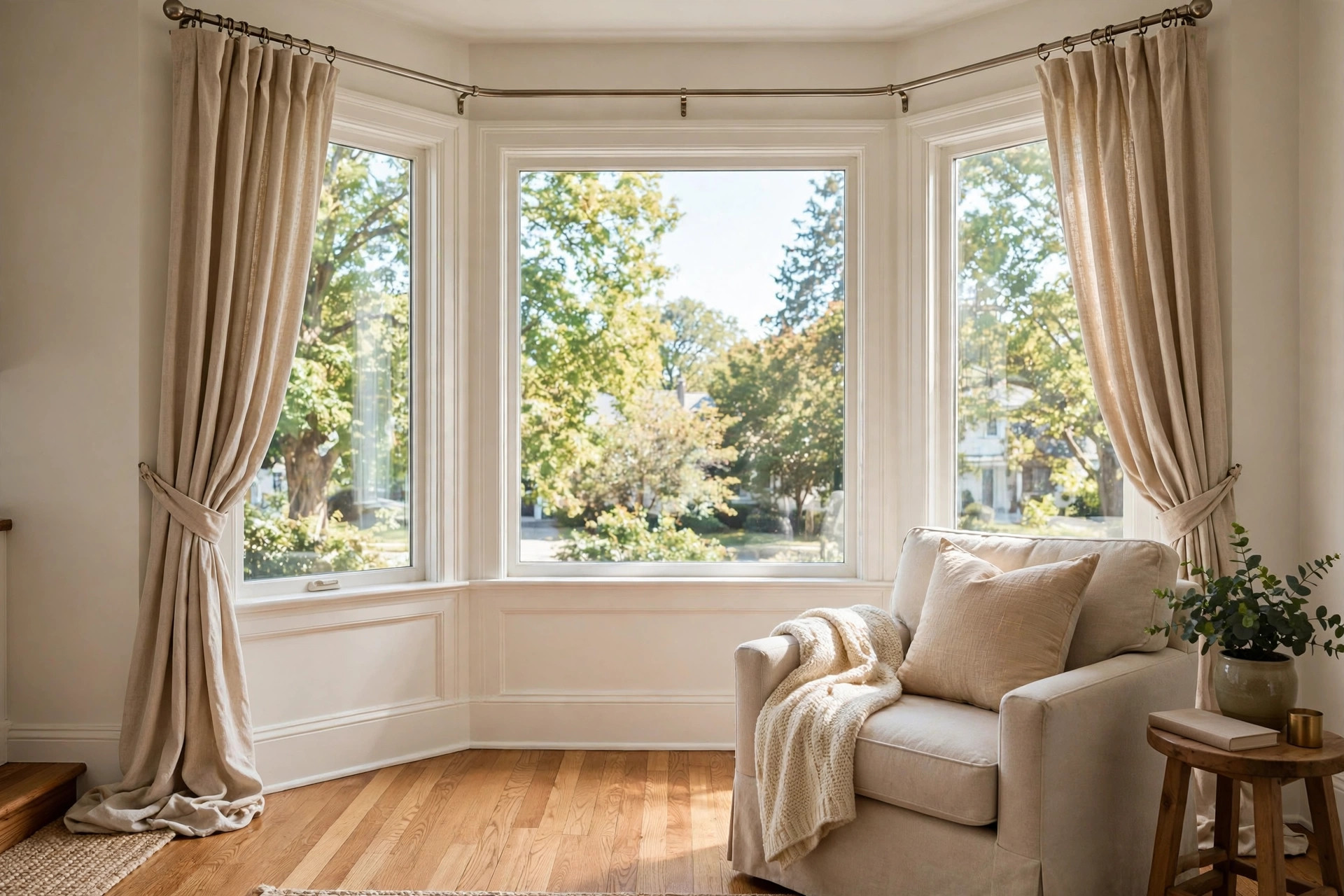

A bay window is one of the kindest gifts a house can give. It pulls light deep into the room. It gives you a place to sit with a book. It makes a small room feel larger. But dressing one with curtains is not the same as dressing a flat window. A straight rod will not bend around the corners, and three separate rods leave gaps and a cluttered look. This bay window curtain rods reviews and buying guide walks you through the choices in plain language, so you can buy with confidence and hang your curtains once, correctly.
Why Bay Window Rods Are Different
A bay window is built from three or more glass panels set at angles. The most common layout has one large center panel with two side panels angled at 135 degrees. Some homes have a curved bow window instead, where the glass arcs gently. In either case, the rod must turn the corner. If it does not, the curtains cannot draw across the full window, and the hardware shows through the gaps.
The angles create another problem. A rod that is stiff in one straight line cannot reach from one end of the bay to the other. That is why makers sell rods built for bays. They come in jointed segments, in bendable lengths, or as flexible tracks. Each type has honest strengths and honest limits. There is no perfect rod for every home. There is only the rod that fits your window, your curtains, and your budget.
Shoppers who read The Spruce often start with a simple question: should the curtains frame the bay or fill it? Framing panels that stay fixed are easy. One rod, three straight sections, panels that do not move. Filling the whole window with curtains that open and close is harder. It calls for a rod that lets the fabric glide around the corners. The choice changes which product you buy, so decide before you shop.
What to Look for When You Shop: Bay Window Curtain Rods Reviews and Buying Guide
A good rod fails in only a few ways. It sags in the middle. It droops at the joints. The rings catch on the bends. The brackets pull out of the wall. Every buying decision you make is really a decision about avoiding one of these failures. Below are the points that matter most.
Metal Strength and Rod Diameter
Diameter decides how much weight the rod can carry. A rod of one half inch in diameter suits sheer panels and light cotton. A rod of three quarters of an inch carries medium weight drapes. A rod of one inch or more handles heavy velvet, lined linen, or thermal drapes. When the curtain is heavy, choose steel over aluminum. Steel bends less under load. Many shoppers compare finishes and prices on Wayfair, where diameter and material are listed in the product details. Read those lines before you read the reviews.
Bends and Joints
The corner is the weak point of any bay rod. Jointed rods use hinged elbows or swivel sockets at each angle. These are simple to install and easy to adjust. They also create a small gap where rings must jump across the joint. Flexible track rods bend to any angle in one smooth curve, so rings glide without catching. The trade is appearance. A track looks plain and modern, while a jointed rod can carry round finials and a classic look. For homes that want both style and strength, pairing the rod with premium double curtain rod brackets for sale lets you layer a sheer panel with a heavier drape.
Length and Projection
Projection is the distance from the wall to the rod. A bay needs more projection than a flat window, because the angled side panels sit forward of the back wall. If the rod sits too close, the curtain will rub against the window frame. If it sits too far out, the rod looks detached and the curtains hang in empty space. Three to five inches of projection suits most bays. Measure your window first, and trust the tape over the product photo. Guides on IKEA and Home Depot show how to take these measurements step by step.
Types of Bay Window Curtain Rods
Shops sell four main approaches. Each one suits a different kind of bay and a different kind of curtain. Reviews posted by owners tend to agree on which approach fits which window. Here is what the market offers.
Jointed Bay Window Rods
A jointed rod ships as three or more straight pieces joined by adjustable elbows. You set each elbow to match the angle of your bay, usually between 90 and 180 degrees. This is the most common type in American stores. It looks like a normal decorative rod, with ball, cap, or square finials at each end. It suits curtains hung on rings or rod-pocket tops. The main complaint in reviews is ring trouble at the joints. Rings with a wide eye glide over the elbow more easily than tight rings.
Flexible Bendable Rods and Tracks
Some rods are made of soft metal that you bend by hand around each corner. Others are tracks made for ceiling or wall mounting that flex to the curve of the window. A track is the smoothest operator of the group. Carriers slide on wheels or hooks inside the channel, so the curtain glides around the corner without a bump. Tracks suit bow windows best, where the curve is gentle and continuous. Readers of HGTV often pair tracks with tailored valances for a finished result.
Three Separate Straight Rods
The simplest answer is to treat each window panel as its own window. You hang one straight rod above each panel. This works well for curtains that stay fixed and do not draw. It costs less than a specialty rod, and you can buy the rods anywhere, from Amazon to Lowe’s. If you use this method with where to buy rod pocket curtains in florida, choose full-coverage panels so the corner gaps read as folds, not holes.
Custom Bent Rods
A few shops will bend a rod to your exact angles and ship it as one piece. You send them your measurements, and they return a rod that fits like a key in a lock. The fit is excellent. The price is high, often three to five times the cost of a jointed rod. Shipping takes weeks, and returns are hard. Custom bent rods suit owners who want a perfect look and have measured twice. They also suit odd bays with unusual angles that off-the-shelf joints cannot match. A helpful middle path is to review a custom double curtain rod brackets buying guide before committing, since strong brackets matter more on a long single piece than on jointed segments.
How to Measure Your Bay Window
Bad measurements cause more returns than bad products. Take fifteen minutes with a steel tape and a helper. Write down every number.
First, measure each window panel across the top, from frame edge to frame edge. Add two to four inches of extra width on each side so the curtains can stack back clear of the glass. Second, measure the height from the floor to where the rod will sit. Most owners mount the rod four to six inches above the window frame. High mounting makes the window look taller. Third, measure the depth of the bay at each corner, from the back wall to the window glass. This number decides your bracket projection.
Check the angles with a simple test. Hold a straight ruler along the center panel and extend the line across the side panel. If the side panel meets the line at roughly 45 degrees, you have a standard 135-degree bay. Most jointed rods adjust to this angle out of the box. If your bay is curved or has five panels, a flexible track is usually the safer buy.
Cost and Price Guide
Prices run wide because materials and brands differ. The figures below reflect typical American retail prices in recent years.
– Jointed bay window rods: 25 to 90 dollars for a standard three-section rod in steel or aluminum. Premium finishes like brushed nickel, oil-rubbed bronze, or matte black sit at the upper end. – Flexible track kits: 30 to 120 dollars, depending on length and whether ceiling brackets are included. – Three separate straight rods: 15 to 60 dollars total for basic rods, which makes this the budget choice. – Custom bent rods: 150 to 500 dollars or more, depending on length, metal, and finish.
Curtains cost extra, and heavier curtains may force you to buy stronger brackets or an extra center support. Shipping can add to the bill for long rods, since carriers charge for length. Buy all the pieces from one store when you can. It keeps the finishes matched and saves a second shipping fee.
Installation: What to Expect
Most owners finish the job in one to two hours. The work is simple but exact. Mark the bracket positions with a pencil and a level before you drill. A crooked rod shows in a bay more than on a flat wall, because the angles multiply every error.
Wall anchors matter. Drywall alone will not hold a rod that carries heavy drapes. Use toggle bolts or screw into studs where you can. Each bracket should sit within a few inches of a joint so the corner carries its share of the weight. On a wide bay, add a center support bracket on the middle panel. It prevents the long slow sag that ruins the look after a year.
Assemble the rod on the floor first. Set the joints to your angles. Lay the whole thing against the wall to check the fit before you drill a single hole. This dry run takes ten minutes and saves most headaches.
Care and Upkeep
A bay window rod asks little of you. Dust it when you dust the room. A soft cloth keeps the finish clean. For metal rods in humid rooms, wipe them dry after cleaning so water does not sit in the joints. Check the bracket screws once a year. Houses settle, screws loosen, and a small turn of a screwdriver keeps everything tight.
Curtains need more care than rods. Wash or dry clean them on the schedule the fabric label gives. Heavy curtains stretch the rod over time, so check for sag each season.
Safety
Window hardware hangs over places where people walk and sit. A rod that falls can hurt a child or a pet. Mount every bracket into a stud or a rated anchor, and test each bracket with a firm pull before you hang the curtains.
Corded curtains carry a known danger. The Consumer Product Safety Commission warns that cords on window coverings can strangle small children. If your bay has corded blinds or corded drapes, move cribs, beds, and play areas away from the cords. Use cord cleats to wrap cords high on the wall, out of reach. Cordless curtains and wands remove the risk entirely. When children or pets use the room, cordless is the better choice every time.
Heavy drapes on a bay also test the wall. If you hang blackout curtains with thermal lining, the total weight can surprise you. Weigh one curtain on a bathroom scale before you buy the rod. Add the weight of all panels, and buy brackets rated for at least twice that total. The extra margin costs little and buys peace of mind.
Frequently Asked Questions
Can I use a normal straight rod on a bay window? No. A straight rod cannot turn the corners of a bay. The curtains would stop at each angle, leaving gaps of bare glass. Buy a rod made for bays: jointed, flexible, or a set of separate rods.
Which rod is best for curtains that open and close every day? A flexible track with gliding carriers is the smoothest choice. Rings on a jointed rod also work if the rings have a wide eye and the joints are set carefully. Test the glide before you hang the full curtains.
How far above the window should I mount the rod? Four to six inches above the frame suits most rooms. Higher mounting makes the window and the ceiling look taller. Keep the rod low enough that the curtains still cover the top of the frame.
Do bay window rods work on bow windows? Jointed rods suit angled bays better than curved bows. For a curved bow window, choose a flexible bendable track. It follows the curve in one smooth line, which a jointed rod cannot copy.
Can one person install a bay window rod alone? It is possible but awkward. A long jointed rod is heavy and springy when half assembled. A helper holds one end while you set the brackets. The job goes twice as fast with two people.
Are expensive bay window rods worth the money? Price buys stronger metal, smoother joints, and truer finishes. For light sheers, a budget rod is fine. For heavy lined drapes that you draw daily, the stronger rod pays for itself in years of trouble-free use.
The Final Word
A bay window deserves hardware that respects its shape. Measure carefully, match the rod to the weight of your curtains, and mount every bracket into something solid. Read real owner reviews before you buy, and favor products with clear measurements and honest weight ratings. With the right rod, your bay window curtains will glide around the corners, frame the light, and look as good in ten years as they do on the day you hang them.
References
Amazon. (n.d.). Online shopping. https://www.amazon.com HGTV. (n.d.). Home and garden ideas. https://www.hgtv.com IKEA. (n.d.). Home furnishings. https://www.ikea.com Lowe’s. (n.d.). Home improvement products. https://www.lowes.com The Home Depot. (n.d.). Home improvement products. https://www.homedepot.com The Spruce. (n.d.). Home and garden advice. https://www.thespruce.com U.S. Consumer Product Safety Commission. (n.d.). Product safety information. https://www.cpsc.gov Wayfair. (n.d.). Furniture and home goods. https://www.wayfair.com
Was this guide helpful?

About Emily Rodriguez
The My Garden US editorial team writes practical, in-depth home and garden guides for American homeowners — tested advice, no fluff.
You May Also Like
Reliable Blinds Installation Companies in California: A Homeowner’s Guide
May 18, 2026 0 views
The Best Decorative Window Film for Midwest Homes: A Plain Guide
June 3, 2026 0 views
How to Choose Thermal Window Film Privacy Tint with Free Shipping
April 7, 2026 0 views