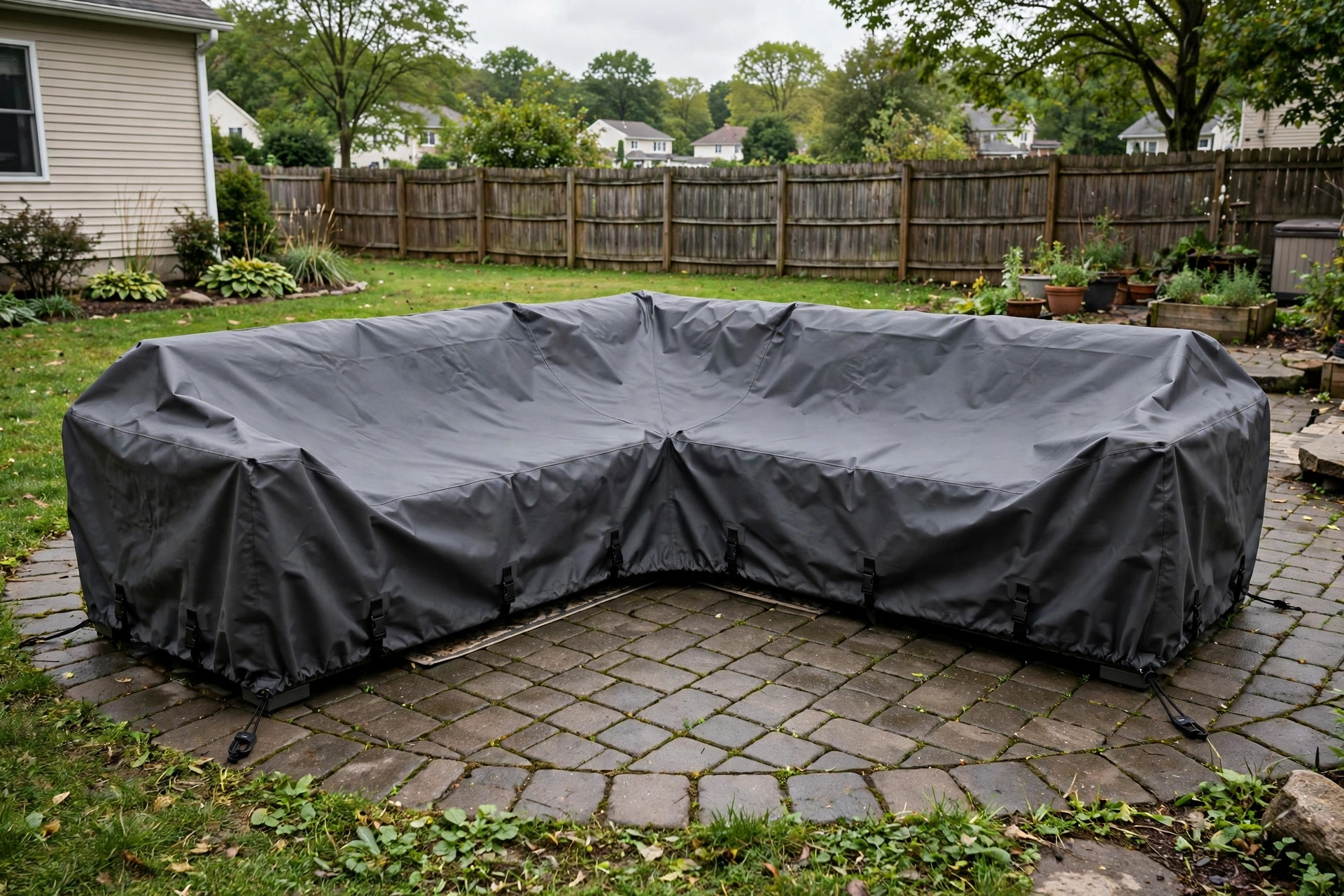
An outdoor sectional cover waterproof heavy duty fabric is one of the smartest buys for any patio. A sectional set costs a good deal of money. Rain, sun, dust, and falling leaves wear it down year by year. A strong cover stands between your furniture and the weather. It keeps cushions dry. It stops frames from rust and fade. It saves you from washing and repair work each spring.
Many covers look the same in a shop photo. They are not the same. Thin covers tear in the first season. Cheap seams let water pass through. A true heavy duty cover uses thick fabric, sealed seams, and strong ties. This guide walks through what to look for, how to pick the right size, what you can expect to pay, and how to care for your cover so it lasts for years.
Why Your Sectional Needs a Heavy Duty Cover
Outdoor furniture lives a hard life. Sun light breaks down fabric and paint. Rain soaks into cushions and wood joints. Wind drives dust and grit into every seam. In winter, snow piles up and ice forms in cracks. Small problems grow into big ones fast.
A heavy duty waterproof cover slows all of that down. It keeps rain off the frame. It blocks the sun that fades bright fabric. It stops bird droppings and tree sap from staining cushions. It keeps pollen and dust out of the weave of the chairs.
Owners who cover their sets report longer furniture life. Cushions hold their color for more seasons. Metal frames show less rust. Wicker and rattan crack less often. A cover also means less cleaning. When spring comes, you lift the cover off and the set is ready to use.
If your sectional sits near trees, a cover matters even more. Leaves trap moisture against the frame. Sap is hard to remove. A cover takes that hit instead of your furniture.
What to Look for When You Choose: Outdoor Sectional Cover Waterproof Heavy Duty
Not every cover sold as “heavy duty” earns the name. Read the fabric weight, the seam style, and the tie system before you buy.
Fabric Weight and Material
Fabric weight is given in denier or in ounces per square yard. Higher denier means a thicker thread. A true heavy duty cover is often 600 denier polyester or thicker. Light covers at 300 denier or less wear thin fast.
The most common fabric is polyester with a waterproof coating. Polyvinyl chloride (PVC) coated polyester is thick and fully waterproof. Oxford fabric with a polyurethane (PU) coating is another common choice. Solution-dyed polyester holds color well in sun.
Waterproof matters, but so does air flow. A fully sealed cover traps damp air inside. Look for covers with mesh air vents. The vents let moisture escape and stop mold from growing under the cover.
Sealed Seams
Water finds the weak point. In cheap covers the seams leak first. Good covers have taped or heat-sealed seams. The tape covers the needle holes and keeps water out. Ask whether the seams are sealed. If the listing does not say, assume they are not.
Fit, Ties, and Straps
A cover that flaps in the wind will tear. Look for covers with buckle straps that pass under the frame. A drawcord hem pulls the base tight. Some covers add elastic around the bottom edge.
Measure your sectional before you shop. Write down the length, width, and height of the whole set pushed together. Add two to four inches to each number so the cover goes on and comes off with ease. A cover that is too small will split at the seams. One that is too big will billow and let rain pool on top.
For L-shaped sectionals, note the shape. Many covers are made for a long rectangle. If your set forms an L, you may need a cover made for that shape, or two covers that overlap.
Extras Worth Having
Handles on the sides make the cover easy to put on and take off. Padded handles are a small comfort that you will thank on a cold day. Mesh vents were noted above. Some covers add click-close straps at the legs for extra hold in storms. A storage bag keeps the cover clean when it is not in use.
Types of Outdoor Sectional Covers
Covers come in a few broad types. Each suits a different buyer.
Standard rectangle covers. These fit sectionals pushed into a long line or a boxy shape. They are the most common and the easiest to find. If your sectional is made of separate pieces, you can group them into a rectangle and cover them as one unit.
L-shaped covers. These follow the bend of a corner sectional. They give a snugger fit for sets that form an L or U. They cost a bit more than standard covers.
Modular piece covers. Some owners cover each seat, corner piece, and ottoman on its own. This takes more work but gives the best fit for odd layouts. It is also easy to use one piece of the set while the rest stays covered.
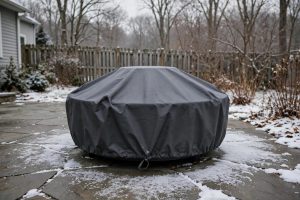
Heavy duty winter covers. These are extra thick, often with a fleece or felt lining. They are built for long cold months and heavy snow. If your winters are harsh, this is the right class.
Your climate should drive the choice. A mild coastal yard needs sun and salt protection. A snowy yard needs a thick winter cover that will not crack in the cold.
How to Measure and Fit Your Sectional
Good fit starts with a tape measure. Push the sectional into the shape it will keep all winter. Measure the full length from end to end. Measure the full width. Measure the height at the tallest point, often the back of the sofa.
Round up, not down. A cover two to four inches larger than the set is easy to secure with straps. A cover two inches too small will never close right.
Place the cover over the top first. Pull it down over the arms and the base. Clip the buckle straps under the frame. Tighten the drawcord at the hem. The cover should look smooth with no deep sags where rain can pool. If water pools, it will strain the seams over time.
Check the fit after the first hard wind. If the cover shifted, tighten the straps or add extra bungee cords. A tight cover lasts longer than a loose one.
Cost and Price: What to Expect
Heavy duty covers cost more than thin ones, and they earn it. A budget cover for a small sectional may run 30 to 60 dollars. A mid range cover in 600 denier fabric with sealed seams often runs 70 to 130 dollars. Large L-shaped or premium winter covers can run 140 to 220 dollars or more.
Price follows size and fabric weight. Brand name and extra features such as padded handles or extra vents add to the cost.
Think of the price against the furniture it protects. A sectional set often costs 800 to 3,000 dollars or more. A 100 dollar cover that adds two or three years of life to the set is a fair trade. Cheap covers that fail each year cost more over time.
Watch for sales in late summer and early fall. Retailers clear patio stock as the season ends. Big home stores carry a wide range of weatherproof patio furniture covers heavy duty options, and sites such as The Home Depot and Lowe’s often mark them down after August.
Care and Upkeep for Long Cover Life
A cover works hard. A little care keeps it working.
Clean the cover once or twice a season. Brush off leaves and dirt first. Wash with mild soap and cool water. A soft brush gets into the weave without harm. Rinse well and let it dry fully before it goes back on the furniture. Never use bleach or strong solvents. They break down waterproof coatings.
Never put a cover on wet cushions. Trap moisture and you grow mold. Let the set dry in the sun first.
In heavy snow, brush snow off the cover. A deep load of snow strains seams and straps. Do not drag sharp tools across the fabric.
When the cover is off for the season, store it clean and dry in its bag or in a large bin. Mice and insects chew fabric, so a sealed bin in a shed or garage is best.
Check straps and buckles each year. Sun weakens plastic buckles over time. Many brands sell replacement strap kits for a few dollars.
Safety Notes
Covers and furniture are safe when used with care. A few points are worth note.
Keep covers away from grills, fire pits, and heaters. Most cover fabrics will melt or catch fire near open flame. Store the cover well clear of heat sources.
Do not let children play under a large cover. A loose cover can wrap around a small child. Keep covers secured and out of reach when not on the furniture.
In very windy areas, anchor the cover well. A cover that flies off can hit windows or cars. Use all the straps the cover came with.
If you cover a set that holds a propane heater or a grill nearby, shut off fuel lines first. Covers trap gas if a valve leaks.
For general outdoor safety rules, the U.S. Consumer Product Safety Commission is a sound source.
FAQ
How long does a heavy duty waterproof sectional cover last?
Most heavy duty covers last three to five years with normal use. Sun is the main enemy. Covers in hot, sunny yards wear faster than covers in shaded spots. Cleaning the cover and storing it right stretches its life. Very thick winter covers can last five years or more.
Can I leave the cover on all year?
Yes, that is what it is made for. Many owners keep the cover on through spring and summer storms too. Take it off when you use the set and put it back on after. If you live where summers are mild and dry, you may choose to leave the set uncovered in high season.
Will the cover stop mold and mildew?
A good cover with air vents cuts mold risk a lot, but no cover is magic. Always cover dry furniture. Leave vents open. On damp days, lift the cover now and then to let air move. If mold spots appear, wash them with mild soap and water and dry the spot in the sun.
What fabric is best for a waterproof sectional cover?
PVC-coated polyester and PU-coated Oxford fabric are the most common good choices. Both shed rain well. Look for 600 denier or higher for true heavy duty use. Solution-dyed fabric holds color best in strong sun.
Do I need a cover if my sectional is already weatherproof?
Weatherproof furniture resists the weather, but it is not proof against it. Covers cut cleaning time and slow fade and wear. Even teak and powder-coated aluminum last longer under a cover. For more on wood care, see this teak patio set maintenance tips guide.
How do I stop rain from pooling on top of the cover?
A snug fit is the first fix. Tighten straps and drawcords so the top is smooth. Some owners place a beach ball or a foam block under the cover at the middle to lift the low spot. That small dome lets rain run off instead of gathering.
A Short Final Word
An outdoor sectional cover waterproof heavy duty fabric is a simple guard for a costly set. Pick a thick fabric with sealed seams and strong straps. Measure with care so the fit is snug. Keep it clean, keep it tight, and it will serve for many seasons. Your sectional will greet each spring looking much as it did the day you bought it.
If you are still planning your patio layout, you may also like this look at the best outdoor sectional sofa for small patios. For ideas on styling the space once it is covered and safe, HGTV and The Spruce both carry patio guides worth a read. Shoppers comparing brands can check test results at Consumer Reports, and Bob Vila offers plain advice on outdoor upkeep. For premium fitted options, Frontgate and Polywood are worth a look, while IKEA covers the budget end of the market.
References
Bob Vila. (n.d.). Home improvement advice. https://www.bobvila.com Consumer Reports. (n.d.). Product reviews and ratings. https://www.consumerreports.org Frontgate. (n.d.). Outdoor furniture and decor. https://www.frontgate.com HGTV. (n.d.). Home and garden ideas. https://www.hgtv.com IKEA. (n.d.). Home furnishings. https://www.ikea.com Lowe’s. (n.d.). Home improvement products. https://www.lowes.com Polywood. (n.d.). Outdoor furniture. https://www.polywood.com The Home Depot. (n.d.). Home improvement products. https://www.homedepot.com The Spruce. (n.d.). Home and garden advice. https://www.thespruce.com U.S. Consumer Product Safety Commission. (n.d.). Product safety information. https://www.cpsc.gov
Was this guide helpful?

About Michael Thompson
The My Garden US editorial team writes practical, in-depth home and garden guides for American homeowners — tested advice, no fluff.