
Introduction
Finding the most energy efficient space heater 2026 usa shoppers can rely on starts with one honest fact. No electric space heater can beat the laws of physics. Every watt that goes into a resistance heater comes out as heat. What separates an efficient model from a wasteful one is not magic. It is how the heater is sized, how it controls temperature, and how long it must run to keep a room warm.
A space heater is a tool for zone heating. You turn down the central furnace and warm only the room you use. Used this way, the most energy efficient space heater 2026 usa buyers bring home can cut winter power bills in a real and measurable way. Used badly, any heater will cost you money and give little comfort in return.
This guide walks through what efficiency means in a space heater, which types make the best use of power, what features to demand, and how to run your heater safely through a cold winter.
Why Efficiency Matters More Than Wattage: Most Energy Efficient Space Heater 2026 Usa
Most electric space heaters sold in the United States are rated at 1,500 watts. That is the standard plug-in limit for a normal household circuit. Whether a heater costs twenty dollars or two hundred, a 1,500-watt setting draws the same power.
The difference lies in how the heater uses those watts. A cheap heater with a poor thermostat clicks on and off at the wrong times. It blasts heat past the target, then shuts down and lets the room cool too far. You feel swings of hot and cold, and the meter keeps spinning.
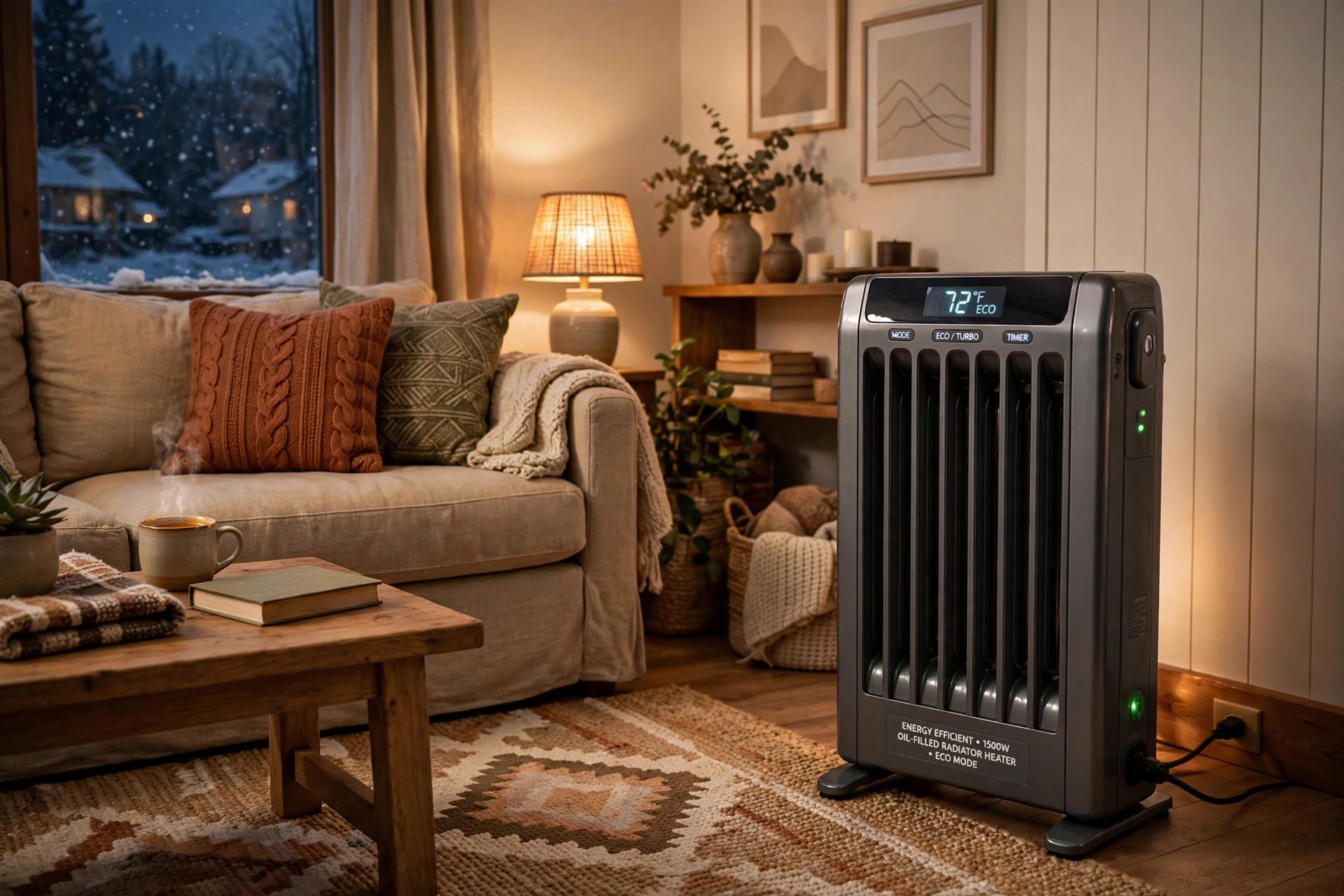
An efficient model holds the room steady. It uses a digital thermostat, a good temperature sensor, and often an ECO mode that steps the wattage down as the room warms. Some models run at 600 or 900 watts for most of the evening, sipping power instead of gulping it. Over a full season, that discipline is where the savings live.
Efficiency also comes from you, the owner. Heating a bedroom at night while the living room sits empty wastes fuel no matter which model you own. The wisest purchase is a heater matched to the room, set to the lowest comfortable temperature, and turned off when the room is empty.
The U.S. Department of Energy notes that zone heating can reduce energy use when you heat only occupied rooms rather than the whole house. A heating guide from energy.gov explains how supplemental heaters fit into a sensible winter plan.
How to Choose an Efficient Space Heater
Shopping for the most energy efficient space heater 2026 usa stores stock is easier when you check a short list of features. Look for each one before you buy.
Thermostat and temperature control
A digital thermostat with a display is the single most useful efficiency feature. It holds the room within a degree or two of your setting. Avoid models with only high, medium, and low switches and no temperature readout. They guess. A good thermostat knows.
ECO and low-watt modes
Many modern heaters offer an ECO setting that starts at high power, then drops to a low wattage once the room reaches the target. This cuts the long, wasteful cycling that drives up bills. Timer functions matter too. A heater that warms the bedroom before you arrive and shuts itself off later is cheaper than one that runs all night.
Room size rating
Buyers often pick a heater that is too strong for the room, or far too weak. A small ceramic unit is fine for a home office. A drafty den needs more body, often an oil-filled radiator or a tall tower model. If you need warmth across a large open room, read a guide to the best space heater for large room usa before choosing.
Safety certifications
Look for independent safety marks from recognized testing labs on the box. Tip-over shutoff and overheat protection are standard on decent models now. Safety information from cpsc.gov covers general product safety rules for home heating equipment.
Noise and comfort
Bedrooms and offices deserve a quiet unit. Oil-filled radiators are nearly silent because they have no fan. Ceramic heaters with fans move warm air fast, but they make a steady hum. Check noise claims with independent testers such as consumerreports.org, which rates many popular models.
Types of Space Heaters Compared
Not every design delivers heat the same way. The right type depends on the room, the people in it, and how long the heater will run.
Ceramic heaters
Ceramic heaters use a fan to blow air across hot ceramic plates. They warm a room quickly and are light enough to move from room to room. They suit offices, bathrooms, and other spaces where you want heat fast. The fan noise and the drying effect on the air are the trade-offs. For steady overnight heat, other types often feel more comfortable.
Oil-filled radiators
Oil-filled radiators look like old-fashioned radiators. Electric elements heat sealed oil, and the metal fins radiate warmth into the room. They are silent, they hold heat for a while after they shut off, and they rarely stir dust. They warm up slowly, and they are heavy to move. For long evenings in one room, they are among the most pleasant and steady options.
Infrared heaters
Infrared heaters send out radiant heat that warms people and objects directly, much like sunshine through a window. They feel good fast and lose little energy to drafts. They are a strong choice for rooms with poor insulation, workshops, and seating areas. They do not raise the air temperature as evenly as convection types, so corners of the room may stay cool.
Micathermic and panel heaters
Micathermic heaters combine radiant and convection heat in a slim panel. They warm fast, run quietly, and fit tight spaces behind doors or beside desks. Panel wall heaters in this family can even be mounted like art. They suit small rooms and apartments where floor space is short.
The head-to-head question
Many shoppers ask which of two designs wins. A fair comparison of oil filled radiator vs ceramic heater usa shows there is no single winner. Radiators win on silence and steady overnight warmth. Ceramic fan heaters win on speed and portability. Match the type to your room, not to a marketing claim.
Manufacturer learning centers, such as carrier.com and trane.com, explain the difference between heating one zone and heating a whole home, which helps put a space heater in its proper place.
Cost and Running Price
A space heater is cheap to buy and not cheap to run. The honest way to judge cost is by the kilowatt-hour.
A 1,500-watt heater draws 1.5 kilowatts each hour it runs at full power. At an electricity rate of sixteen cents per kilowatt-hour, one hour costs about twenty-four cents. Ten hours of steady full-power heating would cost roughly two dollars and forty cents. Few efficient models run at full power all day, because the thermostat throttles them down.
Here is a simple rule of thumb. Divide the wattage by one thousand to get kilowatts. Multiply by your electricity rate. Multiply by the hours the heater actually runs. That gives the daily cost. A heater on ECO mode at 750 watts for six hours at sixteen cents costs about seventy-two cents a day.
Purchase prices in 2026 run from about twenty-five dollars for a basic ceramic cube to over two hundred for a large oil-filled radiator or a feature-rich tower with app control. Mid-range models near sixty to one hundred dollars often hold the best balance of controls, safety, and build quality.
Remember the bigger picture. If running a space heater lets you drop the central thermostat by three or four degrees overnight, the whole-house furnace burns less fuel. That is the real savings story. Reviews and guides at thisoldhouse.com regularly compare whole-home heating costs with supplemental heating strategies.
Care and Upkeep
An efficient heater is a clean heater. Dust is the enemy of good airflow and good sensors.
Vacuum the intake and outlet grilles before each heating season, and once a month during heavy use. A clogged grille forces the fan to work harder and can trip the overheat sensor. Wipe the housing with a dry cloth. Never wash an electric heater with water, and never poke tools into the grilles.
Store the heater upright in a dry place during the summer. Check the power cord before each season. If the plug or cord feels hot during use, stop using the heater and replace it. A warm cord is normal. A hot cord is a warning.
Oil-filled radiators need almost no care, but inspect them for leaks or dents before each season. A damaged radiator should not be repaired at home. Ceramic and fan heaters need their filters cleaned if the maker provides one. Practical maintenance advice from familyhandyman.com covers most portable heater designs.
Safety: The Non-Negotiable Part
Heat is useful and heat is dangerous. The United States sees thousands of home heating fires each winter, and portable heaters are involved in a large share of them. Efficiency means nothing without safety.
Follow these rules every time you run a space heater.
– Give it space. Keep the heater at least three feet from bedding, curtains, papers, and furniture. – Plug it straight into the wall. Never use an extension cord or a power strip, which can overheat under a sustained load. – Put it on a hard, level floor. Never set a heater on a bed, a rug with deep pile, or a chair. – Turn it off when you leave the room or go to sleep. Use the timer instead of memory. – Keep children and pets away from the hot surfaces. – Never dry clothes on a heater, and never use a portable heater in a wet bathroom unless the maker rates it for that use.
Test smoke alarms and carbon monoxide alarms before the heating season. Keep a fire extinguisher within reach of the room where the heater runs. A solid overview of space heater safety tips for usa homes is worth reading before your first cold snap.
Frequently Asked Questions
Are space heaters actually energy efficient?
Electric resistance heaters convert nearly all the electricity they use into heat, so none is wasted in the conversion. True efficiency comes from controls and habits. A model with a good thermostat, ECO mode, and a timer wastes less energy than a basic model, because it runs fewer hours and at lower wattage.
What wattage should I buy for my room?
A rough guide is ten watts of heating power per square foot in a reasonably insulated room. A 150-square-foot bedroom needs about 1,500 watts. A small office of 100 square feet does well with 750 to 1,000 watts. Drafty rooms with high ceilings need the higher end of the range.
Is an oil-filled radiator cheaper to run than a ceramic heater?
At the same wattage, both use the same electricity. The radiator often feels cheaper to run because it cycles less and radiates warmth evenly, so many owners run it at a lower setting. The ceramic heater wins when you want a room warm in five minutes. Compare the two designs side by side with oil filled radiator vs ceramic heater usa before deciding.
Can a space heater lower my heating bill?
It can, when it replaces whole-house heating. Lower the central thermostat and warm only the rooms you use. Heating an empty house all day with the furnace while a space heater runs too will raise the bill. The savings come from zone heating, not from the heater alone.
Are smart features worth paying for?
Wi-Fi control, app scheduling, and voice control are genuinely useful for people with set routines. A heater that warms the home office at eight in the morning and shuts down at six, by itself, saves real money. If you will never open the app, buy the simpler model and spend the difference on insulation.
How long should a good space heater last?
A well-made portable heater usually lasts five to eight years with basic care. Fan motors wear out first on ceramic models. Oil-filled radiators often last longer because they have fewer moving parts. Replace any heater with a damaged cord, a cracked housing, or a thermostat that no longer holds temperature.
A Final Word
The most energy efficient space heater 2026 usa buyers can choose is not one magic model. It is the right type for the room, sized correctly, with a real thermostat and honest safety features, run with discipline. Heat only the rooms you use. Set the lowest comfortable temperature. Let timers do the remembering.
For more context on home heating systems, brand-neutral explainers from lennox.com, rheem.com, and goodmanmfg.com describe how central equipment and supplemental heat work together. Shoppers comparing energy labels should also check energystar.gov, which explains how efficiency ratings apply to heating equipment sold in the United States.
Buy once, buy well, and keep the heater clean. Winter is long enough without surprises on the power bill.
References
Carrier. (n.d.). Heating and cooling systems. https://www.carrier.com Consumer Reports. (n.d.). Product reviews and ratings. https://www.consumerreports.org ENERGY STAR. (n.d.). Energy efficient products. https://www.energystar.gov Family Handyman. (n.d.). DIY home repair and maintenance. https://www.familyhandyman.com Goodman. (n.d.). Heating and cooling equipment. https://www.goodmanmfg.com Lennox. (n.d.). Heating and cooling systems. https://www.lennox.com Rheem. (n.d.). Heating, cooling, and water heating. https://www.rheem.com This Old House. (n.d.). Home renovation guidance. https://www.thisoldhouse.com Trane. (n.d.). Heating and air conditioning. https://www.trane.com U.S. Consumer Product Safety Commission. (n.d.). Product safety information. https://www.cpsc.gov U.S. Department of Energy. (n.d.). Energy efficiency and renewable energy. https://www.energy.gov
Was this guide helpful?

About James Carter
The My Garden US editorial team writes practical, in-depth home and garden guides for American homeowners — tested advice, no fluff.
You May Also Like

Geothermal Heating Pros and Cons USA Homeowners Should Know
August 23, 2026 0 views
HVAC Tax Credits 2026 for Homeowners USA: What You Can Claim and How
May 17, 2026 0 views
16 vs 18 SEER AC Cost Difference USA: What Homeowners Pay
January 31, 2026 0 views