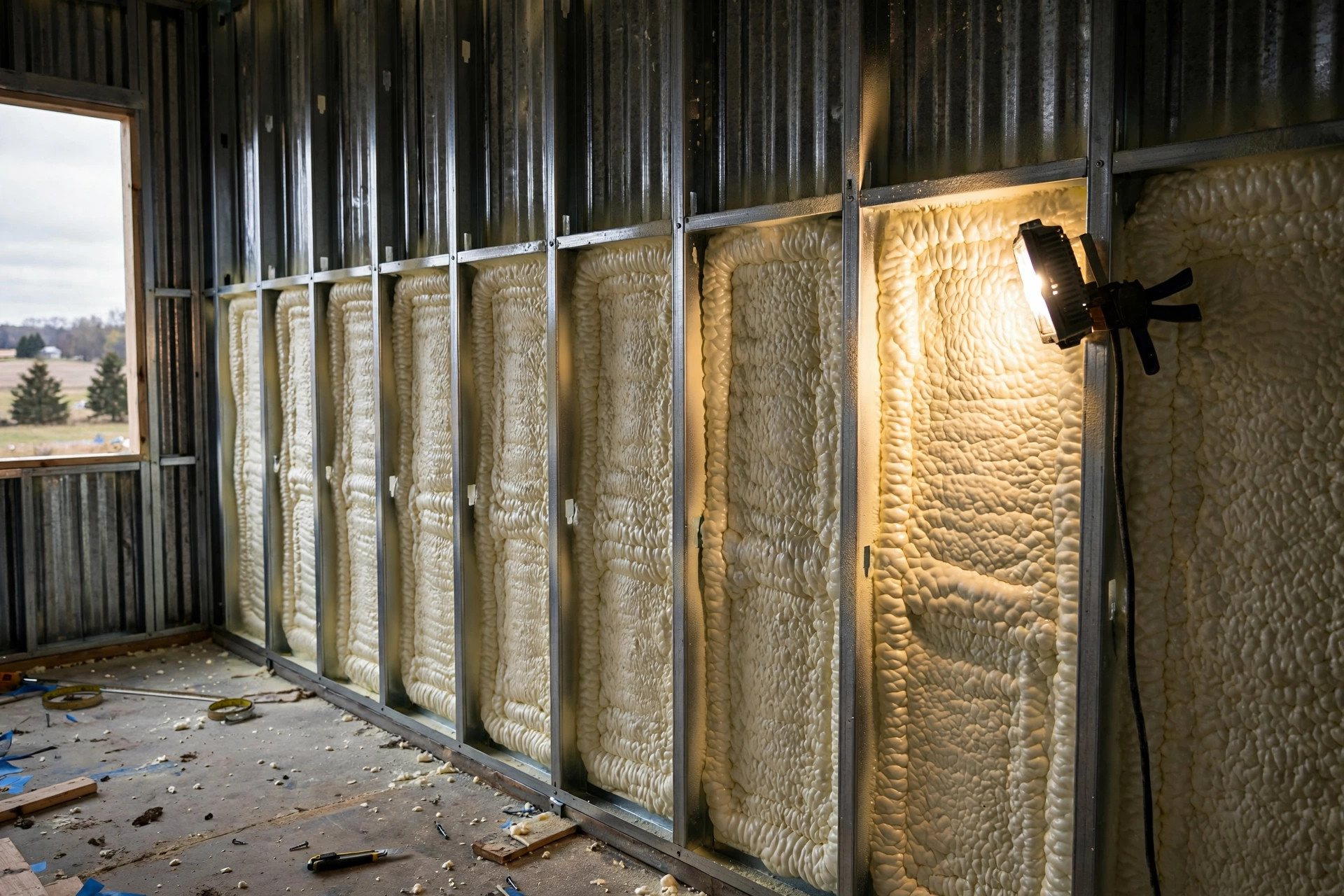

A barndominium looks like a barn on the outside and feels like a home on the inside. The steel shell is strong and fast to build. It is also a poor barrier against heat and cold. That is why barndominium insulation options and costs usa buyers ask about matter so much. Insulation decides whether the home stays warm in January and cool in July. It also decides whether the heating bill stays low or climbs every month. This guide explains the main options in plain terms, with real price ranges and tips for picking the right system for a metal building in any part of the country.
Why Insulation Matters in a Barndominium
A barndominium is built from steel posts, steel girts, and steel purlins. The outer skin is a metal panel. Metal moves heat very fast. In summer, the sun heats the roof panels, and the heat passes straight through into the living space. In winter, the reverse happens. Warm air inside touches the cold metal, and the heat escapes. An ordinary wood-frame house has wood studs and sheathing that slow heat a little. A barndominium has almost none of that natural slowdown.
The second problem is moisture. Warm indoor air carries water vapor. When that air touches a cold steel panel, the vapor turns into liquid water. This is called condensation. Over time, condensation drips onto wood framing, rusts metal, and feeds mold. Good insulation, paired with a vapor barrier, keeps the warm air away from the cold steel. That is the real job of insulation in a metal building. It is not just comfort. It is protection of the structure itself.
The third reason is noise. Rain on a metal roof is loud. Many owners are surprised by how loud it is the first time a storm hits. Insulation and interior walls cut that sound down to a level most people find easy to live with.
What to Look For When You Choose: Barndominium Insulation Options and Costs Usa
Start with the R-value. R-value measures how well a material resists heat flow. A higher number means better resistance. The United States Department of Energy publishes maps that show the R-value homes need in each climate zone. A home in Florida needs less than a home in Minnesota. Check the zone for your county before you buy anything. The guidance at Energy Star is a good place to begin your reading on home energy use.
Next, think about the vapor barrier. In most barndominiums, insulation must include a way to stop moisture from reaching the steel. Some products have a built-in barrier. Others need a separate sheet of plastic or a special paint. Your contractor should explain the plan for moisture before the first panel goes in.
Also ask about the shape of the building. Many barndominiums have tall ceilings, wide open rooms, and large sliding doors. Tall spaces hold heat near the roof. Big doors leak air. The insulation plan should cover the walls, the roof or ceiling, the doors, and the concrete slab edge. A plan that covers only the walls is not complete.
Finally, think about the long term. Some insulation settles over the years. Some sags. Some stays firm for decades. Ask the installer what the material looks like after ten years in a metal building. The U.S. Department of Energy site offers plain facts on how different materials age.
Types and Options
Spray Foam Insulation
Spray foam is the most common choice for barndominiums. It is sprayed as a liquid and grows to fill every gap. There are two kinds. Open-cell foam is soft and light. It costs less. Closed-cell foam is hard and dense. It costs more but gives a higher R-value per inch. Closed-cell foam also acts as its own vapor barrier. That is a large advantage in a metal building. For many owners, closed-cell foam on the roof and walls is the simplest full solution. It also stiffens the structure slightly. The drawback is the price. It is the most expensive common option. It also must be installed by a trained crew with the right safety gear.
Fiberglass Batt Insulation
Fiberglass batts are the pink or yellow rolls sold in every home store. They are cheap and easy to find. In a barndominium, batts are usually placed between the horizontal girts and then covered with a liner panel. A vapor barrier sheet must go on the warm side. Batts work fine in mild climates. They are less ideal in very cold or very humid places. The reason is air movement. Batts leave small gaps around wiring and pipes. Air moves through those gaps and carries moisture with it. They can also sag over time if they get wet.
Rigid Foam Board
Rigid foam boards are stiff panels of polystyrene or polyisocyanurate. They are cut to fit and placed against the steel panels before the interior finish goes up. Boards give a steady R-value and do not sag. Many builders use two layers with staggered seams to block air leaks. The seams must be taped. Boards are a middle choice in both price and performance. They pair well with a separate vapor barrier. They take more labor to fit around steel bracing than spray foam does.
Reflective and Radiant Barrier Insulation
A radiant barrier is a thin sheet with a shiny foil face. It reflects heat rather than slowing it. In hot southern states, a radiant barrier under the roof can cut summer heat gain in a real way. It does not replace other insulation. It works best as an extra layer. Some metal roofing systems come with a radiant barrier already attached to the back of the panel. Ask your builder whether your roof panels include it.
Blown-In and Loose-Fill Insulation
Blown-in cellulose or fiberglass is common in flat attic spaces. Some barndominiums have a framed ceiling with an attic above it. In that design, blown-in insulation works well and costs little. It is not a good fit for the sloped metal roof of a true open barndominium, because there is no flat cavity to hold it. Use it only where a flat ceiling exists.
Mineral Wool
Mineral wool is made from rock or slag. It resists fire well and blocks sound better than fiberglass. It costs more than fiberglass but less than spray foam. It handles moisture better than fiberglass, since it does not hold water in the same way. It is a solid middle option for walls, especially for owners who worry about fire safety near a shop or garage bay attached to the home.
Cost and Price
Prices change by region, crew, and building size. The ranges below cover most of the United States in 2026 and are meant for planning, not as quotes.
Spray foam is the priciest. Open-cell foam usually runs from about $1.00 to $1.80 per square foot of installed surface for a standard thickness. Closed-cell foam usually runs from about $1.80 to $3.50 per square foot. A 2,000 square foot barndominium with tall walls can need 4,000 to 6,000 square feet of insulated surface once walls and roof are counted. That puts a full closed-cell job in the range of $8,000 to $20,000 in many markets. Complex rooflines and far travel for the crew push the number higher.
Fiberglass batts are the cheapest. Material and labor often land between $0.50 and $1.20 per square foot. The same building might cost $2,500 to $6,000. The vapor barrier and liner panels add to the total. Many owners forget to include the liner in the budget. Without a liner, the batts and the barrier stay exposed, which looks unfinished and can be damaged.
Rigid foam board usually lands between $1.00 and $2.50 per square foot installed, depending on thickness and how many layers are used. Tape, fasteners, and trim add cost. Blown-in attic insulation is often $1.00 to $2.00 per square foot. Mineral wool runs near $1.00 to $2.00 per square foot installed.
A radiant barrier adds roughly $0.30 to $0.80 per square foot when added under the roof. Some builders include it in the roof package at a lower added cost.
Do not judge the job by the first price alone. A cheap job that lets moisture reach the steel can cause rust and mold that cost far more to fix. Ask each bidder to put the R-value, the vapor barrier plan, and the covered areas in writing. Then compare the bids line by line. Guides from This Old House and Family Handyman show what a careful bid should spell out.
One more cost note. Insulation works together with heating and cooling. A well-insulated barndominium can use a smaller system. If you are still sizing your equipment, read our comparison of heat pump vs furnace cost comparison usa and our look at the best mini split for cold climates reviews usa. The right system for a tight steel building may differ from the right system for a wood house.
Care and Upkeep
Good insulation needs little care, but it is not care-free. Once a year, walk the building and look for stains on the interior liner or ceiling. A brown ring often means water is getting in. Check around roof screws and trim. Metal buildings move slightly with temperature, and fasteners can loosen over years.
Keep the inside humidity in a normal range. Aim for 30 to 50 percent in most seasons. If the air stays damp, run a dehumidifier or improve ventilation. Constant damp air will test any insulation system.
Do not hang heavy items from the liner without knowing what sits behind it. A screw driven into a foam board or a batt can open a path for air. Use the steel framing members for anchors. If you must cut into a wall for a new vent or wire, seal the opening again when you finish. Small air leaks undo the work of good insulation.
Wet fiberglass and wet cellulose lose most of their R-value. Closed-cell foam handles brief wetting better, but standing water still needs to be dried out.
Safety
Spray foam chemicals are safe once cured, but the spray process is not a do-it-yourself job. The crew must wear respirators and full suits. The home must stay empty during spraying and for the curing time the maker states, often about a day. Keep pets out too.
Fiberglass and mineral wool fibers irritate skin, eyes, and lungs during handling. Wear gloves, long sleeves, eye protection, and a dust mask rated for fine particles. Work in fresh air when you can.
Any insulation near heat sources needs care. Keep insulation away from recessed lights unless the lights are rated for direct contact. Keep it away from flue pipes and wood stoves by the distance the stove maker requires. Mineral wool and foam boards have different fire ratings, so check the label for each product you use.
Finally, check local building codes before work starts. Many counties now require a permit and an inspection for insulation in a dwelling. The code will state the minimum R-value for your zone. Meeting the code is not just a legal matter. It is also the floor for comfort and energy savings.
Frequently Asked Questions
What is the best insulation for a barndominium?
There is no single best choice for every building. Closed-cell spray foam is the most complete answer for most metal barndominiums because it insulates, seals air, and blocks vapor in one step. It costs the most. In mild climates, fiberglass batts with a good vapor barrier give fair results for much less money. The best choice depends on your climate zone, your budget, and how the building is framed.
How much does it cost to insulate a barndominium in the USA?
For a typical 2,000 square foot barndominium, full insulation often costs between $2,500 and $20,000. Fiberglass batts sit at the low end. Closed-cell spray foam sits at the high end. Rigid board, mineral wool, and blown-in options fall in the middle. Roof shape, wall height, and local labor rates move the number up or down. Always get the vapor barrier and liner panels included in the written quote.
Do I need a vapor barrier in a metal barndominium?
In almost all cases, yes. Warm indoor air will find the cold steel and leave water behind. That water causes rust, mold, and damage. Closed-cell spray foam forms its own barrier. Other systems need a separate sheet, coating, or foil facing on the warm side of the insulation. A builder who says the barrier is not needed should explain exactly why, in writing.
Can I insulate a barndominium myself?
Some parts are suited to a careful owner. Fiberglass batts, rigid boards, and radiant barriers can be owner-installed with study and the right safety gear. Spray foam should be left to a trained crew. Blown-in insulation needs a rental machine but is within reach of many owners for a flat attic. A poor install wastes the material and can trap moisture.
How does insulation affect heating and cooling costs?
A well-insulated barndominium can cut heating and cooling bills by a third or more compared with a bare steel shell. The building holds its temperature longer, so the system runs fewer hours. It also lets you buy smaller equipment. If you plan to add attic ventilation as well, see our note on attic fan installation cost near me for how the two upgrades work together. Equipment makers such as Carrier, Trane, Lennox, Rheem, and Goodman all publish sizing guidance that assumes a properly insulated shell.
A Final Word
A barndominium rewards good planning. Pick a system that fits your climate. Insist on a clear vapor barrier plan. Get the price in writing with every layer named. Done right, the building stays quiet, dry, and comfortable for decades.
References
Carrier. (n.d.). Heating and cooling systems. https://www.carrier.com ENERGY STAR. (n.d.). Energy efficient products. https://www.energystar.gov Family Handyman. (n.d.). DIY home repair and maintenance. https://www.familyhandyman.com Goodman. (n.d.). Heating and cooling equipment. https://www.goodmanmfg.com Lennox. (n.d.). Heating and cooling systems. https://www.lennox.com Rheem. (n.d.). Heating, cooling, and water heating. https://www.rheem.com This Old House. (n.d.). Home renovation guidance. https://www.thisoldhouse.com Trane. (n.d.). Heating and air conditioning. https://www.trane.com U.S. Department of Energy. (n.d.). Energy efficiency and renewable energy. https://www.energy.gov
Was this guide helpful?

About James Carter
The My Garden US editorial team writes practical, in-depth home and garden guides for American homeowners — tested advice, no fluff.
You May Also Like

WiFi Thermostat for Vacation Home Reviews USA: A Plain Guide
January 28, 2026 0 views
Rigid Foam Insulation for Basement Walls USA: A Plain Guide
September 15, 2026 0 views
Best Garage Heater for Winter Reviews USA: A Practical Guide to Warmth
September 16, 2026 0 views