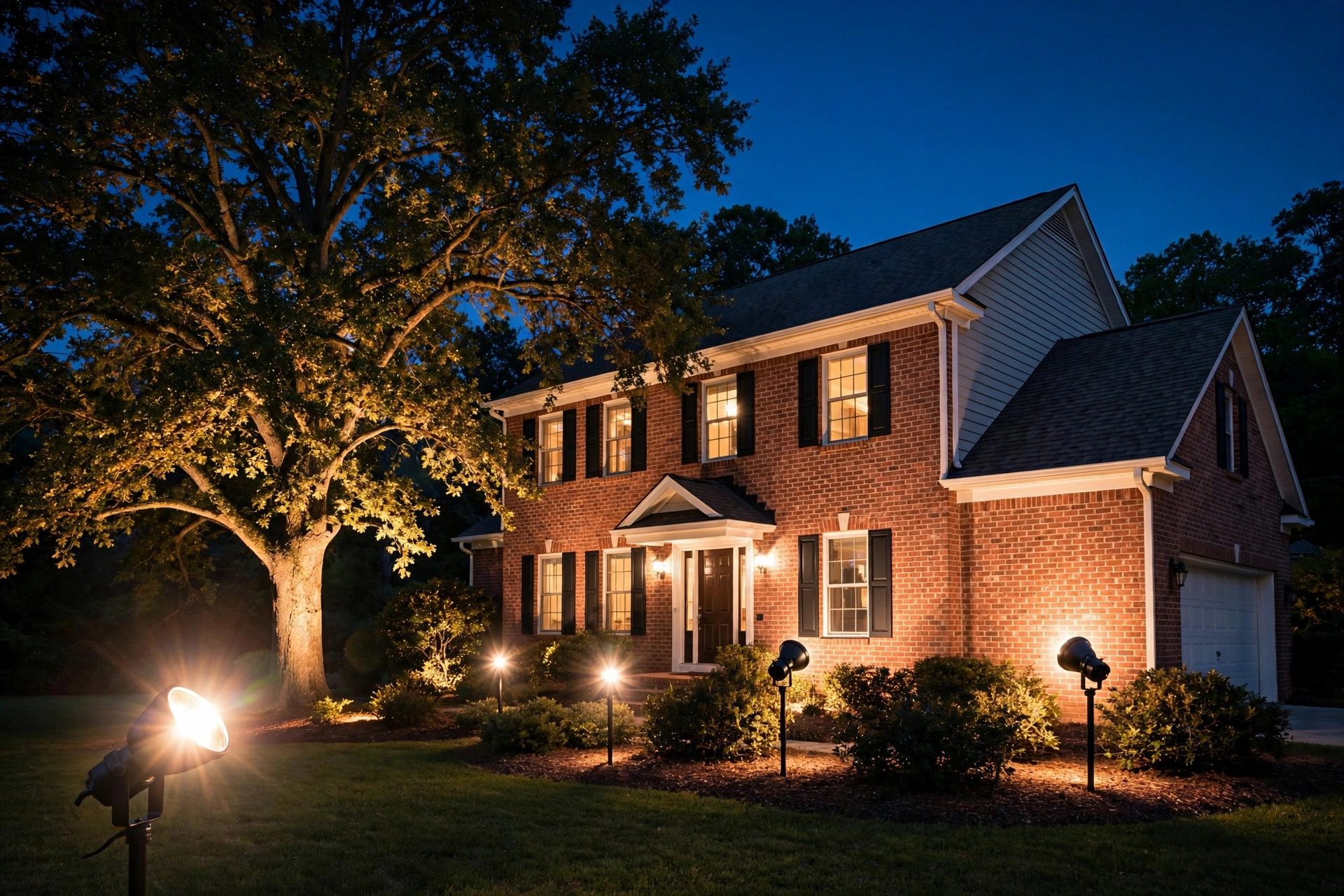
This landscape spot lights american homes guide starts with a simple fact. A good yard does not go to sleep when the sun goes down. With the right lights, the same lawn, the same trees, and the same front door look fine long after dark. A spot light is one of the best tools for the job. It throws a tight, bright beam that can lift a tree out of the dark, wash a wall with light, or mark the path to the door. This guide explains how these lights work, how to pick them, where to put them, what they cost, and how to keep them working for years.
Why Landscape Spot Lights Matter
A yard with no light after dark is a wasted yard. The owner paid for the lawn, the plants, and the stone work. At night all of it disappears. A few well-placed spot lights bring it back. They also do real work. Steps and paths get safer when they are lit. A bright front yard can make an intruder think twice.
Spot lights differ from other yard lights. motion flood lights throw a wide blast of light for security. Path lights mark walkways with a soft pool of glow. A spot light is a narrow beam aimed at one thing: a tall tree, a flag, a garden statue, or the face of the house. That focus is what gives the night yard its shape. The rest of the yard stays dark, and the lit spots stand out.
How to Choose the Right Spot Lights: Landscape Spot Lights American Homes Guide
Know what you want to light
Start by walking the yard at night with a flashlight. Aim the beam at a tree, then at the house wall, then at a bush by the door. What looks best lit? Most homes do well with three to six spots. One aimed up into a large tree is a classic choice. One or two washing the front of the house give the home a finished look. One more near the entrance adds a warm welcome.
Look for key features
Modern landscape spot lights are almost all LED. They use far less power than the old halogen bulbs and they last much longer. When shopping, check four things.
First, brightness. It is measured in lumens. For a small bush, 200 to 400 lumens is plenty. For a large tree or the side of a two-story home, 700 to 1,000 lumens works better. More is not always better. A light that is too strong will bleach the color out of the leaves.
Second, beam angle. Spot lights come in narrow beams, around 15 to 30 degrees, and wider floods, around 40 to 60 degrees. Narrow beams reach high into trees. Wider beams wash walls and wide bushes.
Third, color temperature. Warm white, near 2700K, looks like firelight and suits most homes. Cool white, near 5000K, looks like daylight and can feel harsh on a front yard. Most buyers pick warm white for plants and home fronts.
Fourth, power type. Low voltage wired systems run on a 12-volt transformer plugged into an outside outlet. They are steady and dependable. Solar spot lights carry their own panel and battery. They need no wire but they give less light and fade on cloudy days. For a home that is lit every night, a wired set is the surer pick. Shoppers looking at solar path lights deals near me will find many solar choices, but solar works best for soft path lighting, not for the strong beam a spot light needs.
Check the housing and finish
Yard lights live in rain, snow, and sprinkler spray. Look for a housing made of solid metal, such as brass or aluminum, and a lens of real glass. Cheap plastic shells crack in the sun and let water in. Also check the water rating. A mark of IP65 or better means the fixture stands up to rain and hose spray. A stake that pushes into the soil should feel strong in the hand, not thin and hollow.
Types of Landscape Spot Lights
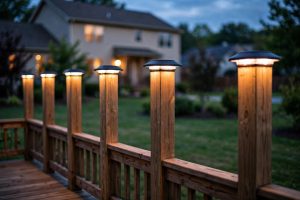
Spot lights come in a few common forms. Stake-mounted spots are the most common: a sharp stake pushes into the soil, and the head can tilt to aim the beam. They are easy to move when the yard changes. Surface-mounted spots bolt to a deck, a fence post, or a low wall. Well lights sit in a can set flush with the ground and shoot straight up; they hide well in lawns but cost more and take more work to install.
Accent spots with adjustable heads. Some fixtures let the user change both the aim and the beam width. One adjustable light can do the work of two fixed ones.
Most yards do fine with simple stake-mounted spots on a low-voltage wire. If the goal is a smart yard, see how deck cap lights pair with spot lights on the same transformer.
Where to Place Spot Lights for the Best Look
Placement is where good lighting is won or lost. A few rules from long practice will help.
Light from the front, not from behind. Stand where people will see the yard, usually the street or the walkway. Place the light between you and the object you want to light. A tree lit from the front shows its shape. A tree lit from behind becomes a flat black shape with a bright edge.
Aim up, but not into eyes. Spot lights aimed up into trees are the classic look. Keep the fixture far enough back that a person walking by does not stare into the beam. Six to ten feet back from the tree trunk is a good start.
Graze the wall. To light the front of the house, place the spot close to the wall, about one foot out, and aim the beam up across the surface. This raking light brings out the texture of brick, stone, or siding. Do not aim straight at windows. Light spilling into a bedroom will not please anyone.
Mix heights. Light the top of a tall tree and also light a low bush near the door. The eye moves from high to low, and the yard feels deep.
Keep the night sky in mind. Aim beams down or at the tree, never straight up into the sky. Straight-up beams waste light and add to the glow that hides the stars. Groups that study night light, such as the dark-sky advocates, ask homeowners to shield lights and aim them only where the light is needed. More on this can be found through the work of the International Dark-Sky Association.
Try it before you dig. Set the lights on the ground, run the wire over the lawn for one night, and look at the result from the street. Move anything that looks wrong. Only then bury the wire.
Cost and Price
Landscape spot lights cover a wide price range. A basic LED stake spot at a home center costs about fifteen to thirty dollars. Better brass fixtures cost forty to eighty dollars each. Top-end solid brass or copper spots can run over one hundred dollars per fixture.
The transformer is the other main cost. A small 60-watt transformer that runs six to eight lights costs about fifty to ninety dollars. A larger one for a big yard can cost two hundred dollars or more. Wire is cheap, a few cents per foot, and connectors cost a few dollars for a pack.
A small do-it-yourself setup of five spots with a transformer and wire often totals two hundred to four hundred dollars. A large yard with twenty fixtures, better housing, and a pro installer can run one thousand to three thousand dollars or more.
Running costs are low. LED spot lights draw only a few watts each. A whole set may cost less than a dollar a month in power on most utility bills. The federal ENERGY STAR program lists outdoor fixtures that meet set efficiency marks, and the Department of Energy publishes guides on choosing efficient lighting for the home.
When comparing prices, check the big-box stores and the specialty lighting sites together. Home Depot and Lowe’s carry the main brands in store and online. Lamps Plus and Lumens carry wider ranges of styles and finishes. Prices for the same brand can differ by a fair amount from one seller to the next.
Care and Upkeep
Spot lights need little care, but they do need some. A little work each year keeps them shining for a long time.
Clean the lens. Dirt, pollen, and sprinkler mineral crust build up on the lens and dim the beam. Twice a year, wipe each lens with a soft cloth and a bit of soapy water. Rinse it clean. The light will look new again.
Trim the plants. Bushes grow over fixtures. A light hidden behind leaves throws a strange shadow. Once or twice a season, cut back the growth around each fixture.
Check the wire. Low-voltage wire lies just under the mulch or soil. Rakes and edgers can nick it. If one light goes dark, check the wire for cuts and the connectors for green corrosion. Most problems come from a loose connector, and a fresh connector costs less than a dollar.
Check the aim. Soil shifts and mowers bump stakes. Once a year, walk the yard at night and look. Straighten any fixture that has tipped, and re-aim any beam that now hits the wrong spot.
Protect in winter. In cold states, snow and ice can crush fixtures. Mark their spots with small flags before the first snow so the shovel and the snowblower miss them.
Safety
Landscape spot lights run on low voltage, twelve volts, which is far safer than house wiring. Still, a few safety steps matter.
Use a proper transformer. Buy a transformer listed for outdoor low-voltage lighting. It must be plugged into a GFCI-protected outlet, the kind with the test and reset buttons. If the outlet is not GFCI, an electrician can change it in a few minutes.
Bury wire at a safe depth. Wire should lie at least six inches under the soil or mulch, and deeper where people dig. Keep the wire away from the path of edgers.
Keep water away from the transformer. Mount it on the wall above ground, under an eave if possible, where rain and sprinkler spray do not hit it day after day.
Do not overload the circuit. Add up the watts of all fixtures on one transformer. The total should stay below the transformer rating, and most installers leave a margin of twenty percent or more. A 150-watt transformer should carry no more than about 120 watts of lights.
Call a pro when in doubt. Running a new outdoor outlet, trenching under a driveway, or wiring a smart hub is work for a licensed electrician.
Frequently Asked Questions
How many spot lights does an average front yard need? Most average front yards look best with three to six spot lights. Light the front of the house with one or two, light one or two trees or large bushes, and put one near the entry. More lights do not always look better. Start with a few and add more only if the yard still looks dark.
Can I install landscape spot lights myself? Yes, in most cases. Low-voltage systems are made for do-it-yourself work. The wire plugs into the transformer, and the transformer plugs into an outdoor outlet. No high-voltage wiring is needed. If the job needs a new outdoor outlet or runs under a driveway, hire an electrician.
Are solar spot lights as good as wired ones? Wired lights give a stronger, steadier beam and light up every night, rain or shine. Solar lights need no wire and are easier to place, but they dim on cloudy days and in shade. For the strong beam a spot light needs, wired is the better choice in most yards.
What color light is best for a home’s exterior? Warm white, around 2700K to 3000K, suits most American homes. It flatters brick, stone, wood, and plants. Cool white can make a house look stark and is better saved for work areas such as driveways and garages.
How long do LED spot lights last? The LED itself often lasts 25,000 to 50,000 hours, which can mean ten to twenty years of nightly use. The fixture body may fail sooner in harsh sun or salt air. Brass and copper housings last longest. When one light dies early, the wire or connector is often the real cause, not the bulb.
Do spot lights use a lot of electricity? No. A typical LED spot light draws four to seven watts. Six of them running eight hours a night use about as much power as one old 60-watt porch bulb. The monthly cost is usually well under a dollar on most American utility bills. For product ratings and maker details, Philips publishes full spec sheets for its outdoor LED line.
A Final Word
A yard lit with care looks fine from the street and feels safe to walk through. The work is simple: pick good fixtures, aim them with thought, and give them a little care each year. Ideas and how-to guides at The Spruce can help with placement ideas for any style of home. This landscape spot lights american homes guide ends where it began. Walk your yard at night, flashlight in hand, and see what deserves to be lit. Then light it.
References
ENERGY STAR. (n.d.). Energy efficient products. https://www.energystar.gov International Dark-Sky Association. (n.d.). Dark sky. https://www.darksky.org Lamps Plus. (n.d.). Lighting and home decor. https://www.lampsplus.com Lowe’s. (n.d.). Home improvement products. https://www.lowes.com Lumens. (n.d.). Lighting and ceiling fans. https://www.lumens.com Philips. (n.d.). Lighting products. https://www.philips.com The Home Depot. (n.d.). Home improvement products. https://www.homedepot.com The Spruce. (n.d.). Home and garden advice. https://www.thespruce.com U.S. Department of Energy. (n.d.). Energy efficiency and renewable energy. https://www.energy.gov
Was this guide helpful?

About Sarah Mitchell
The My Garden US editorial team writes practical, in-depth home and garden guides for American homeowners — tested advice, no fluff.