Stepping onto a cold tile floor on a winter morning is one of the small pains of home life. For this reason, more Americans are shopping for heated floor kits USA online deals, and they are finding warm floors at prices far below what a contractor would charge. A heated floor kit is a set of electric heating wires, mats, or cables that go under tile, stone, or engineered wood. A thermostat controls the heat. The result is a floor that feels warm under bare feet. These kits have grown popular because they are simple to order, simple to ship, and simple for a skilled do-it-yourselfer to install. As HGTV project guides often note, a warm tile floor changes how a bathroom feels each morning.
The appeal of online deals is plain. A homeowner can compare several kits, read reviews, and buy at a sale price without leaving the house. Still, a low price means little if the kit does not fit the room or match the floor type. This guide walks through what heated floor kits are, what to look for, the main types, honest cost ranges, care, and safety. It ends with answers to common questions and a list of sources for further reading.
Why Heated Floors Matter
Tile and stone floors look fine and last for decades, but they pull heat away from the feet. In a bathroom, where people walk barefoot every day, that cold surface can be more than a nuisance. Warm floors raise comfort in a direct way. Radiant heat rises from the floor and warms the room evenly, from the toes up. Many owners report that they run their bathroom heater less once the floor itself is heated.
There is also a quiet benefit. A floor that stays a few degrees warmer dries faster after a shower. Water spots and damp grout get less time to sit. Less dampness can mean less mildew. For a family that uses the bathroom several times a day, that is real value.
Energy use is smaller than most people guess. Electric floor heat usually draws 10 to 15 watts per square foot while it is on. A 40-square-foot bathroom mat therefore draws about what four or five old-style light bulbs draw. Because the mat only heats the floor zone and cycles off once the floor is warm, the monthly cost is often just a few dollars. The heating and energy resources at ENERGY STAR offer useful background on home heating efficiency in general.
What to Look for When You Buy: Heated Floor Kits Usa Online Deals
Shopping for heated floor kits online means sorting through claims, so a short checklist helps. First, match the kit to the floor covering. Almost every electric mat kit is made for tile, stone, or porcelain. Some also work under engineered wood or luxury vinyl, but the temperature limits differ. Read the product sheet and confirm your floor type.
Second, measure the room with care. Measure the floor area and then subtract the space taken by the vanity, toilet, and tub. Heating wire should never run under fixed cabinets or heavy fixtures. Many kits come in fixed mat sizes, such as 20, 30, or 40 square feet. Pick a mat that covers the open walking area with a little room to spare. Buying too large a mat forces awkward cuts, and most mats cannot be trimmed to length except at marked cut points on the mesh.
Third, check the voltage. Most American homes use 120-volt circuits. Some larger kits, built for rooms above 100 square feet, run on 240 volts. The kit voltage must match the circuit it will connect to. If the home panel is full or the wire run is long, a licensed electrician should weigh in before purchase.
Fourth, look at the thermostat. A basic model turns heat on and off by floor temperature. A programmable model lets the owner set morning and evening schedules. A smart model connects to a phone. Each step up adds cost. For a bathroom used at set hours, a programmable thermostat usually gives the best return.
Fifth, confirm the warranty and safety listings. Look for ETL or UL listing marks on the kit and the thermostat. These marks mean an independent lab tested the product against American safety standards. Warranties on mats often run 15 to 25 years, which says something about how long these thin wires last when installed right.
Types of Heated Floor Kits
Electric Mat Kits
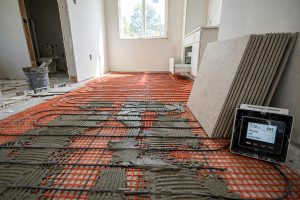
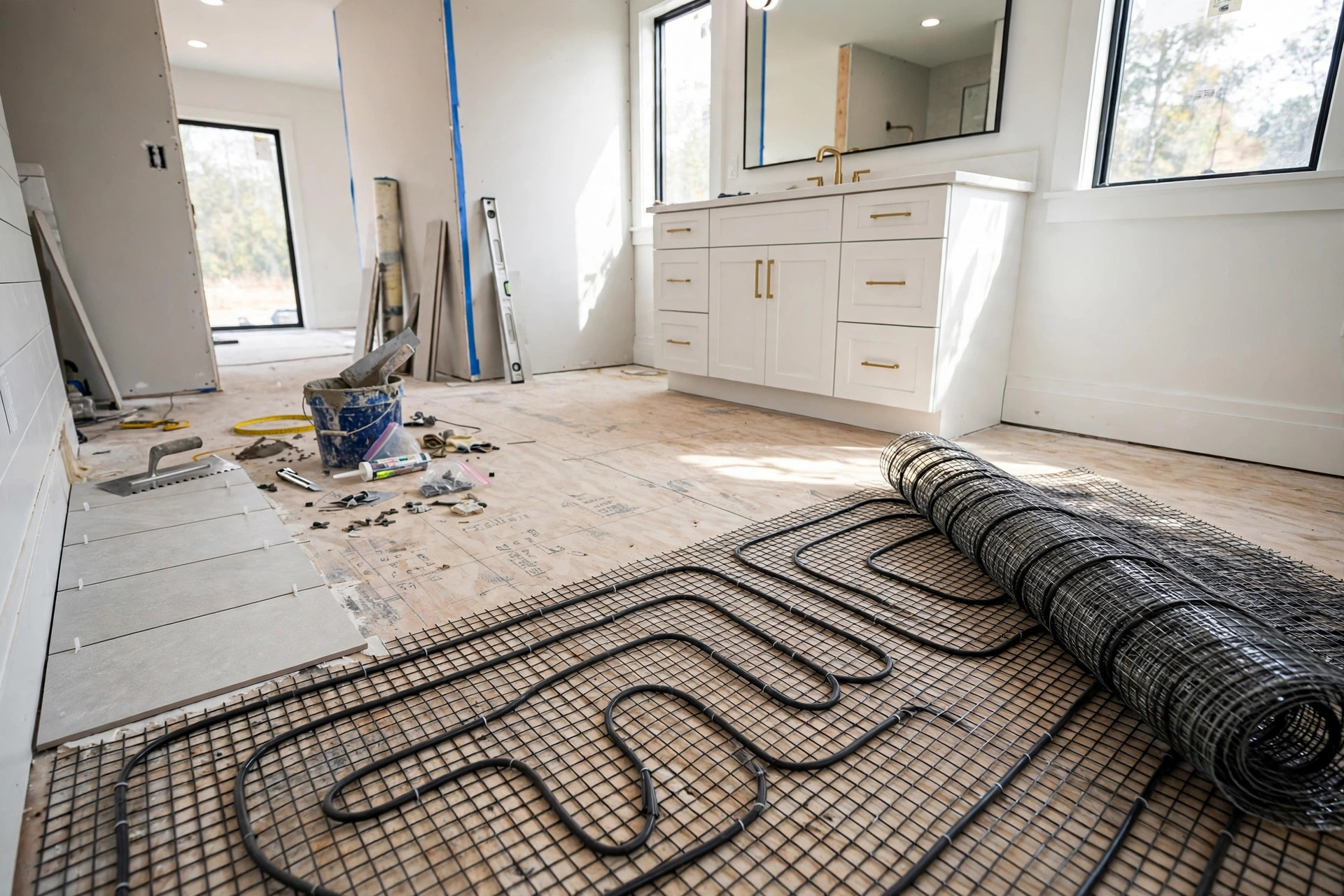
The mat is the most common kit for bathroom remodels. A heating cable is pre-spaced on a fiberglass mesh. The roll unwinds across the subfloor and is held in place with thin-set mortar. Tiles go on top. Mats suit rooms with a plain rectangular shape because the mesh can be cut and turned at the edges to fit around corners. Tile choice matters as well. Tile, porcelain, and stone conduct heat far better than wood or carpet, and The Spruce bathroom flooring guides explain which tile types carry heat best. When the mat or cable sits under a conductive surface, the heat spreads evenly across the whole floor. Homeowners browsing bathroom remodel ideas will see mats used in almost every modern tile bathroom project.
Loose Cable Kits
Loose cable gives more freedom. The wire spools out and fastens to the floor in parallel runs with plastic guides. This option fits rooms with odd shapes, angles, or many cutouts. The trade-off is time. Laying cable evenly takes longer than unrolling a mat, and spacing mistakes change the heat output. Loose cable suits careful do-it-yourselfers or pros.
Hydronic Kits
Hydronic systems move hot water through plastic tubes under the floor. They are quiet, even, and efficient for whole-house heating. They are also far more complex. A hydronic kit needs a boiler or water heater connection, a pump, and a manifold. The cost and the plumbing work put hydronic systems out of reach for most single-bathroom remodels. Step-by-step installation walkthroughs on Bob Vila show just how much extra planning a hydronic loop demands. They remain a strong choice when a whole floor or a new addition is being built.
Cost and Price: What Online Deals Really Mean
Online prices move with sales seasons, so treat the numbers below as working ranges, not quotes. Electric mat kits for a small bathroom, covering 30 to 50 square feet, often sell for $150 to $400 before any deal. Loose cable kits in the same range often run $200 to $500. A programmable thermostat adds $60 to $150. A smart thermostat adds $150 to $250.
Installation cost depends on who does the work. A do-it-yourselfer who already owns a tile saw and a multimeter can install a mat kit for the price of the kit plus mortar and a circuit check. Hiring a tile setter and an electrician for the same room often adds $800 to $2,000, depending on the market. This is why online deals matter so much: buying the kit at a sale price keeps the total project cost down even when labor is hired.
Running cost is the next question. A 40-square-foot mat at 12 watts per square foot draws 480 watts. Run four hours a day at a power price of 15 cents per kilowatt-hour, and the daily cost is about 29 cents. That is less than nine dollars a month. In mild climates the mat may run even less. Radiant floor heating systems for tile are not cheap to install, but they are cheap to run.
A note on deals is in order. A deep discount on an off-brand kit can look tempting. Check the safety listing first. An ETL or UL mark matters more than a coupon code. A bargain kit that lacks a listing can fail an inspection and may be refused coverage by a home insurer after a fire. The safety guidance at the Consumer Product Safety Commission is a good habit to check before buying any electrical home product.
Care and Upkeep
Heated floors ask for very little maintenance. There are no filters to change and no moving parts. The owner should follow a few plain rules.
Keep the thermostat settings steady rather than swinging them up and down. Large daily swings make the system work harder. A set floor temperature between 80 and 85 degrees feels warm without wasting power.
Clean the floor as normal. Tile and stone floors with embedded heat take the same mild cleaners as any tile floor. Avoid harsh acids that attack grout. If a smart thermostat offers a usage log, glance at it once a season. A sudden jump in run time can signal a sensor problem.
One rule matters above all: never drill, nail, or screw into the floor without knowing the wire layout. A photo taken during installation, showing the mat before tile went down, is the cheapest insurance a homeowner can keep. Store it with the house papers.
Safety Notes
Electric floor heat is safe when the kit is listed, installed to the manual, and wired on its own circuit with ground-fault protection. Ground-fault protection is required by American electrical code for bathroom floors. It shuts power off in a fraction of a second if current leaks where it should not.
A few cautions are worth stating. Do not overlap heating wire. Do not cut the heating cable itself. Do not run mats under walls, vanities, or permanent benches, where trapped heat can build. Do not connect the kit to a circuit shared with a hair dryer or a space heater. When in doubt, call a licensed electrician. The fee for a one-hour visit is small next to the cost of the tile work above the wires.
Frequently Asked Questions
Can I install a heated floor kit myself?
A careful homeowner can. The mat or cable layout follows the floor, and the tile work is standard. The electrical hookup is the part that often needs a pro. Most manuals call for a licensed electrician to make the final circuit and thermostat connections. In many states the law requires it.
Will a heated floor replace my bathroom heater?
For most bathrooms, yes, it can carry the main load. Radiant heat warms people and objects directly, so the room feels warm at a lower air temperature. In very cold climates or in a bathroom with big windows, a small backup heater on the coldest days is still wise.
How long do heated floor kits last?
Quality kits carry warranties of 15 to 25 years, and many last the life of the tile floor. The weak point is usually the thermostat or the floor sensor, both of which are cheaper to replace than the mat itself.
What floors work with electric heat?
Tile, porcelain, and natural stone work best because they conduct heat well. Engineered wood and luxury vinyl work with many kits, but the maker sets a lower floor temperature limit, often near 80 degrees. Solid hardwood and thick carpet are poor matches and are usually excluded.
Does the thermostat need its own circuit?
The kit should have a dedicated circuit with ground-fault protection. Sharing a circuit with other bathroom loads can trip the breaker and can violate code. An electrician can confirm whether the panel has room.
Are online deals as reliable as store purchases?
Yes, when the seller is established. Big home retailers and fixture makers sell the same listed kits online and in stores. Check our heated floor kits for sale page to compare current options. The deal to avoid is the no-name kit from an unknown seller with no safety listing and no warranty paper. If you are also comparing heated floor kits for sale across retailers, save the product sheet from each one and match the listing marks before you buy.
A Short Final Word
Warm bathroom floors used to be a luxury item. Fixture makers like Kohler and Moen now design bath lines that pair naturally with heated tile, and heated floor kits USA online deals have put the whole package within reach of an ordinary remodel budget. The buyer who measures the room, matches the kit to the floor, checks the safety listing, and plans the electrical work gets a floor that feels good every single morning. That is a small comfort, but it is one the whole household will notice. Readers who want a step-by-step comparison before they buy can start with our heated floor kits buying guide and our bathroom wall tiles buying guide for the surface that goes on top of the heat.
References
Bob Vila. (n.d.). Home improvement advice. https://www.bobvila.com ENERGY STAR. (n.d.). Energy efficient products. https://www.energystar.gov HGTV. (n.d.). Home and garden ideas. https://www.hgtv.com Kohler. (n.d.). Bathroom and kitchen fixtures. https://www.kohler.com Lowe’s. (n.d.). Home improvement products. https://www.lowes.com Moen. (n.d.). Faucets and plumbing fixtures. https://www.moen.com The Home Depot. (n.d.). Home improvement products. https://www.homedepot.com The Spruce. (n.d.). Home and garden advice. https://www.thespruce.com This Old House. (n.d.). Home renovation guidance. https://www.thisoldhouse.com U.S. Consumer Product Safety Commission. (n.d.). Product safety information. https://www.cpsc.gov
Was this guide helpful?

About Lisa Anderson
The My Garden US editorial team writes practical, in-depth home and garden guides for American homeowners — tested advice, no fluff.