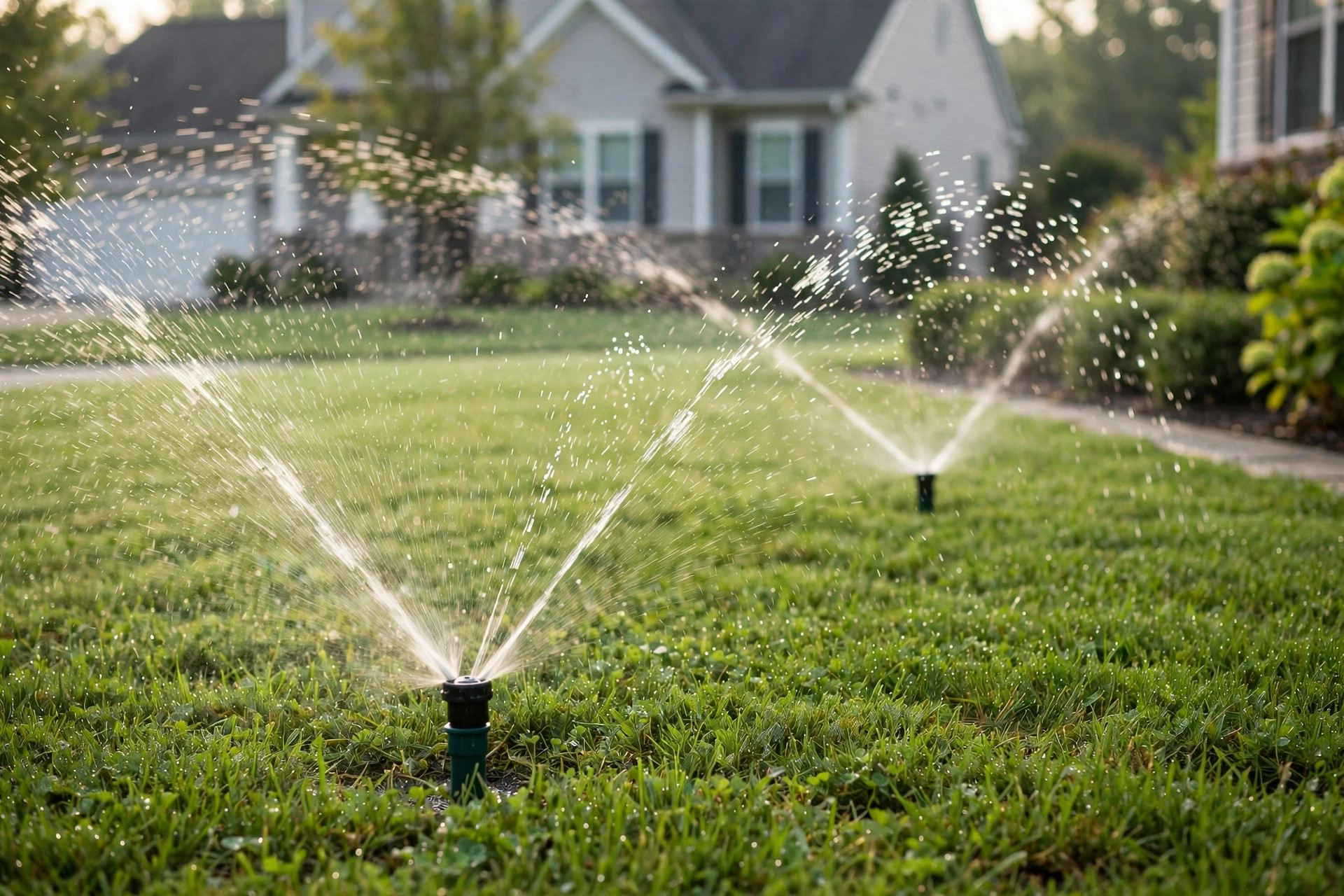

Many American homes live with weak water pressure. The shower runs thin. The hose fills a bucket slowly. And the lawn shows it worst of all. Dry spots spread. Edges turn brown. Grass near the fence stays green while the middle of the yard goes pale. The fault often lies not with the grass or the soil, but with the sprinkler heads. Finding the best sprinkler heads for low water pressure can turn a tired lawn around without digging up pipes or buying a pump.
Why Low Water Pressure Hurts Your Lawn
A sprinkler system is built around pressure. Water must push hard enough to lift pop-up heads from their cases, spin rotors, and throw each stream its full distance. Most spray heads are made to work at 30 to 40 pounds per square inch, which plumbers write as PSI. When pressure drops below 30 PSI, ordinary heads start to fail. Stems rise only halfway. Streams fall short. Water leaves the nozzle as a weak dribble instead of a clean fan.
The result is easy to see. Each head waters a small circle around its base while the ground between heads stays dry. Turf specialists call this poor distribution uniformity. In plain words, some parts of the lawn get soaked and other parts get nothing. Weeds move into the dry gaps. Roots stay shallow because the soil never wets deeply. Over a hot summer, the lawn thins out.
Low pressure has many causes. The house may sit at the end of a long street main. Old galvanized pipes inside the walls may be clogged with rust. A pressure regulator at the meter may be set too low. Or the sprinkler zone may simply carry too many heads for the water supply. In most cases the homeowner cannot change the supply. But the heads can be changed, and that is where the answer lies.
How to Check Your Pressure First: Best Sprinkler Heads for Low Water Pressure
Before you buy anything, test your water pressure. A simple pressure gauge costs little at any hardware store and screws onto a hose bib. Run no other water in the house, attach the gauge to the outdoor spigot nearest the street, and open the valve fully. Read the dial.
Most homes show 40 to 60 PSI at the hose bib. If your reading sits below 35 PSI, you have low pressure for irrigation work. If it sits below 25 PSI, ordinary spray heads will barely work at all. Write the number down. You will need it when you choose new heads.
Also check the flow rate. Set a five-gallon bucket under the spigot, open it fully, and time how long the bucket takes to fill. Divide 300 by the number of seconds to get gallons per minute. This number tells you how much water each zone can use. A system with 8 gallons per minute cannot run the same number of heads as one with 15.
Types of Sprinkler Heads
Not all heads demand the same pressure. Here is what the market offers.
Pop-Up Spray Heads
Spray heads are the small units that pop up three to four inches and throw a fixed fan of water. They cover short ranges, usually 8 to 15 feet. They need strong pressure to atomize water into a fine mist. Below 30 PSI they perform poorly. They are the most common head in older systems and the most common cause of dry spots in low-pressure homes.
Rotary Nozzles
Rotary nozzles, often called multi-stream rotators, fit onto the same spray bodies but throw water in slow rotating fingers instead of a fixed fan. They use less water per minute and work well at lower pressure. Many models keep an even pattern down to 25 PSI or less. They also lay water down slowly, which helps the soil absorb it. For lawns with weak supply, these are often the single best upgrade.
Gear-Driven Rotor Heads
Rotor heads turn a single strong stream back and forth across a large area, 20 to 40 feet or more. Big rotors are made for large lawns and usually want high pressure. But smaller rotor models made for homes can run at 30 PSI and cover wide ground with fewer heads per zone. They are a good choice for big open lawns where spray heads would need too many units.
Bubblers and Drip Emitters
Bubblers release water gently at the base of plants and trees. Drip emitters do the same through thin tubing. Both use almost no pressure. They cannot water a lawn, but they are perfect for flower beds, shrubs, and trees. Moving beds off the lawn zones lowers demand and leaves more pressure for the grass.
What to Look For When You Choose
Keep these points in mind while you shop.
Matched precipitation rate. Heads on one zone should lay down water at the same rate. A thirsty spray head next to a slow rotary nozzle will drown one spot and starve another. Many rotary nozzles are sold in matched sets for this reason.
Low-pressure rating. Read the box. Look for heads rated to work at 25 to 30 PSI. Pressure-regulating spray bodies hold the nozzle at a steady 30 PSI even when the street supply swings up and down. These bodies cost more, but they cure misting and fogging.
Adjustable arc and radius. Heads that let you set the arc from 45 to 360 degrees and trim the throw distance make it easier to fit water to odd-shaped yards. A screw on top of most nozzles shortens the radius by up to 25 percent.
Check valves. A small check valve inside the body keeps water from draining out of the pipe at the low end of a slope. Without it, the lowest head leaks after every cycle and wastes water.
Durability. Brass nozzles and stainless steel springs last longer than cheap plastic parts. In sandy soil, wiper seals around the stem keep grit from jamming the pop-up action.
The Best Sprinkler Heads for Low Water Pressure
No single head fits every yard. But certain types rise to the top for weak supply.
Rotary nozzles lead the list. They were designed to save water, and their slow rotating streams keep their shape at pressures where fixed sprays collapse. Homeowners who swap old spray nozzles for rotary nozzles often see the biggest gain for the smallest cost. One zone at a time can be converted without replumbing.
Pressure-regulating spray bodies come second. If you prefer fixed sprays for small areas, a body that regulates to 30 PSI will smooth out the pattern. Pair it with low-angle nozzles, which throw water on a flatter path and fight wind better than high-arc sprays.
Small rotors serve large lawns. A mid-size gear rotor running at 30 PSI can cover 25 feet with one head where sprays would need three. Fewer heads per zone means each head gets more water, which raises the effective pressure for the whole zone.
Bubblers finish the job in beds. Pull flower beds and shrubs off the lawn zones and give them bubblers. This simple change can free up enough water to lift a weak zone back into a healthy range.
If you plan a larger project, read our guide to the affordable lawn sprinkler installation cost estimate before you call a contractor. Knowing the price range helps you judge any quote.
Cost and Price
Sprinkler parts are modest in price. A standard spray nozzle costs three to eight dollars. A rotary nozzle costs eight to fifteen dollars. A small rotor head costs ten to twenty-five dollars. A pressure-regulating spray body adds about ten dollars over a plain body. For a typical front yard zone with six heads, converting sprays to rotary nozzles runs under one hundred dollars in parts.
Labor is the larger cost. A homeowner who does the work can finish a zone in an afternoon with a shovel and a pair of pliers. Our step-by-step article on how to install pop up sprinklers yourself walks through the process. A contractor will charge by the zone, often one to three hundred dollars per zone for a retrofit, more for new trenching.
A booster pump is the last resort. Pumps that raise house pressure for irrigation cost several hundred dollars plus wiring and a pressure tank. They also raise the electric bill. Change the heads first. Most low-pressure lawns respond to new heads alone.
How Many Heads Can One Zone Run
This is the question that decides everything. Add up the gallons per minute of every head on the zone. The total must stay below your measured flow, with some room left over. As a rule, keep the zone total at about 75 percent of the available flow. Pressure drops when a zone asks for more water than the pipe can give.
Rotary nozzles help here because each one uses about half the water of a fixed spray. A zone that struggled with eight sprays may run fine with eight rotary nozzles, since the total demand falls. If you want finer control over watering times, a smart sprinkler controller for usa homes can run shorter cycles and skip watering after rain.
Care and Upkeep
New heads still need care. Twice a year, walk each zone while it runs and watch every head. Look for stems that do not rise fully, streams that tilt, and brown arcs between heads. Pull the nozzle, rinse it in a bucket, and flush the line before you put it back. Sand and grit are the enemies of pop-up stems.
Trim grass away from each head so the stem can rise clear of the turf. Raise heads that have sunk below grade as the lawn soil settles. In cold regions, blow out the lines each fall with compressed air so trapped water does not crack the bodies in winter.
Check the backflow preventer once a year. It keeps lawn chemicals and fertilizer out of the drinking water. Many cities require a test by a licensed tester, and the test takes only minutes.
Safety
A few rules keep the work safe. Call 811 before you dig anywhere in the yard. The service marks buried gas, electric, and cable lines free of charge. Dig by hand near any marked line. Wear gloves when you handle old pipes, which may have sharp rusted edges.
Do not connect a sprinkler line to the house water without a backflow preventer. Lawn water can carry fertilizer, weed killer, and animal waste back into the home pipes if pressure drops suddenly. The Consumer Product Safety Commission publishes guidance on outdoor equipment hazards, and local plumbing codes spell out the backflow rules for your area.
If you use a booster pump, have an electrician wire it. Outdoor circuits need ground-fault protection and weatherproof boxes. Water and household current are a dangerous pair.
Frequently Asked Questions
What is normal water pressure for a sprinkler system?
Most systems are designed for 30 to 50 PSI at the heads. House supply of 40 to 60 PSI at the hose bib is common. Below 30 PSI at the heads, standard sprays lose their pattern and rotary nozzles become the better choice.
Can I fix low pressure without a pump?
Often yes. Replace fixed sprays with rotary nozzles, move beds to bubblers, and cut the number of heads per zone until demand fits your flow. These three steps cure most low-pressure lawns. A pump is only needed when the supply itself is extremely weak.
Will rotary nozzles fit my old spray bodies?
In most cases, yes. Rotary nozzles use the same female thread as standard spray nozzles and screw onto common pop-up bodies. Check the brand of your bodies first, and buy nozzles made to match. A quick look at the Toro or Briggs & Stratton home pages shows which product lines use standard threads.
How do I know if my zone has too many heads?
Add up the flow rating of every head on the zone. If the total is near or above your measured gallons per minute, the zone is overloaded. Remove heads, switch to lower-flow nozzles, or split the zone into two.
Should pressure-regulating bodies go on every head?
They help most on systems where pressure swings a lot, such as homes on a hill or on a shared well. On steady low pressure they still help by stopping misting at the start of each cycle. They are worth the extra cost on slopes and windy sites.
Do smart controllers help with low pressure?
A controller cannot raise pressure. But a smart sprinkler controller for usa homes can run shorter, more frequent cycles that let soil absorb water slowly, and it can skip watering on rainy days. Reviews of current models appear on Consumer Reports, which tests irrigation gear for real-world performance.
A Final Word
A brown lawn under weak pressure is not a lost cause. Test your pressure, count your flow, and match the heads to what your house can give. Rotary nozzles, regulating bodies, and fewer heads per zone will do more for your grass than any fertilizer. Start with one zone, watch the change for a month, and then roll the fix across the rest of the yard. The best sprinkler heads for low water pressure are the ones that fit your supply, and now you know how to find them.
References
Toro. (n.d.). Lawn care and irrigation products. https://www.toro.com Briggs & Stratton. (n.d.). Engines, pumps, and outdoor power equipment. https://www.briggsandstratton.com Consumer Reports. (n.d.). Product reviews and ratings. https://www.consumerreports.org
Was this guide helpful?

About Lisa Anderson
The My Garden US editorial team writes practical, in-depth home and garden guides for American homeowners — tested advice, no fluff.
You May Also Like

Cheap Sod Installation Cost Per Pallet: A Plain Guide for Homeowners
March 16, 2026 0 views
Cheap Topsoil Delivery Near Me: Prices, Tips, and What to Know Before You Order
July 11, 2026 0 views
The Best Lawn Mower for Wet Grass: A Plain Buyer’s Guide
July 9, 2026 0 views