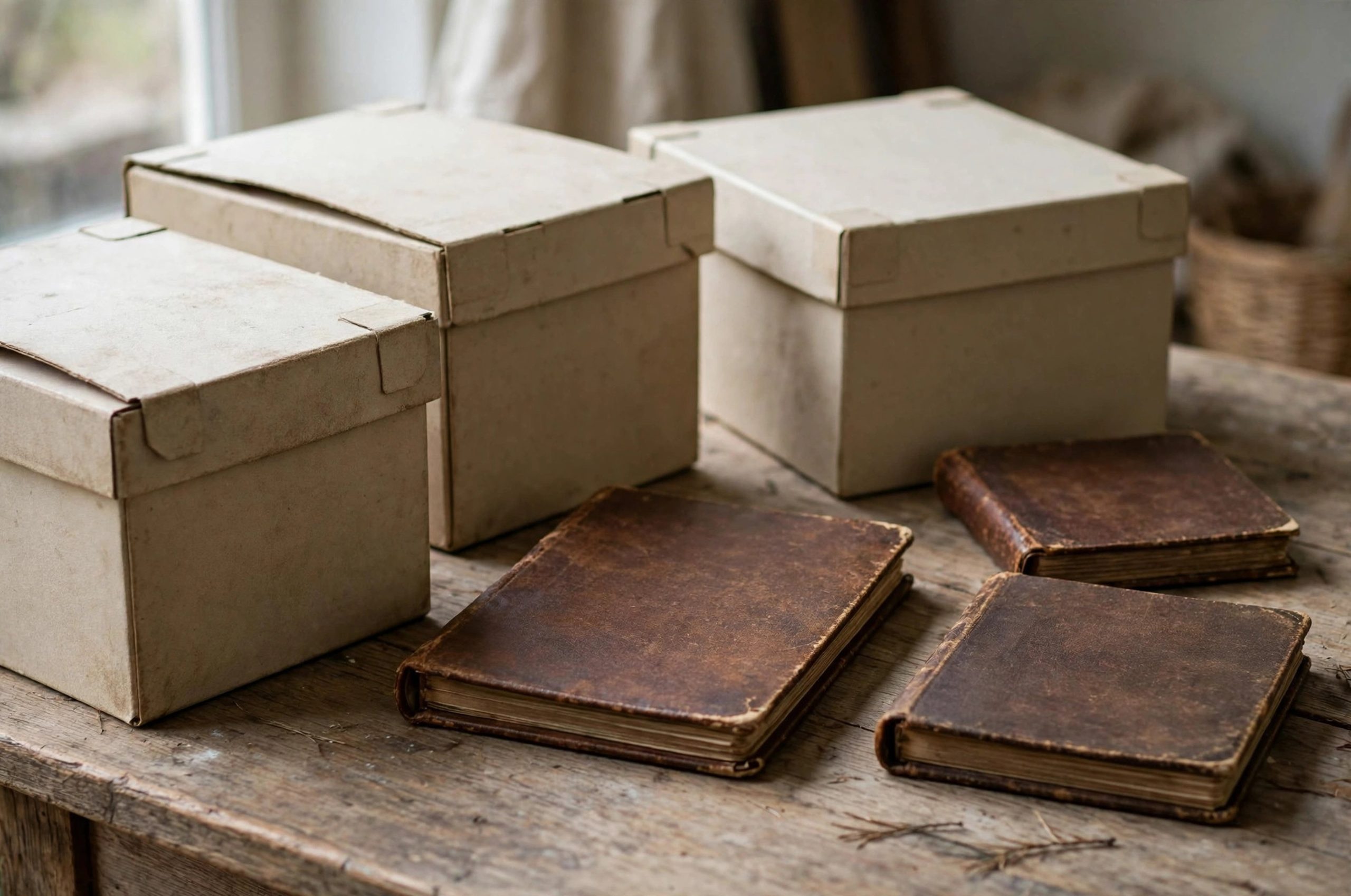
Family photos and keepsakes are the one category of stuff that cannot be replaced. A couch can be rebought. A favorite mug can be found again. But the only print of your grandmother as a young woman, the letters your grandfather wrote home, the baby shoes from your first child: once these are gone, they are gone. That is why learning how to store photos and keepsakes safely long term matters more than organizing any other corner of the house. The steps below show how to store photos and keepsakes safely in plain language.
Table of Contents
Table of Contents
- Store Photos and Keepsakes Safely: Why Photos and Keepsakes Deteriorate
- Choose the Right Storage Materials
- Handle With Clean, Dry Hands
- Control the Environment
- Digitize Everything Important
- Organize Keepsakes by Type, Not by Memory
- Special Care for Albums, Scrapbooks, and Framed Pieces
- Build a System the Whole Family Can Keep
- References
The good news is that preservation does not require a museum budget. It requires the right materials, a stable environment, and a little care in handling. Archivists at the nation's top institutions follow the same basic rules you can follow at home.
Store Photos and Keepsakes Safely: Why Photos and Keepsakes Deteriorate
When it comes to store photos and keepsakes safely, getting the details right makes all the difference.
Many homeowners find that store photos and keepsakes safely is easier than they expected once they know the basics.
Photographs fade and yellow because of light, heat, humidity, and acids in the materials around them. Color prints are the most fragile. Their dyes break down over time, and heat speeds the process. Black-and-white prints last longer, but cheap paper mounts and sticky album pages can stain them.
Keepsakes face different threats. Paper items like letters, certificates, and newspaper clippings turn brittle when acids migrate from cardboard boxes, wooden drawers, or newspaper itself. Textiles like baby clothes and quilts attract moths and mildew in damp spaces. Metal items like medals and jewelry tarnish in humid air.
The three biggest enemies are the attic, the basement, and the garage. Attics bake in summer. Basements flood and grow mold. Garages swing between hot and cold with every season. The National Archives advises keeping family papers and photographs below 75 degrees Fahrenheit and below 65 percent relative humidity, stored up high on shelves, never on the floor.
Choose the Right Storage Materials
Many homeowners find that store photos and keepsakes safely is easier than they expected once they know the basics.
The key to store photos and keepsakes safely is choosing the right approach for your space and budget.
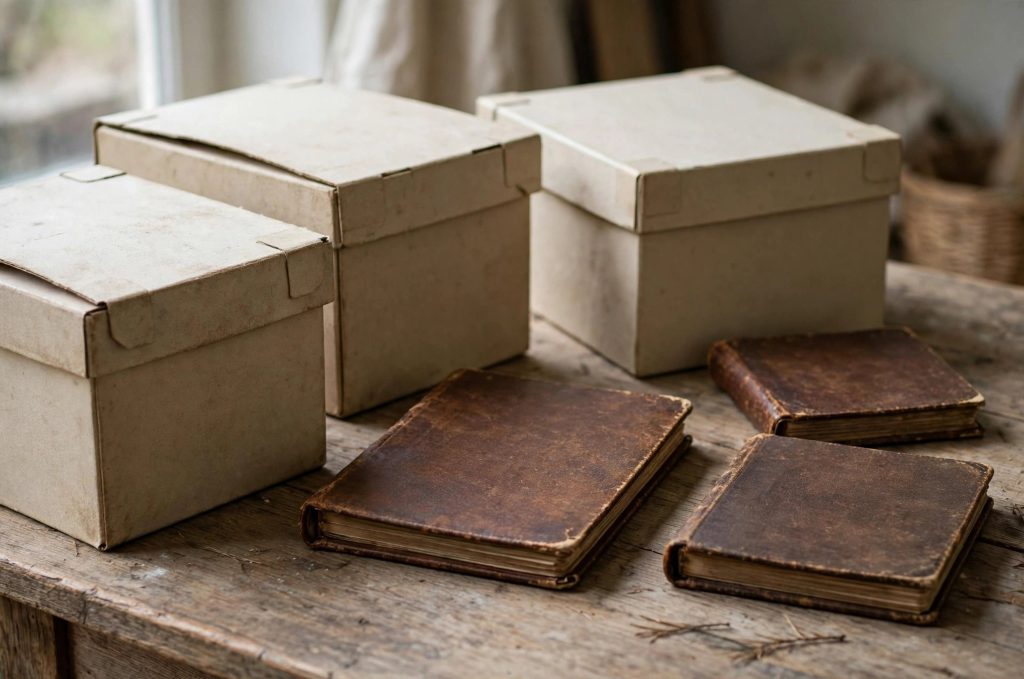
Regular cardboard boxes, manila envelopes, and wooden drawers all contain acids and lignin that migrate into paper and photos over time. The fix is simple: use acid-free, lignin-free materials. Look for boxes, folders, and tissue labeled "acid-free" and, for photographs, "passed the Photographic Activity Test" (PAT).
For prints, Gaylord Archival and similar archival suppliers sell sturdy photo boxes made from buffered barrier board with metal-reinforced corners. These boxes keep prints flat, block light, and buffer against acids. Store prints vertically in envelopes or flat in shallow boxes. Never overstuff a box. Items should slide in and out without bending.
For albums, avoid the old "magnetic" or self-adhesive page albums. The sticky pages yellow and bond to prints permanently. The Library of Congress recommends albums with photo-safe sleeves or acid-free pages, and mounting prints with photo corners instead of glue or tape. Adhesives should never touch the print directly.
For sleeves and enclosures, use only safe plastics: polyester, polyethylene, or polypropylene. Avoid anything that smells like a new shower curtain. That smell means PVC, which releases damaging gases. Preservation Week's quick tips warn against PVC sleeves and recommend moving photos out of attics and basements as the single most impactful first step.
Handle With Clean, Dry Hands
The key to store photos and keepsakes safely is choosing the right approach for your space and budget.
With a little planning, store photos and keepsakes safely can fit even a busy schedule.
Every fingerprint leaves oils that etch into photo surfaces over time. Handle prints by the edges. For valuable or fragile items, wear clean cotton or nitrile gloves. Keep food, drinks, and hand lotion far away from the work area.
Remove paper clips, rubber bands, staples, and sticky notes before storing. Metal clips rust and stain. Rubber bands dry out, snap, and bond to surfaces. Staples rust. Replace them with acid-free folders and soft pencil notes instead.
Write identifications on the back of prints with a soft pencil, not a pen. Ink can bleed through or press into the print stacked below. Record full names, places, and the occasion. "Mom" means nothing to a grandchild fifty years from now. Full names do. As HowStuffWorks' photo storage guide notes, labeling is the step most people skip and the one future generations need most.
Control the Environment
With a little planning, store photos and keepsakes safely can fit even a busy schedule.
Before you start, it helps to understand how store photos and keepsakes safely works in real homes.
You do not need a climate-controlled vault. You need a stable, moderate spot in the living area of your home: a bedroom closet, an interior hallway cabinet, or under a bed. Avoid exterior walls that swing in temperature, and keep boxes off the floor in case of leaks.
Keep storage areas dark. Light fades photographs and documents, and ultraviolet light is the worst offender. Boxes with lids solve this completely. For framed items you want to display, the National Archives' display guide recommends UV-filtering glass or acrylic, keeping originals away from direct daylight, and displaying copies while storing originals safely.
Watch humidity. Damp air grows mold and attracts insects. Very dry air makes paper brittle. If your home runs humid, a small dehumidifier in the storage room helps. If it runs very dry in winter, avoid storing items near heating vents. Good air circulation matters more than perfect numbers.
Keep food and water away from storage areas. Crumbs and leaks attract insects and rodents that chew paper, textiles, and leather. Store keepsakes on shelves, never directly on a basement or garage floor.
Digitize Everything Important
Before you start, it helps to understand how store photos and keepsakes safely works in real homes.
A good plan for store photos and keepsakes safely saves time, money, and frustration.
Physical storage protects the originals. Digitizing protects the memories. Scan prints at a resolution suited to the original, and save preservation copies in uncompressed or lossless formats like TIFF, with JPEG copies for everyday sharing. A flatbed scanner gives the best results for prints. Phone scanning apps work fine for quick copies.
Back up digital files in at least two places: an external hard drive and a cloud service, or two separate drives stored in different locations. Check the files every few years to make sure they still open. Storage media changes, and old CDs, DVDs, and USB drives can fail or become unreadable as technology moves on.
Digitizing also lets you share without handling. Send copies to siblings, children, and cousins. If one copy is lost to fire or flood, the others survive. Our Wabi Sabi Life's photo digitizing guide walks through rescuing prints from obsolete media and organizing decades of family photos into a searchable system.
Label digital files clearly: names, dates, places. A folder of "IMG_0042.jpg" files is almost as useless as an unlabeled shoebox. Rename as you scan. Future you will be grateful.
Organize Keepsakes by Type, Not by Memory
A good plan for store photos and keepsakes safely saves time, money, and frustration.
For most people, store photos and keepsakes safely comes down to a few smart choices.
Keepsakes are harder to organize than photos because every item is different. Sort by material type, since each type needs different care. Paper items go in acid-free folders and boxes. Textiles go in acid-free tissue in breathable boxes, never in plastic bags that trap moisture. Small objects go in padded, divided boxes.
For textile keepsakes like christening gowns and baby blankets, wash hands before handling, fold with acid-free tissue between layers to prevent creases from setting, and refold along different lines every year or two. Never store textiles in direct contact with wood, which releases acids, or in plastic dry-cleaning bags.
For metal keepsakes like medals, coins, and jewelry, handle as little as possible and store in tarnish-resistant pouches or boxes. Do not polish antique finishes without advice from a conservator. The patina is part of the object's history.
Keep one inventory list. A simple notebook or spreadsheet noting what is stored where saves you from opening every box to find one item. Note the box, the shelf, and a short description. This also helps family members find things if you are not around.
Special Care for Albums, Scrapbooks, and Framed Pieces
For most people, store photos and keepsakes safely comes down to a few smart choices.
Old family albums and scrapbooks are often the most damaged items in a collection because early scrapbook materials were highly acidic. Do not try to dismantle a historic album yourself. Interleaving acid-free tissue between pages slows further damage. Store albums flat or upright with support so pages do not slump.
Newspaper clippings are the worst offenders. Newsprint is extremely acidic and stains everything it touches. Photocopy or scan clippings, then store the originals in separate acid-free sleeves away from photographs.
For framed photographs and documents, check the framing. Old frames often used acidic cardboard backing and regular glass touching the surface. A professional framer following preservation standards can reframe with acid-free mat board, spacers that keep glass off the surface, and UV-filtering glazing. Geneosity's preservation guide explains the difference between preservation, which prolongs life, and conservation, which repairs damage, and when to call a professional.
Build a System the Whole Family Can Keep
If you are new to store photos and keepsakes safely, start with the simplest option and build from there.
The best storage system is one the family actually maintains. Use clear bins with lids for the outer layer of organization so everyone can see the labeled archival boxes inside. Keep the inventory list where everyone can find it.
Set a yearly habit: one afternoon to check storage areas for leaks, pests, or humidity problems, and to back up new digital scans. Attic storage solutions can work for some household goods, but keep photos and keepsakes in the climate-controlled living space instead.
For keepsake overflow like baby clothes and small mementos, nursery storage baskets make good staging containers before items move into archival boxes. And if your memory-keeping involves paper crafts, a craft adhesive safe for paper projects helps when assembling new albums without damaging prints.
Photos and keepsakes carry your family's story. A few acid-free boxes, a cool dark closet, clean hands, and a scanner are all it takes to make sure that story survives. Start with the most precious items, work through the rest box by box, and label everything. Your grandchildren will thank you. Keep this guide handy the next time you store photos and keepsakes safely.
References
When it comes to store photos and keepsakes safely, getting the details right makes all the difference.
Gaylord Archival. (n.d.). Barrier board photo and print box. https://www.gaylord.com/Preservation/Photo,-Print-&-Art-Preservation/Storage-Boxes/Gaylord-Archival&%23174;-Barrier-Board-Photo-&-Print-Box/p/HYB02511
Geneosity. (n.d.). How to preserve old documents, photographs and files? https://geneosity.com/how-to-preserve-old-documents-photographs-files/
HowStuffWorks. (n.d.). How to properly store really, really old photos. https://lifestyle.howstuffworks.com/family/heirlooms/properly-store-really-old-photos.htm
Library of Congress. (n.d.). Care, handling and storage of photographs. https://loc.gov/preservation/care/photo.html
National Archives. (n.d.). Displaying family papers and photographs. https://www.archives.gov/preservation/family-archives/displaying
National Archives. (n.d.). Storing family papers and photographs. https://www.archives.gov/preservation/family-archives/storing
Our Wabi Sabi Life. (n.d.). The digital declutter: How to organize 20 years of family photos. https://ourwabisabilife.com/the-digital-declutter-how-to-organize-20-years-of-family-photos/
Preservation Week. (n.d.). Quick preservation tips. https://preservationweek.org/resources/quick-preservation-tips/
Many homeowners find that store photos and keepsakes safely is easier than they expected once they know the basics.
Was this guide helpful?

About My Garden US
The My Garden US editorial team writes practical, in-depth home and garden guides for American homeowners — tested advice, no fluff.
You May Also Like
The Best Stackable Shoe Storage Boxes with Free Shipping: A Practical Guide
May 24, 2026 16 views
Heavy Duty Laundry Room Shelving Buying Guide
August 31, 2026 13 views
Where to Buy Shoe Storage Racks in Arizona
May 4, 2026 10 views