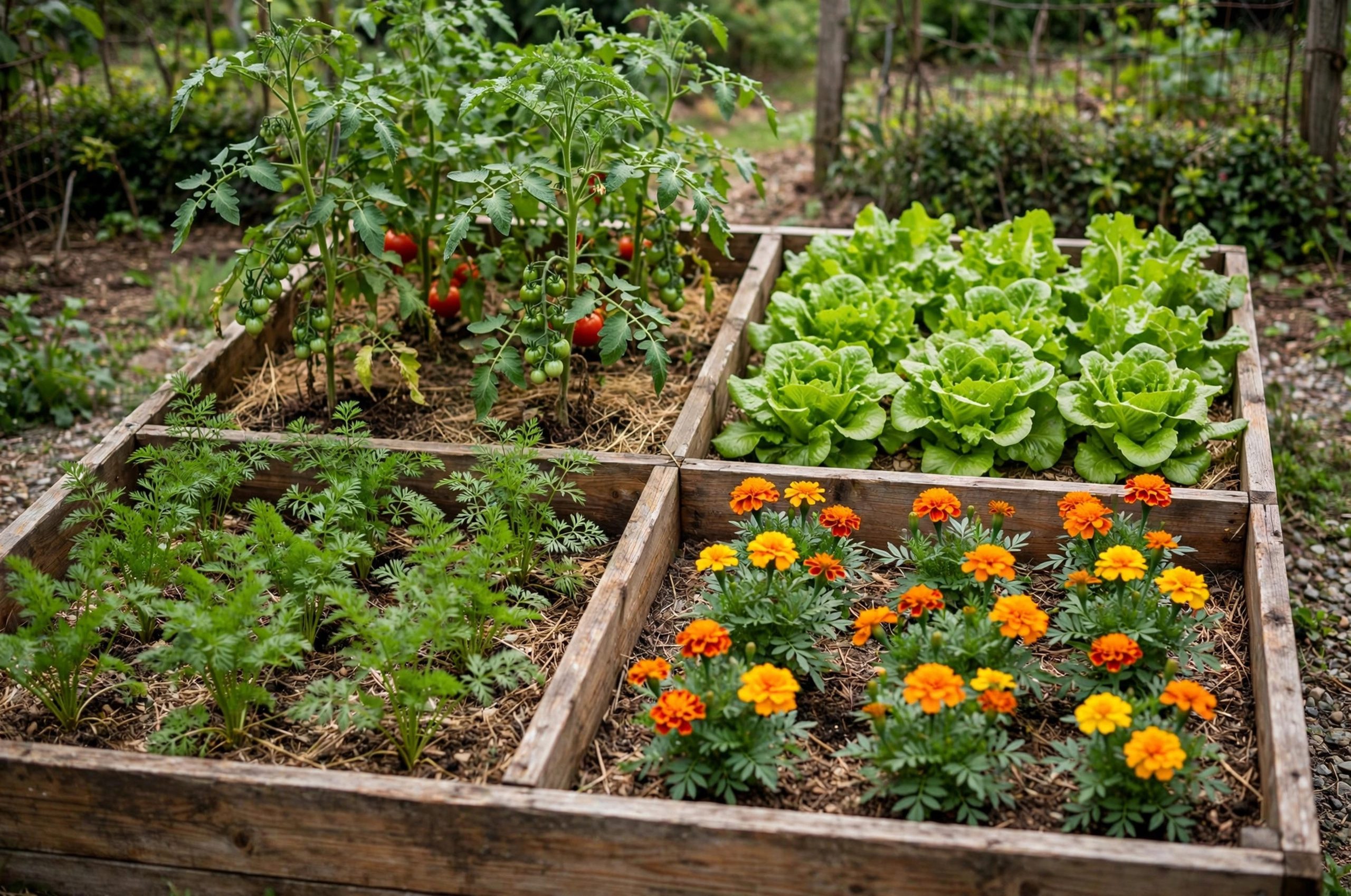
A raised bed is precious real estate. Every square foot has to earn its keep, and what grows next to what matters as much as what you plant. Companion planting is the old practice of placing crops together so they help each other: one shades the soil, another fixes nitrogen, a third confuses pests. Some pairings are genuinely useful. Others are garden folklore. This guide gives you a practical companion planting layout for raised bed vegetables, grounded in what actually works, with sample bed plans you can copy. This article explains companion planting layout in simple terms.
Table of Contents
Table of Contents
- Companion Planting Layout: How Companion Planting Really Works
- The Classic Pairings That Hold Up
- Pairings to Avoid
- The Three Sisters: Companion Planting's Greatest Hit
- Watering and Feeding a Mixed Bed
- Sample Layout 1: The Four-by-Four Salad Bed
- Sample Layout 2: The Four-by-Eight Workhorse Bed
- Sample Layout 3: The Three Sisters Bed
- Succession: The Fourth Dimension
- A Realistic Note on the Science
- Feeding and Watering a Packed Bed
- Frequently Asked Questions
- The Bottom Line
- References
Companion Planting Layout: How Companion Planting Really Works
When it comes to companion planting layout, getting the details right makes all the difference.

Many homeowners find that companion planting layout is easier than they expected once they know the basics.
Strip away the mystique and companion planting rests on a few real mechanisms. Tall plants shade tender ones. Legumes like beans and peas host bacteria that pull nitrogen from the air into the soil, feeding their neighbors. Strong-scented herbs and flowers can mask crops from pests or draw in beneficial insects. Deep-rooted plants pull up nutrients that shallow roots cannot reach. And some plants simply compete badly and should be kept apart.
What companion planting does not do is replace good soil, water, and sun. Think of it as the finishing touch on a well-built bed, not the foundation. For the foundation itself, see our guides to building a raised garden bed cheaply and choosing the best soil for raised vegetable beds.
The Classic Pairings That Hold Up
Many homeowners find that companion planting layout is easier than they expected once they know the basics.
The key to companion planting layout is choosing the right approach for your space and budget.
University of Florida's vegetable companion planting chart remains one of the most-cited references, and its pairings line up with what generations of gardeners report (University of Florida IFAS Extension):
- Tomatoes with basil and carrots. Basil is the famous tomato companion, and carrots use the space below without competing. Keep tomatoes away from corn and potatoes, which share diseases.
- Carrots with onions. Onions and their relatives mask carrots from carrot rust flies, while carrots return the favor against onion flies. Avoid planting carrots near dill.
- Beans with corn. The original partnership: corn gives pole beans a living trellis, and beans feed nitrogen to the soil. Keep beans away from onions and garlic, which stunt them.
- Cucumbers with beans, corn, and radishes. Radishes sown with cucumbers draw flea beetles away from the young vines. Keep cucumbers away from potatoes and strong herbs.
- Lettuce with carrots and radishes. Fast, shallow crops that fill gaps between slower ones. Lettuce dislikes the cabbage family as a neighbor.
- Peppers with basil, onions, and carrots. A friendly cluster with similar water needs. Keep peppers away from fennel and kohlrabi.
- Marigolds almost anywhere. French marigolds are the hardest-working flower in the vegetable garden, and many gardeners ring beds with them (Jung Seed).
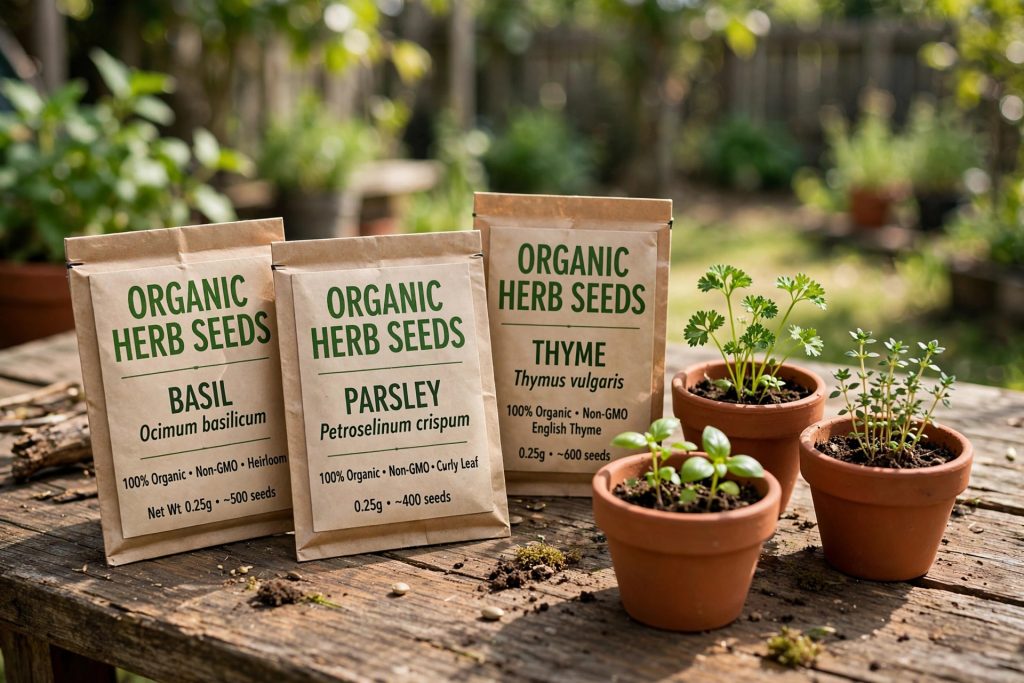
Jung Seed's companion planting guide adds the herb layer: parsley near tomatoes and asparagus, dill near cabbage (but away from carrots), and nasturtiums as a trap crop that lures aphids off beans and squash (Jung Seed).
Pairings to Avoid
The key to companion planting layout is choosing the right approach for your space and budget.
With a little planning, companion planting layout can fit even a busy schedule.
Just as important as the friends are the feuds. Keep these apart:
- Onions and garlic away from beans and peas. Alliums stunt legumes noticeably.
- Tomatoes away from potatoes and corn. Shared blights and pests move easily between them.
- Fennel away from everything. It releases compounds that inhibit most vegetables. Give fennel its own pot.
- Dill away from carrots. They are close relatives and cross poorly; mature dill also shades young carrots.
- Cabbage family away from strawberries and tomatoes. They compete and share some pests.
The University of Arkansas companion chart lays these friend-and-foe pairings out crop by crop for quick reference at planting time (University of Arkansas Extension).
The Three Sisters: Companion Planting's Greatest Hit
With a little planning, companion planting layout can fit even a busy schedule.
Before you start, it helps to understand how companion planting layout works in real homes.
No companion planting discussion is complete without the Three Sisters: corn, pole beans, and squash grown together. Developed by Indigenous peoples of the Americas, it is the most tested polyculture in gardening history. Corn provides a living trellis. Beans climb the stalks and fix nitrogen through root nodules. Squash sprawls at the base, shading out weeds and cooling the soil with its broad leaves (HGTV).
In a raised bed, scale it down. A four-by-eight bed holds the system nicely: plant corn in a block in the center for pollination, sow pole beans around the stalks once the corn is a few inches tall, and tuck compact squash or bush-type plants around the edges where vines can spill over. Stagger the planting so each crop establishes before the next crowds it (GrowOrganic). Raised-bed growers report that a four-by-eight bed is about the minimum that works, with the squash inevitably spilling over the edges, which is fine (Real Self Sufficiency). Corn is wind-pollinated, so keep it in a block rather than a single row, and build low mounds of compost-rich soil for each planting station (Natura Cultura).
Watering and Feeding a Mixed Bed
Before you start, it helps to understand how companion planting layout works in real homes.
A good plan for companion planting layout saves time, money, and frustration.
Companion beds mix crops with different appetites, so feed to the hungriest plant and water to the thirstiest, within reason. Beans and peas make their own nitrogen, which is why the Three Sisters bed needs little added fertilizer once the beans are up. Heavy feeders like tomatoes, corn, and squash appreciate compost worked in at planting and a mid-season side dressing.
Water deeply and less often rather than sprinkling daily; deep watering pushes roots down and keeps foliage dry, which cuts disease. Mulch the open soil between plants with straw or shredded leaves to hold moisture and smother weeds. Drip lines or soaker hoses beat overhead sprinklers in a mixed bed, since wet leaves invite the very blights that companion planting tries to avoid. Our raised bed watering schedule gives seasonal targets you can adapt to any layout.
Sample Layout 1: The Four-by-Four Salad Bed
A good plan for companion planting layout saves time, money, and frustration.
For most people, companion planting layout comes down to a few smart choices.
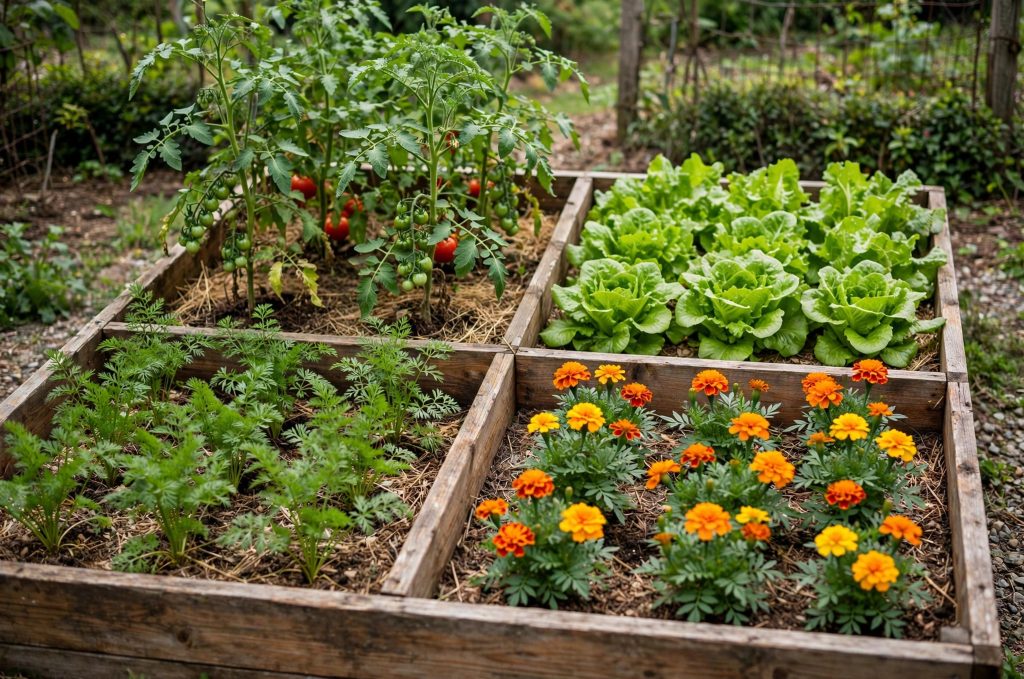
Divide a four-by-four bed into four quadrants:
- Northwest: tomatoes (one staked plant) underplanted with basil
- Northeast: peppers with onions along the edge
- Southwest: carrots in straight rows with a border of radishes
- Southeast: lettuce succession, replanted as each patch is harvested
Marigolds tuck into the corners. This bed works because the tall crops sit where they will not shade the low ones, provided the bed's tall side faces away from the sun's path. Our raised bed carrot guide covers the deep, loose soil the carrot quadrant needs.
Sample Layout 2: The Four-by-Eight Workhorse Bed
For most people, companion planting layout comes down to a few smart choices.
If you are new to companion planting layout, start with the simplest option and build from there.
- North half: two tomato plants, each with basil at its feet and carrots in the gaps
- Middle band: bush beans flanked by onions
- South half: cucumbers on a small trellis at the north edge of this section, with lettuce and radishes in front
- Edges: marigolds and nasturtiums dotted along the frame
Beans feed the bed's nitrogen while the trellised cucumbers stay off the lettuce. Keep this bed's watering even; our raised bed watering schedule helps you dial it in.
Sample Layout 3: The Three Sisters Bed
If you are new to companion planting layout, start with the simplest option and build from there.
- Center block: corn in a tight grid for wind pollination
- Around the corn: pole beans, sown once corn is sturdy
- Perimeter: compact squash, allowed to sprawl over the bed edges
- Corners: sunflowers or bee balm to draw pollinators
This is the lowest-maintenance of the three layouts once established, and the soil improves each season the beans grow.
Succession: The Fourth Dimension
When it comes to companion planting layout, getting the details right makes all the difference.
A layout is not just space, it is time. As spring crops finish, their squares open for summer ones. Lettuce and radishes give way to beans. Peas give way to cucumbers. Planning these handoffs doubles what a bed produces. Keep a simple sketch of the bed and note what followed what; rotating families from season to season also breaks pest and disease cycles. For variety ideas across the seasons, our tomato growing guide covers warm-season stars worth rotating in.
A Realistic Note on the Science
Many homeowners find that companion planting layout is easier than they expected once they know the basics.
Be honest with yourself about what companion planting can and cannot prove. The nitrogen fixing of beans, the shading of squash, and the trellising of corn are solid and measurable. Claims about one plant improving another's flavor, or about precise pest-repelling distances, rest on thinner evidence. Chelsea's garden design guide takes a sensible middle path, treating companion charts as planning tools rather than magic (DIY with Chelsea). Use the pairings, watch your own garden, and keep what works.
Feeding and Watering a Packed Bed
The key to companion planting layout is choosing the right approach for your space and budget.
A companion-planted bed works its soil hard, so start rich. Fill the bed with a mix of topsoil, compost, and something airy like perlite or coarse vermiculite so roots breathe. Our raised bed soil guide walks through the ratios that drain well without drying out. Heavy feeders such as tomatoes and corn earn a mid-season side dressing of compost or worm castings. Light feeders like lettuce and herbs usually need nothing more.
Water deeply and less often rather than a sprinkle every day. Deep watering pushes roots down, which matters when plants are packed tight and sharing the same few inches of soil. Mulch the bare spots between young plants with straw or shredded leaves. It holds moisture, keeps soil from splashing onto leaves, and smothers weeds before they start. Tune your timing to the weather with our raised bed watering schedule.
Eartheasy's raised bed companion guide makes the same point: dense plantings only thrive when water and fertility keep up, and a little extra compost goes further than any clever pairing (Eartheasy).
Frequently Asked Questions
Can I plant tomatoes and peppers together? Yes. They are both nightshades with similar needs for sun, water, and feeding. Give each its own space and stake them well. Just do not plant either where potatoes grew the season before, since they share diseases.
Do marigolds really keep pests away? French marigolds are the best studied of the companion flowers. Their roots give off compounds that suppress root-knot nematodes, and their blooms feed beneficial insects. They are not a magic shield, but as a bed border they earn their keep. A University of Florida companion chart lists marigolds as a friend to tomatoes, peppers, and potatoes (UF companion chart).
How close can I plant companions? Follow the seed packet spacing first, then tuck companions into the leftover gaps. The goal is leaves that just touch at maturity, not a solid mat. If the bed stays damp and airless, thin it out. A compact four-by-four layout that balances height, sun, and pest control shows how tight you can go without trouble (Rootlix).
Should herbs get their own bed? Not necessarily. Basil, parsley, and cilantro tuck happily around vegetables. Give aggressive spreaders like mint their own pots, and keep fennel far from everything, since it holds back most neighbors.
Does companion planting replace crop rotation? No. Rotation is still the backbone. Do not put nightshades in the same spot season after season. A simple sketch of what grew where, kept with your seed packets, is the cheapest fertility tool you own. Evidence-minded gardeners go further and sort every pairing by the strength of its proof, keeping the supported ones and dropping the myths (Verdenook).
For staked tomatoes in the back row of any layout, our tomato growing guide covers pruning and support.
The Bottom Line
A good companion planting layout for a raised bed puts friends together, rivals apart, tall crops where they shade nothing important, and flowers at the edges to work for pollinators. Start with one of the sample beds above, adjust to what your family eats, and let the bed teach you the rest. That is all it takes to handle companion planting layout with confidence.
References
DIY with Chelsea. (n.d.). Garden design: Companion planting chart. https://www.diywithchelsea.com/post/garden-design-companion-planting-chart
GrowOrganic. (n.d.). Three sisters planting: How to plant corn, beans and squash. https://www.groworganic.com/blogs/videos/planting-corn-squash-and-beans-using-the-three-sisters-method
HGTV. (n.d.). How to plant a three sisters garden. https://www.hgtv.com/outdoors/gardens/garden-styles-and-types/all-in-the-family-three-sisters-gardening
Jung Seed. (n.d.). Companion planting guide. https://blog.jungseed.com/companion-planting-guide/
Natura Cultura. (n.d.). The three sisters: Comprehensive guide. https://natura-cultura.com/the-three-sisters-comprehensive-guide/
Real Self Sufficiency. (n.d.). The three sisters garden: Companion planting corn, beans, and squash. https://realselfsufficiency.com/companion-planting-three-sisters/
University of Arkansas Extension. (n.d.). Companion planting chart for vegetables. https://www.slideshare.net/slideshow/companion-planting-chart-for-vegetables-university-of-arkansas/15541420
University of Florida IFAS Extension. (n.d.). Vegetable companion planting chart. https://growables.org/informationVeg/documents/CompanionGuideUF.pdf
Was this guide helpful?

About My Garden US
The My Garden US editorial team writes practical, in-depth home and garden guides for American homeowners — tested advice, no fluff.
You May Also Like

Native Grass Seed Reviews Buying Guide USA: Pick the Right Seed for Your Land
July 11, 2026 18 views
Where to Find a Good Monstera Plants Sale for Sale USA
April 12, 2026 18 views
Garlic Bulbs Planting for Sale USA: A Home Gardener's Guide
January 14, 2026 19 views