
A Faucet That Fills Pots at the Stove
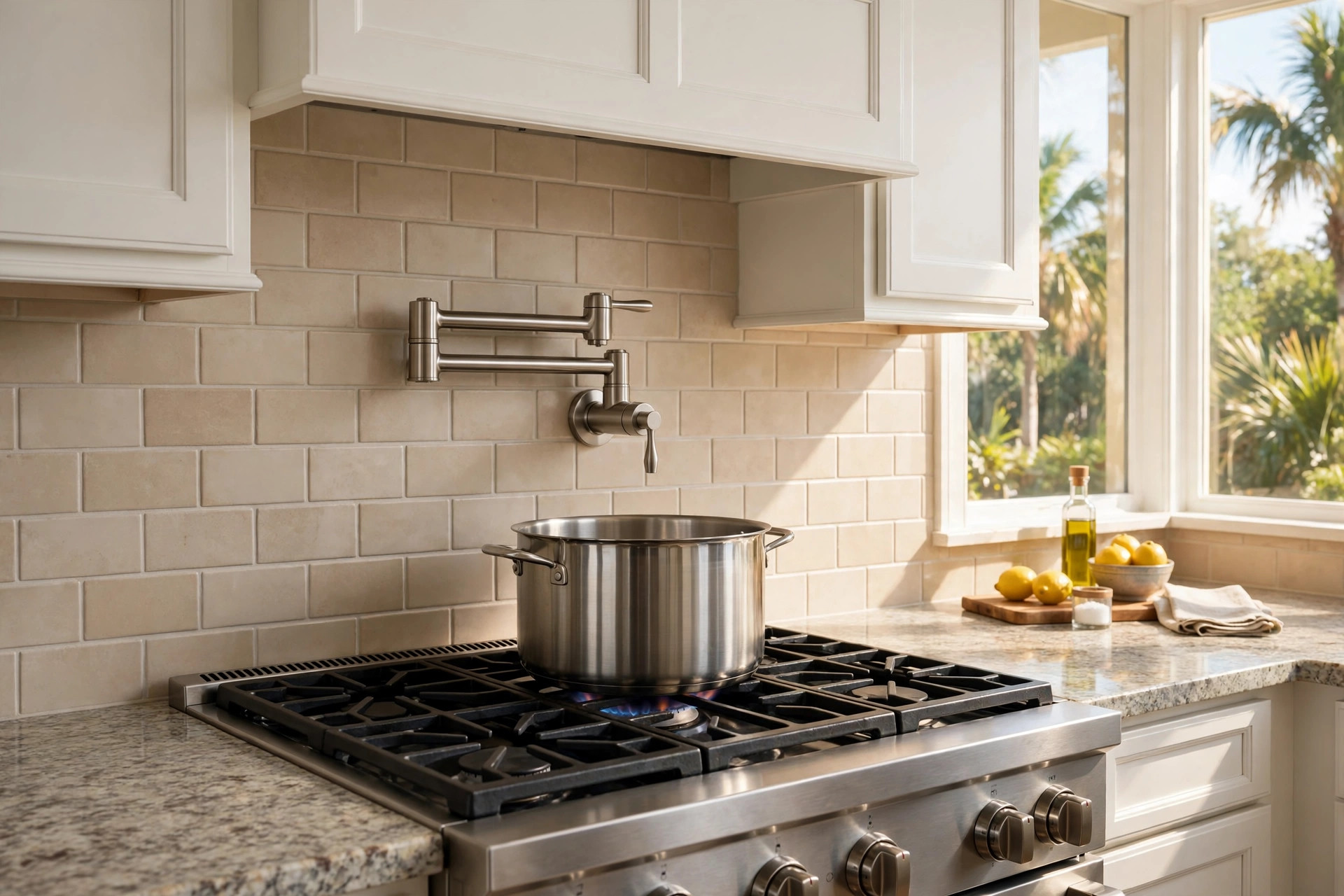
A pot filler is a small faucet that sits on the wall above the stove. It swings out over a pot. It fills the pot with cold water. Then it folds back against the wall. The idea is simple. You do not carry a heavy pot of water from the sink to the range. For cooks who boil pasta, steam crabs, or make stock, this saves real effort.
Interest in pot filler faucets for Florida homes has grown in recent years. Many new kitchens in the state are built with large gas ranges. A large range holds large pots. Large pots are heavy when full. A pot filler takes the strain out of filling them. It also adds a fine, finished look to the kitchen. This guide explains what these faucets are, how to choose one, what they cost, and how to keep one working in the humid Florida climate.
Why a Pot Filler Matters in a Florida Kitchen: Pot Filler Faucets Florida Homes Usa
Florida kitchens see heavy use. Families cook big meals. Holiday gatherings are common. Outdoor cooking and indoor cooking often go together. A stock pot of water can weigh more than twenty pounds. Carrying it across a tile floor is a risk. A slip can burn skin or crack a tile. A pot filler removes the trip.
The faucet also saves time. You fill the pot where it sits. You turn on the burner. There is no walk to the sink. When you cook several dishes at once, every saved minute counts. Many home cooks in the state pair a pot filler with double wall ovens for Florida homes during a full kitchen remodel. The two upgrades often go in together, since both call for changes behind the walls.
There is a design gain as well. A brass or stainless pot filler draws the eye. It marks the cooking zone. It pairs well with stainless range hoods and professional style ranges. Even in a modest kitchen, it gives a sense of a serious cooking space. Real estate agents in the state note that buyers like to see it. It signals that the kitchen was planned with care.
What to Look for When You Choose
Not all pot fillers are the same. A few key points will guide a sound choice.
Style and Finish
The finish should match the rest of the kitchen. Common choices are chrome, brushed nickel, stainless steel, oil-rubbed bronze, and matte black. Chrome is bright and easy to clean. Brushed nickel hides water spots. Matte black suits modern kitchens. Pick the finish that matches your main faucet and cabinet pulls. A mixed set of finishes can look untidy.
The shape matters too. Some pot fillers have a straight, modern arm. Others have a classic curved spout. Modern arms suit flat-front cabinets. Curved spouts suit raised-panel doors. Stand in front of your range and picture each shape. Choose the one that fits the room.
Reach and Mount Height
The arm must reach the center of the largest burner you plan to use. Most pot fillers extend sixteen to twenty-four inches. Measure from the wall to the middle of your front burners. Add two inches. That is the reach you need.
Mount height counts as well. The spout should sit high enough to clear a tall stock pot. Most installers place the faucet twelve to eighteen inches above the cooktop. If you use a very tall canning pot, go higher. Check the clearance before the plumber drills any holes.
Valve and Water Line
A pot filler should have a solid brass body. Brass resists corrosion. It lasts for decades. Look for ceramic disc valves. They turn smoothly and shut off tight. Many models have two shut-off valves, one at the wall and one at the spout. Two valves give extra safety. If the arm valve ever leaks, the wall valve stops the flow.
The faucet needs a dedicated cold-water line. The line runs inside the wall from the nearest supply. In many Florida homes, the wall behind the range is an exterior wall. Running a line there is plain work for a plumber. In a concrete block home, the job takes more care. Plan the pipe run before you buy.
Types and Options
Wall-Mount Pot Fillers
Most pot fillers mount on the wall. The base plate screws to the wall studs. The arm folds flat when not in use. This type is the most common. It keeps the counter clear. It is easy to reach from the front burners. Most buyers choose this type.
Deck-Mount Pot Fillers
A deck-mount model rises from the counter behind the range. It suits kitchens where the wall cannot take a pipe. It also suits island ranges with no wall at all. The trade-off is counter space. The faucet base takes room behind the burners. It can crowd a shallow counter.
Single-Joint and Double-Joint Arms
A single-joint arm has one pivot. It swings in a simple arc. It costs less. A double-joint arm has two pivots. It folds closer to the wall. It reaches further when open. The double joint is more useful over wide ranges. It also looks more refined when folded.
Shoppers comparing a pot filler faucet for a Florida kitchen often read buying guides from sources such as Bob Vila and The Spruce. These sites lay out the types side by side. They help a buyer see the trade-offs in plain terms.
Cost and Price in the USA
Prices vary widely. A basic chrome pot filler can cost under one hundred dollars. A mid-range model in brushed nickel runs one hundred fifty to three hundred fifty dollars. High-end models in solid brass with designer finishes can pass six hundred dollars. The price reflects the metal, the valves, and the brand name.
Installation is a separate cost. If the wall is open during a remodel, a plumber may charge one hundred fifty to three hundred dollars to run the line. If the wall is finished, the cost rises. Opening drywall, running copper or PEX, and patching the wall can add three hundred to six hundred dollars. In a concrete block home, expect the higher end.
Many buyers shop at large retailers such as Lowe’s and The Home Depot. Both carry a wide range of pot fillers. Both list customer reviews. Reading reviews helps you learn how a model holds up after a year of use. Independent ratings from Consumer Reports add another layer of confidence when you compare brands.
Total project cost, faucet plus install, often lands between three hundred and one thousand dollars. That is a modest share of a full kitchen remodel. It is a larger share of a small update. Weigh the cost against how often you fill large pots. Daily cooks gain the most.
Care and Upkeep in a Humid Climate
Florida air is warm and damp for much of the year. Damp air spots up chrome fast. It can dull lesser finishes. Wipe the faucet with a soft cloth once a week. Use mild soap and water. Dry it after. This simple habit keeps the finish bright.
Do not use harsh cleaners. Bleach and strong acids harm the finish. They can void the warranty. A paste of baking soda and water lifts hard-water spots safely. White vinegar on a cloth works too, but rinse it off at once. Acid should not sit on the metal.
Exercise the valves every few weeks. Turn the faucet on and off. This keeps the seals supple. In a guest kitchen that sits unused for months, seals can dry out. A quick monthly turn prevents a stuck valve.
Check the wall connection once a year. Look for drips at the base plate. Feel the wall below for dampness. A slow leak inside the wall can do real harm before you see it. Catching it early saves a costly repair. Home maintenance guides from This Old House cover this kind of yearly check in clear steps.
If your home has hard water, scale can build up in the spout. Soak a cloth in vinegar. Wrap the spout for fifteen minutes. Rinse well. Do this twice a year. The flow will stay strong.
Safety Points to Keep in Mind
A pot filler hangs over an open flame or a hot electric element. Respect that. Always fold the arm back against the wall after use. An arm left over a burner can heat up. It can also drip into a hot pan and cause a steam burst.
Teach children to leave it alone. The handle turns easily. A child can flood the stove. If toddlers use the kitchen, consider a model with a stiff handle or a lock position.
Make sure the plumber adds a shut-off valve in an easy spot. Under the sink or in a nearby cabinet works well. If the faucet ever fails, you can kill the water in seconds. Know where that valve is before you need it.
Do not use the pot filler to fill a pot that is already on a lit burner if the water is cold and the pot is very hot. Add water to a hot pan slowly. A sudden splash of cold water can warp a thin pan. It can also throw up scalding steam.
Pair the faucet with good ventilation. Steam from large pots needs somewhere to go. A strong range hood clears the air. It also cuts the moisture that Florida kitchens already fight. Appliance makers such as GE Appliances and Whirlpool publish guidance on matching hoods to range size. Energy guidance from ENERGY STAR can help you pick efficient kitchen equipment for the whole room.
Frequently Asked Questions
Do I need a plumber to install a pot filler? Yes, in most cases. The job calls for a new water line inside the wall. That work must meet local plumbing code. A licensed plumber will also pressure-test the line. A handy homeowner can mount the faucet itself, but the rough-in belongs to a pro.
Can a pot filler go on any stove? It works best with a range that sits against a wall. Slide-in and freestanding gas ranges are ideal. It is less useful over an electric cooktop with low clearance. It does not suit an island range unless you choose a deck-mount model.
Does it use hot or cold water? Cold water only. Hot water in a pot filler is a scald risk. The water heats on the stove soon enough. Every standard model connects to the cold supply.
Will it raise my water bill? Only by the water you actually use. The faucet itself uses no water at rest. If you fill large pots often, you were using that water at the sink anyway. There is no hidden waste.
How long does a pot filler last? A solid brass model with ceramic valves can last twenty years or more. Cheaper models with plastic parts wear out sooner. Care matters too. Regular wiping and valve exercise add years of life.
Is it worth adding during a small kitchen update? It depends on your cooking. If you boil pasta, make soup, or can vegetables weekly, it earns its keep. If you rarely fill a pot larger than a quart, the money may serve you better elsewhere, such as butcher block countertops or better lighting.
A Final Word
A pot filler is a small luxury with a practical core. It cuts out the heaviest step in cooking with large pots. It suits the big ranges and busy kitchens found in many Florida homes. Choose solid brass, the right reach, and a finish that matches your kitchen. Have a licensed plumber run the line. Keep the faucet clean and the valves moving. Done right, it will serve your family for decades, one full pot at a time.
References
Bob Vila. (n.d.). Home improvement advice. https://www.bobvila.com Consumer Reports. (n.d.). Product reviews and ratings. https://www.consumerreports.org ENERGY STAR. (n.d.). Energy efficient products. https://www.energystar.gov GE Appliances. (n.d.). Kitchen and home appliances. https://www.geappliances.com Lowe’s. (n.d.). Home improvement products. https://www.lowes.com The Home Depot. (n.d.). Home improvement products. https://www.homedepot.com The Spruce. (n.d.). Home and garden advice. https://www.thespruce.com This Old House. (n.d.). Home renovation guidance. https://www.thisoldhouse.com Whirlpool. (n.d.). Home appliances. https://www.whirlpool.com
Was this guide helpful?

About David Wilson
The My Garden US editorial team writes practical, in-depth home and garden guides for American homeowners — tested advice, no fluff.
You May Also Like
Undermount Stainless Sinks Deals Near Me: A Plain Guide for American Kitchens
April 26, 2026 0 views
Double Wall Ovens Where to Buy USA: A Complete Guide
March 6, 2026 0 views
Gas Kitchen Ranges Texas Homes USA: A Full Buying Guide
June 26, 2026 0 views