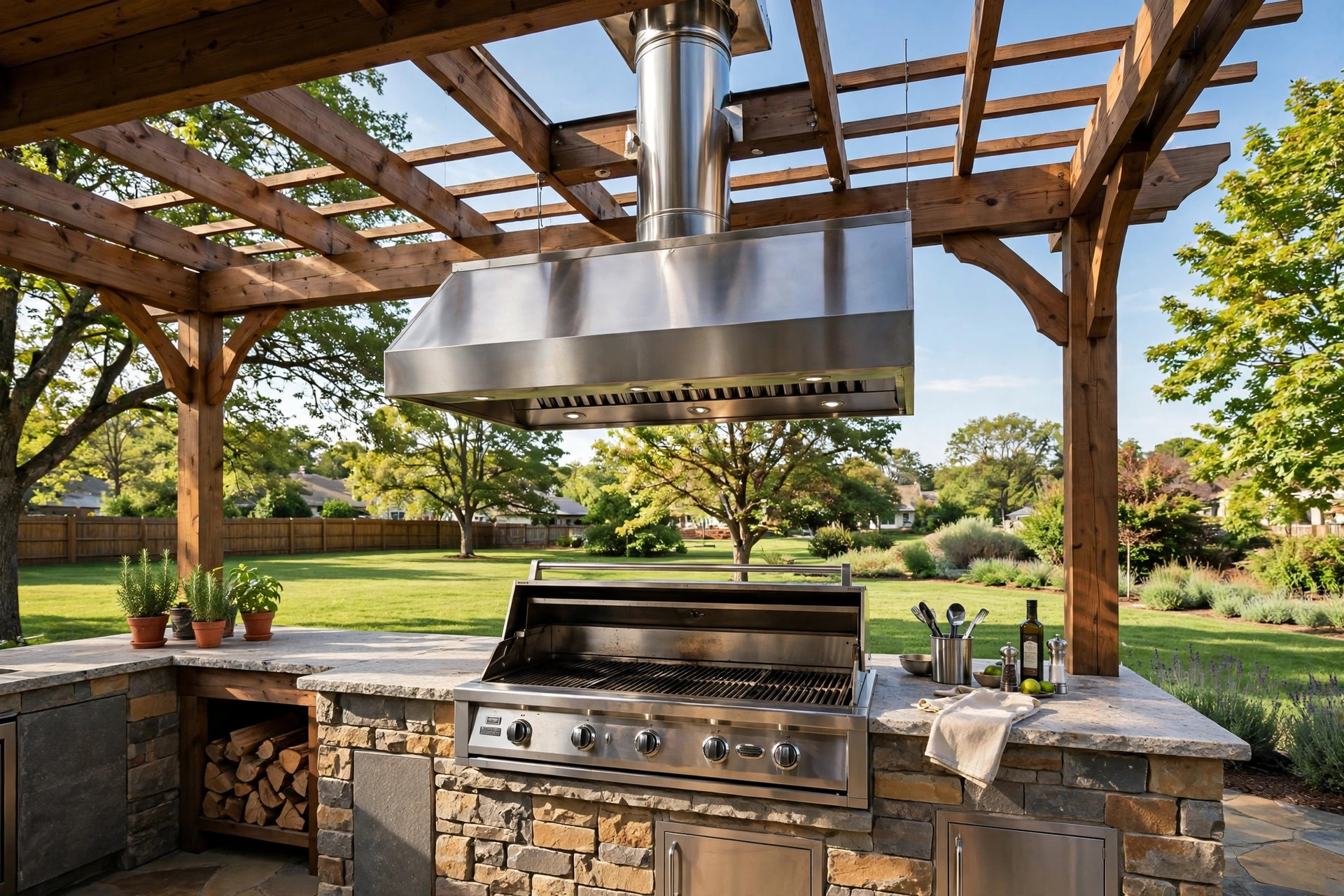

An outdoor kitchen can be a great addition to a home. Many people add grills, smokers, and side burners under a covered patio. But cooking outside still creates smoke, grease, and heat. That is why this outdoor kitchen ventilation requirements guide exists. It explains what you need to know before you build.
The focus keyword may sound long. But the topic is simple. Ventilation moves smoke and grease away from the cook. It keeps the air clear. It also helps meet local rules.
Many homeowners skip this step. They place a grill under a roof and hope the wind does the work. Wind is not a plan. A steady breeze can blow smoke right back into the house. Good ventilation gives smoke one clear path out.
Why Ventilation Matters in an Outdoor Kitchen
Cooking makes more than heat. A grill or a smoker gives off smoke, grease vapor, and carbon monoxide. These rise fast. Under a roof or a pergola with a solid top, they have no place to go. They gather near the ceiling. They stain wood and paint. They set off smoke alarms inside the house.
A vent hood for the outdoor kitchen pulls the smoke up and out. It keeps the cook area clear. The furniture and walls stay cleaner.
Ventilation also matters for health. Carbon monoxide has no color and no smell. Gas grills and charcoal grills both make it. Most of it rises with the heat. But under a low roof, it can pool in dead spots. A working exhaust fan moves it out before it can gather.
Local codes may also demand it. Some towns treat a covered outdoor kitchen like part of the house. They ask for the same clearances and vents used indoors. Others have no rules at all. You must check your own city or county before you build. This outdoor kitchen ventilation requirements guide gives you the questions to ask.
What the Codes and Manufacturers Say: Outdoor Kitchen Ventilation Requirements Guide
There is no single national rule for outdoor kitchen vents. The rules come from local building codes, fire codes, and the manuals that ship with your grill. All three matter.
Start with the grill manual. Every maker lists the clearance that must be kept around the unit. The clearance is the empty space between the grill and anything that can burn. For most gas grills, the back and side clearance is 24 to 36 inches from a wall or rail. The overhead clearance under a roof is often 72 inches or more. These numbers change from model to model. Check the exact numbers in your own manual. Makers such as Weber and Char-Broil print them clearly.
Next, look at local codes. Many cities adopt the International Residential Code or the International Mechanical Code. These codes cover exhaust hoods for indoor ranges. Some building offices apply the same rules to covered outdoor kitchens. They may ask for a hood that extends six inches past the cook surface on each side. They may ask for ducting that goes straight up through the roof. Call your local building office. Ask one clear question: does a range hood over an outdoor grill need a permit here?
Fire codes add another layer. The National Fire Protection Association publishes rules on cooking equipment. Local fire marshals use them. A fire marshal may ask for a certain distance between the grill and the house wall. They may also ask for a non-combustible hood or a rated exhaust fan. A short call now can save a failed inspection later.
How to Choose the Right Ventilation Hood
A hood is not a guess. It has three parts that must fit your kitchen: size, power, and ducting. This section of the outdoor kitchen ventilation requirements guide walks through each one.
Size and Capture Area
The hood must be wider than the cooktop below it. A common rule is six inches of overhang on each side. If your grill is 36 inches wide, your hood should be at least 48 inches wide. The hood should also sit deep enough to catch smoke from front to back. Most outdoor hoods are 24 to 30 inches deep.
The hood also needs the right height. Many makers suggest 36 to 42 inches between the cook surface and the bottom of the hood. Too high and the smoke escapes. Too low and the cook bumps his head. Keep the hood level. A tilted hood lets smoke slip past one side.
CFM Ratings
CFM means cubic feet per minute. It tells you how much air the fan moves. More BTUs need more CFM. A rough rule for outdoor grills is 100 CFM for every 10,000 BTUs of burner power. A 60,000 BTU grill would need about 600 CFM. Wind and open sides make the job harder. Many pros add 10 to 20 percent more power for outdoor use.
Do not buy the loudest fan on the shelf. Check the sone rating too. Sones measure noise. Look for a fan with two or three speeds. Use low speed for slow cooks. Use high speed for searing.
Ducting and Make-Up Air
The duct carries smoke from the hood to the open air. A straight duct works best. Every bend slows the air and lets grease settle. If you must turn, use smooth metal duct, not flex duct. Flex duct traps grease in its folds. Round duct moves air better than square duct of the same size.
Size the duct to the fan. A 600 CFM fan usually needs an 8-inch round duct. A 900 CFM fan often needs a 10-inch duct. The fan manual will list the right size. Keep the run short. Every extra foot of duct costs power.
Types of Outdoor Kitchen Ventilation
Not every outdoor kitchen needs a big stainless hood. The right choice depends on the roof, the fuel, and the budget.
Wall-mount hoods. These attach to a wall or post behind the grill. They work well when the grill sits against the house or a solid wall. The duct can run up the wall and through the roof. Wall-mount hoods cost less than island models.
Island hoods. These hang from the ceiling over a freestanding grill island. They need a strong mount. A pergola beam may not hold the weight. Many island hoods weigh 60 to 100 pounds. Check the beam load before you buy. Island hoods also need ducting through the roof above.
Powered vent fans. Some kitchens use a simple exhaust fan in the ceiling or gable end. A fan costs less than a hood. It works for light cooking, such as a small gas grill. It does not catch grease well. If you sear steaks or use a flat top grill for the outdoor kitchen, a real hood is the better choice.
Natural draft. A few open-air kitchens have no roof at all. Smoke rises and drifts away. This can work. But it fails on still, hot days. It also fails when the wind pushes smoke toward the doors. Even a simple outdoor kitchen design for a backyard can include a small fan for bad days.
Gas, charcoal, and pellet fuels all make smoke. Pellet grills make a steady, light smoke. Charcoal makes heavy smoke at start-up. Gas makes the least smoke but still gives off grease vapor. Size the hood for the smokiest fuel you plan to use. Guidance on how to build an outdoor kitchen on a budget can help you plan the fuel mix before you buy the hood.
Cost and Price
Prices vary widely. A small ductless range hood for a patio grill can cost 200 to 400 dollars. A full-size stainless outdoor hood with a 900 CFM fan can cost 1,500 to 4,000 dollars. Ducting adds 200 to 600 dollars for materials. A pro install can add 500 to 1,500 dollars more.
The roof type drives the cost. A flat roof with open rafters is easy to vent. A vaulted ceiling needs a long duct and a roof cap. A patio with a metal roof may need a pro to cut and seal the opening.
Permits add a small fee in most towns. The fee is often 50 to 200 dollars. An inspection may be needed before you close up the duct. Plan for the permit in your schedule. It can take a week or two to get.
Cheap shortcuts cost more later. An undersized fan leaves grease on the ceiling. A plastic duct can melt or sag. A hood that is too small lets smoke roll out the sides. Spend the money once on the right size. Retailers such as Home Depot stock hoods in many sizes, so you can compare before you buy.
Care and Upkeep
A vent system needs regular cleaning. Grease builds up in the hood, the filters, and the duct. Grease is fuel for fire. A clean system is a safe system.
Wash the baffle filters every month during cooking season. Most filters go in the dishwasher. Check the manual first. Some filters need hand washing. Wipe the inside of the hood with a degreaser. Reach up into the throat of the duct as far as you can.
Inspect the duct once a year. Look for grease pools at the bends. Look for loose joints. Look for rust or holes. A damaged duct lets smoke leak into the attic or roof space. Fix or replace damaged sections right away.
Check the fan motor too. Oil the bearings if the manual calls for it. Listen for new noise. A rattling fan may have a loose blade or a worn bearing. Turn the power off before you touch the motor.
Cover the outdoor hood in winter if you shut the kitchen down. A fitted cover keeps out snow and leaves. Take the cover off before the first spring cook. Check for nests. Birds love a warm duct. Guides from amazingribs.com remind cooks to inspect the whole cook station each spring before lighting up.
Safety Rules to Follow
Safety is the heart of this outdoor kitchen ventilation requirements guide. Follow these rules every time you cook.
Keep the clearance the manual demands. Never store fuel, paper, or wood near the grill. Propane tanks belong upright and away from heat. Charcoal starter fluid stays far from the flame. Kamado-style cookers hold heat for hours after the cook, so check guides from Big Green Egg for cool-down times.
Never use a charcoal grill in a closed space. This includes a garage with the door open. Carbon monoxide can still gather. Keep the grill at least 10 feet from the house wall when possible. Open the patio sides fully during a cook.
Install a smoke and carbon monoxide alarm near the patio doors. Test it each month. Replace the battery each year. An alarm costs little and can save a life. Safety advice from Consumer Reports covers alarm placement in detail.
Keep a fire extinguisher rated for grease fires within reach. A Class K or Class B extinguisher works for grease. Never throw water on a grease fire. Water spreads burning grease. Smother the flame by closing the grill lid if you can do so safely.
Turn off the gas at the tank after every cook. Check hoses for cracks each season. A leak test with soapy water takes five minutes. Bubbles mean a leak. Do not light the grill until the leak is fixed. Reviews and safety notes at The Spruce Eats cover grill upkeep in plain terms.
Frequently Asked Questions
Do I need a vent hood for an outdoor kitchen? You need one if the kitchen has a roof or a solid cover. Smoke and grease rise and gather under the roof. An open kitchen with no roof may vent on its own. But most cooks add at least a fan for still days.
What size hood do I need for a 36-inch grill? Buy a hood at least 48 inches wide. That gives six inches of overhang on each side. The hood should be 24 to 30 inches deep. Hang it 36 to 42 inches above the cook surface.
How many CFM do I need for an outdoor grill? Plan on 100 CFM per 10,000 BTUs of burner power. A 60,000 BTU grill needs about 600 CFM. Add 10 to 20 percent for wind and open sides. The Broil King site lists BTU ratings that help with this math.
Can I use an indoor range hood outside? No. Indoor hoods are not built for rain, heat swings, and wind. They can rust or fail. They may also lack the CFM needed for a grill. Buy a hood rated for outdoor use. Outdoor-rated units use stainless steel and sealed motors.
Does an outdoor kitchen vent need a permit? It depends on your town. Some towns ask for a permit for any exhaust hood. Others ask only if you cut through the roof. Call the building office before you buy. Ask if the hood needs a permit and an inspection.
How often should I clean the vent filters? Clean them once a month in cooking season. Grease builds fast over a hot grill. Wash baffle filters in the dishwasher if the manual allows it. Wipe the hood interior at the same time.
A Short Final Word
Good ventilation is quiet work. You notice it only when it is missing. Plan the hood with the grill, not after it. Size it right. Duct it straight. Clean it often. Check your local rules. Then cook with peace of mind under your own roof.
References
AmazingRibs.com. (n.d.). Barbecue and grilling science. https://www.amazingribs.com Big Green Egg. (n.d.). Kamado grills and outdoor cooking. https://www.biggreenegg.com Broil King. (n.d.). Gas and charcoal grills. https://www.broilkingbbq.com Char-Broil. (n.d.). Gas and charcoal grills. https://www.charbroil.com Consumer Reports. (n.d.). Product reviews and ratings. https://www.consumerreports.org Napoleon. (n.d.). Fireplaces, grills, and heating products. https://www.napoleon.com The Home Depot. (n.d.). Home improvement products. https://www.homedepot.com The Spruce Eats. (n.d.). Recipes and cooking guides. https://www.thespruceeats.com Weber. (n.d.). Grills and outdoor cooking. https://www.weber.com
Was this guide helpful?

About James Carter
The My Garden US editorial team writes practical, in-depth home and garden guides for American homeowners — tested advice, no fluff.
You May Also Like
Charcoal Grill for Beginners Guide: Everything a First-Time Griller Needs to Know
July 16, 2026 0 views
How to Clean a Pellet Grill After Use: A Simple Step-by-Step Guide
March 23, 2026 0 views
The Best Offset Smoker Under 500 Dollars: A Buyer’s Guide
March 6, 2026 0 views