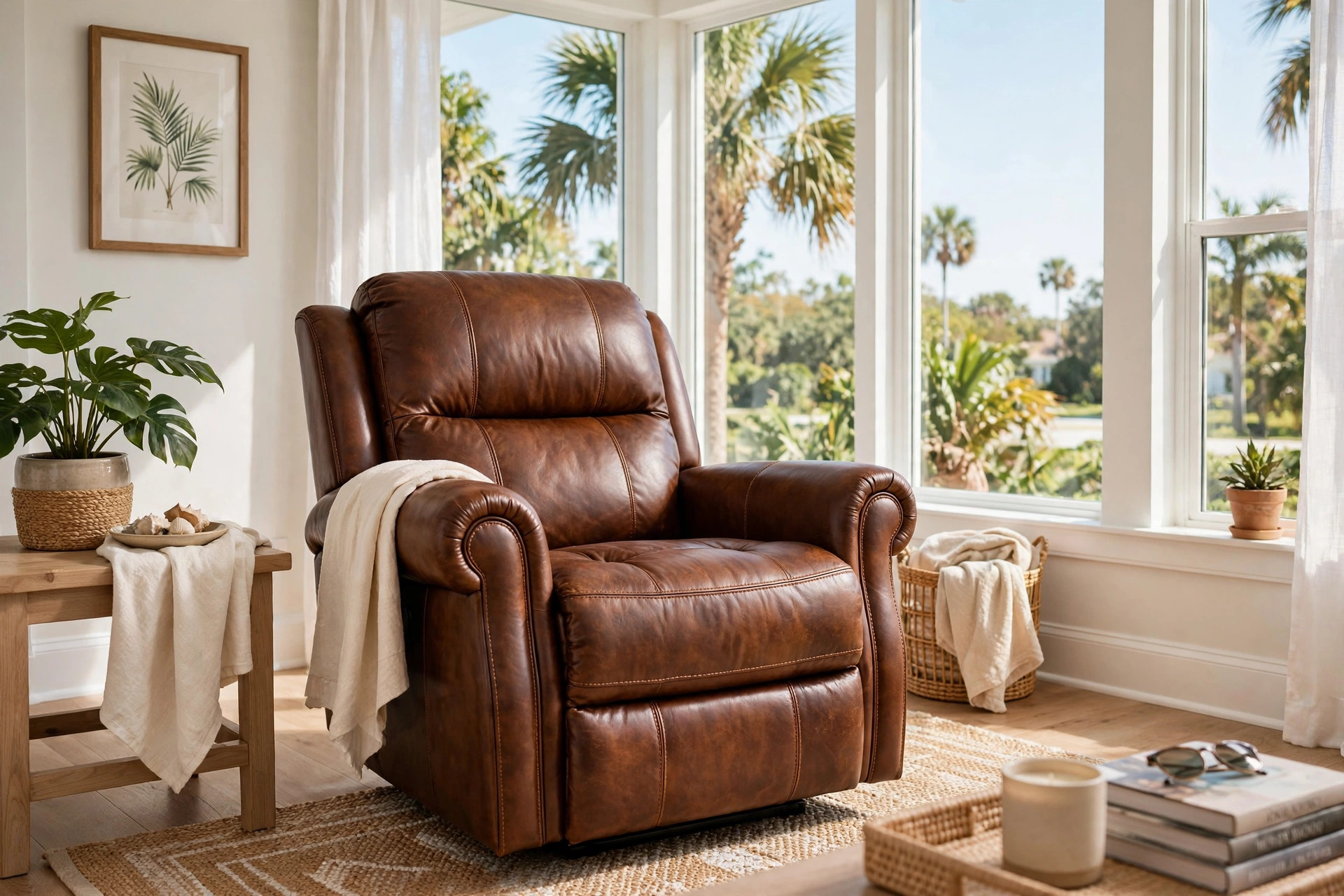

A Chair Worth Choosing Well
A good chair is worth its price. Few chairs earn that praise more fully than the leather recliner. In Florida homes, where the sun is strong and the air stays damp for much of the year, the choice of chair carries extra weight. Leather recliner chairs florida homes usa buyers select must suit the climate as much as they suit the room.
A recliner is more than a seat. It is where the owner reads the morning paper and rests on a slow Sunday afternoon. Florida families spend long hours indoors, cooled by air conditioning while the heat builds outside. The right leather recliner stands up to that life. The wrong one peels, cracks, and fades within a few short years.
This guide covers why leather suits Florida homes, what to look for when shopping, the main types, what you can expect to pay, how to care for the hide, and how to use one safely. It closes with answers to common questions.
Why Leather Recliners Suit Florida Homes: Leather Recliner Chairs Florida Homes Usa
Leather and Florida go well together when the hide is of sound quality. Genuine leather breathes, which matters in a warm climate. A leather seat does not trap heat the way many fabrics do. It feels cool at first touch and warms to the body in seconds.
Leather also wipes clean. Florida homes see their share of spills: iced tea sweating through a glass, a child dropping a snack, a dog jumping up with wet paws after a summer rain. A damp cloth lifts most of these marks from leather before they set, while fabric chairs drink spills in and hold them.
Pets are another reason Florida buyers choose leather. Hair does not cling to it the way it clings to fabric, and a thick top-grain hide resists light claw marks. Smooth leather also holds less pollen and fine sand than fabric, which owners with allergies appreciate.
One caution stands against all of this. Florida sun is fierce. A leather recliner placed in a bright window will fade and dry out faster than one kept in shade. Heat and ultraviolet light are the enemies of good hide. The care section later in this guide explains how to fight them.
What to Look for When You Shop
The Hide
The single most important choice is the grade of leather. Not all leather sold on recliners is equal, and Florida humidity punishes the weak grades hardest.
Full-grain leather is the top grade. It uses the outer layer of the hide, untouched and uncorrected. It is strong, it ages well, and it develops a rich patina with use. It costs the most, but in a Florida home it earns its price.
Top-grain leather is the next grade down. The surface is sanded and finished to remove flaws. Most quality recliners in the mid-price range use top-grain leather, and it serves well for many years.
Split leather and bonded leather sit at the bottom. Bonded leather is made from leather scraps glued together and coated with plastic. It looks like leather in the store, but in Florida heat and humidity it often starts to peel within two or three years. If the price seems too good to be true, check the label. Look for “top grain” or “full grain” instead of the vague “genuine leather.”
The Frame and the Mechanism
A recliner opens and closes hundreds of times a year. Look for a steel mechanism and a hardwood frame, not particleboard. Sit in the chair and work the handle or button several times. The motion should feel smooth and firm, with no grinding and no wobble.
Size and Fit
Recliners come in standard, large, and oversized widths. Measure the space before you shop. A recliner needs room to lean back fully. Most models need about two feet of clearance behind them. Wall-hugger designs need far less, and they suit smaller Florida condos and apartments well.
Sit in the chair before you buy if you can. Your feet should rest flat on the floor when the chair is upright, and the headrest should meet the back of your head. Tall buyers often need a high back. Also measure the narrowest door the chair must pass through. Many models have backs that detach for delivery. Ask the seller before you order.
Color and Style
Leather recliners come in far more than brown. Black, gray, tan, cognac, and burgundy all appear in current lines. Light colors show less dust and reflect heat, which can matter in a sunlit room. Dark colors hide stains but show lint and pet hair.
Style ranges from classic overstuffed models to slim modern frames. A traditional recliner fits a colonial or Mediterranean Florida home, while a clean-lined model suits a modern condo. Browse modern armchair designs or mid-century modern styles to see what is current. Match the chair to the room, not to a passing trend.
Types and Options on the Market
Wall-Hugger Recliners
The wall-hugger reclines forward as it opens, so it needs only four to six inches of clearance behind it. This is the smart pick for tight spaces, which are common in Florida apartments and condos. The trade is a slightly less deep recline than a standard model.
Rocker Recliners
The rocker recliner rests on a curved base and rocks gently, a favorite for nurseries and evening reading. It needs the same rear clearance as a standard recliner.
Power Recliners
A power recliner opens at the touch of a button and stops at any angle. Some add heat, massage, or a USB charging port, which suit older owners who may struggle with a manual lever. The trade is the cord and the motor, which can fail after years of use. Check the motor warranty before you buy.
Manual Recliners
The manual recliner uses a side lever or a simple push-back motion. There is no motor to fail and no cord to hide, and it costs less than a comparable power model. The footrest usually opens in one fixed position rather than stopping anywhere.
Swivel Recliners
The swivel recliner turns on its base, often a full circle. It suits open floor plans, where the sitter may want to face the television or the sliding glass doors in turn. The base must be sturdy, or the chair will wobble with age.
Oversized Recliners
Built for larger sitters, the oversized recliner runs wider and deeper than standard. Measure carefully. An oversized chair can swallow a small room. In a spacious Florida family room, though, it becomes the seat everyone fights over.
Matching Sets
Many makers sell recliners in pairs or as part of a living room set. A set brings a matched look and often a lower price per piece. Some owners prefer to mix one leather recliner with different seating, then tie the room together with luxury area rugs or well-placed floor lamps. Either approach works when done with care.
Cost and Price
Prices for leather recliner chairs florida homes usa shoppers will find span a wide range. What you pay depends on the grade of hide, the mechanism, the brand, and the size.
Budget bonded-leather recliners start around three hundred to six hundred dollars. They look fine in the showroom. In Florida humidity, as noted above, they often peel within a few years. Treat them as short-term seating, not as an investment.
Mid-range top-grain recliners run from about eight hundred to one thousand five hundred dollars. This is the sweet spot for most buyers. A chair in this range, cared for properly, can last ten to fifteen years.
High-end full-grain recliners cost from one thousand five hundred to three thousand dollars and more. Designer names push higher still. You pay for the finest hide, hand finishing, and long warranties. For a primary chair used every day, the cost per year of service often beats the cheaper options.
Watch for sales. Furniture stores in Florida run major sales around Memorial Day, Labor Day, and the winter holidays. Floor models can bring deep discounts, though you should inspect them closely for wear. A wide selection of recliners and leather seating collections online lets you compare prices before you visit a store.
Care and Upkeep in a Florida Climate
Leather asks for little, but it asks regularly. In Florida, the two great threats are sun and humidity swings. Air conditioning dries indoor air, while the outdoor air stays wet. Leather caught between the two can dry on the surface even as moisture lingers beneath.
Dust the chair weekly with a soft dry cloth. Wipe spills at once with a slightly damp cloth, then dry the spot. Never soak the leather, and never use harsh cleaners, bleach, or ammonia.
Condition the leather two to four times a year. Conditioner replaces the natural oils that heat and air conditioning draw out. Apply a thin coat, let it absorb, and buff off the excess. Test any new product on a hidden spot first, such as the back of the chair near the floor. Leather care guides such as The Spruce give the same advice for all fine upholstery.
Keep the chair out of direct sun. Move it a few feet from bright windows, or use curtains and blinds during the harshest afternoon hours. If the chair must sit near glass, a light throw draped over the seat and arms shields it well. Many owners of contemporary furniture follow this same habit with all their upholstered pieces.
Mind the humidity. If your home runs very dry from constant air conditioning, a small room humidifier near the seating area helps the leather. If the home runs damp, good ventilation matters more. Either extreme shortens the life of the hide.
For moving and storage, never drag a recliner across the floor. Lift it, or use furniture sliders. If you must store one between seasons, keep it in a climate-controlled space. A hot garage will bake the leather in a single Florida summer. Wrap it in breathable cloth, not plastic, so moisture cannot trap against the hide.
Safety
A recliner is a machine with moving parts, and it deserves respect. Keep fingers, especially small ones, clear of the mechanism when opening or closing the footrest. Teach children not to play under or behind a reclining chair.
Power recliners add cords. Run the cord along the wall or under a rug, never across a walkway where it becomes a trip hazard. Unplug the chair during long absences and during lightning storms, which Florida sees often.
Elderly users should choose a chair they can exit easily. A seat that sits too low or reclines too far can trap a person with weak knees. Power lift recliners, which tilt forward to help the sitter stand, solve this problem and are worth considering for older Floridians. General home furnishing guidance covers stable placement and safe use of heavy seating.
Anchor the habit of closing the footrest before standing. An open footrest is a common cause of stumbles. Keep the area around the chair clear of toys, shoes, and pet beds.
Frequently Asked Questions
Is leather or fabric better for a recliner in Florida?
Leather usually wins in Florida. It resists humidity better than most fabrics, wipes clean after spills, and does not trap heat the way heavy cloth does. Fabric costs less up front and offers more patterns, but it fades in strong sun and holds stains. For a chair used daily, leather is the practical pick.
How long should a leather recliner last?
A top-grain leather recliner, cared for as this guide describes, should last ten to fifteen years. Full-grain models can last longer. Bonded leather often fails within two to five years in Florida conditions.
Will my leather recliner make me sweat in summer?
Less than you might fear. Leather feels cool at first touch and does not insulate the way thick fabric does. In an air-conditioned room, most owners find leather comfortable year-round. Perforated leather, offered on some models, breathes even better.
Can I put a leather recliner on a screened lanai?
Only with caution. A screened lanai still admits humidity, sun, and temperature swings, and leather left there will age fast. Keep the leather chair inside, where the climate stays controlled.
What is the best way to remove a stain from leather?
Act fast. Blot, do not rub, with a clean dry cloth. For most food and drink spills, a cloth barely dampened with water finishes the job. For grease, sprinkle a little cornstarch or baking soda, leave it for some hours, and brush it off gently. For ink or dye transfer from jeans, use a leather cleaner made for the purpose. When in doubt, call a professional leather cleaner before the stain sets.
Do leather recliners need to be broken in?
Somewhat. A new leather recliner feels firm for the first weeks. The cushions soften and the hide loosens with regular use. Buy for the long term, not the first sit.
A Final Word
A leather recliner is one of the most personal purchases a homeowner makes. It holds your weight every day and anchors the room around it. In Florida, where heat and humidity test every material, the choice of hide and the habit of care matter more than anywhere else.
Buy the best grade of leather your budget allows. Test the mechanism. Measure the room twice. Keep the chair from the sun, feed the leather twice a year, and close the footrest before you stand. Do these simple things, and your recliner will serve you well for a decade or more.
Pair the chair with pieces that complete the room. A side table within reach, a reading lamp at the right height, and perhaps rustic console tables along the far wall turn a single seat into a corner of the home you will never want to leave. For broader design inspiration and small-space living tips, the linked guides are a fine place to start.
References
Apartment Therapy. (n.d.). Home design ideas and inspiration. https://www.apartmenttherapy.com Article. (n.d.). Modern furniture. https://www.article.com CB2. (n.d.). Modern furniture and decor. https://www.cb2.com Crate and Barrel. (n.d.). Furniture and home decor. https://www.crateandbarrel.com Houzz. (n.d.). Home design and remodeling. https://www.houzz.com IKEA. (n.d.). Home furnishings. https://www.ikea.com The Spruce. (n.d.). Home and garden advice. https://www.thespruce.com Wayfair. (n.d.). Furniture and home goods. https://www.wayfair.com West Elm. (n.d.). Modern furniture and home decor. https://www.westelm.com
Was this guide helpful?

About David Wilson
The My Garden US editorial team writes practical, in-depth home and garden guides for American homeowners — tested advice, no fluff.
You May Also Like

Velvet Living Sofas USA Online Deals: What to Know Before You Buy
June 14, 2026 0 views
Modern Farmhouse Tables Deals Near Me: A Buyer Guide
May 6, 2026 0 views
Sofa Console Tables: Where to Buy in the USA
June 30, 2026 0 views