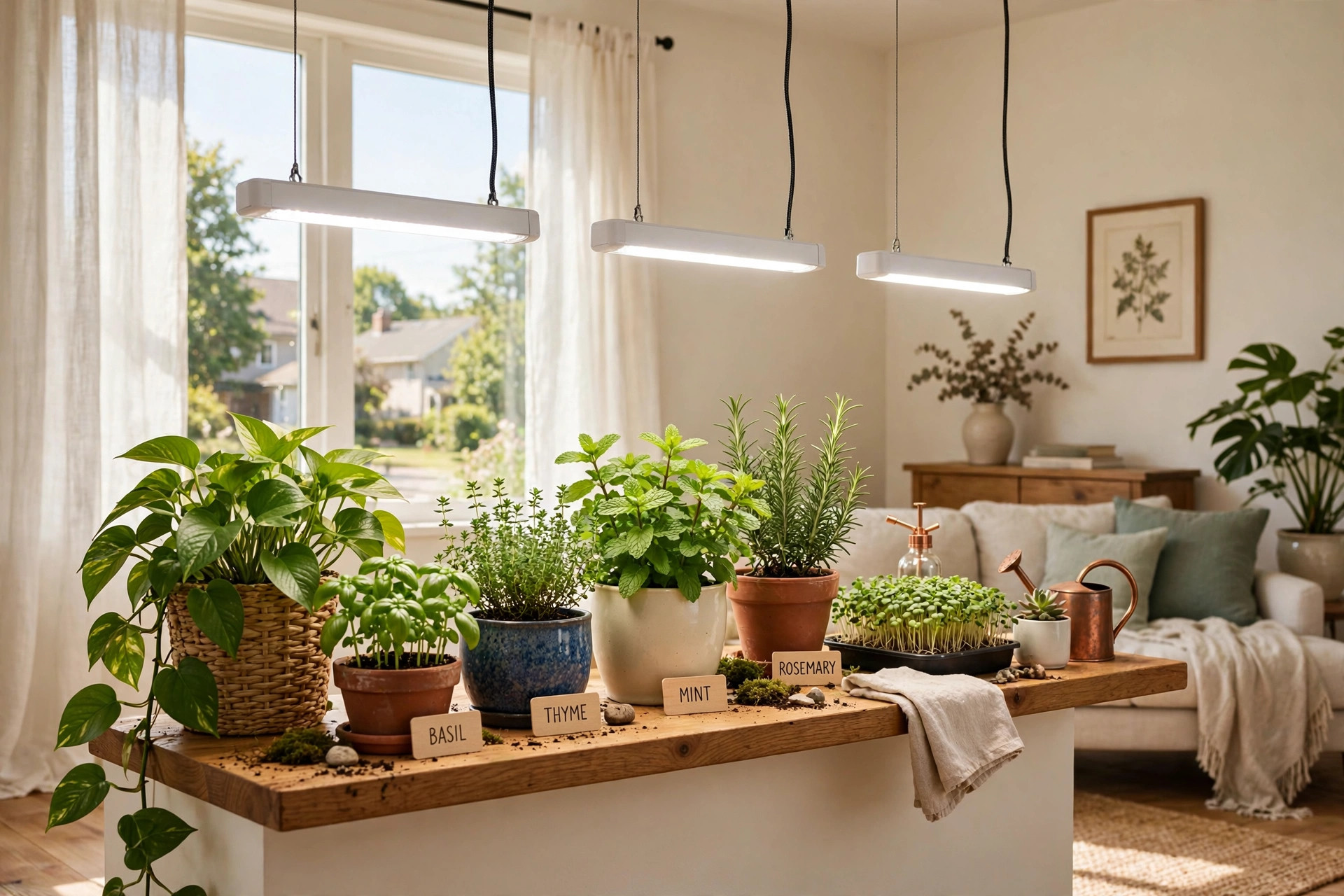

Many homes in the United States do not get enough sun for indoor plants. This is where this indoor grow lights buying guide usa comes in. Windows face the wrong way, winter days are short, and deep rooms stay dark all year. With the right grow light, you can raise herbs, houseplants, and seedlings in any room of the house. This guide will help you choose the right light, pay a fair price, and use it with care.
Why Indoor Grow Lights Matter
Plants need light to make food. The process is called photosynthesis. Without enough light, a plant grows tall and weak. Its stems stretch, its leaves turn pale, and it may drop its leaves one by one. A good grow light gives the plant the light it lacks.
Most houseplants come from warm places near the equator. They are used to bright, steady light for ten to twelve hours a day. A north-facing window in Chicago in January cannot give them that. A grow light fills the gap. It can also let you start a kitchen garden. Basil, mint, lettuce, and green onions grow well under lights. Seeds that you start indoors in February can move outside when the weather warms.
Grow lights also give you control. You decide how many hours of light the plant gets each day. You decide how bright the light is. A timer can turn the light on and off on its own. The result is a steady routine, and plants respond well to a steady routine.
How to Choose the Right Grow Light: Indoor Grow Lights Buying Guide Usa
Measure Your Space
Start with a tape measure. Note how wide the shelf, table, or tent is. The light should cover the whole growing area. A small desk plant needs a light only a few inches wide. A four-foot shelf of seed trays needs a four-foot bar or tube. Light that misses the plant is wasted money and wasted power.
Match the Light to the Plant
Different plants need different amounts of light. Herbs and leafy greens do well with medium light. Fruiting plants such as tomatoes and peppers need strong light. Seedlings need gentle light at first, then brighter light as they grow. Most LED panels and bars let you raise or lower the unit, or change the brightness with a dimmer. A dimmer is a useful feature. It lets one light serve many kinds of plants.
Check the Color of the Light
Plants use blue and red light most. Blue light helps leaves grow. Red light helps flowers and fruit. Many modern grow lights look white or warm white to the human eye, and that is fine. The label may list the color temperature in kelvin. Lights around 4000 to 6500 kelvin work well for green growth. Lights around 2700 to 3500 kelvin suit flowering plants. A full-spectrum white light is a safe choice for mixed houseplants. You do not need a purple or pink lamp unless you grow only one kind of plant.
Read the Brightness Numbers
Packages list brightness in a few ways. PAR and PPFD are the terms used for plants. PPFD is the useful one. It tells you how much light the plant gets at a given height. For low-light houseplants, a PPFD of 100 to 200 is enough. For herbs and vegetables, look for 400 to 700. Fruiting plants may need 800 or more. Many brands post PPFD maps that show how the light spreads. The U.S. Department of Energy publishes plain guides on lighting terms, and Energy Star sets rules for honest lamp labels. Use those guides to read a package with confidence.
Types of Indoor Grow Lights
LED Panels and Quantum Boards
LED is the standard choice today. Panels run cool, last for years, and use little power. A full-spectrum LED board is the most common type sold in the United States. Prices range from about 30 dollars for a small panel to over 200 dollars for a strong one.
Bar and Tube Lights
Long bars and tubes fit under shelves and inside cabinets. They are slim and easy to mount with clips or screws. A two-foot or four-foot bar suits most home setups. Bars are a good pick for seed starting racks. Shoppers who want a tidy under-shelf setup may also read our under cabinet strips buying guide usa for low-profile options.
Clip-On and Desk Lamps
Small clip lamps and gooseneck lamps serve one or two pots. They cost little and plug into any outlet. They are not strong enough for a full tray of seedlings, but they are fine for a pothos or a fern on a dark desk.
Bulbs That Screw Into Sockets
Grow bulbs fit standard lamp sockets. You can place one in a floor lamp or a hanging cord and aim it at a plant. This is the cheapest way to start. One bulb covers about a two-foot circle of light.
Smart and Wi-Fi Lights
Some grow bulbs and panels link to a phone app or a voice assistant. You can set schedules, change brightness, and check power use from the couch. If you like the idea of a connected home, our wifi smart bulbs buying guide usa explains the basics of smart lighting control.
Cost and Price in the USA
A small LED grow bulb costs between 10 and 25 dollars. A clip-on lamp costs 15 to 35 dollars. A two-foot bar light costs 25 to 60 dollars. A full four-foot fixture or a strong panel costs 60 to 250 dollars. Large multi-panel systems for serious hobby growers can cost 300 dollars or more.
Running costs are low. A 40-watt LED panel used 14 hours a day costs roughly 1.50 to 2.50 dollars a month in most states. Older fluorescent or high-pressure sodium lamps cost far more to run and also add heat to the room. Over two or three years, an LED unit pays for itself through lower power bills. Philips and other makers publish wattage and life ratings so you can compare the true yearly cost.
Watch for extra costs too. You may need a timer, a hanging kit, or a surge protector. A simple outlet timer costs about 10 dollars. A sturdy adjustable hanger costs 15 to 30 dollars. Some growers buy a light meter or a small fan, but neither is required to start.
If you are ready to compare models and prices, see our indoor grow lights for sale usa page for current options across the common sizes.
Care and Upkeep
Keep the light clean. Dust on the lens or panel blocks light and traps heat. Wipe the surface with a dry cloth every month or two. Never use a wet rag on a plugged-in light.
Check the hanging height often. Seedlings start close to the light, about four to six inches away. As plants grow, raise the light so leaves do not touch the surface. Touching leaves can burn even under cool LED lamps.
Watch the plant, not the calendar. Pale new growth may mean the light is too far. Burnt leaf tips may mean it is too close. Move the unit an inch or two at a time and wait a week before you move it again.
Give plants rest. Most plants need 12 to 16 hours of light and 8 to 12 hours of dark. A timer makes this easy. Running a light for 24 hours a day stresses the plant and wastes power.
Replace or retire old lights when output drops. Quality LED units last 25,000 to 50,000 hours. If growth slows after years of use, the diodes may be fading. A fresh unit brings the garden back to full speed.
Safety Tips for Home Growers
Buy lights that carry a recognized safety mark, such as UL or ETL. A listed mark means the product passed independent safety tests. Unmarked lamps from unknown sellers can overheat or have weak wiring.
Do not overload outlets. A grow light draws steady current for many hours. Plug it into an outlet or power strip that is rated for the load, and give the strip room to breathe. Keep cords away from water. Indoor gardens involve watering, and wet cords are a real hazard.
Mind the heat. LED lights run much cooler than old bulbs, but strong panels still get warm. Keep them away from curtains, paper, and wooden shelves. Leave a few inches of air above the unit.
Protect your eyes. Strong grow lights can hurt your eyes if you stare into them. Mount the light so it points down at the plants, not out into the room. Wear ordinary sunglasses when you work under very bright panels for a long time. The U.S. Consumer Product Safety Commission is not on this category list, but general lamp safety rules still apply to any plug-in light in the home.
Keep lights out of reach of small children and pets. Hanging units are the safest choice, since cords run high and hot surfaces stay out of touch.
Frequently Asked Questions
How many hours a day should I run a grow light?
Most houseplants do well with 12 to 14 hours of light. Herbs and vegetables like 14 to 16 hours. Seedlings start at 12 hours and move up as they grow. Give every plant a dark rest period of at least 8 hours. A cheap outlet timer keeps the schedule steady.
Can I use a regular LED bulb as a grow light?
A bright daylight LED bulb can help a low-light plant survive. It will not replace a true grow light for herbs, vegetables, or seedlings. Grow lights are built to put out the red and blue bands that plants use most. If your plant only needs a little help, a strong white bulb aimed close may be enough.
How close should the light hang above the plants?
It depends on the strength of the unit. Small clip lamps work at 6 to 12 inches. Mid-size panels work at 12 to 18 inches. Strong commercial panels may need 24 inches or more. Start with the distance on the package, then watch the leaves for a week and adjust.
Do grow lights work through a window?
No. Glass and screens block a large share of useful light. Place the grow light inside the room, above or beside the plant. A window plus a grow light is a fine pair, but the light should shine on the plant directly.
Will a grow light raise my power bill a lot?
Not much. A typical home LED grow light uses 20 to 60 watts. Run for 14 hours a day, that is less than 1 kilowatt-hour per day. In most of the United States, that costs a few dollars a month. The Energy Star program at Energy Star lists efficient models that cost even less to run.
Are purple grow lights better than white ones?
No. Early grow lights looked purple because they mixed only red and blue diodes. Modern full-spectrum white lights give plants the same useful light and look much nicer in a living room. White light also lets you see the true color of your plants, which helps you spot pests and disease.
A Short Final Word
Choosing an indoor grow light is not hard once you know the basics. Measure your space, match the light to your plants, and buy a listed unit from a known brand. Start small if you are new. One good panel over a shelf of herbs will teach you more in a season than any chart. Many gardeners browse seed catalogs at Burpee or indoor growing supplies at Gardeners for ideas, then compare fixture prices at big retailers like Home Depot and Lowes. Design-minded growers may also look at Lumens and Lamps Plus for fixtures that suit the room as well as the plant. For plain, step-by-step growing advice, The Spruce is a handy read. With steady light, steady water, and a little patience, an indoor garden can thrive in any American home, in any season.
References
Burpee. (n.d.). Seeds, plants, and gardening supplies. https://www.burpee.com ENERGY STAR. (n.d.). Energy efficient products. https://www.energystar.gov Gardener’s Supply Company. (n.d.). Gardening tools and supplies. https://www.gardeners.com Lamps Plus. (n.d.). Lighting and home decor. https://www.lampsplus.com Lowe’s. (n.d.). Home improvement products. https://www.lowes.com Lumens. (n.d.). Lighting and ceiling fans. https://www.lumens.com Philips. (n.d.). Lighting products. https://www.philips.com The Home Depot. (n.d.). Home improvement products. https://www.homedepot.com The Spruce. (n.d.). Home and garden advice. https://www.thespruce.com U.S. Consumer Product Safety Commission. (n.d.). Product safety information. https://www.cpsc.gov U.S. Department of Energy. (n.d.). Energy efficiency and renewable energy. https://www.energy.gov
Was this guide helpful?

About Emily Rodriguez
The My Garden US editorial team writes practical, in-depth home and garden guides for American homeowners — tested advice, no fluff.
You May Also Like
Indoor Wall Sconces for Florida Homes USA: A Practical Guide
May 30, 2026 0 views
Where to Buy Deck Cap Lights in the USA: A Full Guide
August 30, 2026 0 views
Garage Shop Lights Reviews Buying Guide USA
June 1, 2026 0 views