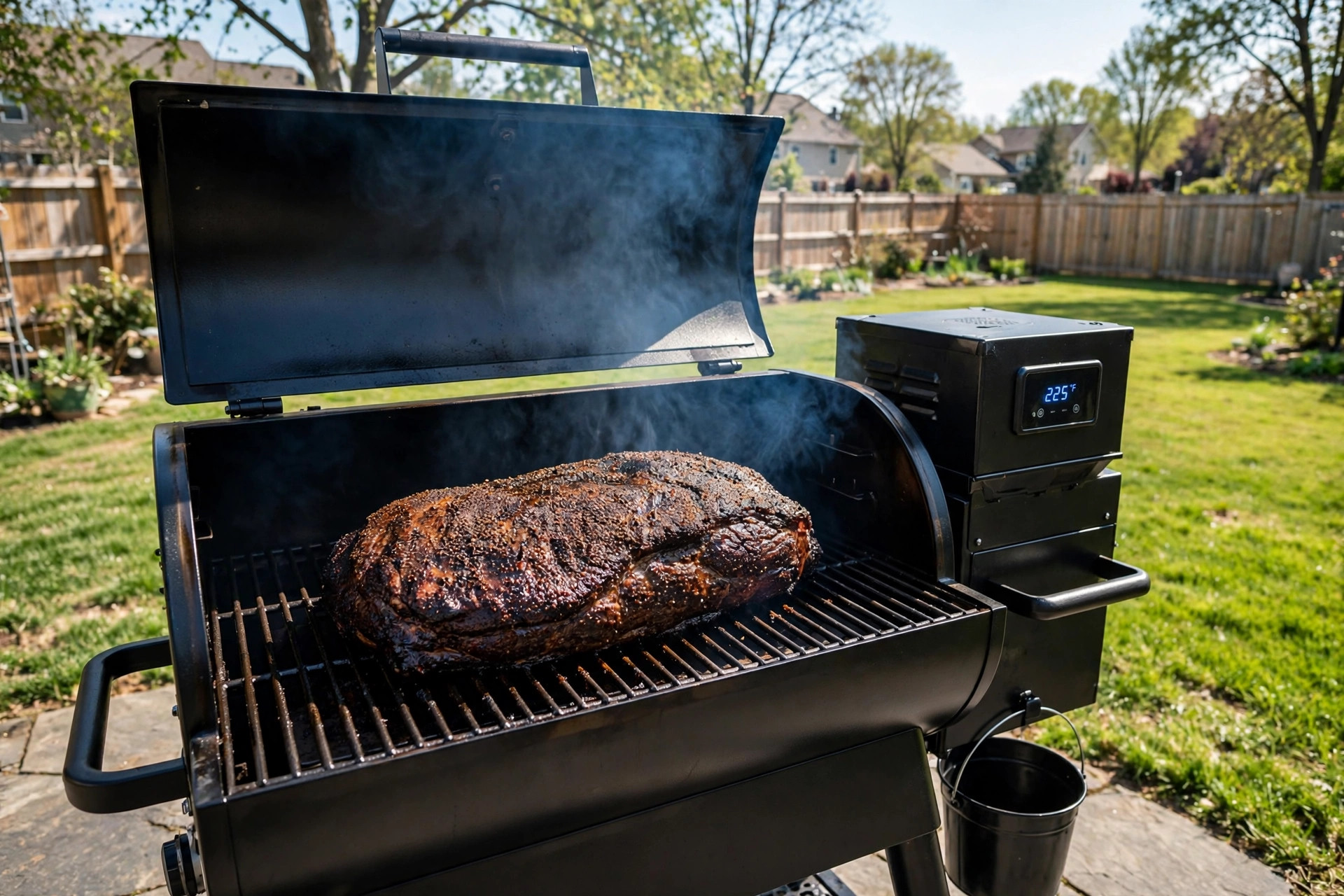

If you want to learn how to smoke brisket on pellet grill, you have come to the right place. Brisket is a tough cut of beef from the chest of the cow. When you cook it low and slow over wood smoke, it turns rich and tender. A pellet grill makes the job much easier than an old wood or charcoal smoker. The grill feeds wood pellets into the fire by itself and holds a steady heat for hours. This guide walks you through each step in plain terms: pick the meat, trim it, season it, set up the grill, manage the long cook, wrap at the right time, rest the meat, and slice it the right way.
Why a Pellet Grill Works Well for Brisket
A brisket needs ten to fourteen hours in most cases. That is a long time to watch a fire. A pellet grill takes care of the hard part. An electric auger feeds wood pellets into a small fire pot. A fan keeps the fire burning. A thermostat checks the heat and adjusts the pellet feed to hold your chosen temperature. You set it at 225 degrees and the grill stays near 225 degrees for hours.
The steady heat matters more than anything else. Brisket is full of tough connective tissue. That tissue only breaks down into soft gelatin when the meat stays hot inside for a long time. If the heat jumps up and down, the meat dries out. A pellet grill holds the line.
Wood pellets also add clean smoke flavor. Pellets are made from compressed hardwood sawdust. Hickory, oak, and mesquite pellets are common picks for beef. The smoke is milder than a stick burner, but it is steady and clean.
What You Will Need Before You Start: How to Smoke Brisket on Pellet Grill
You do not need much gear. Gather these items the day before.
– A whole packer brisket, 10 to 14 pounds, with a thick fat cap. – Coarse salt and coarse black pepper for the rub. That is all you truly need. – Yellow mustard or plain olive oil as a binder, if you like. – Butcher paper or heavy-duty foil for wrapping. – A good leave-in meat thermometer with two probes, one for the meat and one for the grill. – Wood pellets. Oak or hickory blends work well for beef. – A sharp slicing knife and a large cutting board. – A cooler or an empty oven for resting.
Start with a full hopper of pellets. A long brisket cook can burn through 15 to 20 pounds of pellets. Check the hopper every few hours. Running out of pellets in the middle of the night will ruin the cook.
Clean the grill before you start. Empty the ash from the fire pot and scrape the grates. Old ash can choke the fire and cause heat swings.
How to Choose a Good Brisket
Go to a butcher or a good meat counter. Look for a whole packer brisket, which has two parts still joined: the flat, which is lean and even, and the point, which is thick and marbled. The packer cooks more evenly than a flat alone because the fat from the point keeps the lean part moist.
Pick a brisket that bends. Hold it in the middle and let the ends flop. A flexible brisket has less tough tissue and cooks more evenly. Look for even thickness across the flat. Avoid one that is thin on one end and thick on the other, since the thin end will dry out.
Buy the brisket one or two days before the cook. Keep it cold in the fridge. Take it out about an hour before you start trimming so the surface is not ice cold.
Trimming the Brisket
Trimming is the part most new cooks fear. It is simpler than it looks. Work on a large cutting board with a sharp boning knife.
Start with the fat cap side down. Cut away the thick, hard chunks of fat, especially the big lump between the point and the flat. Hard fat will not melt during the cook. Leave a thin, even layer of soft fat about a quarter inch thick on the cap side. This fat will baste the meat as it cooks.
Flip the brisket over. Shave off the thin, silvery membrane called silver skin from the meat side. Silver skin does not melt, and rub will not stick to it. Square off thin, ragged edges on the flat, since these thin bits will burn before the rest is done.
Seasoning the Meat
Simple seasoning wins with brisket. The classic Texas rub is just coarse salt and coarse black pepper, mixed about half and half. If you use a binder, spread a thin coat of yellow mustard over the meat before the rub. Then coat the brisket on all sides with a heavy, even layer of rub. Be generous.
Wrap the seasoned brisket in plastic wrap and set it in the fridge for a few hours, or overnight if you have time. Cold meat takes on more smoke when it first hits the grill, which is one reason many pitmasters start with cold meat.
Setting Up the Pellet Grill
Fill the hopper with pellets and start the grill. Set the temperature to 225 degrees Fahrenheit. Let it run for 20 to 30 minutes with the lid closed so the heat settles. Place a grill-level thermometer probe on the grate near where the brisket will sit. The built-in probe on the grill can read 15 to 25 degrees high or low, so the grate probe tells you the true cooking temperature.
Place a water pan under the grate if your grill allows it. A simple foil pan with hot water adds moisture to the cooking chamber and keeps the meat from drying. It also steadies the heat.
Put the brisket on the grate fat side up or fat side down. Both work. Fat side up lets the melting fat baste the meat. Fat side down shields the meat from the heat if your grill runs hot from below. Many pellet grills heat from below, so fat side down is a safe default. Slide the meat probe into the thickest part of the flat, away from fat pockets.
Close the lid and leave it alone. Resist the urge to open the grill every hour. Each peek lets out heat and adds 15 minutes to the cook. Pellet grill makers such as Weber and Traeger publish startup and seasoning guides for their own models that walk through the same steps.
The Long Cook: What to Expect
The cook moves through clear stages. Knowing them keeps you calm.
The first four to six hours. The brisket takes on smoke and the dark bark forms. The outside turns deep red, then almost black. That dark color is normal. It is the bark, a crust of rub, smoke, and rendered fat. Do not panic and do not wrap yet.
The stall. Somewhere around 150 to 165 degrees inside, the temperature stops rising. It may sit there for three or four hours. This is the stall. Moisture rising from the meat cools it as fast as the grill heats it, like sweat cooling your skin. It is normal. Do not raise the heat to fight it. Wait it out.
The wrap. When the bark is dark and set, usually around 165 to 175 degrees inside, it is time to wrap. Wrap the brisket tight in butcher paper or foil. Butcher paper keeps the bark firm. Foil seals tighter and cooks a bit faster, but it can soften the bark. Put the wrapped brisket back on the grill. After wrapping, you can raise the grill to 250 degrees.
The finish. The brisket is done when a probe slides into the thickest part of the flat with almost no resistance, like pushing into soft butter. This usually happens between 200 and 205 degrees inside, but feel matters more than the number. Start checking around 195 degrees.
Total time for a 12-pound packer is often 10 to 14 hours. Plan for the long end. It is better to finish early and rest the meat than to serve late.
Resting and Slicing
Resting is not optional. Pull the wrapped brisket off the grill and let it rest at least one hour. Two hours is better. Set it in a dry cooler or a turned-off oven. During the rest, the juices settle back into the meat and the temperature evens out. A brisket sliced too soon will spill its juices on the board.
Unwrap the brisket over a tray to catch the juices. Pour those juices over the sliced meat later. Separate the point from the flat along the thick layer of fat between them. Slice the flat across the grain into pencil-thick slices. Look at the meat and find the lines of the muscle fibers, then cut across them. Slicing with the grain makes chewy meat no matter how well you cooked it. The point has a different grain direction, so turn it and slice it separately.
Cost and Price
A whole packer brisket usually costs between 3 and 6 dollars per pound at a grocery store, so a 12-pound brisket runs 36 to 72 dollars. Prime grade costs more. Pellets add about 15 to 25 dollars for a long cook, since you may burn a full 20-pound bag at around a dollar a pound.
The grill itself is the big cost. Entry-level pellet grills start around 400 to 500 dollars. Mid-range models with better temperature control run 800 to 1,200 dollars. Check buying guides from sources like Consumer Reports before you buy, since build quality and temperature accuracy vary a lot between brands and models.
Compared with eating out, home-smoked brisket is a bargain. A restaurant plate of brisket can cost 20 dollars or more. One home cook can feed ten people for less than 100 dollars in meat and fuel.
Care and Upkeep
Clean the grill after every long cook. Empty the ash from the fire pot once it is cool. Scrape the grates while they are still warm. Empty the grease bucket, since brisket gives off a lot of fat and old grease is a fire risk. Store pellets in a sealed bucket in a dry place. Damp pellets crumble and jam the auger.
Safety
Keep the grill at least ten feet from your house, deck rails, and anything that can burn. Never use a pellet grill in a garage or under a low roof, even with the door open. The grill makes carbon monoxide, which you cannot see or smell.
Wear heat-proof gloves when you handle a hot brisket. A full packer is heavy and slippery when hot. Use two hands and a wide tray.
Keep a fire extinguisher rated for grease fires near your cooking area. Never pour water on a grease fire. Cook the meat to a safe finish. Brisket cooked past 200 degrees inside is well beyond the safe zone for beef. Refrigerate leftovers within two hours.
Frequently Asked Questions
How long does it take to smoke a brisket on a pellet grill? Plan on one to one and a half hours per pound at 225 degrees. A 12-pound packer often takes 10 to 14 hours, plus at least one hour of rest. The meat is done when a probe slides in with no resistance, not when the clock says so.
What temperature should I set my pellet grill for brisket? Set it to 225 degrees Fahrenheit for most of the cook. After wrapping, you can raise it to 250 degrees to finish faster. Lower heat gives more smoke flavor, while higher heat shortens the cook.
What pellets are best for brisket? Oak is the classic choice for beef. Hickory gives a stronger smoke flavor. Many cooks use an oak-hickory blend. Avoid fruit woods like apple as your only pellet for brisket, since they are too mild for such a large cut. Use food-grade hardwood pellets with no fillers.
Should I wrap my brisket, and when? Yes, wrap when the bark is dark and set, usually around 165 to 175 degrees inside. Butcher paper keeps the bark firm. Foil cooks a little faster but softens the bark. Either way, wrapping pushes the meat through the stall and keeps it moist.
Can I smoke a brisket overnight on a pellet grill? Yes, and many cooks prefer it. The pellet grill holds its temperature on its own, so you can sleep while it works. Fill the hopper full before bed, set a meat thermometer alarm for 165 degrees so you wake for the wrap, and keep the grill well away from the house.
A Final Word
Learning how to smoke brisket on pellet grill takes patience more than skill. The grill handles the fire. Your job is to pick good meat, trim it with care, season it simply, and give it time. Do not rush the stall. Do not skip the rest. Slice across the grain. Follow these steps and your first brisket can stand next to any backyard cook in the county. Keep notes on each cook, and every brisket will be better than the last.
For more reading on outdoor cooking, sites like The Spruce Eats and AmazingRibs cover smoking science in plain detail. Makers such as Big Green Egg, Broil King, Char-Broil, and Napoleon publish guides for their own cookers that apply to most pellet grills.
If you enjoyed this kind of long, slow cook, you may also like our guide to smoking pork shoulder on the grill. When you are ready to set up a full cooking area, see our piece on the best outdoor grill station with storage. And if you ever want to compare fuel types, read our guide to the best charcoal grill for backyard bbq.
References
AmazingRibs.com. (n.d.). Barbecue and grilling science. https://www.amazingribs.com Big Green Egg. (n.d.). Kamado grills and outdoor cooking. https://www.biggreenegg.com Broil King. (n.d.). Gas and charcoal grills. https://www.broilkingbbq.com Char-Broil. (n.d.). Gas and charcoal grills. https://www.charbroil.com Consumer Reports. (n.d.). Product reviews and ratings. https://www.consumerreports.org Napoleon. (n.d.). Fireplaces, grills, and heating products. https://www.napoleon.com The Spruce Eats. (n.d.). Recipes and cooking guides. https://www.thespruceeats.com Traeger. (n.d.). Wood pellet grills. https://www.traeger.com Weber. (n.d.). Grills and outdoor cooking. https://www.weber.com
Was this guide helpful?

About Robert Taylor
The My Garden US editorial team writes practical, in-depth home and garden guides for American homeowners — tested advice, no fluff.
You May Also Like
How to Choose the Best Grill for Smoking and Grilling
April 13, 2026 0 views
How to Grill Scallops Without Overcooking
March 31, 2026 0 views
Best BBQ for Fathers Day Gift: How to Choose the Right One
May 15, 2026 0 views