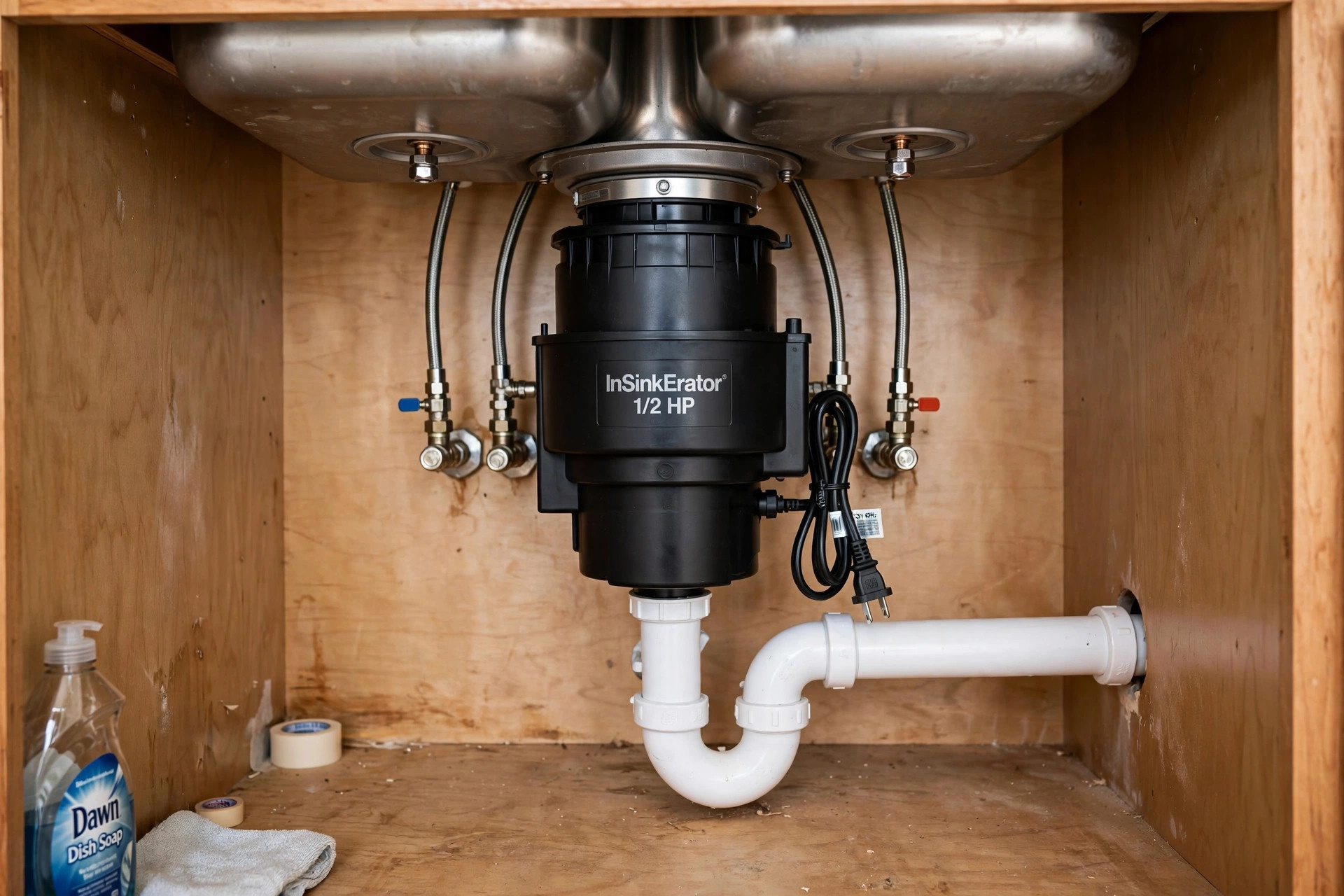

A garbage disposal is one of the most-used appliances in an American kitchen. It grinds food scraps so they wash away with the drain water. This garbage disposal installation reviews buying guide usa walks you through the whole process. It explains how to choose the right unit, what installation involves, what reviewers say, and how much it all costs. By the end, you will know which disposal fits your home and whether to install it yourself or hire a plumber.
Why a Garbage Disposal Matters
Kitchen scraps are a daily fact of life. Peels, cores, coffee grounds, and plate waste pile up fast. A garbage disposal grinds these scraps into fine bits that flow through your plumbing. The kitchen stays cleaner. The trash can fills more slowly. Odors stay down.
For American homes built in the last fifty years, the disposal is almost standard equipment. Buyers expect it. Real estate agents list it as a feature. Homeowners who replace an old unit often notice the kitchen feels more modern right away.
Reviews of disposals in the United States return to a few themes again and again. Noise is the first. Power is the second. Ease of installation is the third. Shoppers want a unit that is quiet, strong, and simple to fit. The best-reviewed models score well on all three. Keep this in mind as you read the sections below.
Types of Garbage Disposals: Garbage Disposal Installation Reviews Buying Guide Usa
Two main types dominate the American market. Each has loyal fans.
Continuous Feed Disposals
A continuous feed disposal is the most common type in American homes. You flip a wall switch, and the motor runs while you feed scraps into the drain. It is fast and convenient. Most undermount stainless sinks pair well with this type, since the disposal mounts to the sink flange under the basin.
Reviewers like continuous feed models because they cost less and install in more kitchens. The downside is safety. The unit runs with the drain open, so a fork or spoon can fall in while it grinds. Never put your hand in a running disposal.
Batch Feed Disposals
A batch feed disposal only runs when you load scraps and twist the stopper into the drain. The stopper acts as the switch. You cannot run it with the drain open. This design is safer around children. It is also quieter on many models.
The trade-off is speed. You must grind scraps one batch at a time. Batch feed units also cost more than continuous feed units of the same power. Reviewers recommend them for families with small children or for kitchens where safety is the top concern.
What to Look for When You Buy
Reviewers across the United States agree on the features that matter most. Use this checklist when you shop.
Horsepower and Grind Stages
Horsepower, written as HP, tells you how strong the motor is. Common ratings are 1/3, 1/2, 3/4, and 1 HP.
– 1/3 HP: Fine for a single person or a couple who cook little. Reviewers say these models jam more often. – 1/2 HP: The sweet spot for most American homes. It handles daily scraps well and costs less than stronger units. – 3/4 HP: A good pick for busy families. It grinds tougher scraps like chicken bones and corn husks with fewer jams. – 1 HP: The strongest home option. Reviewers praise its power but note the higher price.
Grind stages matter too. A one-stage unit grinds scraps once. A two-stage unit grinds twice, leaving finer bits that flow more easily. A three-stage unit is the finest of all. Multi-stage models get better reviews for septic systems and older plumbing.
Noise Level
Noise is the most-mentioned topic in garbage disposal reviews. Older disposals roar. Newer models use sound insulation to muffle the grind. Terms like “sound shield” and “quiet collar” appear in many product listings.
Reviewers say insulation makes a real difference. A well-insulated 3/4 HP unit can sound quieter than a bare 1/3 HP unit. If your kitchen is open to the living room, pay for the quiet model. It is worth the extra money.
Size and Sink Fit
Disposals hang under the sink. Measure your cabinet before you buy. Stronger units are taller and wider. A deep sink plus a tall disposal can crowd the drain pipes. Most standard American sinks use a 3.5-inch drain opening, which fits nearly all home disposals.
If you have a farmhouse sink or a deep single basin, check the clearance. Some reviewers had to swap a deep trap for a shallow one to make room. A tape measure before purchase saves a return trip.
Septic System Compatibility
If your home runs on a septic system, choose a disposal made for septic use. These models inject enzymes that help break down ground food waste in the tank. Standard disposals can overload a septic system and cause expensive pump-outs. When in doubt, ask your septic service what they recommend.
Electrical Setup
A disposal needs power. Most American homes wire the disposal to a dedicated 15- or 20-amp circuit with a wall switch. Some kitchens have a switched outlet under the sink instead. If your kitchen has neither, an electrician must add one. Factor this cost into your budget.
Many top-rated disposals now offer a power cord kit sold separately. The cord plugs into the under-sink outlet, which makes future replacement easy. Reviewers like this setup because the next swap takes minutes.
Installation: What Reviews Say
Installation reviews are the heart of this garbage disposal installation reviews buying guide usa. Shoppers want to know if they can do it themselves. Here is what American reviewers report.
How Long It Takes
For a straight replacement, most reviewers report 30 to 60 minutes. You remove the old unit, clean the sink flange, mount the new unit, and connect the drain and power. If your plumbing and wiring are already in place, the job is simple.
A first-time install takes longer. You must cut a drain opening if there is none, add a trap arm, and wire a switch or outlet. Reviewers without plumbing experience report two to four hours, plus a trip to the store for parts.
The Hardest Parts
Reviewers name three steps as the trickiest. First, seating the sink flange with plumber’s putty so it seals without leaks. Second, lifting the heavy unit up to the mounting ring while working in a tight cabinet. Third, connecting the dishwasher drain hose to the disposal inlet, which requires knocking out a plug inside the unit. Read the manual twice before you start. It helps to have a second pair of hands for the lifting step.
DIY or Hire a Plumber
If you are replacing an old unit and the wiring is already there, most reviewers say DIY is fine. Basic tools are enough: a screwdriver, pliers, a bucket, and plumber’s putty.
Hire a plumber if any of these are true. Your home has no disposal wiring. The drain pipes need rework. You are on a septic system and unsure about code rules. A plumber charges for one to two hours of labor. Many reviewers say the peace of mind is worth it.
For step-by-step repair and remodel advice, This Old House publishes clear how-to guides on sink and drain work. Their plumbing walkthroughs are a good companion to any manual.
Common Installation Mistakes
Reviewers warn about the same mistakes. Forgetting to knock out the dishwasher drain plug, which floods the dishwasher. Over-tightening the mounting ring, which cracks the flange. Skipping the reset button test before closing the cabinet. Running the disposal without water, which burns the motor. Work slowly and test every connection with the water running.
Cost and Price in the USA
Prices vary by power and brand. These ranges reflect typical American retail prices.
– 1/3 HP models: $60 to $100. Basic and loud, but cheap. – 1/2 HP models: $90 to $160. The best value for most homes. – 3/4 HP models: $150 to $260. Quieter, stronger, and better reviewed. – 1 HP models: $220 to $400. Top power for large families.
Professional installation adds $100 to $300 for labor, depending on your area and whether wiring is needed. A simple swap costs less. A first-time install with new wiring costs more. Many big-box stores offer installation services at checkout. Check Home Depot and Lowe’s for bundled deals in your zip code.
Reviewers say the mid-range models give the best return. A $130 disposal with sound insulation outlasts and outperforms the $70 basic unit. Spending a little more now means fewer jams and less noise for years.
Care and Upkeep
A disposal lasts longer with simple care. Run cold water before, during, and after grinding. Cold water keeps fats solid so the unit can chop them. Feed scraps slowly instead of dumping a full plate at once. Let the unit run for 15 to 20 seconds after the grinding sound stops to flush the drain.
Grind ice cubes and citrus peels once a week. The ice scours the grind chamber. The citrus freshens the smell. Never pour grease or oil down the drain, even with a disposal running. Grease coats pipes and causes clogs downstream.
What not to grind: bones larger than small fish bones, coffee grounds in large amounts, potato peels in bulk, pasta, rice, eggshells in piles, and anything fibrous like celery stalks or artichokes. Fibers wrap around the impellers and jam the motor. When a jam happens, turn the unit off, press the red reset button on the bottom, and use the hex key in the base to free the plate.
The Family-friendly plumbing guides at Bob Vila explain routine drain care in plain language. Their maintenance checklists are useful for new homeowners.
Safety Tips
A disposal is safe when you respect it. Keep these rules.
1. Never put your hand or fingers in the drain, running or not. Use tongs to remove a stuck object. 2. Turn the unit off and unplug it before clearing a jam. 3. Keep children away from the switch. Consider a batch feed model or an air switch for extra safety. 4. Do not use chemical drain cleaners in a disposal. They can damage seals and splash back. 5. Run water every time you grind. A dry grind overheats the motor.
Safety agencies also note that kitchen appliances should be installed to code. If your local code requires a licensed electrician for the switch wiring, follow it.
Frequently Asked Questions
How long does a garbage disposal last? Most disposals last 8 to 12 years in an American home. Heavy use shortens the life. Light use extends it. Reviewers replace units when the motor weakens, leaks appear at the flange, or the grind chamber rusts through.
Can I install a garbage disposal myself? Yes, if you are replacing an existing unit and the wiring is in place. Most reviewers finish in under an hour. If there is no wiring or the plumbing needs changes, hire a plumber or electrician.
What size garbage disposal do I need for a family of four? A 3/4 HP unit is the most-recommended size for a family of four. It handles daily scraps, small bones, and fibrous bits with fewer jams. A 1/2 HP unit works if your family cooks less.
Are garbage disposals bad for septic systems? Standard disposals add load to a septic tank. Septic-rated models with enzyme injection are safer. Many septic professionals advise against heavy disposal use. Check with your local service before you install one.
Why does my disposal hum but not grind? A hum with no grind means a jam. Turn the unit off. Press the reset button on the bottom. Insert the hex wrench into the socket at the base and work it back and forth to free the impellers. This fixes most jams in minutes.
Do I need an air switch? An air switch lets you run the disposal with a countertop button instead of a wall switch. It is handy when the wall switch is far from the sink. Reviewers like it for kitchen islands. Many models, including those from GE Appliances, support air switch kits.
A Short Final Word
Choosing a garbage disposal comes down to power, noise, and fit. Read reviews with your kitchen in mind. A quiet 3/4 HP unit with a two-stage grind serves most American families well. Measure your cabinet, check your wiring, and decide whether to DIY or call a plumber. Install it right, feed it kindly, and it will serve your kitchen for a decade or more.
For independent lab test results, Consumer Reports rates disposals on noise, grind fineness, and jam resistance. Their scores line up well with owner reviews. For energy and appliance standards background, ENERGY STAR explains how efficient home appliances are rated, and Bosch Home and Whirlpool show how major brands describe their kitchen lines. For broad buying advice, The Spruce keeps an updated disposal buying guide with owner feedback.
Related reading on this site: our garbage disposal installation buying guide covers the install steps in more depth, our pot filler faucets buying guide looks at another popular sink-area upgrade, and our undermount stainless sinks buying guide helps you pair the right sink with your new disposal.
References
Bob Vila. (n.d.). Home improvement advice. https://www.bobvila.com Bosch. (n.d.). Home appliances. https://www.bosch-home.com Consumer Reports. (n.d.). Product reviews and ratings. https://www.consumerreports.org ENERGY STAR. (n.d.). Energy efficient products. https://www.energystar.gov GE Appliances. (n.d.). Kitchen and home appliances. https://www.geappliances.com Lowe’s. (n.d.). Home improvement products. https://www.lowes.com The Home Depot. (n.d.). Home improvement products. https://www.homedepot.com The Spruce. (n.d.). Home and garden advice. https://www.thespruce.com This Old House. (n.d.). Home renovation guidance. https://www.thisoldhouse.com Whirlpool. (n.d.). Home appliances. https://www.whirlpool.com
Was this guide helpful?

About Emily Rodriguez
The My Garden US editorial team writes practical, in-depth home and garden guides for American homeowners — tested advice, no fluff.
You May Also Like

Butcher Block Countertops for California Homes: A Warm and Honest Guide
May 19, 2026 0 views
Kitchen Pantry Cabinets for Sale USA: A Practical Buying Guide
June 22, 2026 0 views
Undermount Stainless Sinks Deals Near Me: A Plain Guide for American Kitchens
April 26, 2026 0 views