
Learning charcoal grill temperature control tips changes a cookout for the better. A charcoal fire is honest work. It gives deep flavor that gas cannot match. But it also moves on its own. One moment the heat is high, the next it fades. Many new cooks blame the grill. In truth, the heat follows simple rules. Once you know the rules, you can hold a fire at almost any heat you want. This guide walks through the basics in plain terms. You will learn how air, fuel, and timing shape the fire. You will also learn how to set up hot and cool zones so food cooks without burning.
Why Temperature Control Matters
Heat is the tool you cook with. On a gas grill, you turn a dial and the heat obeys. On a charcoal grill, you are the dial. Your hands manage the vents, the coals, and the lid. Each choice raises or lowers the fire. Small changes make a big difference. A fire that runs too hot will char the outside of a steak before the inside is done. A fire that runs too cool will dry out a chicken breast before it browns. Good control keeps the heat where the food needs it.
Steady heat also saves fuel. A cook who opens the vents too wide burns through a bag of charcoal fast. A cook who learns the vent settings uses less and still cooks well. Practice matters more than gear. A simple kettle grill, run with care, can cook as well as a costly model. The difference is the cook, not the box.
Many people fear charcoal because of the learning curve. The fear fades with one or two practice fires. Light the coals, watch the thermometer, and move the vents. You will see how each move changes the needle. After a few sessions, the fire feels less like a wild animal and more like a tool you can trust.
What To Look For: The Three Controls of a Charcoal Fire: Charcoal Grill Temperature Control Tips
Every charcoal fire answers to three things: air, fuel, and the lid. Learn these three, and the fire will follow you.
Air. Charcoal burns when air reaches it. The bottom vents feed air to the coals. The top vent lets smoke and heat escape. Open both wide and the fire burns hot and fast. Close them down and the fire cools and slows. Think of the vents like the gas pedal and the brake. Most of your work will happen at the bottom vents. Small moves, about a quarter of the way, shift the heat by fifty to one hundred degrees.
Fuel. More coals mean more heat. How the coals sit also matters. Coals piled close together burn hotter because they feed heat to each other. Coals spread thin burn cooler and die sooner. Fresh coals burn hotter than old ash-covered ones. For a long cook, add fresh coals on a schedule. For a short sear, a full chimney of lit coals does the job.
The lid. With the lid on, the grill becomes an oven. Heat circles around the food and cooks it from all sides. With the lid off, heat rises and escapes, and the fire below runs hot but uneven. Most cooking happens with the lid on. Take it off only to sear or to check the food fast. Each time you lift the lid, the heat drops and the fire reacts to the rush of air. Keep lid lifts short.
Types of Fires and When To Use Them
Direct Heat
Direct heat means food sits right over the coals. This is the setup for thin cuts that cook fast: burgers, hot dogs, chicken breasts, and thin steaks. Pile the coals in an even layer across the coal grate. Wait until they are covered with light gray ash. Then cook with the lid on or off, turning the food often. Direct heat is strong, so watch the food closely.
The Two-Zone Fire
The two-zone fire is the most useful setup a charcoal cook can learn. Push all the coals to one side of the grill. This leaves a hot side and a cool side. Sear food over the hot side. Then slide it to the cool side to finish cooking with the lid on. Nothing burns while it finishes. This setup also saves food from flare-ups. When fat drips and flames jump, move the food to the cool side until the flames die down. Many cooks use a two-zone fire for almost every cookout.
Indirect Heat and Low and Slow
For big cuts like ribs or a pork shoulder, you want low, slow heat. Bank the coals to one side, or split them into two piles at the sides with a drip pan in the middle. Aim for 225 to 275 degrees on the grill thermometer. Add a few chunks of wood for smoke. Keep the vents nearly closed, with just a sliver open. This kind of cook takes hours. Add fresh coals every hour or so to keep the fire alive. A probe thermometer in the meat tells you when it is done, not the clock.
How To Raise and Lower the Heat
Here are the practical moves, one by one.
To raise the heat: Open the bottom vents wider. Shake the ash off the coals with a gentle poke. Add a few lit coals. If you are in a hurry, leave the lid off for a minute so the fire drinks more air. Then close the lid to trap the heat again.
To lower the heat: Close the bottom vents partway. Do not shut them fully unless you want to kill the fire. Move food to the cool side of a two-zone setup. Put the lid on to calm the flames. If a flare-up starts, never pour water on it. Water turns to steam and can scatter ash over the food. Close the lid and cut the air instead.
To hold the heat steady: Start with a full chimney of coals, lit evenly. Set the vents where the thermometer reads your target. Wait ten minutes and read the thermometer again. Make one small vent change. Wait again. Patience is the whole trick. A fire takes ten to fifteen minutes to answer a vent change. Cooks who chase the needle every minute end up with a fire that swings wild.
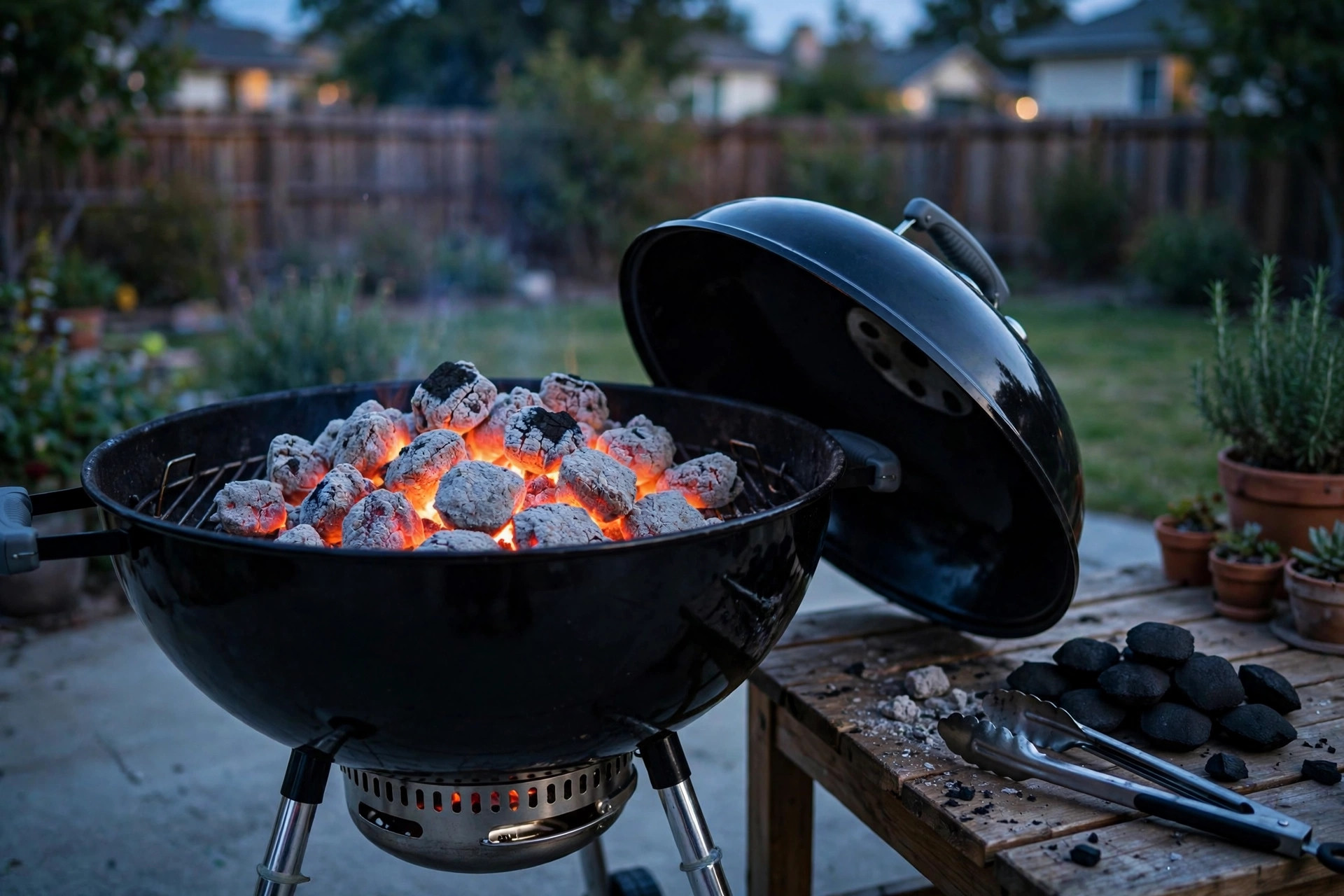
A grill thermometer on the lid helps, but it reads the air near the top, not the grate. For better readings, place an oven-safe thermometer on the cooking grate. Digital probe thermometers give the fastest and truest numbers. If your grill came with a basic dial, you can still cook well by watching the color of the coals. Bright orange with thin flames means high heat. Coals covered in thick gray ash with no flame mean medium heat.
Choosing the Right Fuel
Not all charcoal burns the same. The two main kinds are briquettes and lump charcoal.
Briquettes are pressed from sawdust and binders into even pillows. They light slow, burn steady, and last a long time. Their even shape makes even heat easy. For a beginner, briquettes are the safe choice. They cost less per cook and behave the same every time.
Lump charcoal is wood burned down to carbon, sold in chunks. It lights fast and burns very hot. It gives a clean wood flavor. But the chunks vary in size, so the heat can be uneven. It also burns out faster. Many experienced cooks love lump for hot sears and short cooks. For a long slow cook, briquettes often win on steadiness.
Some cooks add wood chunks or chips for smoke. Chips burn fast and suit short cooks. Chunks smolder longer and suit ribs and roasts. Soak neither; wet wood makes steam, not good smoke. A handful of dry chunks on the coals is enough for an hour of light smoke.
Match the fuel to the food. For burgers and dogs on a weeknight, briquettes lit in a chimney starter are simple and fast. If you are curious about starting a fire without lighter fluid, read our guide on how to start charcoal grill without lighter. Fluid leaves a chemical taste and is never needed when a chimney starter exists.
Cost and Price
Temperature control itself costs nothing. The gear that helps is cheap. A chimney starter costs little and lasts for years. A basic instant-read thermometer saves more food than any gadget. A grill brush, a bag of briquettes, and a cover round out the kit. When you are ready to upgrade the grill itself, our notes on best charcoal grill for backyard bbq compare common kettle and barrel models. For long cooks, a wireless probe thermometer is worth the money. You can check the meat from a chair instead of lifting the lid and losing heat. Lid lifts are the enemy of steady temperatures, so any tool that cuts them pays for itself.
Care and Upkeep
Ash is the quiet killer of a charcoal fire. Ash piles up under the coals and blocks the air holes. A fire with blocked air runs cool and sulky. Before every cook, shake out the old ash through the bottom vents. Once a month, take the grates out and sweep the bowl clean. A clean grill breathes better.
After cooking, close both vents to smother the fire. Usable coals will be waiting for your next cook. Grease on the grates turns into a hard crust if left alone. Brush the grates while they are still hot. For a deep clean, soak the grates in hot soapy water and scrub them with a stiff brush. A clean grate gives better sear marks and food that releases easy.
Store charcoal in a dry place. Damp briquettes are hard to light and burn poorly. A metal can with a lid keeps a bag dry in a damp garage. Keep the grill covered when it sits outside. A cover costs little and adds years to the life of the grill.
Safety
Charcoal safety is mostly common sense, but the rules matter. Never use a charcoal grill indoors or in a garage. Charcoal gives off carbon monoxide, a gas you cannot see or smell. Outdoors with open air is the only safe place.
Light the fire away from walls, railings, and dry leaves. Keep children and pets at arm’s length from the grill. Wear long tongs and heat-safe gloves when you move grates or add coals. Keep a spray bottle of water near for small grease pops on food, but never douse the coals. If grease catches with big flames, close the lid and the vents. The fire will starve and die down.
Let the coals cool fully before you throw out the ash. Ash can hold heat for hours. Dump cool ash into a metal can, not a paper bag or a plastic bin. Many towns take cold ash in the trash, but check local rules first.
FAQ
How long should I wait before putting food on the grill? Wait until the coals are covered with light gray ash. This takes about twenty to twenty-five minutes with a chimney starter. Food put on too early picks up a raw fuel taste. Food put on too late misses the hottest part of the fire.
What temperature should a charcoal grill run for burgers? Aim for 400 to 450 degrees at the grate for a good sear. Use direct heat for thin patties. For thick patties, sear over direct heat, then slide them to the cool side of a two-zone fire to finish.
Why does my charcoal fire keep dying? Three causes cover most cases. The ash is blocking the air holes. The vents are closed too far. Or the coals are old and spent. Shake out the ash, open the bottom vents, and add fresh lit coals. The fire should wake up within ten minutes.
Can I add more coals during a long cook? Yes, and you should. Light the new coals in a chimney starter first, then add them when they are ashed over. Adding unlit coals drops the heat and adds a raw taste. For a steady low fire, add a dozen lit briquettes every hour.
How do I cook ribs on a charcoal grill? Set up a two-zone or indirect fire at 225 to 275 degrees. Use a drip pan under the meat. Add wood chunks for smoke. Cook low and slow for four to six hours, turning once. Our walkthrough on how to smoke ribs on charcoal grill gives the full method with timing and wrapping tips.
Do I need a thermometer, or can I judge heat by hand? A hand held over the grate tells you hot from warm, but it cannot tell 350 from 450. For food safety and even results, a thermometer is the better tool. Chicken and pork must reach safe inner temperatures, and guessing is a poor way to check.
A Final Word
Charcoal grill temperature control tips all come down to one habit: watch the fire and make small moves. Open a vent a little. Wait. Read the thermometer. Close a vent a little. Wait again. The fire will teach you if you give it time. Start with a simple two-zone setup and a chimney of briquettes. Cook burgers and chicken until the moves feel natural. Then try a long slow cook. Before long, you will set the vents without thinking, and the fire will hold steady like a friend who knows the way.
For more background, see The Home Depot, The Spruce Eats, and AmazingRibs.com. For more background, see Consumer Reports, Weber, and Char-Broil. Buying guides are also published by Traeger and Napoleon.
References
AmazingRibs.com. (n.d.). Barbecue and grilling science. https://www.amazingribs.com Char-Broil. (n.d.). Gas and charcoal grills. https://www.charbroil.com Consumer Reports. (n.d.). Product reviews and ratings. https://www.consumerreports.org Napoleon. (n.d.). Fireplaces, grills, and heating products. https://www.napoleon.com The Home Depot. (n.d.). Home improvement products. https://www.homedepot.com The Spruce Eats. (n.d.). Recipes and cooking guides. https://www.thespruceeats.com Traeger. (n.d.). Wood pellet grills. https://www.traeger.com Weber. (n.d.). Grills and outdoor cooking. https://www.weber.com
Was this guide helpful?

About Emily Rodriguez
The My Garden US editorial team writes practical, in-depth home and garden guides for American homeowners — tested advice, no fluff.
You May Also Like
How to Smoke Brisket on Pellet Grill: A Plain Guide
May 28, 2026 0 views
Pellet Grill for Beginners Buying Guide: How to Choose Your First Grill
April 2, 2026 0 views
How to Grill Pizza on a Gas Grill
March 15, 2026 0 views