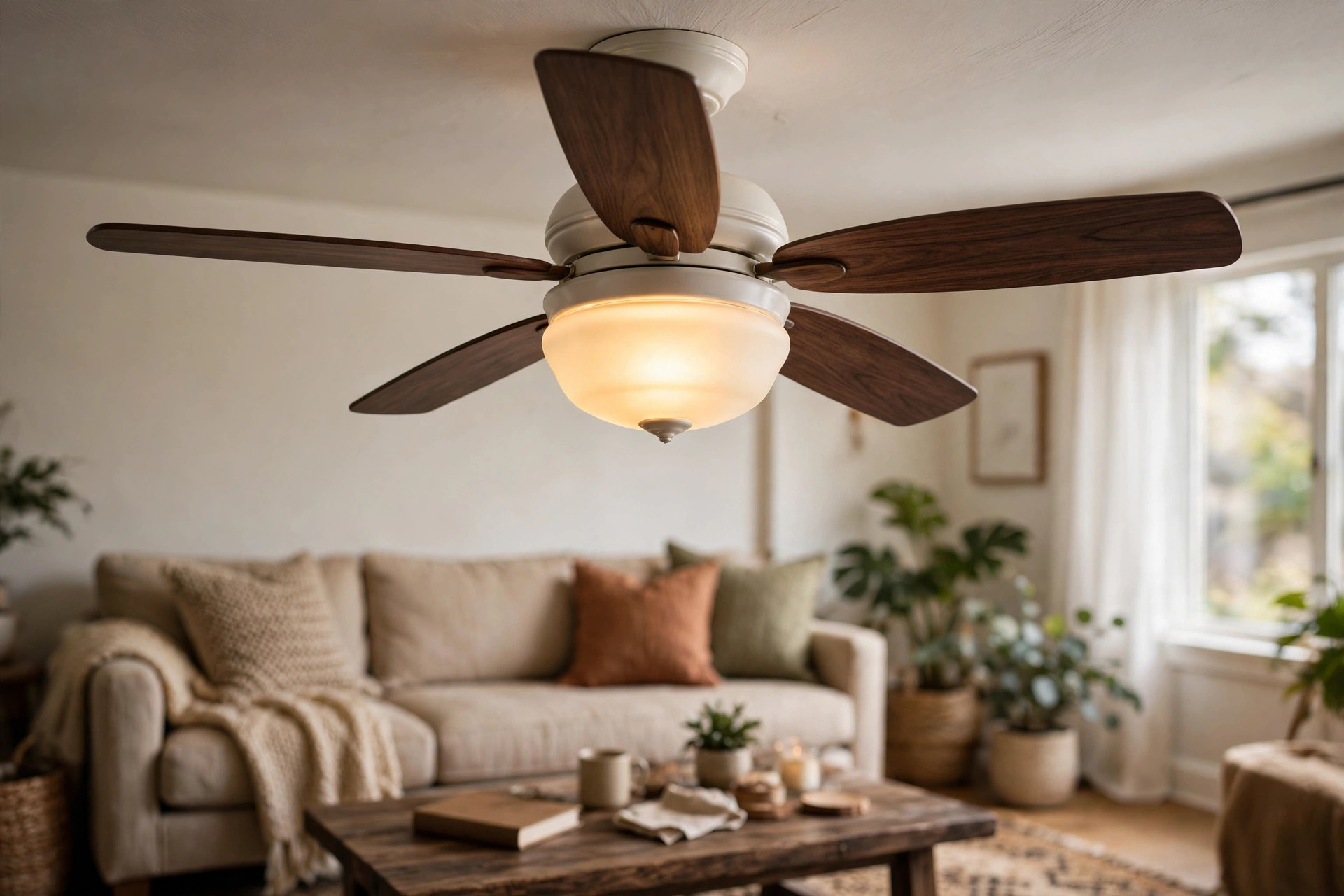
Many shoppers search for ceiling fans lights for sale usa when they want one fixture that cools a room and lights it at the same time. A ceiling fan with a built-in light saves ceiling space, cuts the number of fixtures a room needs, and gives steady light where people sit and work. This guide explains how these fixtures work, what to check before buying, and what prices look like across the United States.
Why a Ceiling Fan with a Light Makes Sense
A fan with a light does two jobs at once. In a bedroom, it moves warm air in summer and gives soft light for reading at night. In a living room, it spreads heat from the heating system back down in winter when the blades turn in reverse. In a kitchen or porch, it keeps air fresh while lighting the work area below.
The idea is simple. One electrical box in the ceiling serves both the fan motor and the light kit. That means less wiring, one remote or pull chain to learn, and one item to clean instead of two. For small rooms, where a separate lamp would take up floor space, a fan-light combination is often the best answer.
Energy savings are real. A ceiling fan uses far less power than an air conditioner. When the fan runs, many people feel cool at a higher thermostat setting. That small change lowers the electric bill over the summer. The U.S. Department of Energy notes that fans can make rooms feel several degrees cooler, which lets homeowners raise the thermostat and save money.
Light quality matters too. Old fans used hot incandescent bulbs. New models use LED lights that run cool, last years, and cost little to run. A fan bought today may carry its light kit for a decade or more without a bulb change.
How to Choose the Right Ceiling Fan with Light: Ceiling Fans Lights for Sale Usa
Buying a fan with a light is not hard, but a few details make the difference between a good buy and a bad one. Measure first, read the box, and think about how the room is used.
Size and Room Match
Blade span should fit the room. For rooms up to 75 square feet, a 29 to 36 inch fan works well. For rooms from 76 to 144 square feet, choose 36 to 42 inches. Large rooms of 144 to 225 square feet need 44 to 50 inches. Very large rooms need 52 inches or more.
Blade pitch matters. A steeper pitch moves more air. Look for a pitch of 12 degrees or more for strong airflow. Cheaper fans may have a flat pitch that moves little air even at full speed.
Downrod length sets the hanging height. The bottom of the blades should sit seven to nine feet above the floor. In a room with an eight-foot ceiling, a flush mount or a very short downrod is best. With a high ceiling, a longer downrod keeps the fan in the air it needs to move.
Light Quality
Check the light type. LED light kits are now standard on most new fans. They give bright light with low power use. Many LED kits let the user change the color temperature from warm white to cool white. That is handy. Warm light suits a bedroom. Cool light suits a kitchen or home office.
Look at the lumen number on the box. Lumens tell how much light the fixture gives. A small bedroom may need only 800 to 1,600 lumens. A living room may need 2,000 to 3,000 lumens. Some fans have a dimmer so the user can set the level.
Some fans use a frosted glass bowl over the light. Frosted glass softens glare. Clear glass gives brighter light but can be harsh. Pick the style that fits the room.
Motor and Control
The motor is the heart of the fan. DC motors are quieter and use less power than old AC motors. They also offer more speed settings. AC motors are fine and cheaper, but they can hum at low speed.
Check how the fan is controlled. Pull chains are simple and never break down. Wall switches are neat. Remote controls add ease, since the user can change speed and light from bed or couch. Many new fans also work with smart home systems, so a phone app or voice command can run them. The Consumer Reports buying guides test fans for noise and airflow, which helps shoppers compare motors fairly.
Also check the mount type. A standard mount uses a downrod. A low-profile mount hugs the ceiling. An angled mount fits sloped ceilings. Match the mount to the ceiling shape.
Types and Options
The market holds many styles of ceiling fans with lights. Knowing the main types helps narrow the search fast.
Standard fans with light kits. These are the classic models. A motor housing hangs from a downrod, with four or five blades and a light bowl below. They suit bedrooms, living rooms, and dining rooms. Most stores carry a wide range.
Flush-mount or hugger fans. These sit close to the ceiling. They work best in rooms with low ceilings, where a long downrod would hang too low. The light kit is compact. Airflow is still strong if the motor is good.
Outdoor and damp-rated fans. These use sealed motors and rust-proof finishes. They can hang on porches, patios, and in sunrooms. Wet-rated models can take direct rain. Always check the rating before placing a fan outside.
Modern minimalist fans. These have sleek blades, dark finishes, and low-profile LED panels instead of glass bowls. They suit new homes and clean room designs. Brands such as those listed at Lumens often show how these styles look in real rooms.
Industrial and large-blade fans. These move a lot of air in great rooms, garages, and workshops. The light kit may be a simple LED ring. They are loud but strong.
Fans with extra features. Some models add a heater, a Bluetooth speaker, or a night light. Others have a sleep timer or a breeze mode that changes speed on its own. These extras raise the price but add comfort.
Retailers such as The Home Depot and Lowe’s list hundreds of models with filters for size, finish, and light type. Specialty shops like Lamps Plus focus on lighting design and show how a fan light looks with matching fixtures.
Cost and Price
Prices for ceiling fans with lights cover a wide range. A basic small fan with a simple light kit may cost 60 to 120 dollars. A mid-range fan with a DC motor, LED light, and remote often costs 130 to 300 dollars. Premium designer fans can cost 350 to 800 dollars or more.
The light kit itself affects price. Integrated LED panels cost more up front but save money over time because they never need new bulbs. Fans that take regular screw-in bulbs cost less to buy, but bulbs must be replaced every few years.
Installation adds cost if the homeowner does not do it themselves. A simple swap where a fan replaces an old fan may cost 75 to 150 dollars for an electrician visit. A new installation that needs wiring run to the ceiling can cost 200 to 400 dollars. Some stores offer install services at checkout.
Running cost is low. An LED light kit may use 10 to 20 watts. A DC fan motor at medium speed may use 20 to 40 watts. Together, a fan with a light often uses less than 60 watts, far less than a central air system. Models with the ENERGY STAR label meet strict efficiency rules and use about 60 percent less energy than standard models.
Bulb replacement is cheap for screw-in types. A pack of LED bulbs costs a few dollars. Integrated LED panels last the life of the fan, so there is nothing to replace.
Care and Upkeep
A ceiling fan with a light needs little care, but regular cleaning keeps it quiet and bright.
Dust the blades every month. Dust makes blades heavy on one side, which causes wobble. A damp cloth or a pillowcase works well. Slide the pillowcase over each blade and wipe the dust into it.
Clean the light cover too. Dust and bugs dim the light over time. Most glass bowls twist off by hand. Wash with warm soapy water, dry fully, and put back.
Check the screws once a year. Vibration can loosen blade screws and the light kit screws. Tighten them with a screwdriver. If the fan wobbles, a balancing kit from the store can fix it.
If the remote stops working, change the battery first. If the light flickers, make sure the bulbs are tight. LED kits rarely fail, but if one does, check whether the maker sells a replacement kit.
For outdoor fans, wipe the motor housing and check for rust each spring. A fan that gets rain should be rated for wet use. The Philips lighting support pages give general advice on LED care that applies to many fan light kits.
Safety
Safety rules for ceiling fans with lights are plain but worth stating.
Turn off the power at the breaker before any wiring work. Do not rely on the wall switch alone.
Use a fan-rated electrical box. A fan is heavy and vibrates. A box made only for a light fixture can break loose over time. The box should say it is rated for fan support.
Keep blades seven feet or more above the floor. Low blades can hit a tall person or a raised hand.
Do not hang an indoor-only fan outside. Moisture ruins the motor and can cause a short. Use damp or wet rated models in porches and patios.
Keep the light away from bedding and curtains if the fan uses old-style bulbs that run hot. LED kits run cool and are safer near fabrics. The U.S. Consumer Product Safety Commission has recalled some fan models over the years, so checking their site before buying is wise.
If the fan shakes hard or makes grinding sounds, turn it off and inspect it. A loose blade or a failing motor needs quick attention.
Frequently Asked Questions
Can I add a light kit to a fan that has none? Yes, in many cases. Many fans are sold as “light kit adaptable.” The maker sells a matching kit that screws under the motor. Check the fan model first. Some very cheap fans cannot take a kit.
Do ceiling fans with lights use a lot of electricity? No. Most use less than 60 watts for fan and light together. That is about the same as one old light bulb. LED light kits use the least power.
What size fan do I need for a 12 by 12 foot bedroom? A 12 by 12 room is 144 square feet. A 44 or 52 inch fan fits well. Pair it with a light kit of 1,600 to 2,500 lumens for good reading light.
Can a ceiling fan with a light go on a sloped ceiling? Yes, with an angled mount adapter. Most makers sell one. The fan hangs straight down while the mount sits on the slope. Check the max slope angle on the box.
Are smart ceiling fans worth the extra cost? For many homes, yes. A smart fan can join a schedule, run from a phone, and tie into a thermostat. That makes it easy to save energy. If the home has no smart system, a remote-control fan gives most of the same ease at a lower price.
How long do LED light kits on fans last? Most LED kits last 25,000 to 50,000 hours. That is 10 to 20 years of normal use. When the LED panel dies, some fans need a new kit from the maker, so keep the model number.
A Short Final Word
A ceiling fan with a light is one of the most useful fixtures a home can have. It cools, it lights, and it costs little to run. The best choice depends on room size, ceiling height, and the kind of light the room needs. Measure the room, read the specs, and buy from a trusted store with a clear return policy.
Shoppers who also want lighting for other parts of the home can look at matching options. For bedside lighting, see these ideas for bedroom table lamps for California homes and bedroom table lamps for Florida homes. For the yard, landscape spot lights for California homes pair well with a porch fan. The Spruce’s home guides at The Spruce also show how fan lights fit into full room designs.
References
Consumer Reports. (n.d.). Product reviews and ratings. https://www.consumerreports.org ENERGY STAR. (n.d.). Energy efficient products. https://www.energystar.gov Lamps Plus. (n.d.). Lighting and home decor. https://www.lampsplus.com Lowe’s. (n.d.). Home improvement products. https://www.lowes.com Lumens. (n.d.). Lighting and ceiling fans. https://www.lumens.com Philips. (n.d.). Lighting products. https://www.philips.com The Home Depot. (n.d.). Home improvement products. https://www.homedepot.com The Spruce. (n.d.). Home and garden advice. https://www.thespruce.com U.S. Consumer Product Safety Commission. (n.d.). Product safety information. https://www.cpsc.gov U.S. Department of Energy. (n.d.). Energy efficiency and renewable energy. https://www.energy.gov
Was this guide helpful?

About James Carter
The My Garden US editorial team writes practical, in-depth home and garden guides for American homeowners — tested advice, no fluff.