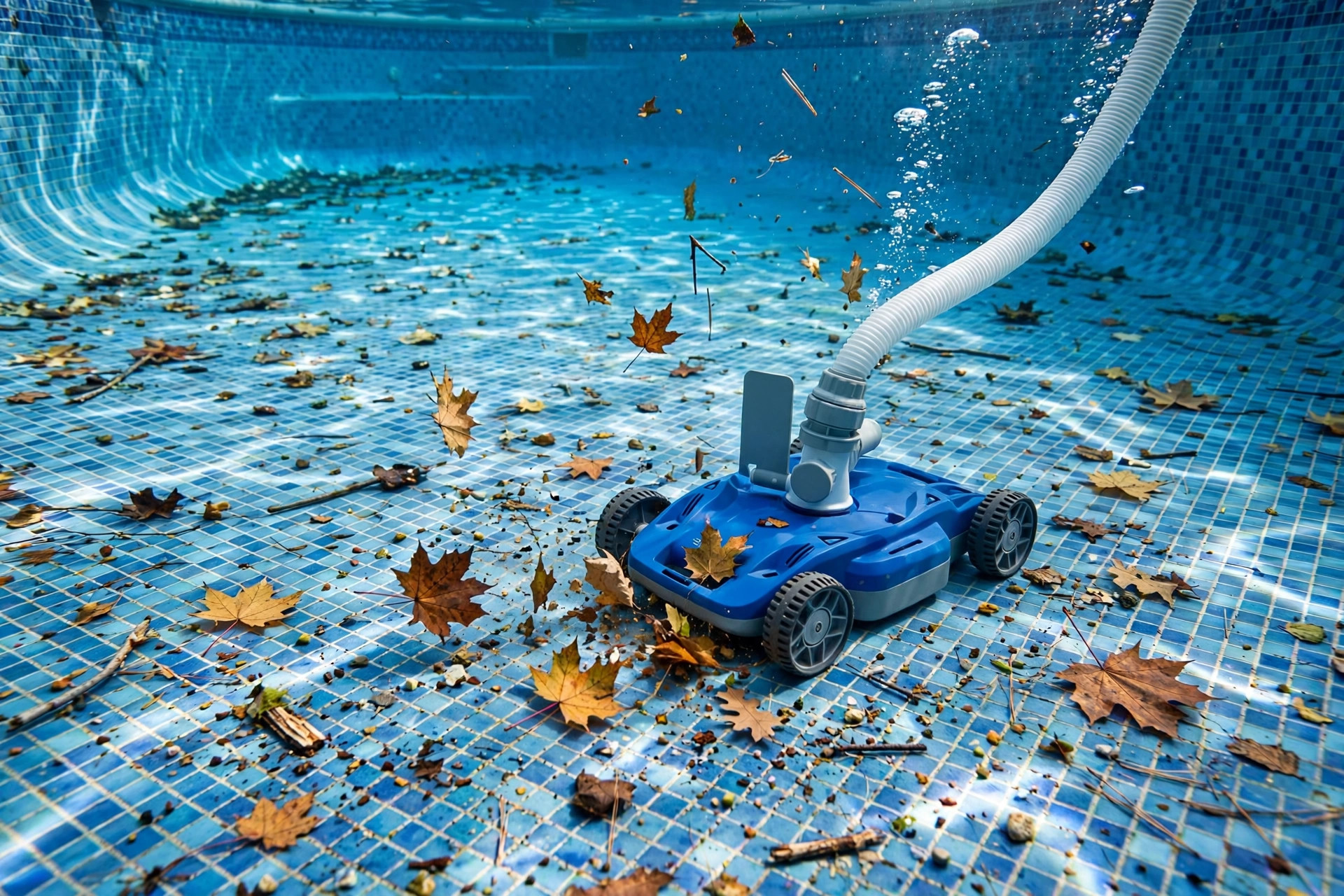

Leaves, twigs, acorns, and seed pods fall into every pool. The best pool vacuum for large debris picks up these heavy loads without clogging. A fine-dirt cleaner may fail where a wide-mouth model does well. This guide explains the main types of pool vacuums, the features that matter for big debris, and what owners should expect to pay.
Why Large Debris Needs a Different Kind of Vacuum
Not all pool cleaners are built the same. Many robotic cleaners are made for sand, silt, and fine dust. Their filters have tight mesh. Their suction ports are small. When a storm drops a hundred oak leaves into the water, these machines can jam in minutes.
A pool vacuum built for large debris solves this problem. It uses a wide intake port. It often has a large filter bag or basket instead of a fine cartridge. Some models run on the pool’s own pump through a skimmer line. Others work with a garden hose and use venturi pressure. A few heavy-duty robots have oversized debris bins made for leaves.
Owners with trees near the pool need this kind of machine most. Maple keys, pine needles, and palm fronds are light but bulky. After a windy week, the pool floor can be covered. A vacuum that chokes on the first pass only wastes time. The right model clears the mess in one or two passes.
Main Types of Pool Vacuums: Best Pool Vacuum for Large Debris
Suction-Side Vacuums
Suction-side vacuums plug into the pool’s skimmer or a dedicated suction line. They use the power of the pool pump to move and clean. The wheels or tracks roll across the floor and walls. Debris goes up the hose and into the pump basket or a leaf canister.
These models are simple and low in price. They work well for large debris when paired with a large leaf canister. The canister sits in the hose line and traps leaves before they reach the pump. This setup protects the pump and cuts down on clogs.
The trade-off is power. Suction-side cleaners borrow flow from the pump. On pools with weak pumps or long hose runs, they can move slowly. They also rely on the pool filter to catch fine particles.
Pressure-Side Vacuums
Pressure-side vacuums hook to the return line from a booster pump or the main pump. Water pushes through a venturi jet. The jet creates strong suction at the mouth of the cleaner. Large debris is blown into an onboard filter bag.
These machines are known for strong debris pickup. The onboard bag holds far more than a pump basket. Many models have wide throats that swallow leaves, twigs, and even small stones. They do not steal suction from the skimmer, so the skimmer keeps working while the cleaner runs.
The main cost is equipment. A booster pump adds to the price and to the electric bill. Some pools already have the right plumbing. Others need a retrofit.
Manual Vacuums
A manual vacuum is a vacuum head on a telescoping pole with a hose to the skimmer. The owner walks the pole around the pool by hand. A wide leaf vacuum head can pick up very large debris in one sweep.
Manual vacuuming is cheap and thorough. It works for spot cleaning after storms. It is also the best way to clean steps and tight corners that robots miss.
The drawback is labor. A big pool takes thirty to sixty minutes by hand. For weekly maintenance, most owners want an automatic helper.
Robotic Vacuums
Robotic cleaners run on their own motor and filter system. They plug into a power supply at the pool edge. They do not use the pool pump at all. Many now come with large filter baskets designed for leaves.
Robots are the easiest option. Set the timer, drop the unit in the water, and walk away. Models with top-loading oversized bins handle large debris much better than older cartridge models. Battery-powered cordless robots add even more ease, though their run times are shorter.
The price is higher than suction or pressure models. Fine-dirt robots still clog on heavy leaves, so shoppers should check the bin size and the intake width before buying.
What to Look for When You Choose
Wide Intake Port
The intake is the mouth of the cleaner. A wide port lets leaves and twigs pass without jamming. Look for models that list the intake size. Anything under two inches can struggle with bulky debris.
Large Filter Bag or Basket
Capacity matters as much as suction. A small basket fills up fast and then the cleaner just pushes leaves around. A large bag or top-loading basket holds a full load of leaves between cleanings.
Brush Type
Brushes stir up debris so the suction can grab it. Soft brushes suit vinyl and fiberglass. Stiffer brushes suit concrete and plaster. Some models use scrubbing brushes that work on algae as well.
Hose Length and Reach
For hose-driven models, the hose must reach every corner of the pool with slack to spare. Measure the farthest distance from the skimmer or return port. Add several feet.
Compatibility With Your Pool
Check the surface type, shape, and size range. Vinyl liners need soft brushes and no sharp edges. Deep pools with steep slopes need good climbing power. Freeform pools with curves need flexible navigation.
Ease of Emptying
You will empty the bag or basket often in leaf season. Top-loading baskets are the fastest to dump and rinse. Bags take longer but hold more. Pick the system you will actually maintain.
Cost and Price Ranges
Manual leaf vacuum heads cost the least. A good wide-mouth head with a pole adapter runs about 40 to 80 dollars. Add a hose and pole if you do not own them.
Suction-side automatic cleaners run from about 150 to 400 dollars. A leaf canister adds 30 to 60 dollars. These models have no electric motor, so there is almost no running cost beyond the pool pump.
Pressure-side cleaners cost 300 to 700 dollars. A booster pump, if needed, adds 250 to 500 dollars to the install price. Electric use is higher than with suction models.
Robotic cleaners range from 400 to over 1,500 dollars. Leaf-capable robots with large bins sit in the middle and upper part of that range. They use little electricity per cycle, often under a dollar.
Prices shift with season and brand. Spring and early summer bring the most sales. Check product guides and retailer pages such as those at The Home Depot for current models and prices before you buy.
How to Get the Best Results
Start with the skimmer. Empty the skimmer basket before each vacuum session. A full basket cuts flow to suction-side cleaners.
Brush the walls first. Loosen debris from the walls and steps so it settles on the floor. Then run the vacuum to pick it up.
Skim the surface by hand. A leaf net removes floating leaves faster than any vacuum. This is the best place to compare tools, and our guide to the best pool vacuum for leaves reviews covers hand nets and vacuum combos in more detail.
Clean the filter after heavy loads. Large debris can pack into cartridges and bags. Rinse them out so the next run starts strong.
Run the cleaner in sections for very dirty pools. Clear half the pool, empty the basket, then clear the rest. Two short runs beat one clogged run.
Check the drain covers too. A vacuum moves a lot of water fast. Broken or missing drain covers are a real entrapment risk for swimmers. Make sure the covers are whole and screwed down tight before the season starts.
Care and Upkeep
Rinse the filter bag or basket after every use. Let bags dry fully before storage to stop mildew. Check hoses for cracks and split seams each season. A leaking hose cuts suction fast.
Store automatic cleaners out of direct sun. UV light breaks down plastic housings and wheels over time. Many owners keep the robot on a caddy in the garage.
Inspect the brushes and tracks once a month. Worn brushes clean poorly and can scratch vinyl. Replace parts when the edges look rounded or thin.
Watch the pool chemistry too. Heavy debris raises chlorine demand and feeds algae. Test the water after a big cleanup. Guides at Swim University explain how to balance water after storms.
Keep spare parts on hand. A spare bag, a hose section, and a set of wheels cost little. They keep one broken part from stopping your whole cleaning routine during the busiest leaf weeks of fall.
Safety Notes
Pool equipment and water demand care. Never run an automatic cleaner while people are swimming. Cords and hoses in the water are trip and tangle hazards.
Store chemicals away from the vacuum gear. Chlorine and acid can damage plastic parts on contact. Rinse hands after handling both.
For general pool and spa safety rules, the U.S. Consumer Product Safety Commission publishes clear guidance for pool owners.
Electric robots use low-voltage power supplies, but the supply box must stay dry and away from the pool edge. Never splice or repair a cord yourself. Replace it.
FAQ
What is the best pool vacuum for large debris overall?
The best pool vacuum for large debris is one with a wide intake and a large filter bag or basket. Pressure-side cleaners and leaf-capable robotic models handle bulky loads best. Manual wide-mouth heads are the cheapest strong option for spot cleaning.
Do robotic pool cleaners pick up leaves well?
Some do. Robots with oversized top-loading baskets handle leaves far better than models with small fine-mesh cartridges. Check the bin capacity and intake size in the specs. For vinyl pools, pair leaf pickup with soft brushes, as discussed in our article on the best robotic pool cleaner for vinyl.
Can a suction-side vacuum handle twigs and acorns?
It can with a leaf canister in the hose line. The canister traps bulky debris before it reaches the pump. Without one, heavy loads can clog the pump basket and slow the whole system.
How often should I vacuum a pool surrounded by trees?
Skim the surface daily in leaf season. Run the automatic vacuum two to three times a week. Empty the bag or basket after every run. Heavy weeks may need daily runs.
Is a pressure-side cleaner worth the extra cost?
For pools with constant large debris, yes. The onboard bag holds more than any pump basket. The cleaner also keeps the skimmer free to work. The booster pump adds cost, but many owners find the time savings worth it.
What vacuum head works best for large debris on vinyl?
A wide-mouth leaf head with soft brushes is the best manual choice for vinyl. It sweeps up leaves without scratching the liner. See our rundown of the best pool vacuum head for vinyl for more options.
A Short Final Word
The best pool vacuum for large debris is the one that matches your pool, your trees, and your patience. Wide intakes and large baskets do the real work. Automatic models save time. Manual heads save money. Owners who clean on a set schedule see far fewer clogged filters and greener water. Pick the right type, keep the filters clean, and the pool stays clear through the worst leaf season. For product comparisons and buying guides, trusted pool retailers like Leslie’s and Pool Warehouse keep current model lineups, while general home guides at The Spruce cover seasonal pool care. Hot tub and spa owners facing similar debris issues can find related advice at Hot Spring and Bullfrog Spas.
References
Bullfrog Spas. (n.d.). Hot tubs and spas. https://www.bullfrogspas.com Hot Spring Spas. (n.d.). Hot tubs and spas. https://www.hotspring.com Leslie’s Pool Supplies. (n.d.). Pool supplies and equipment. https://www.lesliespool.com Pool Warehouse. (n.d.). Pool equipment and supplies. https://www.poolwarehouse.com Swim University. (n.d.). Pool and hot tub care guides. https://www.swimuniversity.com The Home Depot. (n.d.). Home improvement products. https://www.homedepot.com The Spruce. (n.d.). Home and garden advice. https://www.thespruce.com U.S. Consumer Product Safety Commission. (n.d.). Product safety information. https://www.cpsc.gov
Was this guide helpful?

About James Carter
The My Garden US editorial team writes practical, in-depth home and garden guides for American homeowners — tested advice, no fluff.
You May Also Like
How to Drain Pool for Repairs: A Safe Step-by-Step Guide
June 5, 2026 0 views
Best Pool Toys for Teenagers Reviews: A Practical Guide for Families
April 27, 2026 0 views
How to Clean Pool Walls Without Draining
February 16, 2026 0 views