
Introduction
Every parent wants a child who breathes easy at night. Finding the best kids room air purifier for allergies is one of the simplest steps you can take toward that goal. Dust mites, pollen, pet dander, and mold spores float in the air of every home. Children are more sensitive to these tiny particles than adults. A good purifier can catch many of them before they reach your child’s nose and lungs.
This guide explains what an air purifier does, how to choose one for a child’s room, and how to use it safely. The advice is written in plain terms so any parent can follow it.
Why Clean Air Matters for Kids with Allergies: Best Kids Room Air Purifier for Allergies
Children spend ten to twelve hours a day in their bedrooms. They sleep there. They play there. The air in that one room shapes how they breathe for a large part of their lives.
Allergies in children often show up as sneezing, a runny nose, itchy eyes, and a stuffy nose at night. Some children wake up coughing. Others develop skin rashes from dust mite exposure. Poor air quality can also make asthma worse. Doctors at HealthyChildren.org note that reducing triggers in the home is a key part of managing childhood allergies.
No single device can remove every trigger. Bedding, carpets, and stuffed toys all hold dust. But an air purifier works around the clock to pull floating particles out of the air. When the air is cleaner, many children sleep better and wake with fewer symptoms. That is why so many families look for a HEPA air purifier for child allergies.
How an Air Purifier Helps
An air purifier is a small machine with a fan and one or more filters. The fan pulls room air in. The air passes through the filters. The filters trap particles. The fan then pushes cleaner air back out.
Most allergy-focused models use a HEPA filter. HEPA stands for High Efficiency Particulate Air. A true HEPA filter catches at least 99.97 percent of particles that are 0.3 microns wide. Pollen, dust mite waste, mold spores, and pet dander are all larger than this. That is why doctors often suggest HEPA filtration first.
Many models also include an activated carbon filter. This layer absorbs smells and some gases. It can help with odors from diapers, pets, or fresh paint. It does not catch particles, so it works as a partner to the HEPA filter, not a replacement.
What to Look for in a Kids Room Air Purifier for Allergies
True HEPA Filtration
Look for the words “true HEPA” or “HEPA-13” on the box. Some makers use terms like “HEPA-type” or “HEPA-like.” These are not the same. They catch fewer particles. For allergies, only a true HEPA filter gives full value. Reviews at Consumer Reports test how well models actually filter, which can help you compare claims.
The Right Size for the Room
Every purifier lists a recommended room size in square feet. Match this number to your child’s room. A small unit in a large room will run all day and still leave much of the air uncleaned. A slightly larger unit is better than a slightly smaller one. Check the Clean Air Delivery Rate, or CADR. A higher CADR means the machine cleans more air each minute.
Quiet Operation
Children need quiet to sleep. Look for a noise rating in decibels. A good quiet air purifier for kids bedroom use runs at 25 to 35 decibels on low speed. That is about as loud as a soft whisper. Many models have a sleep mode that dims the lights and slows the fan. This feature is worth having in a nursery or child’s room.
Child-Safe Design
The machine should be stable and hard to tip over. Buttons should ideally have a child lock. Avoid models with sharp edges or small parts a toddler could pull off. The U.S. Consumer Product Safety Commission offers general guidance on keeping small appliances safe around children, and it is worth a read before you place any device in a nursery.
Simple Controls and Filter Alerts
A filter change light tells you when the filter is full. Without it, parents often forget to replace filters. Simple dial or button controls beat complex touch screens for most families. If you want app control, make sure the app is easy to use.
Energy Use
The purifier may run for many hours a day. An ENERGY STAR rated model uses less power. Guidance at ENERGY STAR can help you compare the yearly cost of running different models.
Types of Air Purifiers for Children’s Rooms
HEPA Filter Purifiers
These are the standard choice for allergies. They use a fan and a true HEPA filter. They are simple, safe, and proven. Most experts suggest starting here.
Activated Carbon Purifiers
These focus on smells and gases rather than particles. They are useful in rooms with strong odors. For allergy relief alone, they are not enough. Many HEPA models already include a carbon layer, which gives you both benefits in one machine.
UV-C and Ionizer Models
Some purifiers add ultraviolet light or release charged ions. These features promise to kill germs or drop particles from the air. The evidence for allergy relief is weak. Some ionizers can produce ozone, which can irritate young lungs. Most doctors advise parents to skip these extras for a child’s room and stick with plain HEPA filtration.
Whole-Room vs. Personal Units
Whole-room units sit on the floor and clean the full room. Personal or desktop units clean only the air right around them. For allergies, a whole-room unit sized to the bedroom is the better choice.
Where to Place the Purifier
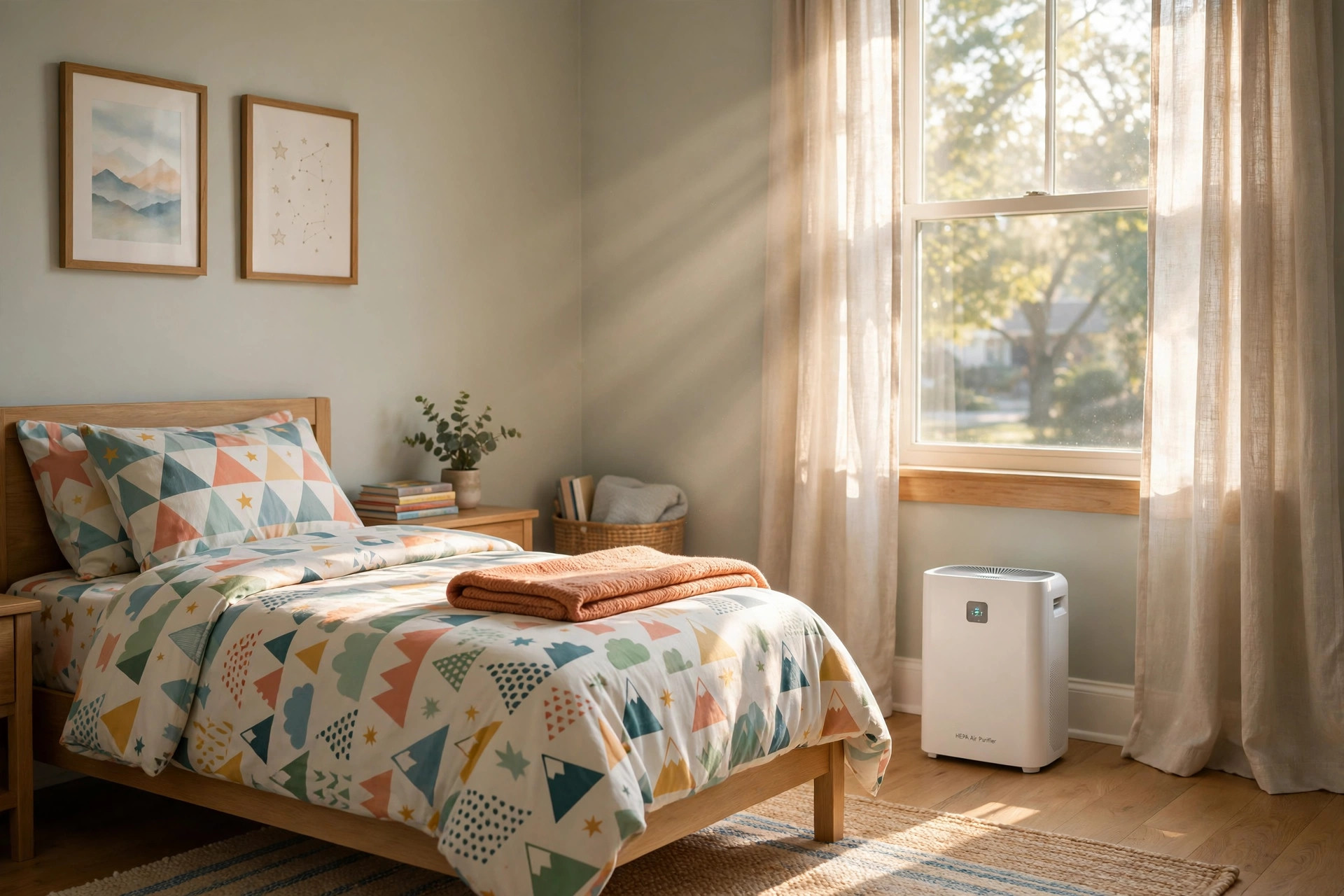
Place the unit where air can flow freely around it. Keep it at least a foot from walls and furniture. Do not put it behind a door or inside a closet. Many parents place it near the bed but out of reach of small hands. A corner of the room often works well.
If the room shares air with a hallway, keep the bedroom door closed at night. This keeps the cleaned air inside. The same idea applies to other nursery items: for example, choosing a nursery crib with drawer underneath storage can reduce clutter that collects dust, and adding a crib rail teething guard cover for safety keeps the sleep area both safe and easier to wipe clean.
Cost and Price
Small purifiers for a child’s room usually cost between 50 and 150 dollars. Mid-range models with better filters and quieter fans run from 150 to 300 dollars. Large or premium models can cost more than 300 dollars.
Filters are the ongoing cost. A replacement HEPA filter often costs 20 to 60 dollars. Most last six to twelve months. Carbon pre-filters may need changing every three months. Before you buy, check the price of replacement filters. A cheap machine with costly filters can become expensive over time.
Running costs are modest. A small ENERGY STAR model may add only a few dollars a month to your power bill. Good buying guides at Good Housekeeping and The Spruce break down long-term costs for popular models.
Care and Upkeep
A purifier only works well when it is cared for. Follow these simple habits.
Change or clean the filters on schedule. Mark the date on a calendar. Vacuum the outside of the unit and the air intake vents once a month. Dust on the vents forces the fan to work harder.
Keep the room itself as dust-free as you can. Wash sheets in hot water once a week. Use dust-mite-proof covers on pillows and the mattress. Vacuum with a HEPA vacuum cleaner. Store stuffed toys in a closed bin and wash them often.
Run the purifier on a low or medium setting through the night. High speed cleans faster but is loud. Medium speed through the whole night usually gives the best balance. During pollen season, run it during the day as well.
Safety Tips
Safety comes first in any child’s room. Keep the power cord out of reach and behind furniture. Do not let a toddler pull the unit over. Place the purifier on a flat, stable floor, never on a bed or a wobbly table.
Avoid ozone-producing models. Ozone can harm young lungs even at low levels. If a product mentions “activated oxygen” or “ionic purification,” check whether it emits ozone. Plain HEPA models do not produce ozone.
Keep water away from the machine. Do not place it next to a humidifier where mist can blow straight into it. Unplug the unit before changing filters.
When you set up the whole room, think about every item in it. Parents planning the space often browse children’s furniture at Pottery Barn Kids, IKEA, and Wayfair to find low-dust, easy-to-clean pieces. A tidy room with smooth surfaces is easier to keep allergen-free. Parenting guides at What to Expect also cover nursery setup basics that pair well with cleaner air.
Living with Allergies Day to Day
An air purifier is one tool in a larger plan. Keep windows closed during high pollen days. Have children wash hands and faces after playing outside. Change their clothes after outdoor play so pollen does not reach the bed.
Watch for signs that allergies are getting worse. These include constant mouth breathing, dark circles under the eyes, frequent ear infections, or a cough that will not stop. If you see these signs, talk to your child’s doctor. A purifier helps with the air, but medical care guides the treatment.
Some families also look at bedding and bedroom furniture as part of the plan. For example, families choosing a best bunk bed with stairs for kids room often pick models with smooth finishes that wipe clean, which helps keep dust down around the sleeping area.
Frequently Asked Questions
Do air purifiers really help kids with allergies?
They can help a great deal with airborne triggers like pollen, dust mite particles, and pet dander. They cannot remove triggers that sit in bedding or carpets. For best results, pair the purifier with dust-mite covers, weekly hot-water washing of sheets, and regular vacuuming.
What is the best type of filter for a kids room air purifier for allergies?
A true HEPA filter is the best choice. It traps the tiny particles that cause most allergy symptoms. Look for “true HEPA” on the label and avoid “HEPA-type” filters, which are less effective.
Should the purifier run all night?
Yes. Night is when your child breathes the room air for the longest stretch. Run it on low or sleep mode so the noise stays soft. Many parents leave it running all day during allergy season.
Are air purifiers safe for babies and toddlers?
A plain HEPA purifier with no ozone output is safe when placed out of reach. Keep cords hidden, use the child lock if the model has one, and make sure the unit cannot tip over onto the child.
How often should I change the filter?
Most HEPA filters last six to twelve months. Carbon pre-filters last about three months. Check the maker’s guide for your model. A filter change light takes the guesswork out of timing.
Will an air purifier help with asthma too?
Cleaner air can reduce some asthma triggers, such as dust and pollen. Many families search for a kids room air purifier for asthma and allergies together for this reason. But asthma needs a doctor’s care plan. A purifier supports that plan; it does not replace it.
A Final Word
Choosing the best kids room air purifier for allergies does not need to be hard. Pick a true HEPA model sized to the room. Make sure it runs quietly. Place it safely and change the filters on time. Small steps like these add up to cleaner air and calmer nights.
Every child is different. What works for one family may need adjusting for another. Start with the basics in this guide, watch how your child responds, and talk to your doctor about any lasting symptoms. Clean air is a gift you can give your child every single night.
References
American Academy of Pediatrics. (n.d.). HealthyChildren.org. https://www.healthychildren.org Consumer Reports. (n.d.). Product reviews and ratings. https://www.consumerreports.org ENERGY STAR. (n.d.). Energy efficient products. https://www.energystar.gov Good Housekeeping. (n.d.). Product reviews and home advice. https://www.goodhousekeeping.com IKEA. (n.d.). Home furnishings. https://www.ikea.com Pottery Barn Kids. (n.d.). Kids furniture and decor. https://www.potterybarnkids.com The Spruce. (n.d.). Home and garden advice. https://www.thespruce.com U.S. Consumer Product Safety Commission. (n.d.). Product safety information. https://www.cpsc.gov Wayfair. (n.d.). Furniture and home goods. https://www.wayfair.com What to Expect. (n.d.). Pregnancy and parenting guidance. https://www.whattoexpect.com
Was this guide helpful?

About Jennifer Lee
The My Garden US editorial team writes practical, in-depth home and garden guides for American homeowners — tested advice, no fluff.
You May Also Like
The Crib Canopy Net for Mosquito Protection USA Parents Trust
April 16, 2026 0 views
Nursery Storage Drawers Under Crib Space: A Practical Guide
August 15, 2026 0 views
A Toddler Bedding Set with Curtains Matching: A Calm Room for Your Little One
May 11, 2026 0 views