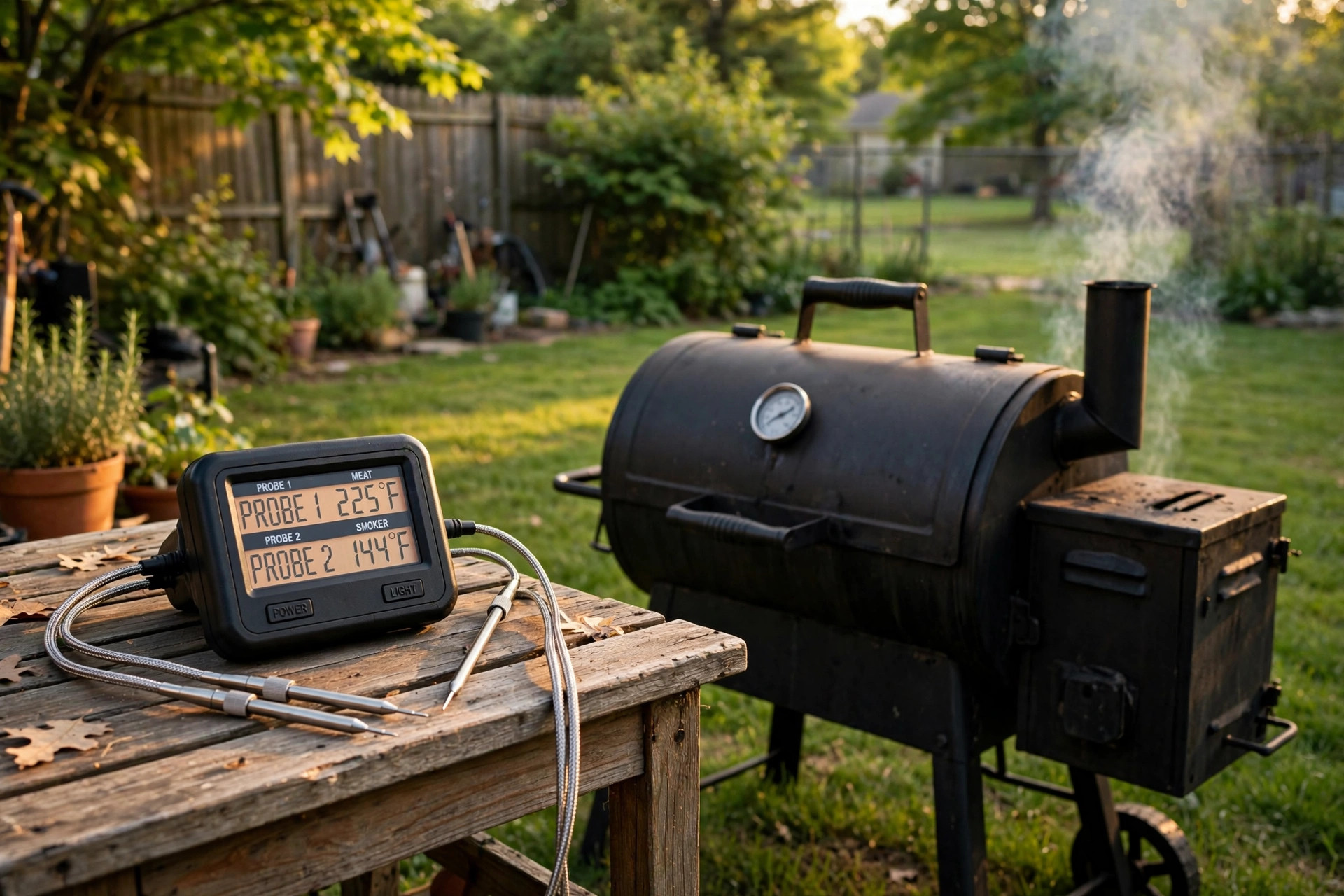
Good barbecue takes time. A brisket may sit in the smoker for twelve hours. A pork shoulder can take longer. Chicken turns dry when the cook watches the clock instead of the heat. This is where a thermometer with two probes earns its place. One probe goes into the meat. The other probe sits in the smoker and watches the cooking chamber. These best smoker thermometer dual probe reviews explain what these tools do, how the leading models differ, and which features matter most when you buy one.
Why a Dual Probe Thermometer Matters
A single reading tells half the story. Meat temperature tells you when food is done. Chamber temperature tells you how fast you are getting there. Smokers run hot and cold. Wind, rain, and cheap vents all push the heat up and down. Without a chamber reading, you are cooking blind.
Most smokers have a lid thermometer. Most lid thermometers read wrong. They sit in the dome, far from the food. They can run fifty degrees off the grate temperature. Cooks who trust them often serve meat that is tough or dry. A probe at grate level tells the truth.
Two probes also keep the lid shut. Every time you lift the lid, heat escapes. It can take twenty minutes to recover. A dual probe set with a display on the table lets you read both numbers without opening the door. That alone improves results more than any rub or sauce.
Food safety is the last reason. Ground meat, pork, and poultry each have a safe final temperature. Color is not a test. Juice color is not a test. Only temperature counts. A probe in the meat removes the guess.
How to Choose: What to Look For: Best Smoker Thermometer Dual Probe Reviews
Accuracy
Accuracy comes first. Look for a reading that holds within two degrees. Cheaper units drift when the fire gets hot. A unit that reads wrong by ten degrees is worse than no unit at all. Check independent testing groups when you compare brands. A stated accuracy of plus or minus one to two degrees is the mark of a solid tool.
Probe Design
Probes take the heat, not the base unit. The probe must handle smoker temperatures up to 500 degrees and more. Look for stainless steel probes with heat-resistant cables. Braided cables last longer than plastic ones. The meat probe should be long and thin, so it slides into a brisket without tearing the muscle. The chamber probe should have a clip that grips the cooking grate and holds the tip away from the metal.
Wireless Range
Wireless models send readings to a receiver or a phone. Range matters if you cook while you work in the yard. Basic radio models reach 100 to 300 feet through open air. Walls cut that distance fast. Bluetooth models reach about 100 feet in the open. WiFi models can reach anywhere your network reaches. Match the range to your habits. A review that praises a long range is only useful if you actually leave the patio. For a deep look at radio-based units, see our notes on wireless barbecue thermometers.
Alarms and Presets
Good units beep when the meat hits the target. Better units let you set high and low alarms for the chamber too. If the fire drops below 200 degrees or climbs past 300, the alarm tells you before the meat suffers. Preset meat temperatures help new cooks. Make sure you can change them, because factory presets are not always right.
Display and Battery
The display should be large and easy to read in sunlight. Backlight helps at night. Battery life should last through a full brisket cook, twelve hours or more. Rechargeable units cost more but save money over time. Units that take common AA batteries are easy to feed on a cook day.
Types of Dual Probe Thermometers
Wired Digital Units
The simplest type has a base unit that sits on a table near the smoker. Two cables run from the unit to the probes. The display shows both temperatures side by side. These units cost the least and break the least. They are the right pick for cooks who stay near the fire. Their only limit is the cable. You must stay within arm’s reach.
Wireless Remote Models
These add a receiver you carry in your pocket. The base unit stays at the smoker and sends readings by radio. You can watch the cook from the house. Most receivers show both probe temperatures and sound alarms. They are the most popular type in smoker thermometer dual probe reviews, and for good reason. They give freedom without the fuss of a phone app.
Bluetooth and WiFi Models
These send readings to a phone app. The app graphs the cook over time. You can see the stall in a brisket as a flat line on the chart. Some apps send alerts when the cook finishes. They are fun tools and they teach a lot. They cost more, and they add a phone to the fire. Keep a backup plan for long cooks in case the app drops the link.
Which Type Fits Your Cooking
Pick wired if you cook within sight of the smoker. Pick wireless remote if you move around the yard and house. Pick Bluetooth or WiFi if you want graphs and records of every cook. All three types use the same probes, and accuracy matters more than the radio inside the box. Many cooks start with a wired unit and upgrade to wireless after a few seasons. That path keeps the learning cheap and the results steady.
Cost and Price
Prices fall into three groups. Basic wired units sell for about twenty-five to forty dollars. They read true and last for years. Wireless remote units sell for about fifty to eighty dollars. They add range and alarms. Bluetooth and WiFi units sell for about eighty to one hundred twenty dollars. They add apps and graphs.
Spending more buys range and features, not better probes. A forty-dollar wired unit often reads just as true as a hundred-dollar app model. Buy the features you will use. A new cook gains little from a WiFi graph. A pit master gains a lot from a loud chamber alarm. Home improvement stores carry all three groups side by side, which makes comparing easy.
Replacement probes cost extra. Budget for a spare set. Probes wear out before the base unit does. A cheap unit with fresh probes beats an old premium unit with tired ones.
Care and Upkeep
Probes are tools, not dishes. Never put probes in the dishwasher. Wash them by hand with warm soapy water. Dry them at once. Keep water out of the cable joint, where the wire meets the probe. That joint is the weak point of every probe.
Do not kink the cables. Lay them flat when you store the unit. Sharp bends break the wires inside. Do not run cables through a hot lid seal without a notch or a port. Crushing the cable under a heavy lid ruins it in one cook.
Test accuracy twice a year. Fill a glass with ice and water. Stir it well. A probe in the ice bath should read thirty-two degrees. Boiling water at sea level should read two hundred twelve degrees. If a probe reads more than a few degrees off, replace it. Probes are cheap. Ruined briskets are not.
Store the unit indoors. Heat, sun, and rain shorten the life of the display and the battery. A small pouch or box keeps probes straight and cables clean between cooks. For more on keeping your whole setup in good shape, charbroil.com and other smoker makers publish care guides worth reading.
Safety
Food safety rests on numbers. Poultry must reach one hundred sixty-five degrees. Ground meat must reach one hundred sixty degrees. Whole cuts of beef and pork must reach one hundred forty-five degrees with a short rest. These numbers come from public health guidance, not from habit. Place the meat probe in the thickest part of the cut. Keep it away from bone, which conducts heat and reads hot.
Chamber safety matters too. A smoker that runs above three hundred fifty degrees can burn grease and start a fire. A chamber alarm set below that line gives you time to act. Keep the smoker on a level surface, away from wood decks and low roofs. Keep a fire extinguisher within reach.
Handle probes with care after the cook. They come out of the smoker hot enough to burn skin. Use tongs or a cloth. Keep cables away from open flame. A cable that melts can drip plastic into the fire box. Small care here keeps the tool safe and the cook safe.
Frequently Asked Questions
Do I really need two probes? For smoking, yes. One probe cannot watch the meat and the fire at the same time. A single-probe unit forces you to choose. The two-probe design is the whole point of a smoker thermometer. It is the first thing every smoker thermometer dual probe review should explain.
Can the probes stay in the meat during the whole cook? Yes. These are leave-in probes. They are built for long cooks. Instant-read thermometers are different. Those go in and come out in seconds. Leave-in probes can stay in the meat for twelve hours or more.
How accurate should the thermometer be? Within two degrees is fine for barbecue. Within one degree is excellent. Anything worse than three degrees will hurt your cooking. Test every new unit in an ice bath before you trust it on a brisket.
Can I use a dual probe thermometer on a gas grill or an oven? Yes. The meat probe works anywhere food cooks. The chamber probe works in any oven or grill with a grate. Many cooks use the same unit for holiday turkeys, roasts, and baked goods. Learn the basics first if you are new; our guide to how to smoke brisket on a pellet grill pairs well with a first thermometer.
Are the apps worth the extra money? They are worth it if you like records and graphs. They teach you how a cook moves through the stall and the finish. They are not worth it if you only want a number and an alarm. A wireless remote unit does that job for less money.
How long do probes last? With care, one to three years of regular smoking. Heat, kinks, and water kill them. Keep a spare set on hand. When readings start to drift, replace the probe before the next cook.
A Final Word
A dual probe thermometer is the cheapest way to make better barbecue. It costs less than one ruined brisket. It tells you what the fire is doing and what the meat is doing, at the same time, without lifting the lid. Buy for accuracy first. Buy for the range and alarms you will actually use. If you are still picking your cooker, our look at the best smoker for beginners under $300 is a good next read. Then trust the numbers, feed the fire, and let the smoke do the rest.
For more background, see AmazingRibs.com, Weber, and Traeger. See Big Green Egg for more detail.
References
AmazingRibs.com. (n.d.). Barbecue and grilling science. https://www.amazingribs.com Big Green Egg. (n.d.). Kamado grills and outdoor cooking. https://www.biggreenegg.com Char-Broil. (n.d.). Gas and charcoal grills. https://www.charbroil.com Consumer Reports. (n.d.). Product reviews and ratings. https://www.consumerreports.org Napoleon. (n.d.). Fireplaces, grills, and heating products. https://www.napoleon.com The Home Depot. (n.d.). Home improvement products. https://www.homedepot.com Traeger. (n.d.). Wood pellet grills. https://www.traeger.com Weber. (n.d.). Grills and outdoor cooking. https://www.weber.com
Was this guide helpful?

About Emily Rodriguez
The My Garden US editorial team writes practical, in-depth home and garden guides for American homeowners — tested advice, no fluff.