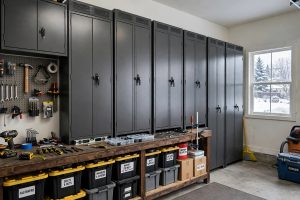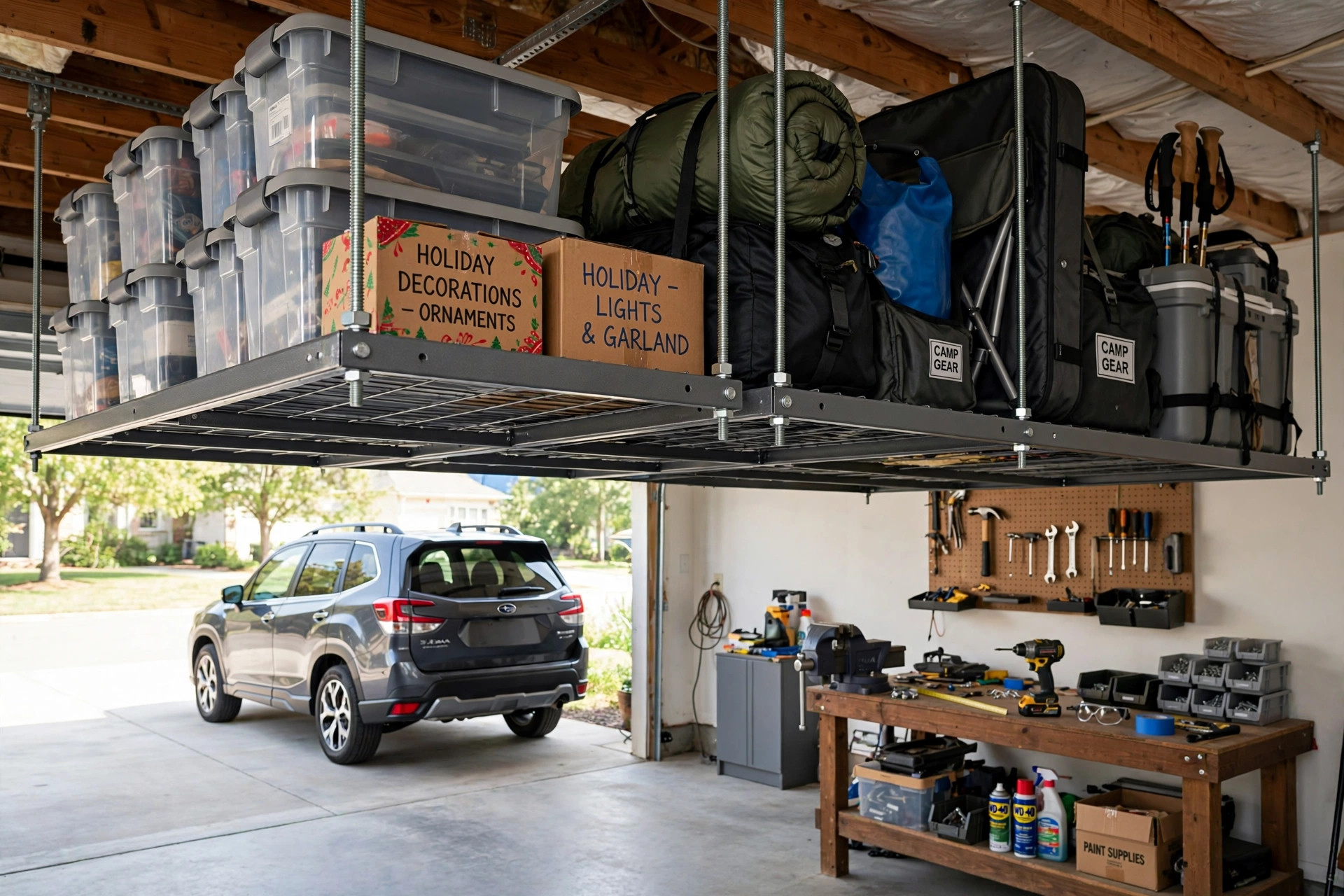
Most American garages hold far more than cars. They hold tools, holiday boxes, camping gear, paint cans, sports gear, and old furniture. Over time the floor space fills up. The car ends up in the driveway. The garage turns into a shed with a door.
The ceiling offers an answer. Overhead garage storage systems lift bins and bulky items up to the joists. They free the floor. They make the garage work like a room again.
This top rated overhead garage storage systems buying guide covers what these systems are, how they work, and how to choose one that is safe for your home. It looks at types, weight limits, price ranges, and care. By the end you will know how to pick a rack that fits your ceiling and your needs.
Why Overhead Storage Matters
The garage is the largest storage room in many homes. It is also the messiest. Floor space is precious. Every bin on the floor takes room that a car, a workbench, or a walking path could use.
Overhead storage uses the space between the ceiling joists and the top of the garage door track. That space sits empty in most homes. A good rack turns it into 24 to 48 square feet of shelf space. That is enough for holiday decorations, camping gear, and old files.
There are real gains beyond floor space. Items stored overhead stay away from water on the floor. They stay out of reach of small children and pets. The garage looks cleaner and feels larger. Many homeowners say the garage becomes the easiest room in the house to keep tidy once the clutter moves up.
Overhead racks also cost less than a storage unit. A mid-range system costs a few hundred dollars and lasts for years. A storage unit charges that much every few months. For long term storage of seasonal goods, the rack wins on value.
How Overhead Garage Racks Work: Top Rated Overhead Garage Storage Systems Buying Guide
Most systems use the same basic idea. Steel beams or a wire deck hang from the ceiling joists by threaded rods or straps. The rods bolt through the joists. The deck sits flat. Bins and boxes rest on the deck.
Weight spreads across several joists. This is key. A single joist cannot hold a loaded rack. A good system spreads the load across four to six joists. Some racks also tie into the wall for extra support.
Two mounting styles are common. The first bolts a frame directly to the ceiling joists. The rods hang down and hold the platform. The second style is a hoist or pulley system. It lowers the platform to the floor for loading, then you raise it back up and lock it in place.
Motorized lifts take this idea further. A small electric motor raises and lowers the platform with a remote or a wall switch. These cost more. They suit heavy items that are hard to lift by hand.
What to Look For Before You Buy
Not every rack fits every garage. Measure first. Buy second. Here are the points that matter most.
Weight Capacity
Check two numbers. The first is the total weight rating of the system. Common ratings run from 250 to 750 pounds. Some heavy duty models claim 1,000 pounds or more.
The second number is the rating per rail or per mounting point. A rack rated for 600 pounds spread over six mounting points is safer than one rated for 600 pounds on four points. More mounting points mean less stress on any single joist.
Think about what you will store. Plastic bins full of books can weigh 40 to 60 pounds each. A rack with six bins can pass 300 pounds fast. Pick a system rated for more than your planned load. A safety margin of 25 to 50 percent is smart.
Ceiling Height and Joist Type
Measure from the floor to the bottom of the joists. Most garages have ceilings between 8 and 12 feet. Taller ceilings allow deeper racks. Short ceilings need slim racks so cars still clear the deck.
Know your joist type. Many homes have open wood joists in the garage. These are the easiest to mount to. Some homes have drywall ceilings that hide the joists. You will need a stud finder to locate them. A few homes use steel joists or engineered trusses. These need special hardware or a different rack design.
Also check the spacing of the joists. Standard spacing is 16 or 24 inches on center. Most racks fit both. Odd spacing may need an adapter kit.
Size and Adjustability
Racks come in common sizes such as 4 by 8 feet and 3 by 6 feet. Bigger decks hold more. They also weigh more and cost more. Measure the clear area of your ceiling before you choose.
Watch for obstructions. The garage door track, the opener rail, light fixtures, and ductwork all take up ceiling space. The rack must clear the garage door when it opens. Leave at least a few inches of clearance.
Adjustable drop distance helps. Good systems let you set the deck from about 18 to 42 inches below the joists. This lets you fit tall bins on top and still park a tall vehicle below.
Materials and Finish
Most racks use powder coated steel. Powder coating resists rust and scratches. Look for thick steel in the frame. Thin metal bends under load over time.
Wire decks allow dust to fall through and make it easy to see what is on the rack. Solid decks hold small loose items better. Both work well. The choice comes down to what you store.
Related Long Tail Guides
Readers of this top rated overhead garage storage systems buying guide often compare ceiling racks with other storage plans. For full garage makeovers, many owners pair overhead racks with heavy duty wire shelving for the walls. If clutter under the sink also bothers you, see our guide to under sink organizers you can order online. For whole house storage ideas, read our bookcases with storage doors reviews and buying guide.
The Main Types of Overhead Systems
Shoppers meet four main styles. Each has strengths and weak points.
Fixed Ceiling Racks
Fixed racks are the most common type. They bolt to the joists and stay put. You climb a step ladder to load them. They cost the least and hold the most weight per dollar.
Best for: bins and boxes you reach a few times per year, such as holiday lights and winter coats.
Drawback: you must lift every item up to the deck by hand.
Motorized Lift Platforms
A motor raises and lowers the platform. You press a button. The deck comes down to a height you can reach. You load it. You press the button again. It rises back up.
Best for: heavy items like golf bags, coolers, and power tools. Also good for owners with bad backs or weak knees.
Drawback: cost. These run two to five times the price of a fixed rack. They also need a power outlet near the ceiling.
Pulley and Hoist Systems
These use ropes or straps and a hand crank to lift a platform. You load at floor level and crank it up. Simple versions store bikes or kayaks overhead.
Best for: light to medium loads and tight budgets. A kayak hoist can cost less than fifty dollars.
Drawback: limited weight capacity. Cranking a heavy platform takes effort and care.
Wall-to-Ceiling Hybrid Units
These systems bolt to both the wall studs and the ceiling joists. The load splits between wall and ceiling. Some models include side rails that keep bins from sliding.
Best for: garages with weak or oddly spaced joists. The wall takes part of the load.
Drawback: you need open wall studs or solid blocking in the right spot.
Where Shoppers Find the Best Options
Big home improvement retailers carry a wide range of overhead racks. Stores such as Home Depot and Lowe’s stock fixed racks, hoists, and motorized lifts. You can see the steel gauge in person and compare deck sizes side by side.
General retailers like Walmart and Target carry budget models online. Furniture and storage sellers such as Wayfair and IKEA list racks with full specs and customer reviews.
For deep product tests, Consumer Reports rates storage and garage gear with lab testing. How to guides from Bob Vila walk through mounting methods step by step. Small space ideas from Apartment Therapy help renters and condo owners plan around tight garages.
Cost and Price
Prices vary by type and size. The ranges below reflect typical United States prices in recent years.
Fixed racks cost about 80 to 250 dollars for a standard 4 by 8 foot model. Heavy duty fixed racks run 250 to 400 dollars. These prices cover the rack and mounting hardware. You supply the ladder and the drill.
Pulley and hoist systems cost about 30 to 150 dollars. Simple bike hoists sit at the low end. Platforms with hand cranks sit at the high end.
Motorized lifts cost about 400 to 1,200 dollars. Remote control and steel cable models cost more. Professional installation adds 150 to 300 dollars if you do not want to wire it yourself.
Wall-to-ceiling hybrid units cost about 150 to 400 dollars.
Budget for extras. You may need a stud finder, lag bolts, a socket set, and a step ladder. If your ceiling is drywalled, add the cost of cutting and patching small access holes.
Cost per square foot is a fair way to compare. A 200 dollar rack that adds 32 square feet costs about 6 dollars per square foot. That is cheap storage.
Installing and Maintaining Your System
Most fixed racks take two people about two to four hours to install. Motorized lifts take longer. Read the manual before you drill any holes.
Find the center of each joist with a stud finder. Mark the lines clearly. Drill pilot holes. Use the lag bolts that come with the kit. Never substitute drywall screws for lag bolts. Drywall screws snap under shear loads.
Hang the frame and check it with a level. A rack that tilts will stress one side. Tighten all bolts. Then load it slowly. Watch the mounting points as the weight goes up. Any creaking or shifting means you should stop and recheck the hardware.
Keep a load log. Tape a card to the wall near the rack. Write the weight of each bin on the card. This keeps you under the limit without guessing.
Care is simple. Once a year, check every bolt for looseness. Look for rust on the frame and rods. Wipe dust off the deck. Check that straps and cables show no fraying. Replace worn hardware at once.
Seasonal rotation helps. When you pull down the holiday boxes, check the rack while you are up there. Tighten what is loose. This habit takes ten minutes and keeps the system safe.
Safety Rules
An overhead rack holds hundreds of pounds above your head and your car. Safety is not optional.
First, never exceed the weight rating. The rating is a limit, not a goal. Leave a margin.
Second, spread the load evenly. Do not pile all the heavy bins on one end. Balance the weight front to back and side to side.
Third, secure loose items. Bins with snap lids are best. Strap down odd shaped items. Nothing should be able to roll or slide off the deck.
Fourth, check the garage door clearance every time you add a tall bin. The door moves along its track when it opens. A bin that hangs too low can block or damage the door.
Fifth, keep children away during loading. A falling bin can cause serious harm. Teach older children that the rack is not a climbing frame.
Sixth, store heavy items low and light items high. On a two level setup, the heaviest bins belong on the lower deck. On a single rack, place heavy bins near the joists and light bins at the edges.
Seventh, know your ceiling. If your home has engineered trusses, check with the builder or a contractor before mounting. Some truss designs should not carry added point loads without extra bracing.
Eighth, in earthquake prone areas, add straps across the bins. A strap across the top keeps bins on the deck during shaking.
Frequently Asked Questions
How much weight can my garage ceiling hold?
It depends on the joists and the rack. Most residential joists handle a spread load well when the rack ties into four or more joists. Always follow the rack maker weight rating and the advice of a contractor if your ceiling is unusual.
Can I install an overhead rack by myself?
Most makers call for two people. One person holds the frame while the other drives the bolts. A solo install is risky because the frame is long and heavy. Ask a neighbor or a friend for help.
Will the rack damage my garage door opener?
It can if you place it wrong. Keep the rack clear of the opener rail and the door track. Measure the full travel path of the door before you mount anything. If the opener rail runs through your planned rack zone, shift the rack or choose a slimmer model.
What is the best height for the deck?
Set the deck as high as you can while still loading it with a short step ladder. This leaves the most clearance below for cars and people. Most owners set the drop between 24 and 36 inches below the joists.
Do I need a permit to install a rack?
Most towns do not require a permit for a standard rack that bolts to joists. Motorized lifts that need new wiring may need an electrical permit in some areas. Check with your local building office if you are unsure. Renters should get written approval from the landlord before drilling into the ceiling.
How do I know the rack is still safe after ten years?
Inspect it yearly. Look for bent rods, loose bolts, rust spots, and cracked welds. If the frame sags or tilts, unload it and inspect every mounting point. Steel racks in dry garages last for decades. Racks in damp garages may need new hardware sooner.
A Short Final Word
A good overhead rack is a quiet upgrade. It does not change how the garage looks from the street. It changes how the garage works every day. Bins go up. The floor clears. The car comes back inside.
This top rated overhead garage storage systems buying guide gave you the key steps. Measure your ceiling. Pick a type that fits your strength and budget. Respect the weight limit. Install with care and check it once a year.
Start with one rack over the area you use least. Many owners add a second rack within a year once they see how much floor space the first one freed. Your garage can hold your life and your car at the same time. It just needs to use the ceiling.
References
Apartment Therapy. (n.d.). Home design ideas and inspiration. https://www.apartmenttherapy.com Bob Vila. (n.d.). Home improvement advice. https://www.bobvila.com Consumer Reports. (n.d.). Product reviews and ratings. https://www.consumerreports.org IKEA. (n.d.). Home furnishings. https://www.ikea.com Lowe’s. (n.d.). Home improvement products. https://www.lowes.com Target. (n.d.). Retail store. https://www.target.com The Home Depot. (n.d.). Home improvement products. https://www.homedepot.com Walmart. (n.d.). Everyday low prices. https://www.walmart.com Wayfair. (n.d.). Furniture and home goods. https://www.wayfair.com
Was this guide helpful?

About James Carter
The My Garden US editorial team writes practical, in-depth home and garden guides for American homeowners — tested advice, no fluff.