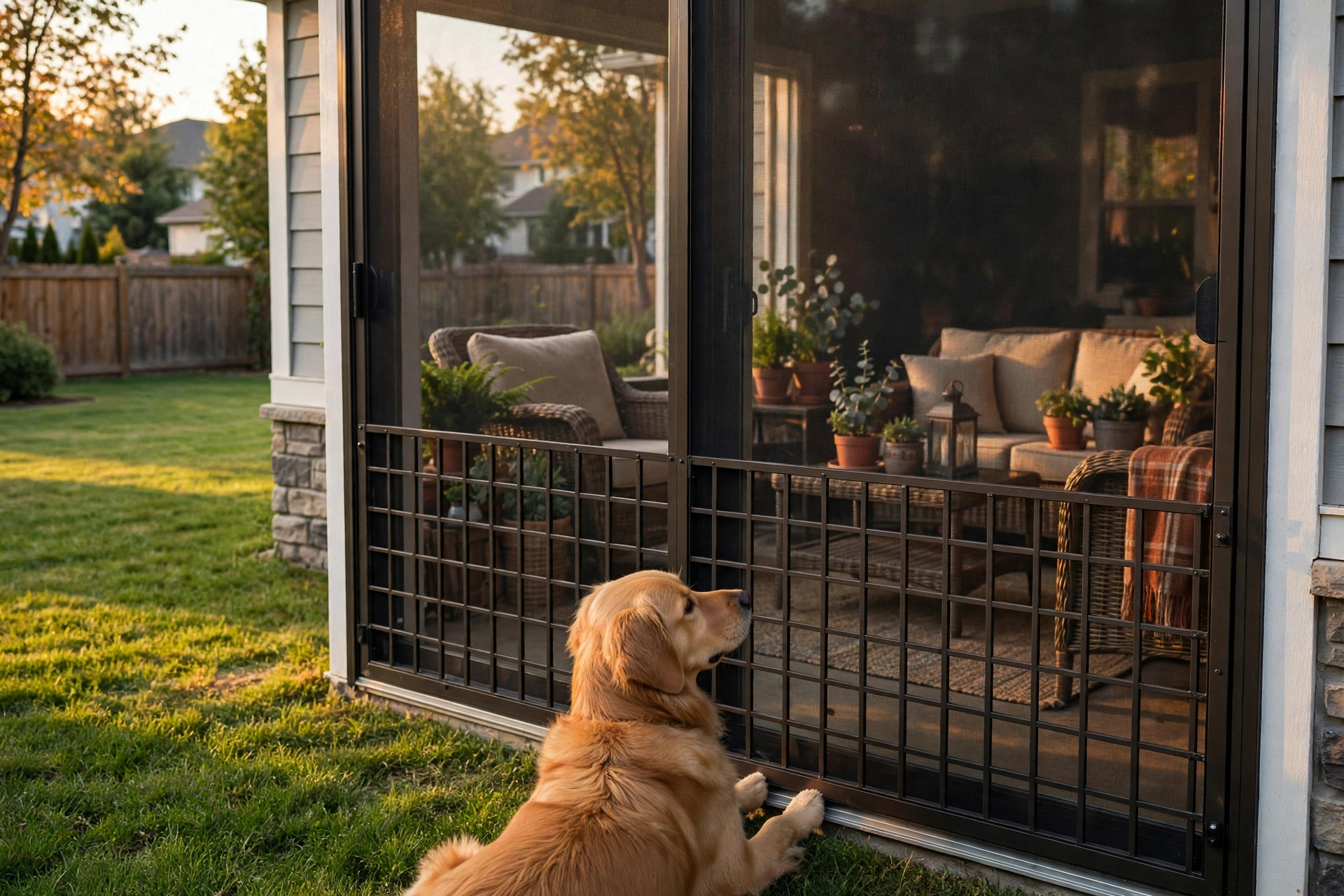

If you own a dog and a sliding patio door, you know the problem. The dog scratches at the screen. It pushes through the mesh. It tears a hole in one season. The best patio door screen for dogs solves this trouble. It uses stronger mesh. It holds up to claws and paws. It still lets fresh air move through the house. This guide explains what to look for. It covers the main types, the cost, the care, and the safety points. By the end, you will know which screen fits your home and your dog.
Why a Dog-Proof Screen Matters
A standard window screen was not built for dogs. It uses thin fiberglass mesh. A cat can tear it. A large dog can push through it with little force. Once the mesh rips, the screen loses its job. Flies come in. Mosquitoes come in. Heat comes in. The repair costs money and time.
A screen built for dogs changes the daily pattern of a house. The dog can go to the yard and come back without help. You do not need to open the glass door each time. The house stays cool with the breeze. The dog stays safe inside the yard. This matters most in summer, when the patio door stays open for hours.
The right screen also saves money over time. A cheap screen that tears every year costs more in repairs than one strong screen that lasts five years. Pet owners often learn this after the third repair. Buy strength once. Avoid repeat work.
What to Look for When You Choose: Best Patio Door Screen for Dogs
Mesh Strength
Mesh is the heart of the screen. Regular screen mesh is thin. Pet-proof mesh is thicker. It is made from vinyl-coated polyester. It can be seven times stronger than standard mesh. It resists tears from claws. It resists chewing at the edges.
When you shop, look for words like pet-proof, pet-resistant, or heavy-duty. Ask for the mesh weight. A heavier mesh lasts longer. Also check the weave. A tight weave keeps small insects out. A loose weave lets more air through but may let tiny gnats in.
The Right Fit for Your Door
A screen only works if it fits the frame. Measure your sliding door track before you buy. Measure the width and the height. Write the numbers down. Most sliding patio doors use standard sizes. But older homes may have odd sizes.
Check the track as well. A worn track makes a new screen hard to slide. Clean the track with a brush. Spray a little silicone on it. The screen should glide with one hand. If it sticks, the dog will push harder, and that strains the frame.
Opening Style and Dog Size
Think about how the dog uses the door. A small dog may be happy with a reinforced lower panel. A large dog needs a full pet-proof panel or a built-in pet flap. Some screens come with a small door flap at the bottom. The dog pushes through the flap. The rest of the screen stays whole.
For tall dogs, look for a screen with a guard grille. The grille is a metal or plastic grid over the lower part of the mesh. It takes the force of the dog’s paws. The mesh behind it stays safe. This is a good choice for dogs over fifty pounds.
Visibility and Air Flow
A darker mesh gives better outward vision. You can see the yard clearly. A lighter mesh reflects light and looks brighter from inside. Pet-proof mesh is a little darker and thicker than standard mesh. It still lets air move well. If your patio faces the street, a darker mesh also adds a bit of privacy.
Types of Screens for Homes With Dogs
Pet-Proof Mesh Replacement Panels
The simplest fix is a replacement panel. You keep your current frame. You swap the thin mesh for pet-proof mesh. A hardware store can cut the mesh to size. You can also do it at home with a spline roller. This is the cheapest path. It works well if your frame is still strong.
This option suits renters too. Many landlords allow a mesh swap because it does not change the door. Keep the old mesh. Put it back when you move out.
Full Sliding Pet Screen Doors
A full pet screen door replaces the whole sliding unit. It comes with a strong frame and pet-proof mesh built in. Some models include a pet flap at the bottom. The dog learns to push the flap open. You never need to slide the door for the dog again.
These doors cost more than a mesh swap. But they last longer. The frames are often aluminum. They resist bending when a large dog leans on them. If your old frame is bent or loose, this is the better choice.
Retractable Screen Doors
A retractable screen rolls into a side housing when not in use. It stays hidden. When you want air, you pull it across the doorway. Some models use pet-proof mesh. The roll-up design keeps the mesh safe from claws when it is stored.
The weak point is the bottom edge. A strong dog may learn to nose under the screen. Choose a model with a secure bottom seal. Train the dog to wait at the side while you pull the screen across.
Magnetic Screen Doors
A magnetic screen hangs in the doorway. Magnets down the center seam snap shut after the dog passes through. These are cheap and easy to hang. They need no tools. They work well for calm dogs that walk through gently.
They are not the best pick for rough or large dogs. The magnets can pull apart and stay open. The fabric edges can tear under claws. Think of this as a light-duty answer, not a long-term fix.
Guard Grilles and Pet Guards
A guard grille mounts on the lower half of the screen. It is a grid of steel or heavy plastic bars. The dog pushes against the bars, not the mesh. The mesh lasts far longer. Grilles are cheap. They fit most sliding doors.
Many owners pair a grille with pet-proof mesh. This gives two layers of defense. The grille takes the hits. The strong mesh handles what gets past. For a big, lively dog, this pair is hard to beat.
Cost and Price
Prices vary by type and by dog size. A roll of pet-proof mesh for a do-it-yourself swap runs about twenty to forty dollars. This covers one door. A spline roller adds a few dollars more.
A ready-made sliding pet screen door costs between one hundred and three hundred dollars. Doors with a built-in pet flap sit at the higher end. Retractable models with pet-proof mesh can reach three hundred dollars or more.
Guard grilles are the cheapest add-on. Most cost between fifteen and forty dollars. They mount with screws in a few minutes. A magnetic screen door costs about twenty to thirty dollars.
Labor adds cost if you hire help. A handyman may charge fifty to one hundred dollars to fit a new sliding screen. Many owners do the job themselves. The tools are simple. Online videos show each step.
When you compare prices, think in years. A forty-dollar mesh swap that lasts four years beats a twenty-dollar standard screen that tears twice a year. The best patio door screen for dogs is not always the cheapest one on the shelf.
Care and Upkeep
Pet-proof mesh needs little care. Brush it twice a year with a soft brush. Wash it with mild soap and water. Rinse with a gentle hose spray. Do not use a pressure washer. The force can stretch the weave.
Check the spline each spring. The spline is the rubber cord that holds the mesh in the frame. Sun and heat dry it out. If it feels brittle, replace it. A fresh spline keeps the mesh tight.
Keep the sliding track clean. Dirt and pet hair build up in the track. This makes the door drag. A dragging door tempts the dog to push harder. Vacuum the track each month. Wipe it with a damp cloth.
If you use a pet flap, check its edges. Dogs rub the same spot each day. The flap edge can wear thin. Most flaps are easy to swap. Keep a spare if your dog is a heavy user.
Take care of the rest of the patio too. A clean patio makes the screen last longer. Dust and pollen settle on the mesh and dull it. A quick wipe keeps the view clear. For the long term, heavy-duty furniture covers protect your patio set from the same dust and sun that wear down screens.
Safety Points for Dog Owners
A screen is not a barrier for a determined dog. Never leave a dog alone with only a screen between it and the yard if the dog may run off. A strong dog can still break a screen in time. Use the glass door or a lock when you leave the house.
Watch the pet flap size. A flap should fit your dog snugly. A flap that is too large lets in stray cats, raccoons, and opossums. A flap that is too small rubs the dog’s back and hips. Measure the dog at the shoulder before you buy.
Check for sharp edges after any do-it-yourself job. Cut mesh ends can be rough. A grille with loose screws can scratch a paw. Run your hand along every edge when the work is done. Fix anything sharp.
Heat is another risk. A dark pet-proof mesh absorbs sun. On a hot day the lower panel can get warm. This is rarely a burn risk, but a dog that leans on a hot screen all afternoon may get restless. Give the dog shade and water on the patio side.
Lock the sliding door at night. Many pet screen doors have a simple latch. Use it. An unlocked screen is easy for a person to slide open from outside. A screen keeps bugs out. It does not keep people out.
Frequently Asked Questions
Will pet-proof mesh keep out small insects?
Mostly yes. Pet-proof mesh has a slightly larger weave than fine insect mesh. It stops flies and mosquitoes. Very tiny gnats may pass through some brands. If gnats are a big problem in your area, look for a pet-proof mesh that lists a fine weave. You trade a little air flow for better bug control.
Can I install a pet screen door myself?
Yes, in most cases. A sliding pet screen door fits the same track as your old screen. You lift the old one out and set the new one in. Adjust the rollers at the bottom until it glides. A mesh swap needs a spline roller and a utility knife. The job takes under an hour. If your door frame is bent, call a handyman.
How long does a dog-proof screen last?
A good pet-proof screen lasts three to seven years. The range depends on the dog and the sun. A calm small dog in a shaded doorway may get seven years. A large young dog in full sun may get three. Guard grilles stretch the life of the mesh by taking the force of paws.
What is the best option for a large dog?
For a large dog, choose a full aluminum-frame sliding door with pet-proof mesh and a guard grille on the lower half. Add a pet flap sized to the dog if you want hands-free access. This setup handles weight and force. It is the setup most large-dog owners keep the longest.
Do retractable screens work with dogs?
They can work with calm dogs. The screen stays hidden when not in use, so it avoids claw damage most of the day. Train the dog to pass through slowly. A dog that charges the screen may pull it off its track. For rough dogs, a fixed sliding screen is the safer pick.
Where can I compare models before I buy?
You can compare screen models at Wayfair, which lists many pet-proof sliding screens with buyer reviews. Reading real owner reviews helps. Look for reviews from owners with the same breed and size of dog as yours. Their notes on strength and fit are the most useful.
A Short Final Word
A dog and a patio door can live in peace. The fix is simple. Use stronger mesh. Fit it well. Add a grille for a big dog. Keep the track clean. The best patio door screen for dogs is the one that matches your dog’s size and habits. Measure first. Read reviews from other dog owners. Buy once, and enjoy the breeze without the torn screens.
If you are setting up the whole patio for a dog-friendly home, plan the seating too. A sectional sofa for small patios keeps the space open for the dog to move, and a wicker loveseat for a screened porch gives you a quiet spot to watch the yard. For honest product testing beyond store reviews, Consumer Reports publishes independent test results on home products. And when you shop for patio basics at IKEA, you can round out the space in one trip.
References
Consumer Reports. (n.d.). Product reviews and ratings. https://www.consumerreports.org IKEA. (n.d.). Home furnishings. https://www.ikea.com Wayfair. (n.d.). Home goods and patio products. https://www.wayfair.com
Was this guide helpful?

About Michael Thompson
The My Garden US editorial team writes practical, in-depth home and garden guides for American homeowners — tested advice, no fluff.
You May Also Like

How to Waterproof Outdoor Furniture Cushions: A Plain Guide
June 23, 2026 0 views
Best Outdoor Bench with Backrest Reviews: What to Know Before You Buy
September 15, 2026 0 views
Outdoor Wall Sconce Lighting for Patio: A Practical Guide
June 17, 2026 0 views