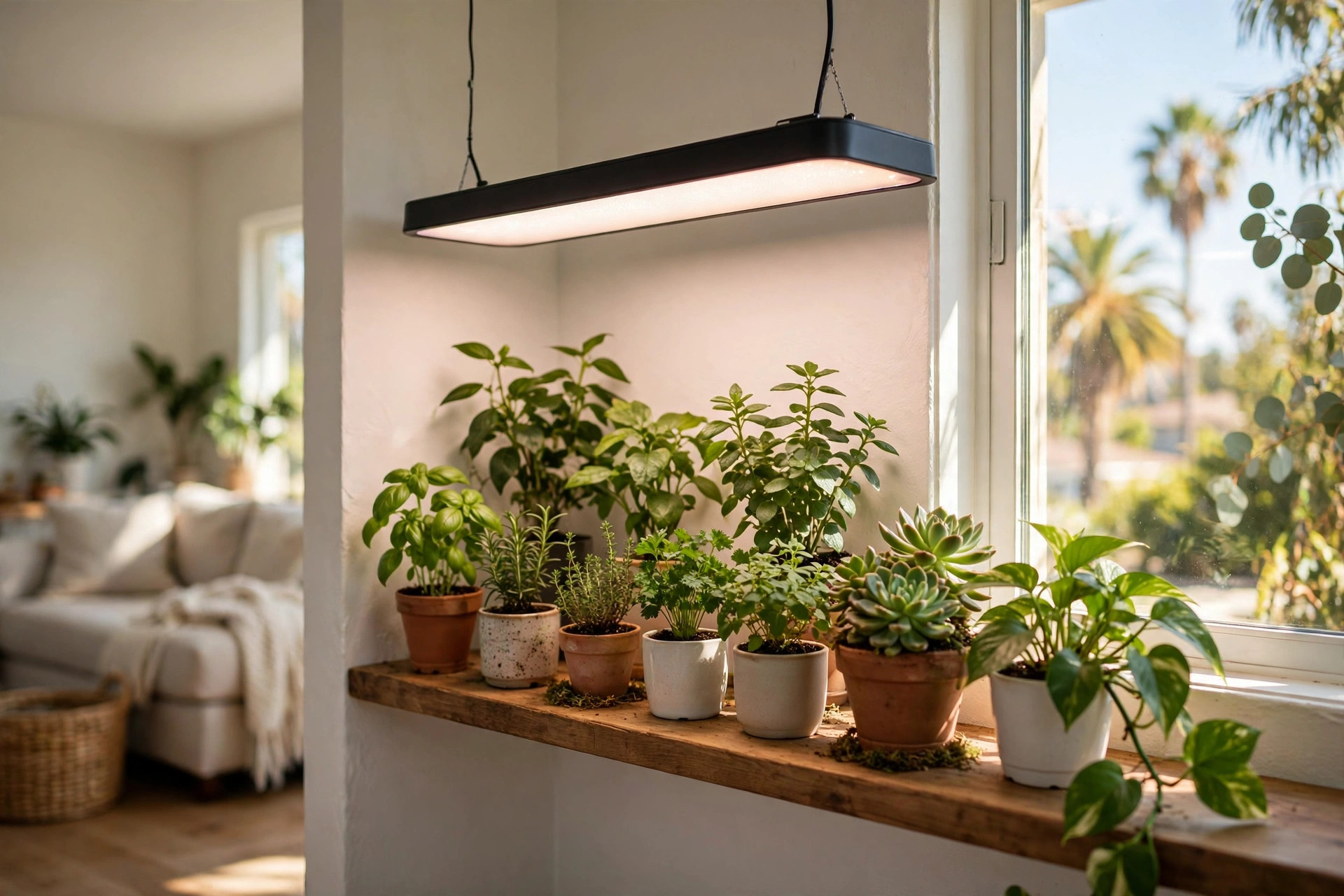
Many California homes have warm sun and mild air. Still, house plants often fail to thrive. The reason is light. Even a bright window gives far less light than a plant needs. Days grow short in winter. North-facing rooms stay dim all year. Tall homes, wide eaves, and shade trees cut light further. Indoor grow lights solve this problem. They give plants steady, measured light every day of the year. This guide explains how indoor grow lights work in California homes, how to choose the right type, what they cost, and how to use them safely.
Why Indoor Grow Lights Matter for California Homes
Plants make food from light. This process is called photosynthesis. Without enough light, a plant cannot grow. It grows tall and thin. Its leaves turn pale. New leaves stay small. Flowering plants refuse to bloom. These are all signs of low light.
California has more sun than most states. Yet indoor light is a different matter. A sunny window may look bright to the human eye. To a plant, it is often dim. Light falls fast as you move away from glass. Most living rooms, hallways, and offices in California homes are simply too dark for healthy growth.
Indoor grow lights close the gap. They add light where nature falls short. They also add control. A grower can set the hours of light with a timer. This steady schedule beats the shifting light of a window and the short days of winter. Grow lights serve real needs in the USA home: kitchen herbs, tropical plants, early seed starts, and dark garages or closets where no sun reaches at all.
What Plants Need From Light
Three things matter: color, brightness, and time. Color is measured in Kelvin. Lower numbers look warm and red; higher numbers look cool and blue. Most indoor plants do well near daylight, around 5000 to 6500 Kelvin. Lights that copy this are called full-spectrum lights.
Brightness can be read from a measure called PPFD, which counts the light particles plants use. Seedlings need low numbers, leafy greens need medium numbers, and fruiting plants such as tomatoes need high numbers. Most makers print PPFD maps for their lamps.
Time is the hours the light stays on, set by a timer. Most house plants do well with 12 to 14 hours. Leafy greens often get 14 to 16 hours. Plants also need a dark period: 8 to 10 hours of total darkness keeps them on a natural cycle.
Types of Indoor Grow Lights: Indoor Grow Lights California Homes Usa
Four main types of grow lights are sold in the USA today. Each has its strengths.
LED Grow Lights
LED stands for light-emitting diode. LED grow lights are now the most common choice. They use far less power than older types. They make little heat. They last a long time, often 25,000 to 50,000 hours. Most LED grow lights give full-spectrum light that suits many plants. They come in many shapes: panels, bars, and clip-on lamps.
LED lights are the best fit for most California homes. They run cool, so they can sit close to plants without burning leaves. They keep power bills low, which matters in a state with high electricity rates. For more detail on how modern lighting saves power, the Energy Star lighting program explains efficiency ratings for household lamps.
Fluorescent Grow Lights
Fluorescent tubes, often marked T5 or T8, were the standard for years. They are cheap to buy. They give good light for seedlings and low-light plants. They run cooler than old incandescent bulbs. Their weak points are life span and power use. They fade with age and need yearly replacement for best results. They also contain a small amount of mercury, so they must be recycled, not thrown in the trash.
Fluorescent lights still work well for seed starting and for small herb racks. A two-tube fixture over a seed tray is a classic setup. But for most uses, LED lamps have taken their place.
HID Grow Lights
HID stands for high-intensity discharge. The two common kinds are metal halide and high-pressure sodium. They give very strong light, but they draw 400 to 1000 watts and run very hot, often needing a fan or vent. For a California home, the heat and power draw are usually a poor trade. Most home growers now choose LED instead.
How to Choose the Right Indoor Grow Light
Start with your plants. Group them by need.
– Low-light plants such as pothos, snake plants, and ZZ plants need only a small boost. A modest LED panel or a clip-on grow lamp is enough. – Medium-light plants such as most houseplants, ferns, and philodendrons need more. A full-spectrum LED panel of 30 to 60 watts suits a shelf of plants. – High-light plants such as herbs, greens, and citrus need strong light. Look for LED bars or panels of 100 watts or more with a published PPFD map. – Fruiting plants such as tomatoes and peppers need the most. They want high PPFD and 14 to 16 hours of light each day.
Next, measure your space. A small shelf needs one bar. A four-foot rack needs two to four bars. A grow tent needs a panel sized to the tent. Light makers list coverage area on the box. Match it to your space.
Check the spectrum. For mixed houseplants, choose full-spectrum white light. It looks natural in a living room. Older “blurple” lights give pink-purple light. They work, but they look harsh in a home.
Look at dimming. A lamp with a dimmer lets you start seeds at low power and raise it as plants grow. It also saves power. Timers matter too. A simple plug-in timer or a lamp with a built-in timer keeps the schedule steady.
Read the fine print. Look for lamps with safety marks such as ETL or UL listing. These marks show the lamp was tested to USA safety standards. A buying guide to lighting can help you compare features side by side.
Special Notes for California Homes
California homes raise a few special points. First, electricity cost. California has some of the highest residential power rates in the USA, so LED efficiency matters more here than in most states. The Department of Energy lighting pages explain how efficient lamps cut running costs. Second, heat. Many California homes use air conditioning for months. A cool LED lamp saves money twice: once on the lamp, once on cooling. Third, room use. In many California homes the indoor garden sits in the living space, so sleek white full-spectrum LEDs blend in far better than harsh purple lights. Fourth, winter daylight is still fair, so in rooms with south or west windows the lamp may only need to run morning and evening. Fifth, fire season. Choose lamps with proper safety listings and keep them clear of dry curtains, paper, and fabric.
Cost and Price of Indoor Grow Lights
Prices in the USA fall into clear bands.
– Clip-on and desk grow lamps: 15 to 40 dollars. Best for one or two plants. – Two-foot LED bars: 30 to 70 dollars each. Best for shelves. – Full-spectrum LED panels, 100 to 200 watts: 80 to 200 dollars. Best for racks and small tents. – High-output LED panels, 300 watts and up: 200 to 500 dollars. Best for serious growing.
Running cost is separate from the price of the lamp. A 60-watt LED running 14 hours a day uses about 25 kilowatt-hours per month. In California, that can cost 7 to 10 dollars per month. A 150-watt panel at the same hours can cost 18 to 28 dollars per month. Your rate depends on your utility and your plan.
Do not forget the small costs. A timer costs 10 to 15 dollars. Adjustable hangers cost a few dollars. A power strip with surge protection is wise. These small parts make the setup safe and easy to run.
Buy from known stores. Large home stores carry tested brands with clear specs. Both Home Depot and Lowe’s stock LED grow lights with published specs and return policies. Specialty lighting stores such as Lumens and Lamps Plus carry design-minded fixtures that blend into home rooms. Reading maker specs, such as those from Philips, helps you compare true light output rather than sales claims.
Setting Up Your Grow Light
Good setup matters as much as a good lamp. Hang the lamp 12 to 24 inches above the plant tops. Seedlings want more distance; mature plants can sit closer. If leaves bleach or curl, the light is too close. If stems stretch long and thin, it is too far.
Cover the whole growing area. Light falls off at the edges, so two bars spaced apart beat one bar in the middle. Set a timer: 12 hours for houseplants, 14 to 16 for herbs and greens, with 8 to 10 hours of true darkness. Raise the lamp as plants grow so they never touch it. Grow lights speed growth, so check soil often and feed lightly and often.
Care and Upkeep of Grow Lights
Grow lights need little care, but a few habits keep them working well.
Dust the lamp often. Dust on the diodes cuts light output. A soft dry cloth once a month is enough. Make sure the lamp is off and cool first.
Check the timer now and then. Power cuts can reset cheap timers. A wrong schedule can stress plants. Smart plugs with built-in schedules keep working through short outages.
Watch for aging. LEDs fade slowly over years. If plants start to stretch after two or three years, the lamp may be fading. Fluorescent tubes fade faster and should be replaced each year for best results.
Keep cords tidy. Loose cords in a damp growing area are a hazard. Use cord clips. Keep power strips off the floor and away from water trays.
Store spare lamps well. Keep them in a dry place. Keep the original box for safe moves.
Safety Tips for Indoor Grow Lights
Grow lights are safe when used with care. These rules matter in any USA home.
– Use lamps with ETL or UL listing marks. These marks show testing to USA standards. – Do not overload outlets. One high-wattage panel per outlet is a safe rule. – Keep lamps away from water. Do not hang them over open water trays where they can fall in. – Keep lamps clear of curtains, paper, and fabric. Even cool LEDs should not touch dry goods. – Let lamps cool before handling. Some panels still get warm at the heat sink. – Use a surge protector. It guards the lamp and the home wiring. – In rented California homes, check lease rules before adding large growing setups. – Keep lights off at night for the sake of neighbors. Bright grow lights in windows can annoy others and waste power.
For more on home electrical safety, the Consumer safety pages from the federal energy office cover safe lamp use in the home.
Common Mistakes to Avoid
Too little light. A lamp that is too weak or too far away is the most common error. Stretchy stems and pale leaves are the signs. Move the lamp closer or buy a stronger one.
Too much light. Bleached leaf tips and curled edges mean the lamp is too close. Raise it or turn on the dimmer.
No dark period. Most plants need a night rest. Give 8 to 10 hours of darkness; do not run lights 24 hours a day.
Wrong spectrum. A warm yellow reading lamp is not a grow light. Use lamps made for growing, with full-spectrum or daylight output.
Forgetting water. Faster growth drinks more water. Check soil more often under grow lights than in a dim room.
FAQ About Indoor Grow Lights for California Homes
How many hours should indoor grow lights run each day?
Most houseplants do well with 12 to 14 hours of light per day. Herbs and leafy greens often get 14 to 16 hours. Give plants 8 to 10 hours of full darkness each night. Use a timer so the schedule stays steady.
Can indoor grow lights replace sunlight completely?
Yes, for most plants. A good full-spectrum LED at the right brightness gives plants all the light they need. Many growers in California homes use grow lights alone in rooms with no windows.
Do grow lights raise the power bill a lot in California?
It depends on lamp size. A small 30-watt LED lamp adds only a few dollars per month. A 150-watt panel running 14 hours daily can add 18 to 28 dollars per month at California rates. LED lamps cost far less to run than old HID lamps.
Are LED grow lights better than fluorescent for home use?
For most uses, yes. LED lamps use less power, make less heat, and last longer. Fluorescent tubes still work fine for seed starting on a budget.
How high should I hang a grow light above my plants?
Most LED panels work best 12 to 24 inches above the tops of the plants. Start at 18 inches and watch the plants. If stems stretch, lower the lamp. If leaves bleach, raise it.
Will grow lights bother my family or neighbors?
Full-spectrum white LEDs look like normal room light and bother no one. Run lights on a daytime schedule and close blinds if the glow spills out of windows at night.
Final Word on Indoor Grow Lights for California Homes
Indoor grow lights give California homes what windows often cannot: steady, strong light every day of the year. Start with your plants and your space. Choose a listed, full-spectrum LED lamp that fits the area. Hang it at the right height. Set a timer. Watch your plants and adjust. With these simple steps, herbs, greens, and houseplants can thrive in any room, from a sunny San Diego kitchen to a dim San Francisco flat. For related ideas around the house, see our guides on dining room chandeliers, kitchen track lighting, and motion flood lights.
References
ENERGY STAR. (n.d.). Energy efficient products. https://www.energystar.gov Lamps Plus. (n.d.). Lighting and home decor. https://www.lampsplus.com Lowe’s. (n.d.). Home improvement products. https://www.lowes.com Lumens. (n.d.). Lighting and ceiling fans. https://www.lumens.com Philips. (n.d.). Lighting products. https://www.philips.com The Home Depot. (n.d.). Home improvement products. https://www.homedepot.com The Spruce. (n.d.). Home and garden advice. https://www.thespruce.com U.S. Department of Energy. (n.d.). Energy efficiency and renewable energy. https://www.energy.gov
Was this guide helpful?

About Sarah Mitchell
The My Garden US editorial team writes practical, in-depth home and garden guides for American homeowners — tested advice, no fluff.