
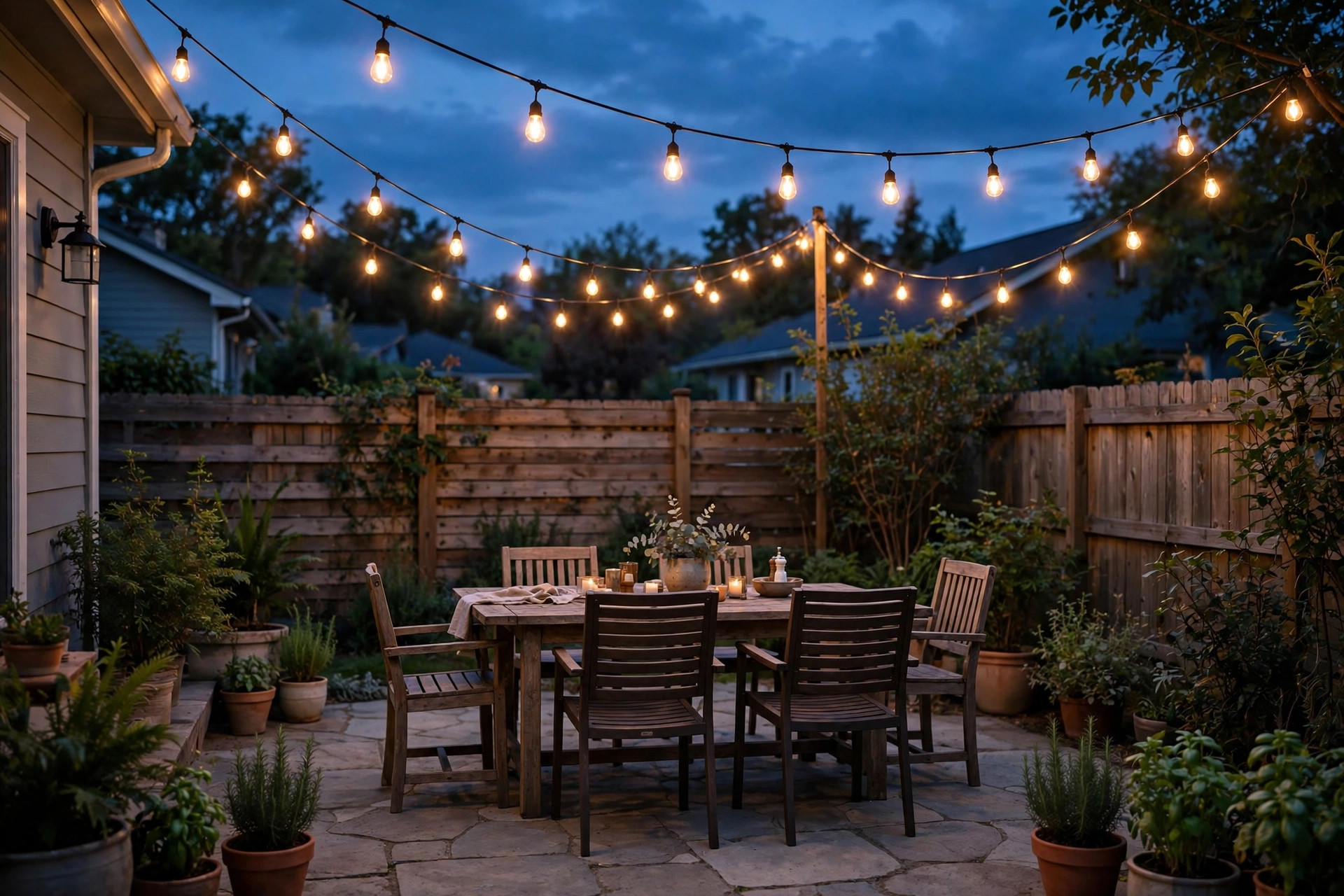

Few things change a backyard the way patio string lights can. At dusk, a row of small bulbs can turn a plain concrete slab into a place where people want to sit and talk. Shoppers in the United States now have more choices than ever, from old-fashioned incandescent sets to modern solar and smart versions. This patio string lights reviews buying guide usa walks through what matters, what to skip, and how to buy with confidence.
Why Patio String Lights Matter
A patio is one of the most used outdoor spaces in an American home. It holds cookouts, birthday parties, and quiet evenings after work. Good light makes all of these better. Harsh floodlights can make a patio feel like a parking lot. String lights give a soft, even glow that flatters faces and food alike.
There is also a practical side. A lit patio is a safer patio. Steps, low walls, and uneven pavers are easier to see when the area has steady light. Guests can find their way without a flashlight. Pets are less likely to wander into the dark corners of the yard.
Value is another reason. Compared with wired landscape lighting, string lights are cheap to buy and simple to install. A homeowner can light a twelve-by-twenty patio for less than the cost of one professional landscape fixture. When the bulbs last for years, the yearly cost drops to almost nothing.
What to Look for When You Buy: Patio String Lights Reviews Buying Guide Usa
Start with the power source. Plug-in string lights connect to a standard outdoor outlet. They are the brightest and most reliable. Solar string lights need no outlet at all, but they depend on sunlight and grow dim on cloudy weeks. Battery-powered sets work well for renters and for spots far from the house.
Next, check the bulb type. Incandescent bulbs give the warmest, most classic look, but they use more power and burn out faster. LED bulbs cost more up front, yet they last for years and use a fraction of the electricity. Most buyers today choose LED.
Look at the wire and sockets. Outdoor sets should be rated for outdoor use. The listing or package will say “suitable for outdoor use” or carry a UL mark for wet locations. Cheap indoor sets will crack and fail after one season of rain.
Pay attention to length and spacing. A set may be twenty-five feet long or fifty feet long. Count how many bulbs it holds and how far apart they sit. Bulbs spaced two to three feet apart give a full, even canopy. Wide spacing looks thin and unfinished.
Check the connection type. Many sets are connectable, which means you can join two or three strands end to end on one outlet. Each strand will list a maximum number of connectable sets. Do not go past that number, or the wire can overheat.
Finally, read the warranty. A one-year warranty is common. Better brands offer two or three years. A warranty tells you that the maker expects the set to last.
Types of Patio String Lights
Classic Edison-style LED sets. These copy the look of old filament bulbs. They give a warm amber glow that suits brick patios and wooden decks. They are the most popular type in the country.
Globe lights. Round bulbs in frosted or clear glass give a softer, more even light. They work well over dining tables because the glow does not glare into the eyes of seated guests.
Fairy or micro lights. These use tiny LED dots on a thin wire. They are delicate and best for decoration rather than real light. They suit pergolas, shrubs, and holiday displays.
Solar string lights. A small panel charges a battery during the day. At night, the lights come on by themselves. They are easy to place anywhere, but the light is weaker and shorter-lived than plug-in sets. They work best in sunny states.
Smart string lights. These connect to a phone app or a voice assistant. You can dim them, change colors, and set timers. They cost more, but they give full control without getting up from the chair.
Heavy-duty commercial sets. Made for restaurants and event spaces, these have thick wire and shatterproof bulbs. Homeowners with large patios or high winds often choose them for their strength.
For more outdoor lighting ideas, see our guide to outdoor wall lanterns, our notes on motion flood lights, and our look at deck cap lights.
How to Hang Patio String Lights
Planning comes first. Measure the patio. Draw the shape on paper and mark where you want the lights to go. Most people hang lights in a V shape, a zigzag, or straight lines across the space. Leave a little slack in each run so the wire hangs in a gentle curve, called a catenary. A deep sag looks careless; a light curve looks right.
You need anchor points. The house wall is the most common anchor. A tall wooden post, a pergola beam, or a tree can serve as the other end. If no anchor exists, you can set posts in planters filled with concrete. Do not hang lights from gutters or thin trim, which can bend or pull loose.
Use the right hardware. Cup hooks, eye bolts, and screw-in anchors hold the wire. Zip ties work for temporary setups. Guide wire, a thin steel cable strung first, gives extra support for long runs and heavy sets. Retailers such as Home Depot and Lowe’s sell all of these parts in their lighting aisles.
Hang the lights high enough to clear heads. Seven to nine feet above the floor is a good range. Over a dining table, hang them a little lower, about six to seven feet, so the table sits in a pool of light.
Keep the plugs dry. Use an outdoor-rated extension cord and plug covers. Loop the cord so water drips off instead of running into the socket. Test everything at night before the first party so you can adjust the height and spacing.
Cost and Price
Prices vary with length, bulb type, and brand. A basic twenty-five-foot LED set costs between fifteen and thirty dollars. A fifty-foot Edison-style set with shatterproof bulbs runs thirty to sixty dollars. Smart sets with app control start near fifty dollars and can pass one hundred.
Solar sets are often the cheapest, sometimes under twenty dollars for a long strand. Their low price reflects weaker light and shorter life. Commercial-grade sets cost more, often sixty to one hundred twenty dollars for fifty feet, but they can last for many seasons.
Do not forget the extras. Mounting hardware, posts, timers, and outdoor extension cords can add twenty to fifty dollars to the project. Even so, a full patio setup often costs less than one hundred fifty dollars in total.
When you compare sets, divide the price by the number of bulbs and by the expected life in hours. LED bulbs rated for twenty-five thousand hours will outlast ten incandescent sets. The cheapest sticker price is rarely the cheapest long-term choice. Guides at The Spruce and Lamps Plus often compare long-term costs across bulb types.
Care and Upkeep
String lights need little care, but a little attention each season goes far. In spring, wipe the bulbs with a soft cloth and check for cracked sockets. Replace any burned-out bulbs before the first cookout. Check that all connections are tight and dry.
During storm season, take down light sets if high winds are forecast. Even strong sets can whip against posts and break. If you leave them up, make sure the anchors are tight and the wire has enough slack to move without snapping.
At the end of the season, some owners take the lights down for winter. In mild states, sets rated for year-round outdoor use can stay up. If you take them down, coil the wire loosely and store it in a dry box. Never wind the wire tight around your hand, which can kink and weaken it.
Bulbs collect dust and pollen. A quick wipe in midsummer restores full brightness. For solar sets, clean the small panel with a damp cloth so it charges fully. Test the batteries once a year and replace them when the light fades early in the evening.
Safety
Outdoor electricity demands respect. Only buy sets listed for outdoor use by a testing lab such as UL or ETL. The mark should be on the package and on the wire tag. Indoor sets belong indoors.
Keep all plugs and connections off the ground and out of standing water. A raised outlet box or a cord cover keeps rain out. Do not run cords across walkways where people can trip. If a cord must cross a path, cover it with a cord ramp or bury it in a shallow trench with outdoor-rated conduit.
Do not overload one outlet. Each set lists its wattage. Add the watts of every connected strand and stay below eighty percent of the outlet rating. LED sets use so little power that this is rarely a problem, but incandescent sets can add up fast.
Turn lights off when you are done for the night. A timer or a smart plug does this by itself and saves power. It also extends bulb life. The U.S. Department of Energy and ENERGY STAR both recommend timers for outdoor lighting to cut waste.
Frequently Asked Questions
How many feet of string lights do I need for my patio? Measure each run and add them together, then add ten to fifteen percent extra for the sag between anchors. A twelve-by-sixteen patio with a zigzag pattern usually needs sixty to eighty feet of lights.
Are LED string lights really better than incandescent? For most buyers, yes. LED sets use about one tenth of the power, last years longer, and stay cool to the touch. Incandescent sets still win on pure warmth of color, but the gap is small now.
Can I leave patio string lights up all winter? It depends on the set and the state. Sets rated for year-round outdoor use can stay up in mild winters. In states with heavy snow and ice, taking them down in late fall protects the wire and sockets.
Do solar string lights work on cloudy days? They work, but weakly. A full day of sun may give six to eight hours of light. A cloudy day may give two to three hours. If your patio gets little direct sun, a plug-in set is the safer choice.
How high should I hang string lights over a dining table? Six to seven feet above the table surface is ideal. This puts the bulbs above eye level for seated guests while keeping the table in warm, useful light.
What is the difference between warm white and daylight bulbs? Warm white, around twenty-seven hundred kelvin, gives the amber glow most people want on a patio. Daylight, around five thousand kelvin, looks blue and harsh outdoors. For patios, warm white is almost always the right pick. Lighting specialists at Lumens and Philips explain color temperature in plain terms.
A Short Final Word
Patio string lights are a small purchase that pays back every evening you use them. Choose a set rated for the outdoors, hang it with care, and keep the connections dry. Whether you pick a simple LED strand or a smart color-changing set, the result is the same: a patio that draws people outside and keeps them there after dark. For independent test results and buying advice, sources such as Consumer Reports and Bob Vila are worth a visit before you check out.
References
Bob Vila. (n.d.). Home improvement advice. https://www.bobvila.com Consumer Reports. (n.d.). Product reviews and ratings. https://www.consumerreports.org ENERGY STAR. (n.d.). Energy efficient products. https://www.energystar.gov Lamps Plus. (n.d.). Lighting and home decor. https://www.lampsplus.com Lowe’s. (n.d.). Home improvement products. https://www.lowes.com Lumens. (n.d.). Lighting and ceiling fans. https://www.lumens.com Philips. (n.d.). Lighting products. https://www.philips.com The Home Depot. (n.d.). Home improvement products. https://www.homedepot.com The Spruce. (n.d.). Home and garden advice. https://www.thespruce.com U.S. Department of Energy. (n.d.). Energy efficiency and renewable energy. https://www.energy.gov
Was this guide helpful?

About Jennifer Lee
The My Garden US editorial team writes practical, in-depth home and garden guides for American homeowners — tested advice, no fluff.
You May Also Like
Sensor Porch Lights Texas Homes USA: A Practical Guide to Motion and Dusk-to-Dawn Porch Lighting
June 1, 2026 0 views
Indoor Grow Lights Reviews Buying Guide USA: Grow Healthy Plants Without Sunlight
June 1, 2026 0 views
Dining Room Chandeliers Reviews Buying Guide USA
September 5, 2026 0 views