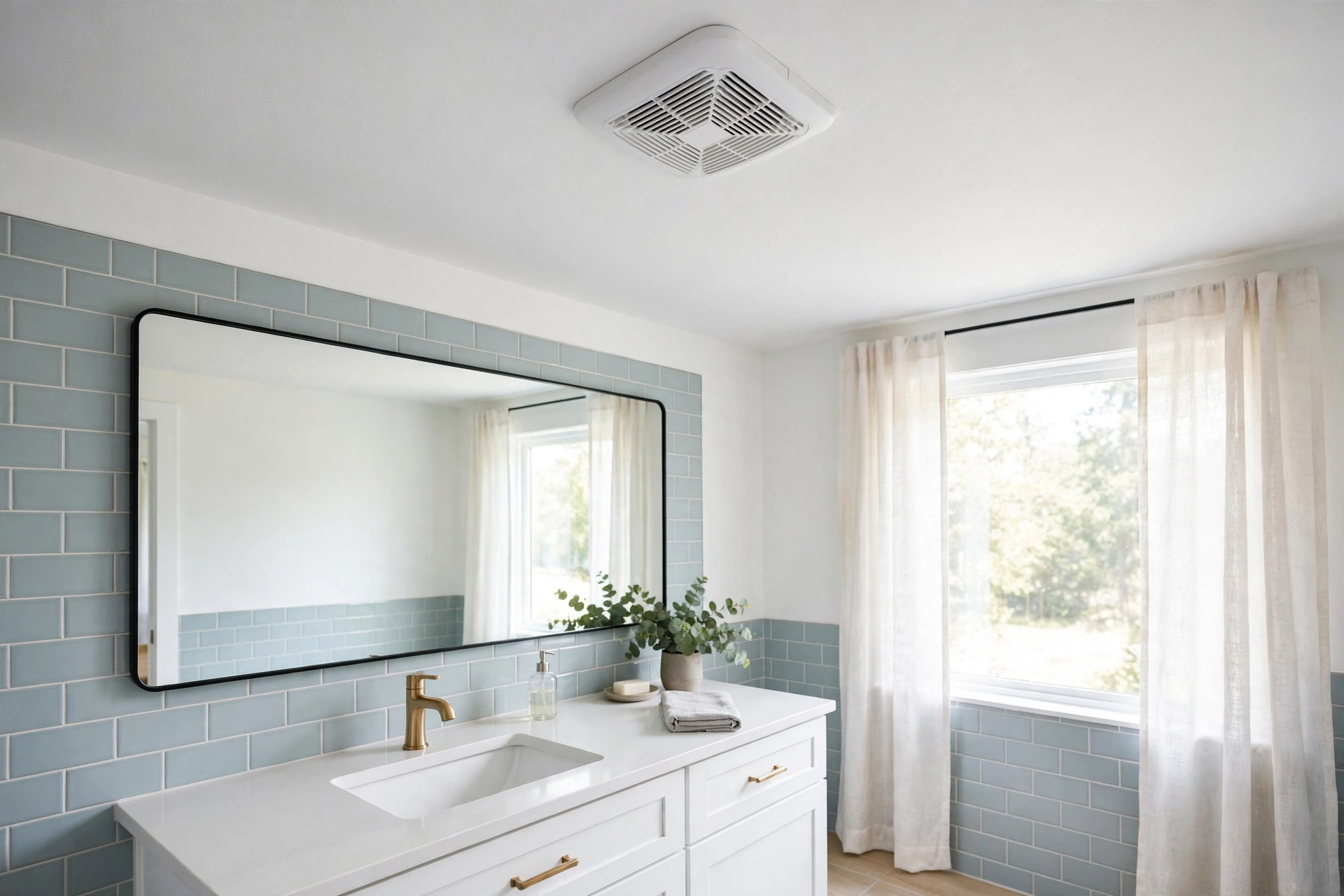

A loud bath fan is easy to ignore until it is too late. The racket drives you to leave the fan off. Steam settles on the walls. Paint blisters. Grout turns dark. Mold creeps into the corners. This quiet exhaust fans buying guide USA exists for one simple reason: the right fan is so quiet that you forget it is on, and so strong that your bathroom stays dry.
American homes lose many bathrooms to moisture damage each year. A good exhaust fan is the cheapest defense. It pulls humid air out of the room and sends it outdoors. New models run at sound levels that were unheard of twenty years ago. This guide walks you through sound ratings, air power, sizing, types, costs, wiring, and upkeep, so you can buy with confidence.
Why a Quiet Fan Matters More Than You Think
A bath fan has two jobs: move air and stay out of your way. If it is noisy, people switch it off. That defeats the purpose. Moisture from a hot shower can raise the humidity of a small bathroom to near one hundred percent in minutes. Wood trim swells. Wallpaper seams curl. Mirror frames rot from behind.
Quiet fans change the habit. When you cannot hear the motor, you leave it running for twenty or thirty minutes after a shower. That is the time it takes to pull the last of the steam from the walls and ceiling. Over years, this one habit saves thousands of dollars in repairs.
There is also a comfort factor. Early morning showers are quieter. Late night trips do not wake the house. If you like a calm bathroom, the fan should match the mood of the room, just like your LED bathroom mirrors and fresh fixtures match its style.
How Fan Noise Is Measured
Fan noise is rated in sones. One sone is about the level of a quiet refrigerator hum. Most old builders-grade fans run at 3 to 4 sones. You hear them from the next room.
A fan rated at 1.0 sone or less counts as quiet by industry measure. The best models today reach 0.3 sones, which is close to silent. When you shop, look for the sone rating on the box or the spec sheet. Treat it like a grade. Under 0.5 is excellent. Under 1.0 is good. Anything over 2.0 will sound like the old unit you want to replace.
How Air Power Is Measured
Air power is rated in CFM, or cubic feet per minute. The rule used by the Home Ventilating Institute is simple. For bathrooms up to 100 square feet, allow 1 CFM per square foot. A 60-square-foot bath needs at least 60 CFM. For larger rooms, add up the fixtures: 50 CFM for each toilet, shower, and tub, plus 100 CFM for a whirlpool tub.
Pick a fan that meets this minimum and a little more. Oversizing slightly helps the fan clear air faster without running longer. But do not go far beyond what the room needs, since a very large fan in a tiny room can feel drafty.
How to Choose the Right Fan: Quiet Exhaust Fans Buying Guide Usa
Start with the room. Measure the length and width to get the square footage. Note the ceiling height. A standard eight-foot ceiling follows the simple rule above. Vaulted or nine-foot ceilings need extra power, roughly 10 to 15 percent more.
Next, look at how the fan will be vented. The best exhaust fans vent straight through the roof or a side wall. A short, straight duct run works best. Every bend in the duct cuts the air flow. Flexible duct should be stretched tight, never left sagging between joists. A proper installation matters as much as the fan itself.
Sone Ratings Worth Paying For
The jump from 2.5 sones to 1.0 sone is the biggest step in value. The jump from 1.0 to 0.3 sones costs more but gives true silence. If the bathroom sits next to a bedroom or a home office, aim for the lower number. Retailers such as Home Depot and Lowe’s list sone ratings in their product filters, which makes side-by-side shopping easy.
CFM Sizing Chart by Room Size
| Bathroom Size | Minimum CFM | Good Pick | |—|—|—| | Under 50 sq ft | 50 CFM | 80 CFM | | 50 to 80 sq ft | 50 to 80 CFM | 90 to 110 CFM | | 80 to 100 sq ft | 80 to 100 CFM | 110 to 130 CFM | | Over 100 sq ft | 1 CFM per sq ft | Add 10 percent |
These are starting points from the Home Ventilating Institute method. The This Old House site has long advised homeowners to size up slightly rather than down.
Types of Quiet Exhaust Fans
Ceiling-Mount Fans
This is the common type. The unit sits between the ceiling joists, with a grille flush to the ceiling. Most quiet models today are ceiling-mount. They come in a wide range of CFM ratings and sone levels. Installation is straightforward for anyone comfortable in an attic.
Wall-Mount Fans
Wall-mount fans vent directly through the outside wall. They suit bathrooms on the ground floor where attic access is poor. The duct run is short, which helps air flow. Sound ratings are similar to ceiling models, though the selection is smaller.
Inline or Remote Fans
In this design, the motor sits in the attic or a remote spot, connected to the bathroom grille by ductwork. The room itself hears almost nothing. Inline fans can serve two or three bathrooms from one motor. They cost more and need more attic work, but they are the quietest option of all.
Fan and Light Combinations
Many quiet fans include a light, a night-light, or a heater. Combination units save ceiling space. The heater models are popular in colder states. When comparing combos, check the sone rating for the fan alone and for the heater mode, since heater fans often run louder.
Humidity-Sensing Fans
These units carry a built-in sensor that turns the fan on when moisture rises and off when the air is dry. You never have to remember the switch. The sensor adds cost, but it protects the bathroom even when guests forget to run the fan. Several brands in the Kohler and Moen lines now pair well with smart bathroom setups.
Features Worth the Money
Look for a few details that separate good fans from great ones. A DC motor runs quieter and uses far less electricity than an old AC motor. Many DC models carry an Energy Star label and can run all day for a few dollars a year in power.
A built-in damper keeps cold outside air from flowing back into the house. This matters in winter. The damper should close fully and seal well.
Grille design matters too. A grille that is easy to remove makes cleaning simple. Some grilles come in designer finishes that blend with freestanding soaking tubs and modern tile.
Timer switches are a small add-on with a big payoff. Set the fan to run twenty minutes after you leave, and moisture never gets a foothold. Some new fans include the timer inside the unit itself.
Cost and Price in the USA
Quiet bath fans span a wide price range. A basic 50 CFM unit at 2.0 sones costs around 40 to 60 dollars. A mid-range 80 to 110 CFM fan at 0.8 to 1.0 sone runs 80 to 150 dollars. Premium models with DC motors, humidity sensors, and 0.3 sone ratings run 150 to 300 dollars. Combination units with heaters run 120 to 350 dollars.
Professional installation adds 150 to 350 dollars in most markets, more if new ductwork or wiring is needed. Replacing an old fan with a new one of the same size is often a do-it-yourself job of two to three hours. Running new duct to the roof or adding a circuit for a heater combo is best left to a licensed electrician or contractor. Review guides on Bob Vila and The Spruce often break down these install costs by region.
Installation Basics
Turn off the breaker before you touch any wiring. Remove the old grille and housing if this is a replacement. Many new fans ship with retrofit brackets that fit the old ceiling hole.
Mount the housing to a joist or use the included brackets. Connect the duct with a metal clamp and seal the joint with foil tape, not cloth duct tape. Run the duct to the outside, never into the attic. Venting into the attic dumps moisture where it causes rot.
Wire the fan to the wall switch or to a timer switch. Restore power and test. Hold a square of toilet paper up to the grille. A strong fan holds it firmly against the grille. If it flutters or falls, check the damper and duct for kinks.
Care and Upkeep
A quiet fan stays quiet only if it is clean. Dust builds on the grille and on the blower wheel inside. Once or twice a year, turn off the power, pull off the grille, and vacuum it. Wipe the blower blades with a damp cloth. Vacuum dust from the motor housing.
Check the outside vent cap each spring. Birds nest in them. Lint and dust cake over them. A blocked cap forces the motor to strain, which raises noise and shortens the fan’s life.
Listen once a year. A new rattle or hum means the mounting screws loosened or the damper flap is worn. Both are quick fixes. A fan that suddenly grows loud may need its motor replaced, but most quality fans last ten to fifteen years.
Safety Notes
Electricity and water share a small room, so respect both. Always kill the breaker before working on the fan. If the fan sits directly over a tub or shower, code in many areas calls for a GFCI-protected circuit. Check your local code or ask an electrician.
Never vent a bath fan into the attic, soffit, or wall cavity. Moisture trapped there feeds mold and rots wood. Always vent to the outside air. American Standard and Delta Faucet product guides echo this rule, and it matches what home inspectors look for.
If your bathroom has no window and no fan, adding one is a priority. Some older homes were built without any bath ventilation. Bringing the room up to current practice protects the structure and improves air quality.
Frequently Asked Questions
What is the quietest bath fan I can buy?
The quietest widely sold models rate at 0.3 sones with DC motors. In a real room, you will hear only a faint whisper of moving air. Inline remote-mount fans are quieter still at the grille, since the motor sits far from the room.
How many CFM do I need for a small bathroom?
For a bathroom under 100 square feet, the rule is 1 CFM per square foot. A 50-square-foot bath needs 50 CFM at minimum. Most shoppers choose 80 CFM for small baths so the room clears faster.
Can I install a bath fan myself?
A like-for-like replacement is a common do-it-yourself project. You will need basic tools, a ladder, and comfort with simple wiring. New duct runs, roof penetrations, and heater-combo circuits are better handled by a pro.
Do quiet fans cost more to run?
Usually they cost less. Quiet models often use DC motors that draw 5 to 12 watts, versus 25 to 40 watts for old AC fans. Running a modern fan for an hour costs only a few cents.
How long should I run the fan after a shower?
Run it for at least twenty minutes after the shower ends. Thirty minutes is better in a room with no window. A timer switch or a humidity-sensing fan handles this without you thinking about it.
Will a bigger fan be louder?
Not always. A larger, well-made fan moving more air can run at lower speed and lower noise than a small fan straining at full speed. Compare sone ratings directly rather than guessing from size.
Final Word
The best bath fan is the one you never notice. Start with the right CFM for your room size. Then buy the lowest sone rating your budget allows. Vent it to the outside with a short, straight duct. Keep the grille clean. Do these four things, and your bathroom will stay fresh, quiet, and free of moisture damage for years.
Pairing the fan with the rest of your remodel, from heated floor kits to fresh fixtures, turns the bathroom into a room you enjoy rather than a room you maintain. For style ideas and remodel planning, browse the design guides at HGTV. A quiet fan is a small part of the budget, but it protects every other dollar you spend.
References
American Standard. (n.d.). Bathroom and kitchen products. https://www.americanstandard.com Bob Vila. (n.d.). Home improvement advice. https://www.bobvila.com Delta Faucet. (n.d.). Kitchen and bathroom faucets. https://www.deltafaucet.com HGTV. (n.d.). Home and garden ideas. https://www.hgtv.com Kohler. (n.d.). Bathroom and kitchen fixtures. https://www.kohler.com Lowe’s. (n.d.). Home improvement products. https://www.lowes.com Moen. (n.d.). Faucets and plumbing fixtures. https://www.moen.com The Home Depot. (n.d.). Home improvement products. https://www.homedepot.com The Spruce. (n.d.). Home and garden advice. https://www.thespruce.com This Old House. (n.d.). Home renovation guidance. https://www.thisoldhouse.com
Was this guide helpful?

About Jennifer Lee
The My Garden US editorial team writes practical, in-depth home and garden guides for American homeowners — tested advice, no fluff.
You May Also Like

Walk In Shower Kits for Sale USA: A Plain Guide for Homeowners
June 3, 2026 0 views
Bathroom Linen Cabinets Deals Near Me: How to Save on Bathroom Storage
September 10, 2026 0 views
Bidet Toilet Seats for California Homes in the USA
May 21, 2026 0 views