---
Table of Contents
Table of Contents
A great tailgate looks easy from the outside. Burgers sizzling, friends laughing, everything within arm's reach. Behind that easy scene is a cooking station someone planned well. The grill is in the right spot. The tools are laid out. Raw meat and cooked food never cross paths. And when the game starts, the whole thing packs down in minutes. The rest of this guide covers tailgate cooking station setup in plain language.
This guide shows how to set up a tailgate cooking station that works: the gear, the layout, the food safety rules, and the cleanup plan.
Tailgate Cooking Station Setup: Start With the Plan, Not the Gear
When it comes to tailgate cooking station setup, getting the details right makes all the difference.
Many homeowners find that tailgate cooking station setup is easier than they expected once they know the basics.
Before you pack anything, answer three questions. How many people are you feeding? What are you cooking? How much time do you have? A tailgate for six with burgers is a different job than a tailgate for thirty with ribs.
Keep the menu simple. Tailgating limits you to what fits in the car and what you can cook without a full kitchen. Burgers, brats, chicken thighs, and sausages are tailgate classics because they cook fast, hold well, and feed a crowd. Ambitious low-and-slow barbecue is wonderful but risky on a tight game-day clock. Experienced tailgaters advise doing most prep at home and keeping game-day cooking fast and simple (Bleacher Report).
Write a checklist. Packing from memory is how the tongs get left at home. A written list, reused and improved each time, is the difference between a smooth setup and a parking-lot scramble.
The Core Gear
Many homeowners find that tailgate cooking station setup is easier than they expected once they know the basics.
The key to tailgate cooking station setup is choosing the right approach for your space and budget.
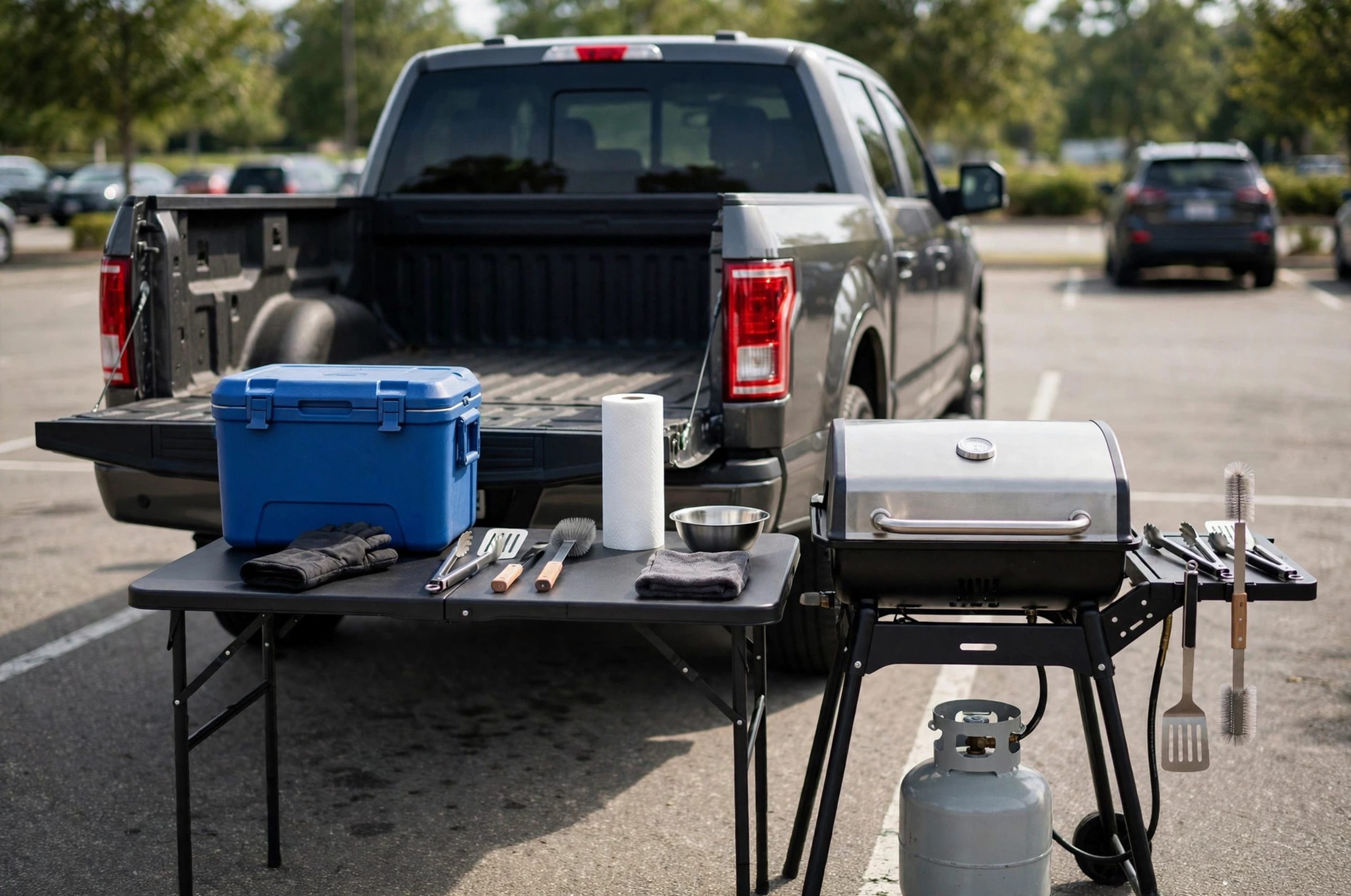
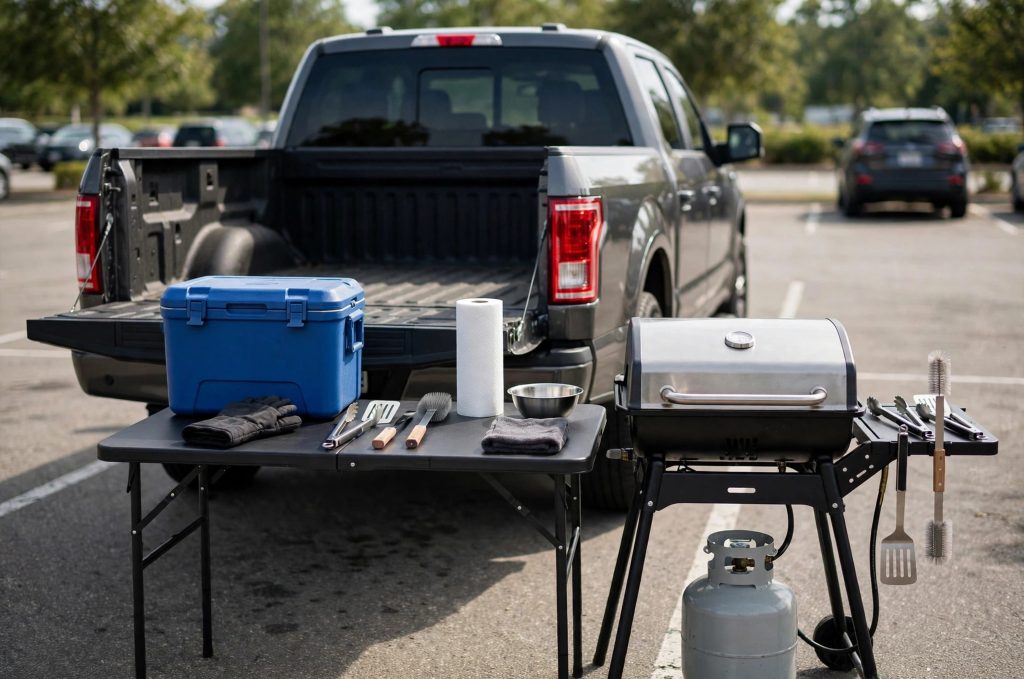
Every tailgate cooking station needs the same core kit.
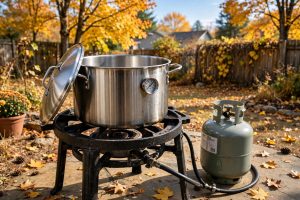
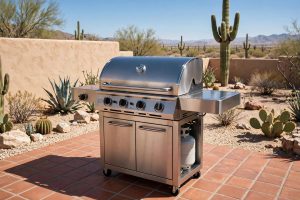
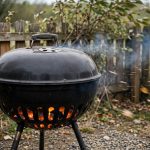
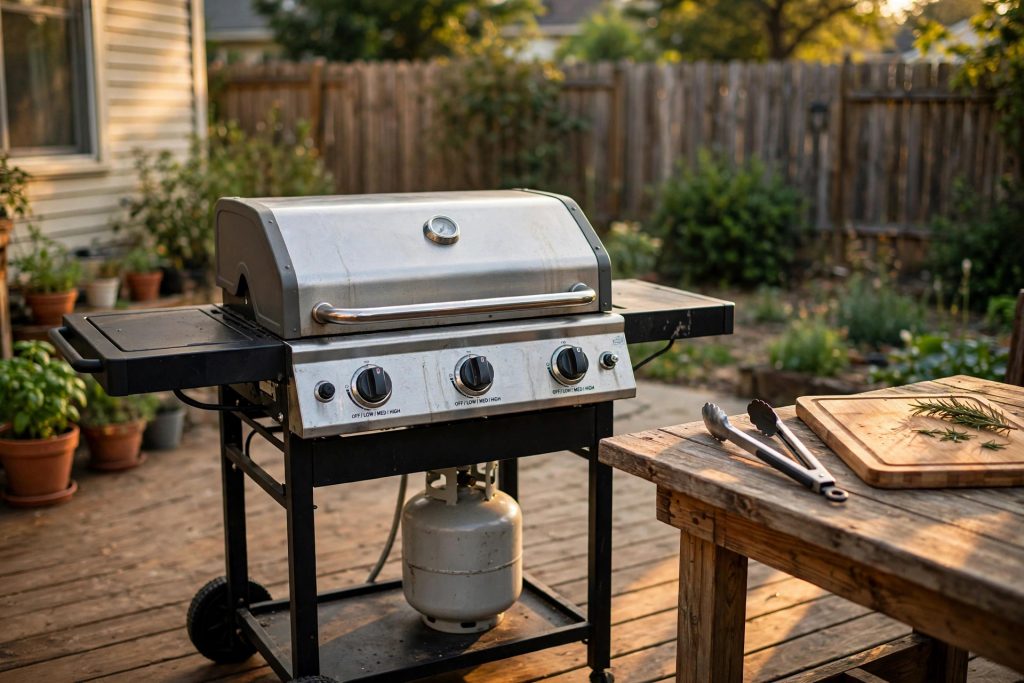
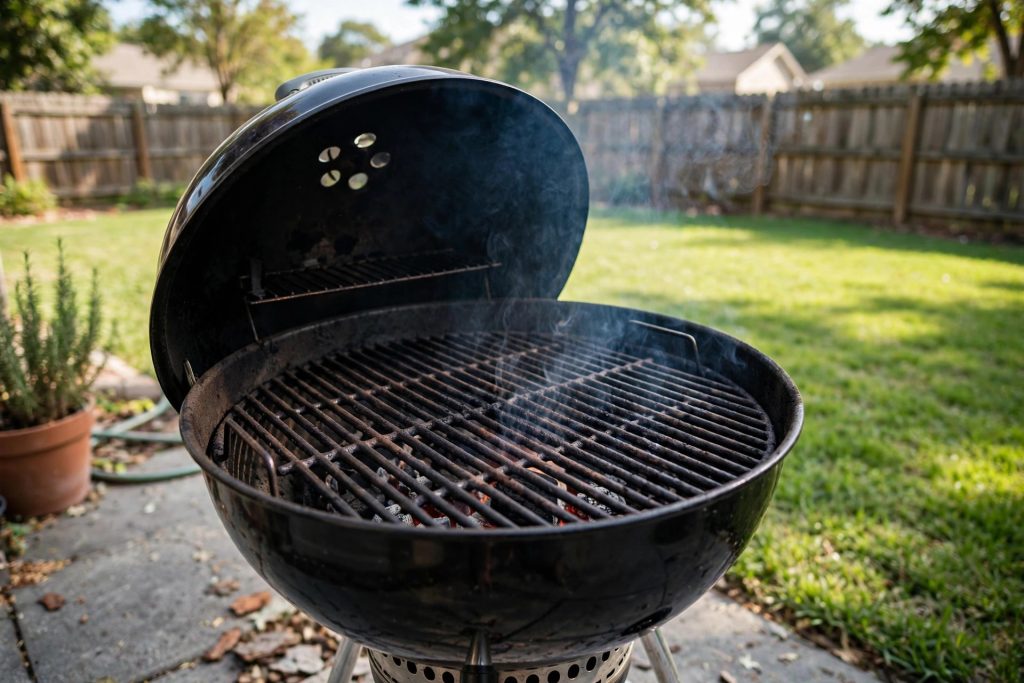
A portable grill is the centerpiece. Small propane grills and compact charcoal grills both work. Propane lights fast and controls easily. Charcoal gives better flavor but needs more time and makes more mess. Pick based on your menu and your patience. Our portable grill for camping guide covers small grills that travel well, and the charcoal vs gas cost comparison helps you weigh fuel costs.
A folding table gives you a prep surface and a landing zone for cooked food. The truck bed works in a pinch, but a table keeps food off gritty surfaces and at a comfortable height. Look for one that folds flat and wipes clean (StackFire Stacks).
Coolers are non-negotiable. Bring at least two: one for raw meat and one for drinks and ready-to-eat food. Raw meat juices must never touch food that will not be cooked. Packing raw meat in its own cooler is the simplest way to prevent cross-contamination ([LSU AgCenter](<https://www.lsuagcenter.com/portals/our_offices/parishes/st helena/features/southern_university_news/touchdown-with-tailgating>)).
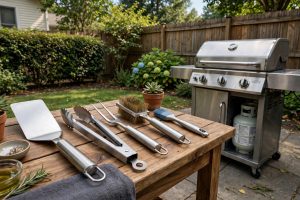
Tools: long tongs, a spatula, a grill brush, a sharp knife, and a cutting board. Add aluminum pans and heavy-duty foil. Foil pans are the tailgater's secret weapon: they marinate, transport, hold warm food, and serve as extra plates (StackFire Stacks).
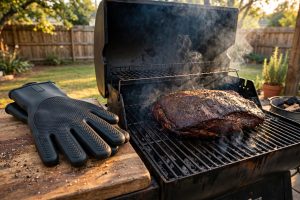
Do not forget the non-cooking essentials: paper towels, trash bags, hand wipes, a fire extinguisher or a bucket of water, and a first-aid kit. A heat-proof grill mat under the grill protects the pavement and keeps you in good standing with the lot attendants. Good BBQ gloves for handling hot meat are worth packing too.
Laying Out the Station
The key to tailgate cooking station setup is choosing the right approach for your space and budget.
With a little planning, tailgate cooking station setup can fit even a busy schedule.
Set up in zones. The hot zone holds the grill, with clear space around it. Keep the grill away from cars, tents, and foot traffic, and never under a tent canopy. The prep zone is your table, with tools, seasonings, and raw meat coming straight from the cooler. The serving zone is a separate table or the far end of the same table, with clean platters, buns, condiments, and napkins.
Traffic flow matters. Guests should be able to reach the serving zone without walking through the hot zone. Kids and dogs stay on the serving side. The cook works the grill and prep side.
Set up early enough to cook without rushing. Food should be ready and eaten with time to spare before kickoff, since perishable tailgate food should be packed away before you head into the game ([LSU AgCenter](<https://www.lsuagcenter.com/portals/our_offices/parishes/st helena/features/southern_university_news/touchdown-with-tailgating>)).
The key to tailgate cooking station setup is to take it one step at a time.
Food Safety at the Tailgate
With a little planning, tailgate cooking station setup can fit even a busy schedule.
Before you start, it helps to understand how tailgate cooking station setup works in real homes.
Outdoor cooking without a kitchen demands discipline. The rules are the same as at home, but the setting makes them harder to follow.
Keep cold food cold. Pack coolers with plenty of ice and keep them closed. A thermometer in the cooler should read 40 degrees or below. Pack coolers last so the food stays cold as long as possible (Penn State).
Keep hot food hot. Cooked meat must stay above 140 degrees. If there is a gap between cooking and eating, hold the meat in insulated carriers or on the cool side of the grill. An insulated serving dish can hold grilled food above 140 degrees for a couple of hours with no power at all (Host Modern), and a foil tent buys you a shorter hold (Grilling Dude).
Cook to temperature, not to color. Burgers need 160 degrees inside. Chicken needs 165. A thermometer is the only way to know. Bring it, use it, and clean the probe between checks (The Pig Site).
Use separate plates and utensils for raw and cooked food. Color-code them if you can: red for raw, white for cooked. Wash hands before handling food and after touching raw meat. Hand wipes work when there is no running water. One old cookout handbook offers a timeless packing tip: the equipment you use first should be packed last, so it comes out first (Streetdirectory).
Watch the clock. Perishable food should not sit out more than two hours, or one hour when the air temperature tops 90 degrees. Plan the meal so food is eaten and packed away before the game, not during halftime.
Serving a Crowd Smoothly
Before you start, it helps to understand how tailgate cooking station setup works in real homes.
A good plan for tailgate cooking station setup saves time, money, and frustration.
Slice and portion before the rush. Burgers and brats are self-portioning, which is why they dominate tailgates. If you serve pulled pork or sliced brisket, have it ready in a foil pan in an insulated carrier so serving is just scooping.
Label anything with common allergens. A simple card that says what is in the dish takes ten seconds and saves someone a bad afternoon.
Keep the condiment station simple and shaded. Mayo-based salads and dairy dips should sit on ice or stay in the cooler until serving time. Put out small portions and refill rather than putting the whole bowl out at once.
For big-group cooking ideas, our BBQ guide for family reunions scales these same ideas up to thirty or more guests.
The Pack-Out: Leaving It Clean
A good plan for tailgate cooking station setup saves time, money, and frustration.
For most people, tailgate cooking station setup comes down to a few smart choices.
A good tailgate ends clean. Kill the grill first: close the vents on charcoal and let coals die, or shut off the propane and disconnect the canister. Let the grill cool before it goes back in the car. Hot grills and car trunks are a bad mix.
Bag all trash and take it with you. Most lots have dumpsters, but do not count on it. Bring more trash bags than you think you need. Wipe down tables, shake out the grill mat, and do a final walk of your spot for bottle caps and foil bits.
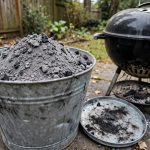
Handle leftover charcoal ash the safe way. Let it cool fully in the grill, then move it to a metal container with a tight lid. Wet the ash down, keep the container outside and away from anything flammable, and never dump warm ash into a plastic trash bag. Embers can stay hot enough to start a fire for days.
Pack in reverse order of setup: serving gear first, then prep, then the grill once it is cool. With a checklist and zones, the whole station breaks down in fifteen minutes and you walk into the game on time.
Frequently Asked Questions
For most people, tailgate cooking station setup comes down to a few smart choices.
What grill is best for tailgating? A small portable propane grill is the easiest choice: fast to light, easy to control, and simple to pack. Compact charcoal grills give better flavor but need more time and cleanup.
How do I keep food safe without a kitchen? Use two coolers, one for raw meat and one for everything else. Cook everything to a safe temperature checked with a thermometer. Keep hot food above 140 degrees and cold food below 40 degrees.
How much food should I bring? Plan on about half a pound of meat per person for a main-dish cookout, plus buns, sides, and drinks. It is better to have a little extra than to run short.
Can I set up a grill under a tailgate tent? No. Never put a lit grill under a canopy or tent. Set the grill in the open with clear space around it, away from cars and foot traffic. Keep this guide handy the next time tailgate cooking station setup comes up.
References
If you are new to tailgate cooking station setup, start with the simplest option and build from there.
Bleacher Report. (n.d.). Four keys to a quality tailgating experience. https://bleacherreport.com/articles/246704-four-keys-to-a-quality-tailgating-experience
Grilling Dude. (n.d.). How to keep grilled food warm safely: Expert tips for perfect BBQ. https://grillingdude.com/how-to-keep-grilled-food-warm-safely/
Host Modern. (n.d.). How to keep grilled food warm: Grill to table. https://hostmodern.co/pages/keep-grilled-food-warm
LSU AgCenter. (n.d.). Touchdown with tailgating. https://www.lsuagcenter.com/portals/our_offices/parishes/st helena/features/southern_university_news/touchdown-with-tailgating
Penn State. (n.d.). Tailgating this football season? Avoid a food safety fumble. https://www.psu.edu/news/agricultural-sciences/story/tailgating-football-season-avoid-food-safety-fumble
StackFire Stacks. (n.d.). Tailgate grilling made simple: Charcoal only, no gas. https://stackfirestacks.com/blogs/blog/tailgate-grill-checklist
Streetdirectory. (n.d.). Success for your tailgating grill party. https://www.streetdirectory.com/food_editorials/cooking/barbeque_recipes/success_for_your_tailgating_grill_party.html
The Pig Site. (n.d.). Expert shares tips for food safety at cookouts and potlucks. https://www.thepigsite.com/articles/expert-shares-tips-for-food-safety-at-cookouts-and-potlucks
When it comes to tailgate cooking station setup, getting the details right makes all the difference.
Was this guide helpful?

About My Garden US
The My Garden US editorial team writes practical, in-depth home and garden guides for American homeowners — tested advice, no fluff.