---
Table of Contents
Table of Contents
Thin steaks cook fast. A half-inch skirt steak or flank steak can go from perfect to overdone in under a minute. That speed makes a meat thermometer more important, not less. But thin cuts are also the hardest to measure. Stick the probe in from the top and the tip can poke straight through, reading the heat of the grill instead of the meat. Here is what to know about meat thermometer tips thin steak before you start.
This guide gives meat thermometer tips for thin steak cuts that actually work: how to place the probe, which thermometers to use, what temperatures to pull at, and the mistakes that ruin thin steaks.
Meat Thermometer Tips Thin Steak: Why Thin Steaks Are Tricky to Measure
When it comes to meat thermometer tips thin steak, getting the details right makes all the difference.

Many homeowners find that meat thermometer tips thin steak is easier than they expected once they know the basics.
A thermometer reads the temperature at its tip. On a thick ribeye, there is plenty of meat around the tip, so the reading is accurate. On a thin steak, the tip may sit too close to the surface or push through to the hot grate below. Either way the number lies.
The USDA is clear that color is not a reliable sign of doneness. Meat can look done and still be undercooked inside, or look pink and be fully safe. Only a thermometer gives the truth (USDA). For thin cuts, getting a true reading takes a little technique.
Use the Sideways Method
Many homeowners find that meat thermometer tips thin steak is easier than they expected once they know the basics.
The key to meat thermometer tips thin steak is choosing the right approach for your space and budget.
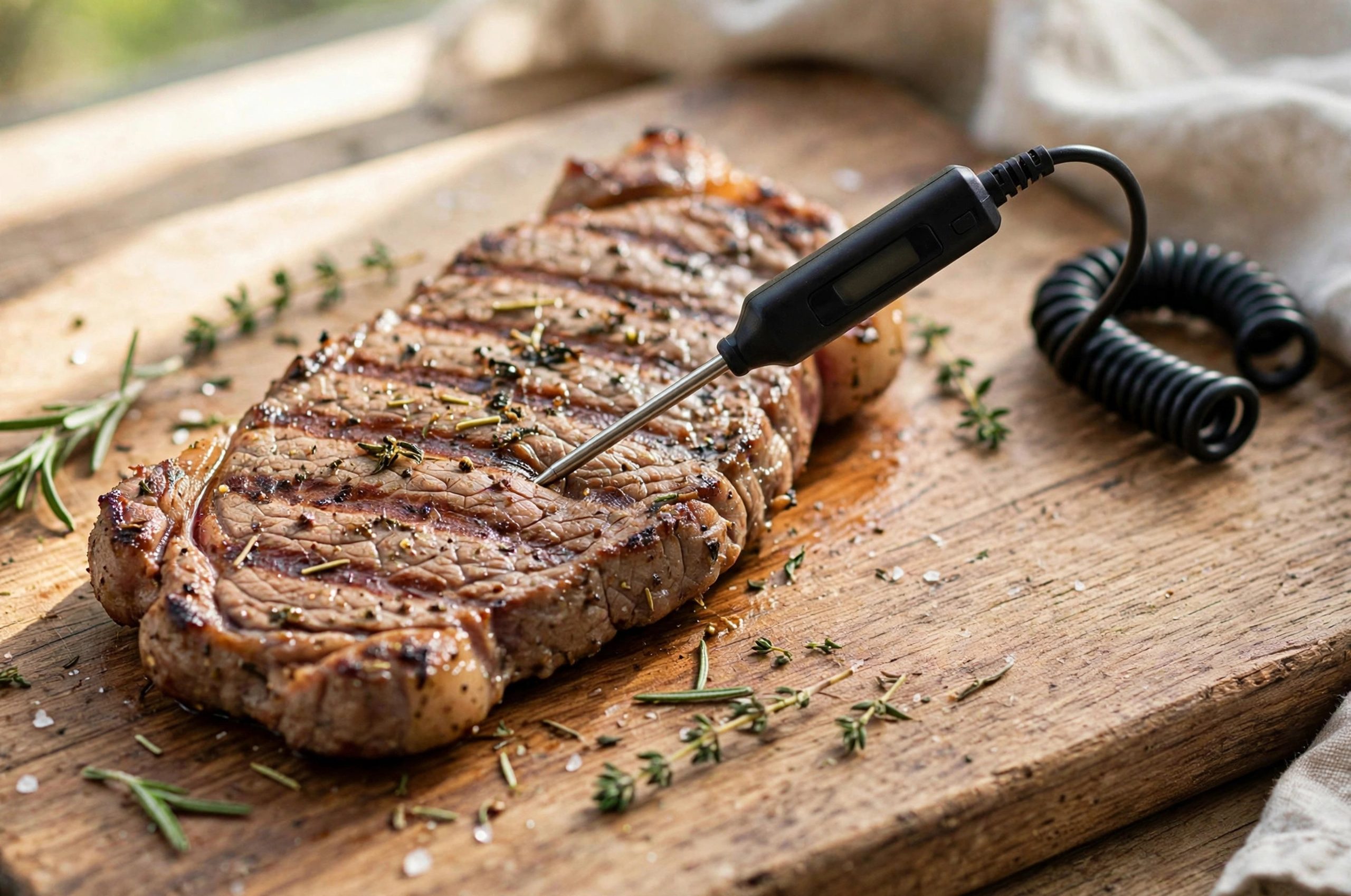
The single most useful trick for thin steaks is to insert the probe from the side, not the top. Slide the thermometer in horizontally through the edge of the steak so the tip lands in the center of the meat. This puts the maximum amount of meat around the sensor.
Penn State Extension's food safety educators teach exactly this: for thin items like patties and thin cuts, tilt the meat with a spatula if needed and insert the thermometer from the side so the tip rests in the middle of the thickest part (Penn State Extension). The University of Minnesota Extension gives the same advice for thin foods like hamburgers and chicken breasts (University of Minnesota Extension).
Push the probe in slowly until the tip reaches the center. If you feel it poke through the far side, back it out a little. Take the reading, then check a second spot. Two readings beat one.
Pick the Right Thermometer
The key to meat thermometer tips thin steak is choosing the right approach for your space and budget.
With a little planning, meat thermometer tips thin steak can fit even a busy schedule.
Not all thermometers suit thin cuts. A good instant-read digital thermometer with a thin probe is the best all-around choice. Look for a probe no thicker than a couple of millimeters and a readout that stabilizes in a few seconds. Thin-tip models made for delicate foods exist, and food safety agencies note that thin foods call for a thin-tip thermometer (Public Health Madison and Dane County).
Skip the big dial thermometers for thin steaks. Their probes are thick and need to be inserted inches deep to read correctly. On a half-inch steak, that is impossible. Leave the dial thermometer for roasts and whole birds.
Thermocouple thermometers are the fastest and most accurate, reading in two to three seconds. They cost more, but for someone who grills thin cuts often, the speed matters. When a steak cooks in four minutes total, a thermometer that takes 30 seconds to settle is nearly useless.
Whatever you buy, check its accuracy now and then. The ice water test is easy: fill a glass with crushed ice and water, stir, and put the probe in. It should read 32 degrees. If it is off by more than a couple of degrees, calibrate it or replace it (Food Poisoning News).
Know Your Pull Temperatures
With a little planning, meat thermometer tips thin steak can fit even a busy schedule.
Before you start, it helps to understand how meat thermometer tips thin steak works in real homes.
Thin steaks keep cooking after they leave the grill. This carryover cooking adds 3 to 5 degrees while the meat rests. So pull the steak a few degrees below your target and let it coast up.
For beef steaks, the USDA safe minimum is 145 degrees with a three-minute rest. Many grill cooks prefer lower for flavor, and that is a personal choice, but 145 is the safety line (USDA). A practical approach for thin cuts:
- For medium-rare, pull around 130 to 135 degrees and rest. It will rise to about 135 to 140.
- For medium, pull around 140 to 145 degrees and rest.
- For well-done, pull around 155 degrees and rest.
Because thin steaks cook so fast, check early and check often. Start checking a minute or two before you think the steak is done. You can always cook more. You cannot uncook.
A little planning makes meat thermometer tips thin steak much easier.
Timing Tips for Thin Cuts
Before you start, it helps to understand how meat thermometer tips thin steak works in real homes.
A good plan for meat thermometer tips thin steak saves time, money, and frustration.
Thin steaks reward a hot, fast sear. Get the grill ripping hot, oil the grates, and lay the steak down. A half-inch skirt steak needs about two to three minutes per side. A three-quarter-inch flank steak needs about three to four minutes per side. These are starting points, not rules. The thermometer decides.
Do not press the steak with a spatula. Pressing squeezes out juice and does not speed cooking in any useful way. Do not poke it full of holes checking the temperature either. One or two clean probe insertions are fine. Ten holes turn the steak into a dry sponge.
Let thin steaks rest for five minutes after grilling. Tent loosely with foil. The short rest evens out the temperature and keeps the juices in. Then slice against the grain, especially for flank and skirt steaks, which are chewy when sliced with the grain.
Thin steaks also benefit from a short pause before you take the final reading. Carryover cooking is fast on thin cuts, and the temperature can climb a few more degrees while the meat sits. If you are aiming for a precise doneness, pull the steak, wait a minute, then take your final reading. That last number is the one that counts.
Common Thermometer Mistakes on Thin Steaks
A good plan for meat thermometer tips thin steak saves time, money, and frustration.
The most common mistake is reading the grate. If the probe tip touches the hot grill through the meat, the number jumps 50 degrees or more. Insert from the side and keep the tip centered.
The second mistake is checking too late. On a thin steak, the difference between right and ruined is about 60 seconds. Set a timer, check early, and trust the numbers.
The third mistake is using a slow thermometer. If your thermometer takes half a minute to settle, the steak keeps cooking while you wait. A fast instant-read model pays for itself in saved steaks.
The fourth mistake is skipping the thermometer entirely and going by feel or color. The touch test takes years to learn, and color lies. Even experienced cooks get surprised. A thermometer is cheap insurance (Quality Assurance Magazine).
Caring for Your Thermometer
For most people, meat thermometer tips thin steak comes down to a few smart choices.
Wash the probe with hot soapy water after each use, or wipe it with a sanitizing wipe between checks when grilling. Do not dunk a non-waterproof unit. Store it in its case or sleeve so the probe stays straight. A bent probe reads wrong.
If you grill at tailgates or cookouts, bring the thermometer with you. Penn State's tailgating food safety guidance lists a calibrated food thermometer as essential gear, since it is the only reliable way to confirm safe temperatures away from home (Penn State).
For more on steak grilling, see our BBQ gloves guide for handling hot meat safely, our guide to smoking lamb on a charcoal grill for larger cuts, and our family reunion BBQ guide for cooking steaks for a crowd.
Frequently Asked Questions
If you are new to meat thermometer tips thin steak, start with the simplest option and build from there.
Where do I put the thermometer in a thin steak? Insert the probe sideways through the edge so the tip sits in the center of the meat. This keeps the tip away from the hot grate and surrounded by meat.
What temperature should I pull a thin steak? Pull 3 to 5 degrees below your target, since carryover cooking finishes the job during the rest. For medium-rare, pull around 130 to 135 degrees.
Can I use a dial thermometer on thin steaks? It is not ideal. Dial probes are thick and need deep insertion. A thin-probe digital instant-read thermometer works far better on thin cuts.
How do I know my thermometer is accurate? Do the ice water test. Crushed ice plus water should read 32 degrees. Recheck now and then, especially after dropping the thermometer. Once you try it, meat thermometer tips thin steak gets easier each time.
References
When it comes to meat thermometer tips thin steak, getting the details right makes all the difference.
Food Poisoning News. (n.d.). How to properly and safely use a food thermometer. https://www.foodpoisoningnews.com/how-to-properly-and-safely-use-a-food-thermometer/
Penn State. (n.d.). Tailgating this football season? Avoid a food safety fumble. https://www.psu.edu/news/agricultural-sciences/story/tailgating-football-season-avoid-food-safety-fumble
Penn State Extension. (n.d.). Checking food temperatures. https://extension.psu.edu/checking-food-temperatures
Public Health Madison and Dane County. (n.d.). Thermometer use. https://publichealthmdc.com/documents/Thermometer%20Use.pdf
Quality Assurance Magazine. (n.d.). USDA provides food safety tips for stars, stripes and safe bites. https://www.qualityassurancemag.com/news/usda-provides-food-safety-tips-for-stars-stripes-and-safe-bites/
The Pig Site. (n.d.). Expert shares tips for food safety at cookouts and potlucks. https://www.thepigsite.com/articles/expert-shares-tips-for-food-safety-at-cookouts-and-potlucks
University of Minnesota Extension. (n.d.). How to use food and refrigerator thermometers. https://extension.umn.edu/preserving-and-preparing/food-thermometers
U.S. Department of Agriculture. (n.d.). Cooking meat: Is it done yet? https://Www.Usda.Gov/about-usda/news/blog/cooking-meat-it-done-yet
Was this guide helpful?

About My Garden US
The My Garden US editorial team writes practical, in-depth home and garden guides for American homeowners — tested advice, no fluff.