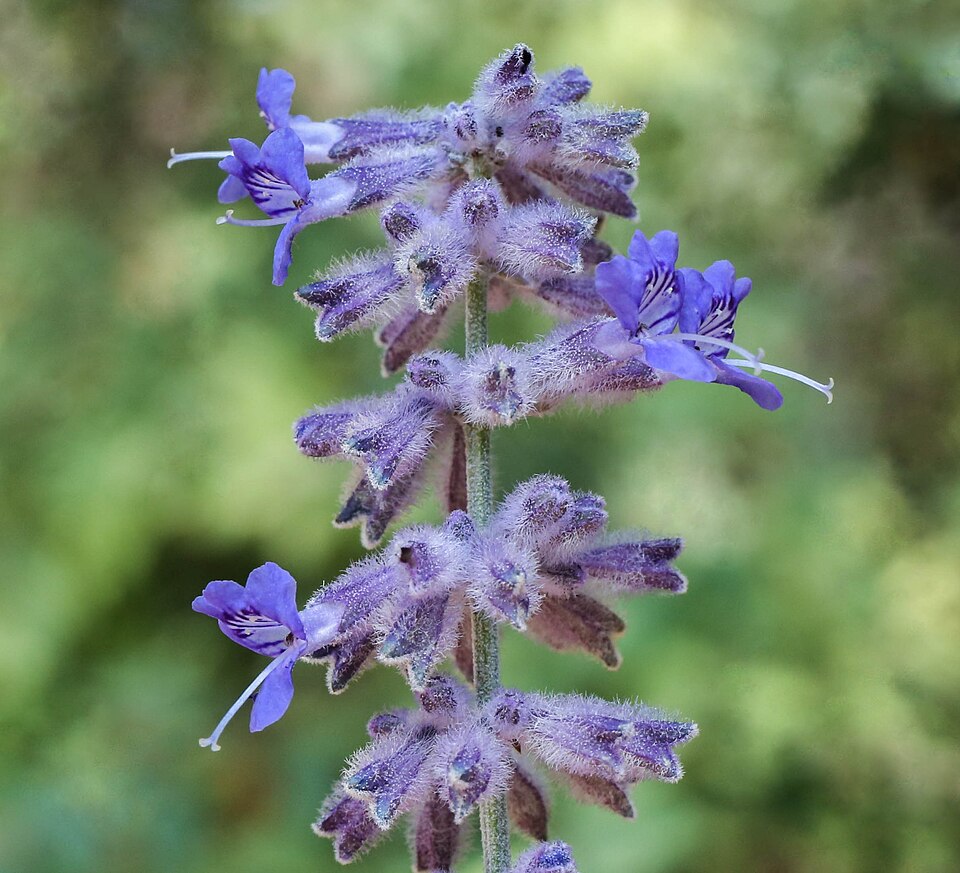
Russian sage - Salvia yangii - is the plant that looks like lavender smoke. From midsummer into fall, its silvery stems carry clouds of tiny lavender-blue flowers, creating a haze of color four feet tall and just as wide. It is one of the toughest perennials in the garden: drought-proof, deer-proof, heat-proof, and beautiful for months. Learning how to grow Russian sage is mostly about restraint - poor soil, little water, and one hard haircut a year.
Table of Contents
Table of Contents
This is the backbone plant of the low-water border, the one designers reach for when they need height, texture, and months of color without irrigation. Paired with ornamental grasses it makes the classic prairie-style planting; on its own it is a silvery exclamation point. It asks for sun and drainage and gives back one of the longest shows in the perennial garden.

Photo: Wikimedia Commons
Getting Started: A Subshrub, Not a True Sage
When it comes to how to grow russian sage, getting the details right makes all the difference.

Many homeowners find that how to grow russian sage is easier than they expected once they know the basics.
Despite the name, Russian sage is neither Russian nor a true sage - it is a Central Asian native in the mint family, reclassified by botanists from Perovskia to Salvia. It grows as a woody-based subshrub, hardy in zones 4 through 9, reaching three to five feet tall with an airy, open habit. The USDA PLANTS database and nursery references track the name change; gardeners just call it Russian sage and plant it.
Buy nursery transplants - named varieties like 'Blue Spire', 'Little Spire' (compact), and 'Lacey Blue' offer different heights for different spots. Seed-grown plants are variable and slow; transplants establish fast and bloom the first year. Set them out around your last spring frost, spacing 24 to 36 inches apart - they grow wide and need the room. If you want to check your USDA zone planting dates, our planting calendar will help with spring timing.
From planting to full glory takes a season or two - first-year plants establish roots, second-year plants make the famous haze. Be patient; the wait is worth it. The Missouri Botanical Garden rates it among the finest perennials for hot, dry sites, and its plant profiles show what a mature specimen does.
When and How to Plant
Many homeowners find that how to grow russian sage is easier than they expected once they know the basics.
The key to how to grow russian sage is choosing the right approach for your space and budget.
Plant transplants in spring after the soil warms - around your last spring frost is ideal. The Almanac planting calendar helps with spring timing in your zone. Fall planting works in mild zones but risks winter loss in cold ones, since the roots need establishment time. Dig a hole no deeper than the pot, set the plant at the same level, water in, and walk away.
Spacing matters more than with most perennials: 24 to 36 inches apart, because a mature Russian sage is a big plant and crowded ones flop into each other. In humid regions, err toward wider spacing - air circulation prevents the floppiness and disease that humidity encourages. The Old Farmer's Almanac perennial-spacing advice was written for plants exactly like this one: give them room and they behave.
Do not amend the planting hole richly. This is the plant where the standard "dig a big hole and fill it with compost" advice backfires - rich soil grows soft, floppy stems that collapse. Plant it in your native soil, water it in, and let its Central Asian toughness do the rest.
Soil and Sun
The key to how to grow russian sage is choosing the right approach for your space and budget.
With a little planning, how to grow russian sage can fit even a busy schedule.
Full sun - absolute, all-day, no-compromise sun. Russian sage in shade is a tragedy: leggy, floppy, sparse-flowering, and prone to every problem the plant otherwise never has. The hottest, sunniest spot in the garden is the right spot. Eight hours minimum; more is better.
Poor, dry, well-drained soil is ideal - this is the plant's defining preference. It hates rich, wet soil, which makes it floppy and short-lived; it thrives in the lean, gravelly ground where other perennials struggle. Sharp drainage is non-negotiable: winter-wet soil rots the crown, the main killer in cold zones. If your soil stays soggy, plant on a mound or a slope, or choose a different plant. Like coneflowers in their lean-soil preference but even more extreme, Russian sage proves that poor soil grows the toughest plants.
A near-neutral to slightly alkaline pH suits it. Do not fuss over exact numbers - drainage and sun matter a hundred times more.
Watering and Feeding
With a little planning, how to grow russian sage can fit even a busy schedule.
Before you start, it helps to understand how how to grow russian sage works in real homes.
Water to establish - a few weeks of steady moisture for new transplants - then stop. Established Russian sage is extremely drought-tolerant, thriving on rainfall alone in most climates. Overwatering is the main killer: it makes soft growth, invites crown rot, and shortens the plant's life. When in doubt, do not water. This is the plant for the bed with no irrigation, the far slope, the gardener who forgets.
Do not fertilize. Ever. Feeding Russian sage is actively harmful - it produces the tall, weak, floppy growth that gives the plant its (undeserved) reputation for messiness. The plant's stiff, upright, silvery form comes from lean conditions. If neighboring plants get fed, the Russian sage will tolerate the runoff, but it will never need feeding itself.
Mulch lightly with gravel or not at all. Organic mulches hold moisture against the crown, which this plant dislikes; a gravel mulch suits both the drainage needs and the silvery aesthetic. The University of Minnesota Extension notes the same crown-dryness requirement for woody Mediterranean and Central Asian perennials.
Care Through the Season
Before you start, it helps to understand how how to grow russian sage works in real homes.
A good plan for how to grow russian sage saves time, money, and frustration.
Cut the whole plant back hard in early spring - to 6 to 12 inches - just as new growth starts. This is the annual haircut that keeps Russian sage compact and floriferous. Without it, the plant grows tall, woody, and open, with flowers only at the tips; with it, you get dense new growth loaded with bloom. Do not prune in fall: the standing stems protect the crown through winter and give the garden structure. Spring pruning, not fall - this timing matters.
In humid regions, give it extra space for air flow - the one concession to climate. Crowded, still air in humidity encourages the floppiness and leaf problems that the plant never has in dry air. Wide spacing, full sun, and no overhead watering keep it happy even where summers steam.
Few pests or diseases bother it - deer will not touch the aromatic foliage, rabbits avoid it, and insects mostly leave it alone. This is one of the most trouble-free perennials in the garden, which is why designers specify it by the dozen. Pair it with ornamental grasses for the classic low-water border: the fine textures play beautifully together, and both want the same lean, dry conditions. Gardenia.net has good companion-planting suggestions for dry borders.
Leave the plant standing through winter. The silvery stems catch frost beautifully, give the garden structure, and shelter beneficial insects. Cut back in spring, as above - the winter skeleton is a feature, not neglect.
Harvest
A good plan for how to grow russian sage saves time, money, and frustration.
For most people, how to grow russian sage comes down to a few smart choices.
Cut stems for dried arrangements - the silvery foliage and lavender haze dry beautifully, holding color and form for months. Cut when the flowers are at peak, hang upside down in small bunches in a dark, airy spot, and you have everlasting material for winter arrangements. The dried stems are as architectural as dried black-eyed Susans, with a finer texture.
The flowers are also excellent for fresh cutting at peak bloom - the airy sprays add height and a misty texture to summer bouquets that heavier flowers cannot match. Cut in the cool of the morning and condition in water for a few hours before arranging.
Beyond cutting, the "harvest" is the garden show itself: weeks of lavender haze, bees working the flowers from morning to evening, and silver structure through winter. It is a plant that gives for three seasons and asks for one haircut.
Troubleshooting
For most people, how to grow russian sage comes down to a few smart choices.
If you are new to how to grow russian sage, start with the simplest option and build from there.
Tall, floppy, falling open. Too rich, too shady, too wet, or never cut back - the four horsemen of floppy Russian sage. Clemson Cooperative Extension perennial guides address floppiness in humid climates with the same cultural fixes.
Crown rotted over winter. Waterlogged winter soil - the main killer. Improve drainage, plant on a mound, pull mulch back from the crown, and do not water in fall. In heavy clay, this plant needs a raised bed or it will not persist.
No flowers. Too much shade is the usual cause, or a very late spring pruning that removed the blooming wood - prune as new growth starts, not later. Young transplants sometimes take a season to hit their stride; be patient.
Center died out. Old, woody plant - normal after many years. Russian sage is long-lived but not immortal; take cuttings or buy a fresh plant for that spot. The Clemson Home and Garden Information Center notes the lifespan realistically in its perennial guides.
It seeded into the gravel path. It self-sows modestly - not aggressively, but enough to notice. Deadhead if it bothers you, or let the seedlings come and transplant the volunteers. Compared to true thugs, this is gentle behavior.
Russian sage is the proof that tough can be beautiful - plant it lean in full sun, cut it back hard each spring, and let the lavender haze roll. The USDA National Agricultural Library and modern design literature agree: for hot, dry, difficult sites, there is nothing better. One plant, one haircut a year, months of glory.
References
If you are new to how to grow russian sage, start with the simplest option and build from there.
When it comes to how to grow russian sage, getting the details right makes all the difference.
- Clemson University Cooperative Extension. (n.d.). Home & garden information center. https://hgic.clemson.edu/
- Gardenia. (n.d.). Russian sage growing guide. https://www.gardenia.net/
- Missouri Botanical Garden. (n.d.). Plant finder. https://www.missouribotanicalgarden.org/
- U.S. Department of Agriculture. (n.d.). PLANTS database. https://plants.usda.gov/home
- University of Minnesota Extension. (n.d.). Drought-tolerant perennials. https://extension.umn.edu/
Many homeowners find that how to grow russian sage is easier than they expected once they know the basics.
When it comes to how to grow russian sage, getting the details right makes all the difference.
Many homeowners find that how to grow russian sage is easier than they expected once they know the basics.
Was this guide helpful?

About My Garden US
The My Garden US editorial team writes practical, in-depth home and garden guides for American homeowners — tested advice, no fluff.
You May Also Like
Peat Pots for Seedlings: A Plain Guide to Buying in the USA
January 8, 2026 17 views
Native Grass Seed for California Homes: A Guide to a Lawn That Loves Dry Weather
February 20, 2026 21 views
How to Grow Water Chestnuts: Aquatic Tuber Guide
October 20, 2026 32 views