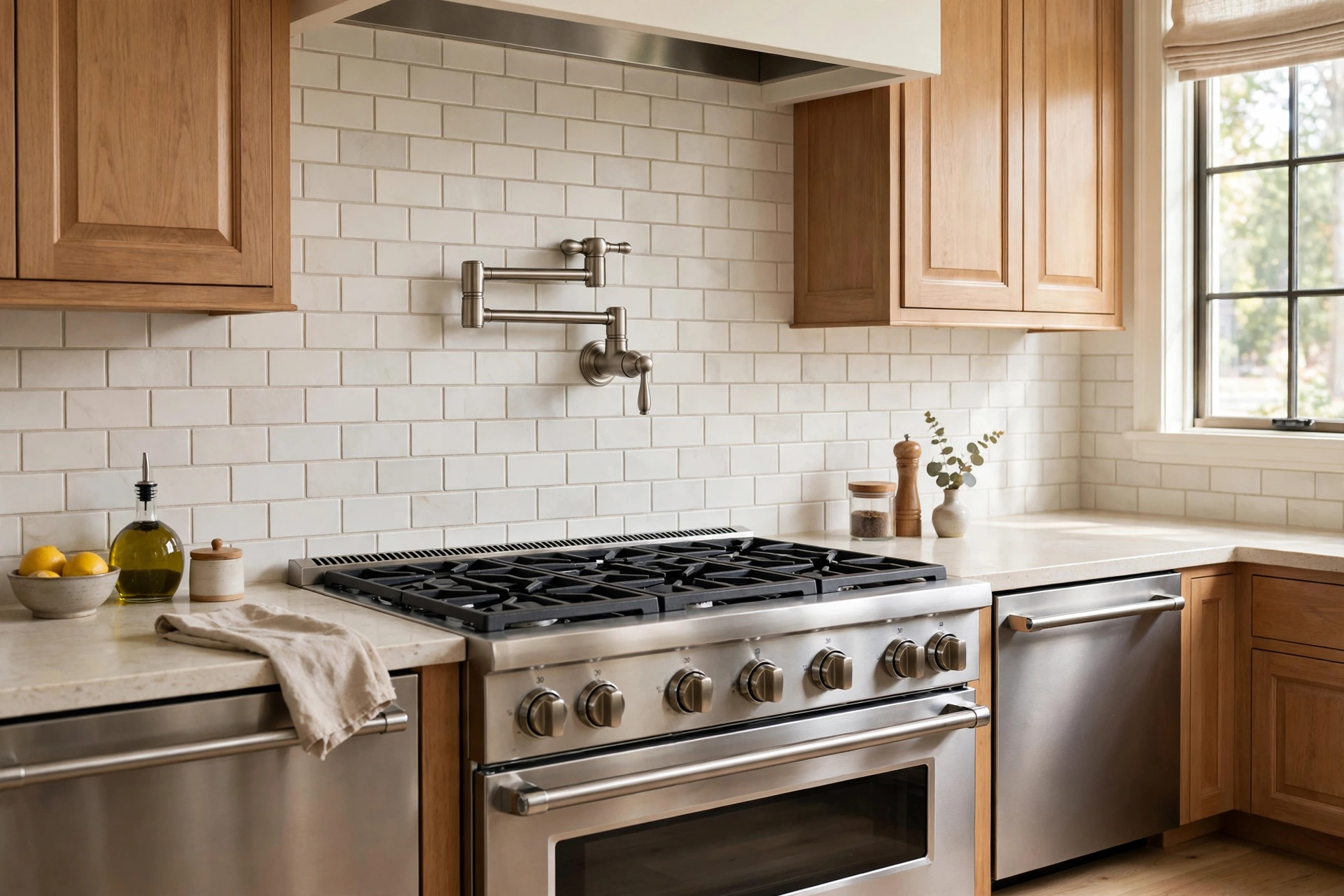

A pot filler faucet is a small luxury that earns its keep in a busy kitchen. It mounts on the wall above the stove. Its long arm swings out and fills a pot right on the burner. There is no need to carry a heavy pot of water from the sink. This pot filler faucets reviews buying guide walks USA homeowners through every choice. It explains the styles, the materials, and the features that matter. It also looks at what real buyers praise and what they complain about in reviews.
Who benefits most? Anyone who cooks pasta, soups, or canning batches on a regular basis. A gallon of water weighs more than eight pounds. A stock pot can hold four gallons or more. Carrying that weight across a kitchen floor invites spills and strained backs. A pot filler removes the trip. It also speeds the work. You set the pot on the grate, swing the arm over, and turn the handle. The gain is modest for a small household. For a serious cook, it is a daily convenience.
This guide keeps the language plain and the advice practical. It draws on the patterns found in hundreds of buyer reviews. Read it through, and you will know which model suits your kitchen, your budget, and your habits. Many buyers now weigh a wall mount pot filler faucet installation against a simple faucet upgrade.
Why a Pot Filler Matters
A pot filler changes the rhythm of cooking. The most obvious gain is convenience. Water comes to the pot instead of the pot going to the water. Filling a six-quart pot at the sink takes time and muscle. Doing it at the range takes seconds and almost no effort. For cooks who boil water every day, that saved effort adds up.
Safety is a second gain. Wet floors cause falls. A full pot sloshes. The shorter the walk, the smaller the risk. Older homeowners and anyone with a bad back feel this most. Reviews from buyers over sixty mention it often. They call the pot filler one of the best changes they made during a remodel.
Not every kitchen needs one. If you rarely boil large pots, the gain is thin. A pot filler also costs money that could go to better lighting or a stronger vent hood. Weigh your habits against the price before you commit.
How to Choose a Pot Filler Faucet: Pot Filler Faucets Reviews Buying Guide Usa
Choosing well means matching the faucet to your stove, your water line, and your taste. Four points deserve close study: reach and joints, finish, valve quality, and mounting style. The best pot filler faucet for gas range setups is the one that reaches every burner you actually use.
Spout Reach and Swing Joints
Reach is the single most practical measure. Most pot fillers extend between twenty and twenty-four inches from the wall. Measure your range. The arm must reach the front burners where tall pots sit. A single-joint arm swings in a wide arc but covers less ground. A double-joint arm folds flat against the wall and reaches farther when opened. Buyer reviews complain about short arms more than any other flaw. Measure twice. A faucet that cannot reach your largest pot is useless. Range pairings shown by Whirlpool place the filler over the center of the cooktop for even coverage.
Finish and Materials
Finish affects both looks and care. Chrome stays bright and cleans with a wipe. Brushed nickel hides water spots. Oil-rubbed bronze suits traditional kitchens. Matte black fits modern rooms. Look past the surface. The body should be solid brass. Brass resists corrosion and holds threads for years. Cheaper bodies use zinc alloy. Zinc works, but it wears faster and strips more easily. Reviews of budget models often mention loose joints after a year of use.
Valve Quality
The valve controls flow and shutoff. A quarter-turn ceramic disc valve is the standard to seek. It opens fully with a short twist and closes drip-free. Older compression valves need more turns and wear out sooner. Check the handle placement. Many pot fillers have two shutoffs: one at the wall and one at the spout. The wall valve acts as a backup. If the spout valve ever leaks, the wall valve stops the water. Reviewers who have suffered a leak value this feature highly. Water-use tips from ENERGY STAR remind owners that a fast, controlled fill also cuts waste.
Mounting Style and Height
Almost all pot fillers mount on the wall. The pot filler faucet height above stove matters a great deal. Most installers place the spout twelve to sixteen inches above the cooktop. That clears tall pots yet keeps the arm within easy reach. Check your range height and the tallest pot you own before the plumber cuts the wall. A faucet set too low blocks large stock pots. One set too high splashes. Plan the rough-in before the backsplash goes up.
Types of Pot Filler Faucets
Three main types cover nearly every sale in the United States. Each suits a different kitchen and budget.
Single-Joint Wall Mount
The single-joint model has one pivot where the arm meets the wall. It swings left and right in a simple arc. It costs less than the other types. It also sticks out farther from the wall when at rest, which some owners dislike. It works well over narrow ranges where the arm needs little travel. Reviews rate these models as solid and simple. Fewer joints mean fewer places to leak.
Double-Joint Articulating Models
The double-joint model is the most popular type. A second pivot sits midway along the arm. The arm folds flat against the wall when idle and unfolds to a long reach. It covers wide ranges and pro-style cooktops with six burners. It costs more than a single-joint model. Reviews praise the reach and the tidy profile. Style roundups at The Spruce and kitchen guides from Bosch feature these models in modern layouts. They also note that two joints need occasional tightening. A quality brass body keeps this minor.
Deck-Mount and Cold-Only Models
A few models mount on the counter behind the range instead of on the wall. These suit kitchens where the wall behind the stove cannot hold a pipe. Almost all pot fillers deliver cold water only. Cold water is the norm.
What Reviews Tell You
Buyer reviews reveal patterns that spec sheets hide. Reading articulating pot filler faucet reviews across many stores teaches several lessons. First, brand name matters less than build. Well-known labels and store brands both earn praise when the body is brass and the joints are tight. Both earn complaints when the arm sags or the finish flakes.
Second, water pressure shapes the verdict. A pot filler on a strong line fills fast and satisfies. On a weak line, it trickles and disappoints. Reviews from homes with low pressure rate the same model lower. If your house has modest pressure, ask your plumber about the supply line size before you buy. A half-inch line serves a pot filler well.
Third, installation quality decides the outcome. Reviews that mention a professional install skew positive. Reviews that mention a do-it-yourself job skew mixed. The valve must sit level. The pipe must anchor to a stud or blocking. A loose mount wobbles and strains the joints. Budget for a licensed plumber unless you have real pipe experience.
Fourth, finish durability divides opinion. Chrome and brushed nickel hold up best in reviews. Dark finishes draw praise for looks and complaints about chips. Matte black shows water spots in hard-water homes. If your water is hard, choose a lighter finish or plan to wipe the faucet after use.
Fifth, buyers love the shutoff placement. Models with a wall-side shutoff plus a spout handle earn the highest marks for peace of mind. A pot filler is an open water source above a hot stove. Owners want a fast way to stop flow. Two shutoffs give it.
Finally, warranty length predicts satisfaction. Brands that offer a lifetime finish warranty get fewer long-term complaints.
Cost and Price
Pot fillers span a wide price range in the United States. Basic single-joint models start near one hundred dollars. Mid-range double-joint models in solid brass run from two hundred to five hundred dollars. Designer models with premium finishes can pass eight hundred dollars. Price follows materials and brand, not water flow. A three-hundred-dollar faucet often outlasts a one-hundred-dollar one by many years.
Installation adds to the bill. A plumber charges for the rough-in, the valve, and the trim set. During a full remodel, the added cost is modest, often a few hundred dollars. The wall is open and the plumber is already on site. Adding a pot filler to a finished wall costs far more. The plumber must open tile, run a new line, and repair the wall. That job can run past a thousand dollars. Plan the rough-in early.
Think in total cost, not sticker price. A mid-priced brass model plus a planned rough-in is the sweet spot for most kitchens. It lasts, it looks right, and it never becomes a regret. Check current prices at large retailers such as faucet displays at Home Depot and Lowe’s to set a realistic budget.
Care and Upkeep
A pot filler asks little of its owner. Wipe it after heavy steam sessions. Steam from a boiling pot leaves mineral spots on the finish. A soft cloth and mild soap handle the job. Avoid abrasive pads. They scratch the finish and void many warranties.
Check the joints once a year. Swing the arm through its full range. Feel for looseness at the pivots. Tighten the set screws gently if the arm drifts. Do not force them. Stripped screws are a common do-it-yourself error.
Flush the line now and then. Sediment collects in any little-used pipe. Run the faucet for ten seconds before first use each week. This clears stale water and grit from the valve. Health guidance from the EPA supports flushing little-used lines like this. It also confirms that both shutoffs still turn freely. A valve that sits unused for months can stiffen.
In freezing climates, note the pipe route. A pot filler line runs through an exterior wall in some kitchens. Insulate that section well. A frozen pipe behind the stove is a costly repair. If your climate is harsh, ask the plumber to route the line through interior framing.
Finish care differs by type. Chrome tolerates most cleaners. Brushed nickel likes non-abrasive soap. Living finishes such as unlacquered brass develop a patina. That change is normal, not damage. Buyers who expect a living finish to stay bright are often disappointed. Read the finish description before you buy.
Safety
A pot filler is safe when installed and used with care. Three rules cover most risks.
First, always close the spout valve when done. The wall valve is a backup, not the daily switch. Leaving the spout open invites a slow leak to run unnoticed. Teach every cook in the house this habit.
Second, keep the arm folded when not in use. An extended arm over a hot burner collects heat. It also blocks the vent hood. Folded arms stay cooler and out of the way. Most models fold with one hand.
Third, mind the steam. Filling a pot that is already hot creates a burst of steam. Stand back and fill slowly. Use the lowest flow that does the job. Scalds from steam hurt as much as scalds from water.
Gas range owners should note clearance. Keep the arm and any hose away from open flame. The best pot filler faucet for gas range layouts keep the faucet centered between burner rows or over the back burners. Check your range manual for minimum clearances above the cooktop.
Frequently Asked Questions
Do I need a plumber to install a pot filler? In most cases, yes. A pot filler needs a new water line inside the wall. A licensed plumber sizes the line, sets the valve level, and anchors it to solid blocking. A poor install leads to leaks inside the wall. That repair costs far more than the plumber.
Can I add a pot filler after the kitchen is finished? You can, but the cost rises. The plumber must open the backsplash and wall, run the line, and patch everything. During a remodel, the same work costs a fraction. If a remodel is years away, wait and plan it in.
Do pot fillers drip or leak over time? Any faucet can develop a drip. Quality models with ceramic disc valves drip rarely. Reviews show that leaks most often trace to loose joints or poor installs, not the valve itself. Annual checks catch small issues early.
What finish is easiest to maintain? Chrome and brushed nickel win in buyer reviews. They resist spots and clean with a wipe. Matte black looks sharp but shows hard-water marks. Oil-rubbed bronze hides spots but can wear at touch points. Match the finish to your water and your tolerance for wiping.
Final Word
A pot filler is a modest upgrade with an outsized daily payoff for the right cook. Choose solid brass, a proven valve, and an arm long enough for your range. Place it at the right height. Have it installed by a professional during a remodel. Then use it every day without a second thought. Readers planning a full kitchen update may also browse our notes on double wall ovens for sale, undermount stainless sinks, and kitchen backsplash tiles to complete the project.
References
Bob Vila. (n.d.). Home improvement advice. https://www.bobvila.com Bosch. (n.d.). Home appliances. https://www.bosch-home.com Consumer Reports. (n.d.). Product reviews and ratings. https://www.consumerreports.org ENERGY STAR. (n.d.). Energy efficient products. https://www.energystar.gov GE Appliances. (n.d.). Kitchen and home appliances. https://www.geappliances.com Lowe’s. (n.d.). Home improvement products. https://www.lowes.com The Home Depot. (n.d.). Home improvement products. https://www.homedepot.com The Spruce. (n.d.). Home and garden advice. https://www.thespruce.com This Old House. (n.d.). Home renovation guidance. https://www.thisoldhouse.com U.S. Environmental Protection Agency. (n.d.). Protecting human health and the environment. https://www.epa.gov Whirlpool. (n.d.). Home appliances. https://www.whirlpool.com
Was this guide helpful?

About Michael Thompson
The My Garden US editorial team writes practical, in-depth home and garden guides for American homeowners — tested advice, no fluff.
You May Also Like
Garbage Disposal Installation in California Homes: A Complete Guide
September 3, 2026 0 views
Garbage Disposal Installation for Texas Homes: A Practical Guide
September 20, 2026 0 views
Microwave Drawer Units for California Homes
September 27, 2026 2 views