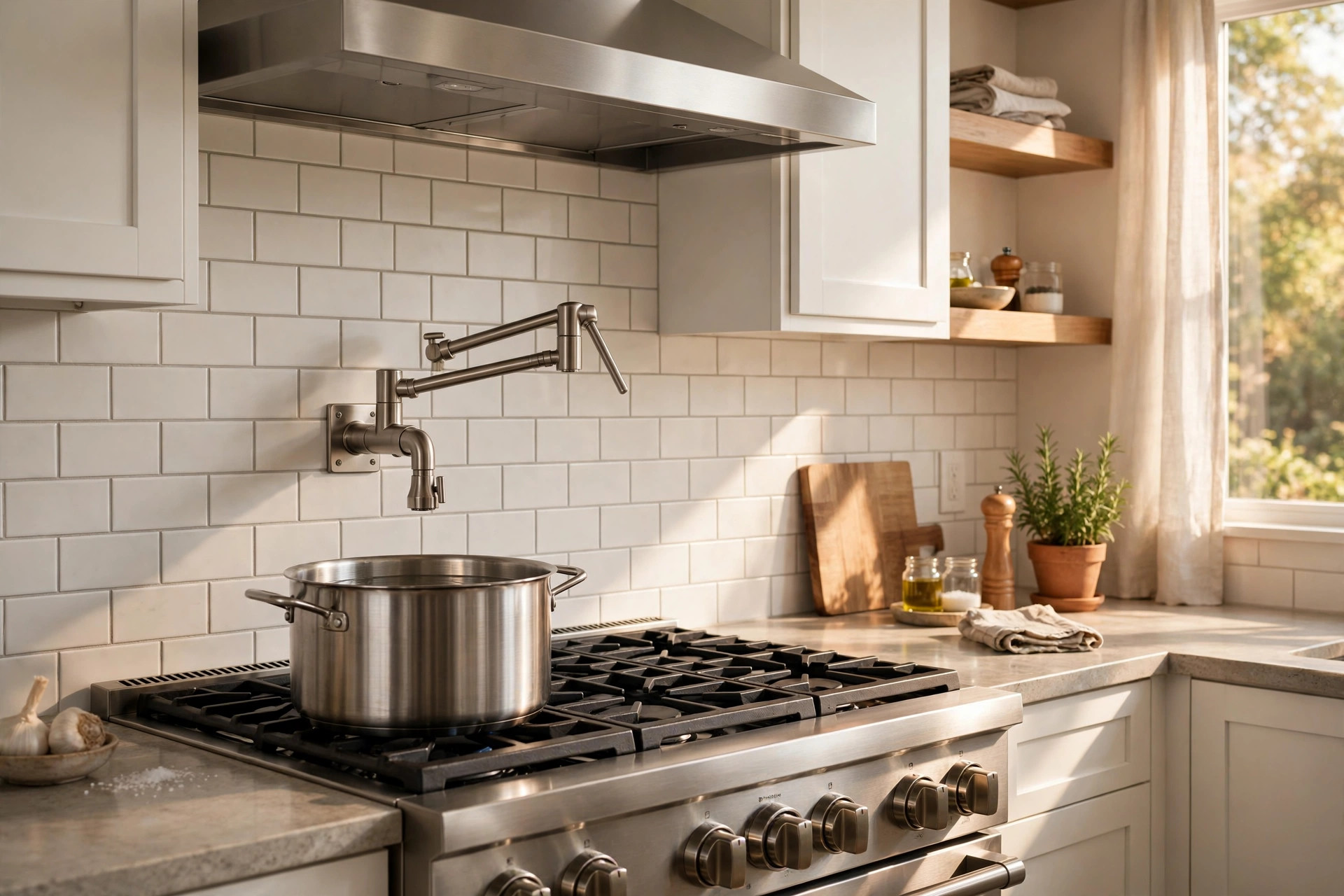

A kitchen upgrade does not need to cost a fortune. When a cook searches for pot filler faucets deals near me, the goal is simple. Find a good faucet for filling pots at the stove. Pay a fair price. This guide will show how.
A pot filler is a swing-arm faucet mounted on the wall above the range or cooktop. It reaches out over the burner and fills pots right where they sit. No more carrying a heavy pot of water from the sink to the stove.
The phrase pot filler faucets deals near me tells a story. The shopper wants a deal, close to home. They want to see the faucet, touch the handle, and ask questions before buying. This article covers both local and online options, with an eye on price and value.
Why a Pot Filler Matters
A large stock pot filled with water can weigh more than thirty pounds. That is a real strain on the back, the arms, and the wrists.
A pot filler removes that chore. The pot sits on the burner. The faucet arm swings out over it. Water flows in. When the pot is full, the arm swings back against the wall. The cook never lifts the heavy pot until the food is done and much of the water is gone or served out.
There is a second benefit that few people talk about. Safety. A pot of water sloshing on the way from sink to stove is a spill risk. A pot filler keeps the water where it will be heated.
There is also a design benefit. A pot filler looks sharp in a kitchen. It is one of those undermount stainless sinks neighbors that buyers notice during a tour.
For all these reasons, a pot filler is worth the money for people who cook often. The key is to avoid paying too much. Read on for prices, places to shop, and what to look for.
What to Look For When You Buy: Pot Filler Faucets Deals near Me
Not all pot fillers are equal. The differences are real, and they matter over ten years of daily use.
First, check the finish. Most kitchens in America use stainless steel, chrome, or brushed nickel. Match the pot filler to the main faucet and the range hood. A mismatched faucet draws the eye in a bad way. Some shoppers choose oil-rubbed bronze or matte black for a bold look. That can work if the rest of the hardware follows the same scheme.
Second, check the valve count. Many pot fillers have one lever at the arm. Better models have two valves: one at the wall and one at the spout. Two valves give extra protection against drips. If one valve fails, the other holds the water back. The two-valve design is worth a small price increase.
Third, check the reach. Measure the distance from the wall to the farthest burner you will use. The arm must reach it with room to spare. Most arms fold back flat against the wall when not in use.
Fourth, check the joints. The swing arms pivot at two or three joints. Cheap joints wear out and start to sag. Heavier brass construction lasts longer than thin stamped metal. Pick up the display model in the store if you can. Swing it back and forth.
Fifth, check the water flow. A pot filler should fill a stock pot in a reasonable time. Most models deliver between two and four gallons per minute. A slow trickle will make you wish you had kept carrying the pot.
Guides like the pot filler faucets buying guide go deeper into finishes and valve designs. Read one before you visit the store.
Types and Options on the Market
Pot fillers fall into three main styles. Each has its place.
Single-Joint Models
The single-joint pot filler has one arm and one pivot. It swings left and right only. It is simple and low cost. It works best when the stove is small and the wall is close to the burners. The price is usually the lowest of the three styles.
Double-Joint Models
The double-joint model is the most common in American kitchens. It has two arms joined by a pivot. It folds flat against the wall and unfolds to reach far burners. If you are not sure which style to buy, start here.
Articulated and Commercial Styles
Articulated models have three or more pivot points. Some look like they belong in a restaurant kitchen. They reach every corner of a wide range. They cost more and they stick out farther from the wall. They suit large professional-style ranges in open kitchens.
Beyond style, there are finish and material choices. Solid brass bodies with ceramic disc valves are the standard for long life. Chrome plating is easy to clean. Brushed finishes hide fingerprints and water spots better.
Some pot fillers come with a matching deck-mounted faucet as a set. If you are remodeling the whole sink area, a set can save money against buying each piece alone.
Cost and Price: What Deals Look Like
Now to the heart of the matter. What does a pot filler cost, and what counts as a real deal?
As of 2026, prices in the United States fall into three bands. Budget models sell for forty to one hundred and twenty dollars. Mid-range models sell for one hundred and twenty to three hundred dollars. Premium models sell for three hundred to eight hundred dollars or more.
The budget band includes simple chrome and stainless models from house brands at big-box stores. The mid-range band is the sweet spot for most families. You get solid brass, decent valves, and a finish that holds up. The premium band buys designer names, heavy brass, and lifetime warranties.
Installation adds to the cost. A new water line must run inside the wall to the spot above the range. A licensed plumber typically charges one hundred and fifty to four hundred dollars for this work, depending on the region and the wall. If the wall is open during a remodel, the cost is at the low end. If the wall must be cut open and patched, the cost climbs.
A deal is not just a low sticker price. A true deal means a fair price for solid quality, plus low installation cost, plus a warranty you can use. Watch for these signs of a real deal.
– Clearance racks at local home improvement stores. Floor models and last-year finishes sell at deep discounts. – Holiday sales events. Memorial Day, Labor Day, and Black Friday bring strong faucet sales. – Open-box items. A returned faucet with no defect can sell for half price. – Bundle pricing. Some stores cut the price when you buy the pot filler with a range or sink.
Start your search at a big home improvement store such as Home Depot, which stocks many brands side by side so you can compare finishes in person. Then check a second store such as Lowe’s for a different set of house brands and sale prices. Comparing two local stores often finds a lower price without any online order.
Online shops can also deliver real deals. Always include shipping cost in the comparison.
Where to Find Deals Near You
The phrase pot filler faucets deals near me works well in a search box. Local results show stores, plumbers, and kitchen showrooms within driving distance. Here is a plan for a smart local search.
First, check the big-box home improvement stores within twenty miles. Call ahead and ask if they stock pot fillers in the finish you want. Ask if any are on clearance. A phone call saves a wasted trip.
Second, visit a local plumbing supply house. These shops sell to plumbers and to the public. Their prices on quality brands often beat the big-box price during contractor sales.
Third, ask your plumber. Plumbers buy fixtures every week. They know which suppliers give trade discounts.
Fourth, check kitchen and bath showrooms. They carry higher-end lines, but they also hold sample sales.
For research before you shop, home guides such as This Old House publish plain advice on kitchen fixtures and how to spot quality. Renovation sites such as Bob Vila also carry fixture buying articles written for homeowners. These sources help you walk into the store with knowledge.
If you want brand research, Whirlpool and GE Appliances both publish kitchen planning guides that show how a pot filler fits a full appliance plan.
For energy and water context, ENERGY STAR explains efficient home products and rebates.
Consumer testing matters too. Consumer Reports rates kitchen fixtures and appliances with lab testing. Check their ratings before you commit to a brand.
And for style ideas, The Spruce shows real kitchen photos with pot fillers in many finishes. Photos help you picture the faucet in your own kitchen.
Installation Basics
Installing a pot filler is a job for a licensed plumber in most cases. A water line must be added inside the wall. The work must meet local plumbing code. A bad job can leak inside the wall and cause mold.
Here is what the job involves. The plumber shuts off the water. A supply line is run from a nearby cold-water pipe to the spot above the range. A shut-off valve is installed at the wall. The faucet is mounted and tested.
Height matters. Most installers mount the pot filler about twenty to twenty-four inches above the range surface. Too low and it hits tall pots. Tell the plumber the height of your tallest stock pot.
Plan the timing with the rest of the remodel. If you are also changing the range hood or the backsplash, do the plumbing first while the wall is open. For a kitchen with new quartz countertop installation work planned, buying faucet sets during the remodel can cut costs.
Care and Upkeep
A pot filler needs little care, but small habits keep it working for years.
Wipe the faucet with a soft cloth after cooking. Grease from the stove settles on everything near the range. Use mild soap and water only. Harsh cleaners can damage the finish.
Check the joints once a year. Swing the arm through its full range. It should move smooth and stay put. If a joint loosens, many models have an adjustment screw. Tighten it gently.
Look for drips. A drip at the spout or a joint means a washer or cartridge needs service. Fix it early. A slow drip wastes water and can stain the wall.
In cold climates, the water line sits inside a warm wall, so freezing is rare. But if the range sits on an outside wall in a very cold region, ask the plumber about insulation.
Never hang heavy items from the arm. It is built to carry water, not a cast-iron pan.
Safety Notes
A pot filler holds water under pressure inside your wall. Treat it with respect.
Always install a shut-off valve at the wall connection. If the faucet ever fails, you can stop the water fast. Know where that valve is.
Teach children that the pot filler is not a toy. The arm swings. Some families keep a simple rule. Only adults use the pot filler.
During a long vacation, shut off the water to the house or at least to the kitchen lines. A leak while you are away can cause heavy damage.
If you ever smell gas near the range while using the faucet, stop. Ventilate the room and call for help. This is rare, but it is worth stating.
FAQ
How much should I pay for a pot filler?
Most American families do well in the one hundred and twenty to three hundred dollar range for the faucet itself. Add one hundred and fifty to four hundred dollars for a plumber to run the water line. A real deal keeps the total under five hundred dollars for a mid-range faucet with standard installation.
Can I install a pot filler myself?
If you have plumbing skill and the wall is already open, some handy owners do it. But most people should hire a licensed plumber. The work is inside the wall. Local code may also require a permit.
Do pot fillers waste water?
Not in any meaningful way. You use the same water you would carry from the sink. Fix drips promptly and there is no waste.
What finish is best?
Match the main kitchen faucet and the range hood. Chrome is easy to clean. Brushed nickel hides water spots. There is no wrong answer if the kitchen hardware matches.
Will a pot filler work with any stove?
It works with gas, electric, and induction ranges. The key is reach. Measure from the wall to the farthest burner. The arm must reach it with room to spare.
Where do I find pot filler faucets deals near me?
Start with the big-box stores within driving distance, then check local plumbing supply houses and kitchen showrooms. Call ahead about clearance and open-box items. Ask your plumber about trade discounts.
A Final Word
Searching for pot filler faucets deals near me is a smart move. It keeps the purchase local. It lets you see the faucet before you buy. It builds a link with a plumber who can install it right.
The best deal is not the cheapest faucet on the shelf. It is a solid brass faucet in a finish that matches your kitchen, bought at a fair price, and installed by a plumber who knows the work. Spend the time to compare. Swing the display arms in the store. Read the warranty card.
A pot filler is a small change with a daily payoff. Every time you fill a stock pot without carrying it across the kitchen, you will be glad you bought one. Buy smart, install it right, and enjoy the cooking.
References
Bob Vila. (n.d.). Home improvement advice. https://www.bobvila.com Consumer Reports. (n.d.). Product reviews and ratings. https://www.consumerreports.org ENERGY STAR. (n.d.). Energy efficient products. https://www.energystar.gov GE Appliances. (n.d.). Kitchen and home appliances. https://www.geappliances.com Lowe’s. (n.d.). Home improvement products. https://www.lowes.com The Home Depot. (n.d.). Home improvement products. https://www.homedepot.com The Spruce. (n.d.). Home and garden advice. https://www.thespruce.com This Old House. (n.d.). Home renovation guidance. https://www.thisoldhouse.com Whirlpool. (n.d.). Home appliances. https://www.whirlpool.com
Was this guide helpful?

About Sarah Mitchell
The My Garden US editorial team writes practical, in-depth home and garden guides for American homeowners — tested advice, no fluff.
You May Also Like
Undermount Stainless Sinks Where to Buy USA
May 6, 2026 0 views
Dual Fuel Ranges for Florida Homes: A Buyer’s Guide for USA Kitchens
June 21, 2026 0 views
Microwave Drawer Units USA Online Deals: A Buyer Guide to Finding the Best Price
January 28, 2026 0 views