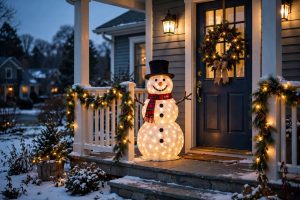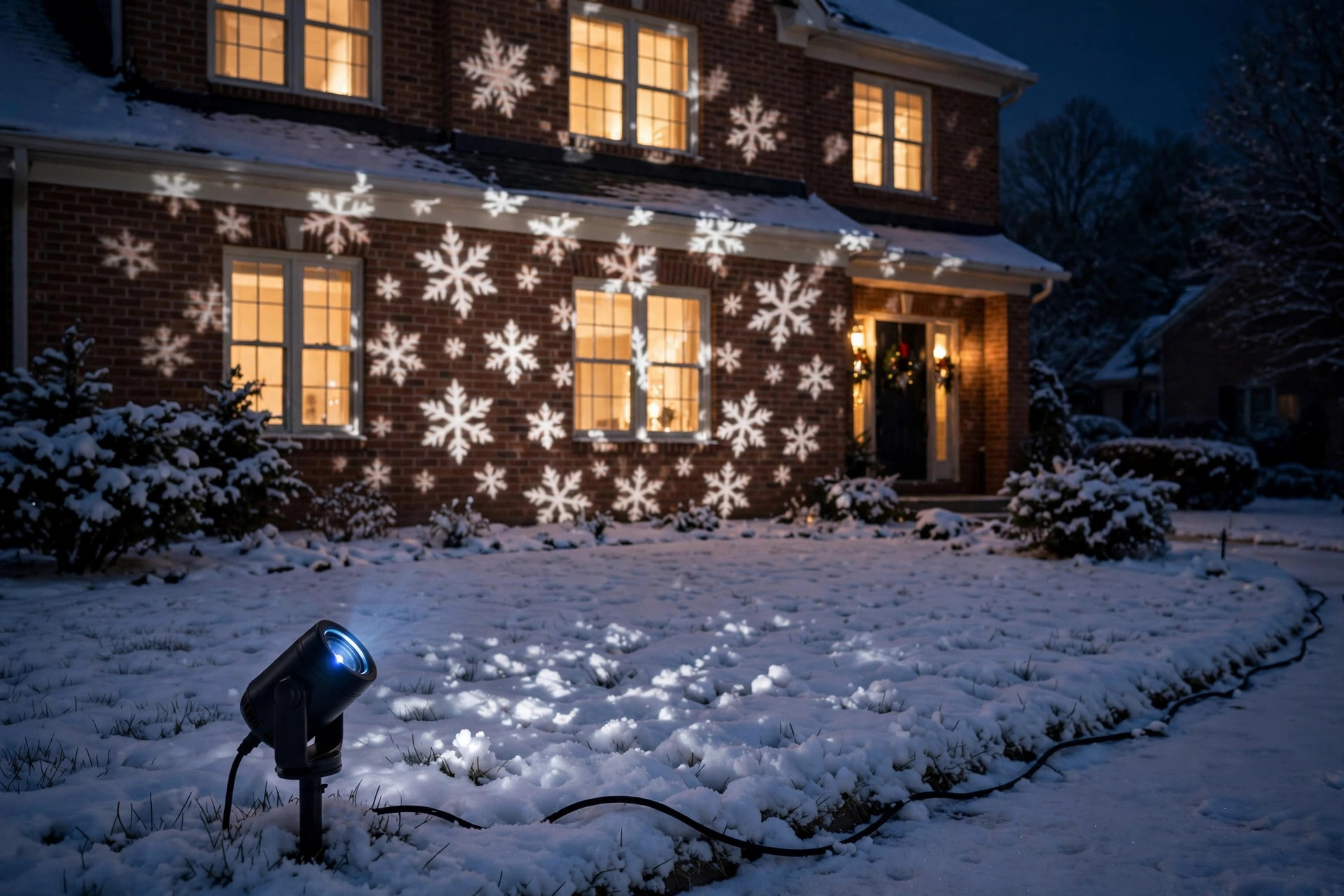

The best christmas outdoor projector with remote timer turns a plain house front into a holiday show in a few minutes. There is no ladder to climb. There is no string of bulbs to untangle. One small box on a stake sends moving snow, stars, or Santa scenes across your walls and roof. The remote timer does the rest. It turns the light on at dusk and off at bedtime, night after night, with no help from you.
In this guide you will learn why a projector beats old string lights, what to look for before you buy, which types fit your home, what you can expect to pay, how to care for the unit, and how to use it safely. By the end, you will know exactly how to pick the best christmas outdoor projector with remote timer for your own yard.
Why a Christmas Projector Beats String Lights
String lights have charm. They also have cost. The average American home takes three to four hours to cover in lights, and much of that time is spent on a cold ladder. A projector cuts that job to ten minutes. You push the stake into the lawn, aim the head at the house, plug in the cord, and press a button on the remote.
A projector also saves money. One LED projector draws about 5 to 15 watts. That is less than one old string of incandescent lights, yet it covers an area up to 25 feet wide. Over a whole season of December nights, the power bill barely moves. Many owners report their holiday lighting cost falls by more than half when they switch.
There is another gain. A remote timer gives you a set-and-forget holiday. In the old days, you walked out in the cold at 10 p.m. to pull the plug. Now you press a few keys once, and the show runs on its own until Christmas Day. Families with long driveways or steep roofs feel this benefit most. If your roofline already has outdoor christmas lights for house roofline usa, a projector adds motion and color above and around them.
What to Look for When You Choose: Best Christmas Outdoor Projector with Remote Timer
Not all projectors are the same. The box may look alike on the shelf, but the parts inside differ. Here are the points that matter most.
Brightness
Brightness is measured in lumens or watts. For a home front of 20 feet, look for a projector rated at least 7 watts, or roughly 800 lumens. Homes set far back from the street need more. Check the rated projection range on the box. It tells you how far the unit sits from the wall.
Coverage and Throw Distance
Throw distance is the gap between the projector and the surface. Most units work from 10 to 25 feet. A short lawn needs a wide-angle lens. A deep lawn needs a stronger beam. Measure your yard before you shop. A tape measure and two minutes of work will save you a return trip.
Weather Rating
Outdoor units must carry an IP rating. IP44 handles rain from any side. IP65 handles heavy rain and dust. Look for at least IP44 on the label. In snow country, a small clear cover over the lens helps. Consumer Reports notes that weather resistance is one of the top reasons outdoor lights fail early, so this line on the spec sheet is worth reading twice.
The Remote Timer
The timer is the heart of the best christmas outdoor projector with remote timer. A good remote offers two, four, six, and eight hour settings. You set it once, and the projector starts at the same time each night. Some remotes also change patterns, speed, and color without a walk outside. Radio remotes work through walls. Infrared remotes need a clear line of sight, so stand in the yard when you test them.
Power Source
Most projectors plug into a standard outdoor outlet. A few run on batteries or solar. Plug-in units are brighter and steadier. Solar units save a cord but dim on cloudy days. For a full December, a plug-in unit with a heavy duty outdoor extension cord is the plain choice.
Pattern Quality
The lens slide or LED wheel makes the picture. Look for sharp edges on snowflakes and stars. Cheap units throw a blurry blob. Good units throw crisp shapes. If you can, read buyer photos before you buy. Retailers such as Home Depot and Walmart show real customer photos next to the product.
Types of Outdoor Christmas Projectors
There are three main types. Each suits a different home.
Laser projectors. These throw thousands of tiny red, green, or blue dots across the house. They are the brightest type and cover the most ground. They use very little power. Some towns have rules about laser lights near roads, so check local rules first.
LED slide projectors. These shine colored light through a printed slide. The slide may show snowflakes, Santa, reindeer, or a Christmas tree. The image is clear and still. Many units come with six to twelve slides you can swap. This type is best for a sharp, picture-like show.
Motion and video projectors. These play moving scenes, like falling snow or a waving Santa. They cost more. They need a darker yard to look their best. If your street has many lamps, a laser or slide unit may show up better.
Some buyers mix types. A laser unit covers the whole house in dots. A slide unit adds a sharp Santa scene on the garage door. This mix looks rich and costs less than full string coverage. For tips on mixing light styles, the guides at This Old House show how layered lighting gives a yard depth.
Cost and Price
Prices run wide. A basic laser projector with a remote timer sells for 25 to 40 dollars. A mid-range LED slide unit with eight slides runs 40 to 70 dollars. A high-end motion projector with full color and a strong timer can reach 90 to 130 dollars.
The remote timer itself adds about 10 to 15 dollars to the price over a non-timer model. That extra cost pays for itself in ease. Think of the cold nights you will not spend outside pulling plugs.
Set a budget before you shop. For most single-family homes, the 40 to 70 dollar range gives the best mix of brightness, pattern sharpness, and a true remote timer. Lowe’s and Amazon both carry wide lines in this range, and holiday sales in late November often cut prices by a fifth.
Do not forget the extras. A good outdoor extension cord costs 15 to 25 dollars. A simple outdoor timer box, if your projector lacks a built-in timer, costs about 12 dollars. Even so, the whole setup stays well under the cost of a full set of quality string lights plus clips.
Care and Upkeep
A projector is simple to keep. Wipe the lens with a soft dry cloth once a week during the season. Dust and rain spots blur the picture. A quick wipe brings back the sharp edge.
When rain is heavy, aim the lens slightly down so water runs off the glass. In freezing weather, bring the unit inside overnight if the manual allows it. Ice on the lens can crack the glass when the lamp heats it.
After Christmas, store the unit in its box in a dry place. Remove the batteries from the remote. Damp basements and hot attics shorten the life of the seals. With plain care, a good projector lasts five to eight seasons. Bob Vila’s holiday guides note that simple storage habits double the life of seasonal lights, and the same rule holds for projectors.
Safety First
Outdoor lights are safe when you follow a few plain rules.
Keep the cord off walkways. A cord across the path is a trip risk on a dark night. Run it along the edge of the lawn and stake it down. Use only cords rated for outdoor use. Indoor cords crack in the cold.
Plug into a GFCI outlet. This is the outlet with the test and reset buttons, found on most modern home exteriors. It cuts power if water gets into the line. If your home lacks one, an electrician can fit one in under an hour.
Never aim a laser projector at the sky or at the road. Bright laser light can blind a driver for a second. That second is all it takes for harm. Aim low, at your own walls and lawn. The Consumer Product Safety Commission reminds buyers each year to read the warning label on laser lights, and this is the warning that matters most.
Keep the projector away from dry leaves and mulch beds. The lamp head runs warm. A few inches of clear space is enough. And never let children stare into the lens. Treat it like a bright flashlight and you will be fine.
Frequently Asked Questions
How far should the projector sit from the house?
Most units work best 10 to 20 feet from the wall. Check the box for the rated throw. A unit set too close throws a small bright patch. A unit set too far throws a dim wide wash. Start at 15 feet and move it until the picture fills the wall.
Will it work on a brick or dark-colored house?
It will, but the picture looks dimmer. Light walls bounce the light back. Dark brick soaks it up. If your home is dark, choose a brighter laser unit or move the projector closer. White trim and light siding give the sharpest show.
Can I leave it out in the rain?
Yes, if the unit is rated IP44 or better. Light rain is no harm. In a hard storm, it is wise to unplug and bring it under cover. Standing water around the stake is a sign to move the unit to higher ground.
Does the remote timer work through walls?
Radio remotes work through walls and windows. Infrared remotes do not. Check the type before you buy. If you want to run the show from your couch, a radio remote is worth the small extra cost.
How many projectors do I need for a large house?
One unit covers about 600 to 1,000 square feet of wall. A small ranch needs one. A two-story colonial may need two, one for each side of the front. Place them so the beams overlap slightly in the middle. Country Living’s holiday features show how two units can frame a home like a stage.
Can I use it for other holidays?
Many owners do. A laser dot unit works for any night of the year. Some slide units ship with Halloween or Fourth of July slides in the box. A projector you buy for Christmas can light the yard for fall parties and spring nights too, much like best halloween outdoor decorations scary yard displays that get a second life.
A Short Final Word
The best christmas outdoor projector with remote timer is the one that fits your yard, your budget, and your patience. Measure the lawn. Pick a weather rating that suits your winters. Choose a true remote timer with a radio remote. Then enjoy December from inside the warm house while the light show runs on its own.
Pair the projector with the rest of your holiday plan. It sits well beside best christmas stockings personalized for family hung by the fire and a wreath on the door. For fresh display ideas each year, the seasonal pages at HGTV and Michaels are worth a look before the season starts.
References
Amazon. (n.d.). Online shopping. https://www.amazon.com Bob Vila. (n.d.). Home improvement advice. https://www.bobvila.com Consumer Reports. (n.d.). Product reviews and ratings. https://www.consumerreports.org Country Living. (n.d.). Country home and lifestyle. https://www.countryliving.com HGTV. (n.d.). Home and garden ideas. https://www.hgtv.com Lowe’s. (n.d.). Home improvement products. https://www.lowes.com Michaels. (n.d.). Arts and crafts supplies. https://www.michaels.com The Home Depot. (n.d.). Home improvement products. https://www.homedepot.com This Old House. (n.d.). Home renovation guidance. https://www.thisoldhouse.com U.S. Consumer Product Safety Commission. (n.d.). Product safety information. https://www.cpsc.gov Walmart. (n.d.). Everyday low prices. https://www.walmart.com
Was this guide helpful?

About James Carter
The My Garden US editorial team writes practical, in-depth home and garden guides for American homeowners — tested advice, no fluff.
You May Also Like

Best Christmas Garland With Lights for Mantel: A Complete Buying Guide
August 29, 2026 0 views
The Best Fall Table Runner for Dining Room Harvest: A Simple Buying Guide
February 15, 2026 0 views
Christmas Nutcracker Decorations for Entryway (USA Guide)
June 6, 2026 0 views