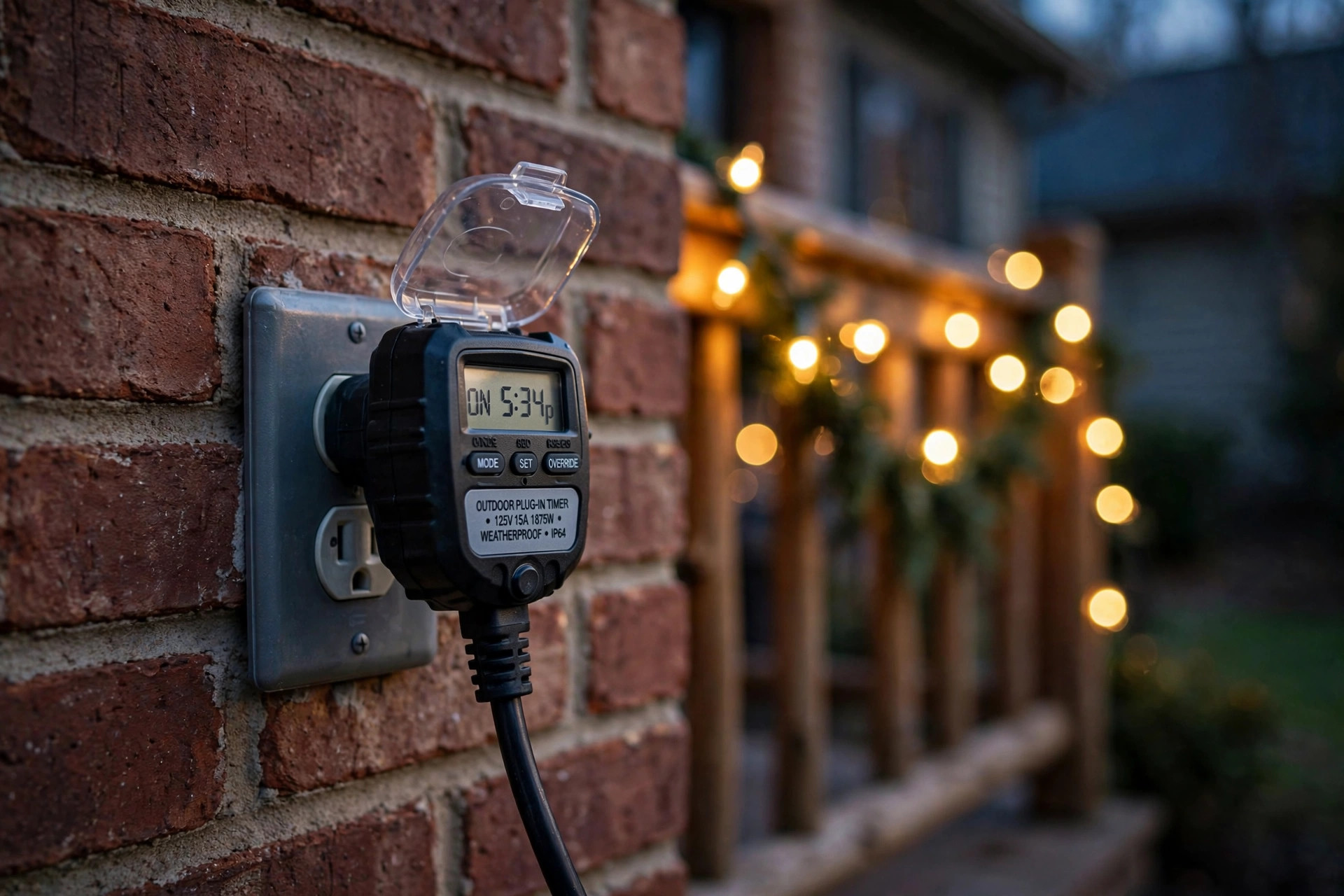

A Christmas lights timer for outdoor outlets is a small device that turns your lights on and off at set times each day. You plug the timer into an outdoor outlet. Then you plug your light strings into the timer. The timer handles the rest. It brings the glow each evening and shuts it down when you choose.
The best Christmas lights timer for outdoor outlets does this job without fuss. It must stand up to rain, cold, and wind. It must hold its settings through a power loss. And it should be simple to set, even with gloves on in December.
Why It Matters
A timer saves you more than a walk to the porch. First, it saves power. Lights that run all night cost far more than lights that run from dusk to midnight. A timer keeps the schedule tight and the electric bill low. The U.S. Department of Energy offers plain guidance on cutting home energy use, and outdoor lighting is a good place to start.
Second, a timer adds safety. It means you do not have to step out on a dark, icy porch to unplug lights. It also lowers fire risk. Lights that burn around the clock run hotter and wear out faster. The Consumer Product Safety Commission reminds homeowners each year to check cords and use only outdoor-rated gear.
Third, a timer brings order. Your whole display can switch on at once, every night, at the same hour. The street looks its best. You never forget to turn the lights on before guests arrive. You never wake to find them still burning at dawn. And when you pair a timer with the right decorations, the whole yard reads as one clean picture. Many families plan their porch and tree together with guides like our roundup of the best artificial christmas tree for small apartments.
What to Look For: Best Christmas Lights Timer for Outdoor Outlets
Weather Rating
Outdoor timers must carry an outdoor rating. Look for the words “outdoor use” and “weather resistant” on the package. The case should be sealed against rain and snow. Cheap indoor timers crack in the cold and let water in. That is the fastest way to ruin a display or trip a breaker.
Plug Style
Most outdoor timers plug straight into a standard outdoor outlet, often a GFCI outlet on a porch or garage wall. Some timers have a short cord. That cord is useful when the outlet sits behind a downspout or in a tight spot. Check how many outlets the timer gives you. A single outlet works for one string. A two-outlet model lets you run the roof line and the porch rail at once.
Power Capacity
Each timer lists a maximum wattage. Add up the watts of every string you plan to plug in. Stay well under the limit. LED strings draw far less power than old incandescent strings, so most displays fit with room to spare. Still, check the math. An overloaded timer can overheat and fail.
Set and Forget
The best Christmas lights timer for outdoor outlets holds its program after a power outage. Some models use a small backup battery. Others use a pin or dial that cannot be erased by a blink in the power. If your block loses power often in winter, this feature matters more than any other.
Dawn and Dusk Sense
Some timers include a light sensor. The sensor reads the sky and switches the lights on at dusk. You set only the off time, such as midnight or 2 a.m. This is the easiest style to use. You never adjust for the long nights of December or the shorter evenings after New Year.
Clear Controls
Outdoor timers should set up in under five minutes. Big buttons and a simple dial win over tiny touch screens. Many good models use old-style pins or sliders. They are not fancy. They work in the cold with gloves on. The family handyman guides often note that the simplest tool is the one you will actually use.
Types of Outdoor Timers
Mechanical Plug-In Timers
The mechanical timer is the old workhorse. It has a dial with pins you push down for the hours you want the lights on. The dial turns with the clock. It is cheap, tough, and very easy to understand. The weak point is a power loss. The dial stops, and the schedule drifts until you reset it. For most yards, a mechanical timer is still the best value.
Digital Plug-In Timers
Digital timers let you set on and off times to the minute. Many offer two or more programs, such as different times for weekdays and weekends. Some run on a battery that survives outages. The trade-off is size. The cases are larger, and the buttons can be small for cold hands.
Photocell Dusk-to-Dawn Timers
A photocell timer watches the light and turns on at dark. You choose the off time. Some models shut off after a fixed number of hours. Others shut off at dawn. This type needs almost no setup. Make sure the sensor faces open sky. A sensor shaded by a gutter or bush may trigger at the wrong hour.
Smart Wi-Fi Timers
Smart timers connect to your home network. You set schedules from a phone app. You can turn lights on early when guests come, or off late on party nights. Some work with voice control. The cost is higher. They also need a strong Wi-Fi signal at the porch or yard. If your router sits far from the outlet, test the signal first.
Hardwired and In-Use Cover Options
A few heavy-duty timers sit inside a weatherproof box mounted near the panel. These suit large displays with many strings. They cost more and may need an electrician. For a normal home display, a simple plug-in model is plenty.
How to Choose
Start with the size of your display. Count every string, every wreath, and every yard figure. Add the watts. A modest roof line and two bushes might total under 100 watts with LEDs. A big display with lighted village pieces on the mantel and yard figures can run higher. Match the timer to the load with room to spare.
Next, think about the outlet. Most American homes have GFCI outlets on porches and near garages. Test yours before the season starts. Press the test button and then the reset button. If the outlet is dead, fix it before you hang a single light. The Home Depot project guides walk through basic outlet checks in plain steps.
Then think about your schedule. If you want lights on at dusk and off at 10 p.m., a mechanical pin timer is fine. If you want two programs, such as lights until midnight on weekends, a digital model fits better. If you hate setting clocks, buy the photocell type.
Finally, think about winter. Wind, ice, and snow test every seal. Read reviews from buyers in cold states. A timer that works in mild weather may fail in a hard freeze. The Lowes buying guides list temperature ratings that help here.
Cost and Price
Prices are modest. Basic mechanical outdoor timers run from five to fifteen dollars. Digital models cost fifteen to thirty dollars. Photocell dusk-to-dawn models fall in the same range. Smart Wi-Fi timers run thirty to sixty dollars, sometimes more for rugged models.
A timer often pays for itself in one season. Lights left on all night can add real money to a winter bill. A timer that shuts them off at midnight cuts that cost by a third or more. Pair the timer with LED strings, which cost less to run than old bulbs, and the savings grow.
Buy the timer before the rush. Stock sells out in late November. Prices climb as Christmas nears. A simple model bought in October works just as well in December.
Care and Upkeep
Take the timer down when the season ends. Store it indoors in a dry box. Check the case each year for cracks. Check the plug prongs for rust or pitting. If the seal looks worn, replace the unit. A ten-dollar timer is not worth a short circuit.
Test the timer before you hang lights. Plug it in on the kitchen table. Set a short program. Make sure it clicks on and off as set. It is much easier to swap a bad timer in October than on a ladder in December.
Keep the outlet cover closed. Outdoor outlets should sit under an in-use cover, the kind with a lid that closes while cords are plugged in. This keeps rain off the connections. The Bob Vila site covers in-use covers in its outdoor wiring guides.
Unplug strings in high winds. A timer cannot stop a storm from whipping cords against a gutter. Bring fragile figures inside. The timer stays, sealed under its cover, until the wind passes.
Safety
Safety comes first with outdoor power. Only use cords and timers rated for outdoor use. Keep all connections off the ground. Water pools in low spots, and a plug lying in a puddle is a hazard.
Do not overload the timer or the outlet. Check the wattage rating on both. Do not chain too many strings together. Follow the limits printed on the string packaging.
Use a GFCI outlet. Most outdoor outlets in modern homes are GFCI protected. If yours is not, have an electrician upgrade it. The Spruce home site explains GFCI protection in clear terms for beginners.
Check cords for damage each year. Mice chew on stored cords. Sun and cold crack old insulation. Throw out any cord with bare wire or cracked jackets. It is never worth the risk.
For holiday decorating safety rules, Country Living and Michaels both publish yearly checklists that are worth a read before you climb the ladder.
Setting Up Your Timer
Mounting is simple. Plug the timer into the outlet. Close the in-use cover if it fits. Some timers are small enough to sit inside the cover. Larger ones may hang just below it. Keep the timer off the ground and out of direct drip lines from the eaves.
Set the time. For a mechanical model, turn the dial to the current time and set the pins. For a digital model, follow the on-screen steps. For a photocell model, just set the off time. Test the whole display at dusk for one night. Adjust as needed.
Label your cords. A strip of tape on each cord saves time next year. You will know which cord feeds the roof line and which feeds the walkway. This small habit turns a long setup into a short one.
FAQ
Can I use an indoor timer outside if it stays dry? No. Indoor timers are not sealed. Cold air and damp air alone can damage them. Use only timers rated for outdoor use.
Will a timer work with LED Christmas lights? Yes. LEDs work well with timers and draw little power. A few very cheap digital timers need a small minimum load to switch cleanly. If your display flickers, move to a mechanical or photocell timer.
What happens when the power goes out? It depends on the model. Mechanical timers stop and lose time. Battery-backed digital timers hold the schedule. Photocell timers simply start fresh at the next dusk. After any outage, check your timer the same night.
Can one timer run my whole yard? One timer can run the whole yard if the total watts stay under the timer’s rating and all cords reach it. Large displays often use two timers on two outlets. This spreads the load and gives you two zones, such as the roof on one schedule and the trees on another.
Do smart timers need Wi-Fi all the time? Most smart timers keep running their last schedule even if Wi-Fi drops. You only need Wi-Fi to change settings. If your porch signal is weak, pick a non-smart model instead.
Where should I buy an outdoor timer? Hardware stores, home centers, and craft stores all carry them in season. Wayfair and big-box sites list models with reviews from cold-climate buyers. Compare the outdoor rating and wattage before you buy.
A Final Word
The best Christmas lights timer for outdoor outlets is not the fanciest one. It is the one that matches your display, survives your weather, and sets up in minutes. A simple pin timer does the job for most homes. A photocell model suits those who never want to touch a dial again. A smart timer fits the tech-minded who want control from the couch.
Whichever you choose, buy it early, test it before the ladder comes out, and give your lights a steady nightly rest. Your display will look better. Your bill will be smaller. And you will spend December watching the lights, not tending them. For more holiday table ideas to round out the season, see our guide to the best thanksgiving napkins for holiday table setting.
References
Bob Vila. (n.d.). Home improvement advice. https://www.bobvila.com Country Living. (n.d.). Country home and lifestyle. https://www.countryliving.com Family Handyman. (n.d.). DIY home repair and maintenance. https://www.familyhandyman.com Lowe’s. (n.d.). Home improvement products. https://www.lowes.com Michaels. (n.d.). Arts and crafts supplies. https://www.michaels.com The Home Depot. (n.d.). Home improvement products. https://www.homedepot.com The Spruce. (n.d.). Home and garden advice. https://www.thespruce.com U.S. Consumer Product Safety Commission. (n.d.). Product safety information. https://www.cpsc.gov U.S. Department of Energy. (n.d.). Energy efficiency and renewable energy. https://www.energy.gov Wayfair. (n.d.). Furniture and home goods. https://www.wayfair.com
Was this guide helpful?

About Michael Thompson
The My Garden US editorial team writes practical, in-depth home and garden guides for American homeowners — tested advice, no fluff.
You May Also Like

How to Choose the Best Christmas Wreath Storage Bag for 36 Inch Wreaths
January 19, 2026 0 views
A Christmas Tree Waterer for Real Tree Care in the USA
September 28, 2026 0 views
Best Fall Garland with Lights for Staircase Decor
September 22, 2026 0 views