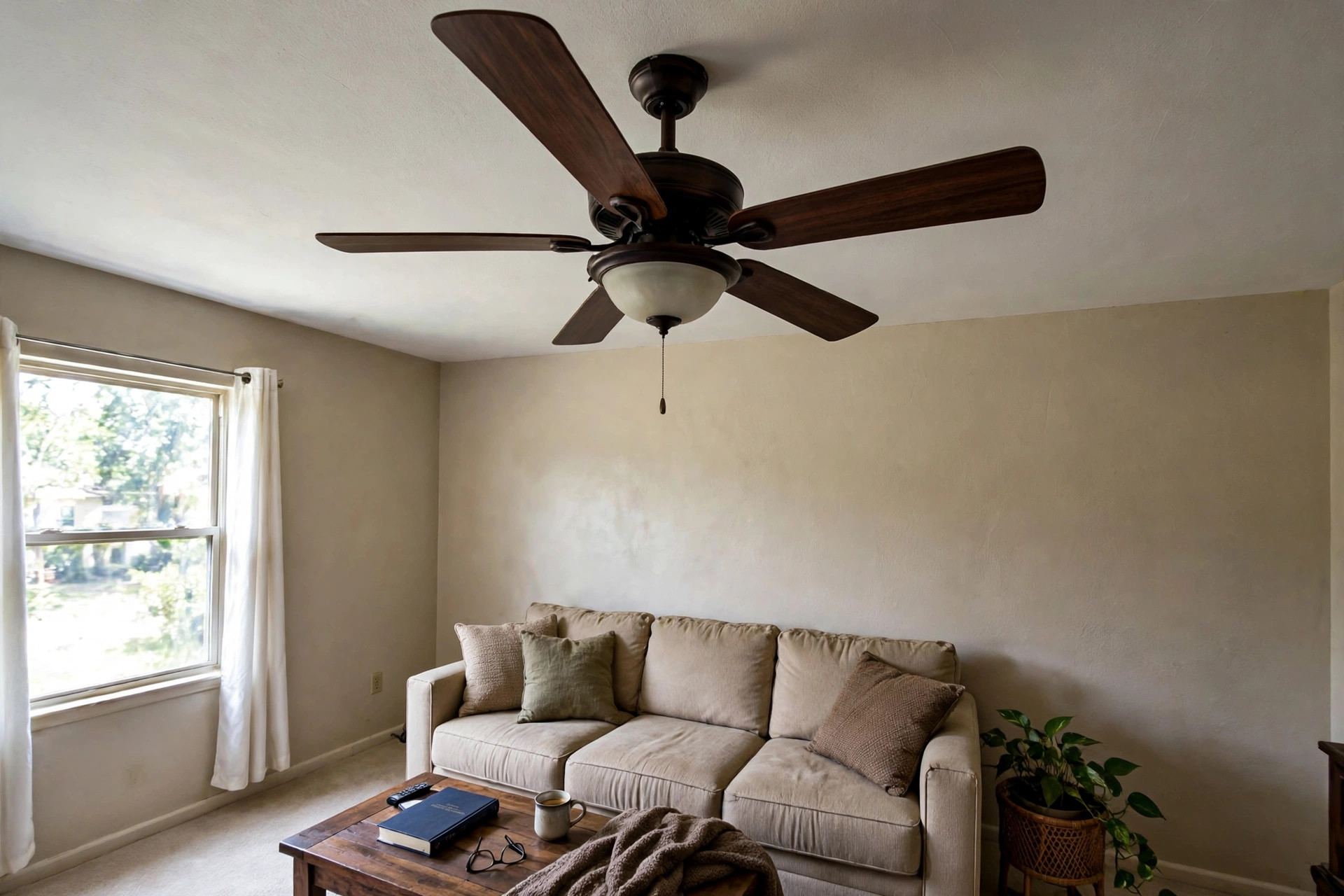
If you search for the ceiling fan installation cost near me, you will see a wide range of prices. Some people pay very little. Others pay several hundred dollars for the same job. This guide explains why the price moves so much and what a fair price looks like in 2026.
A ceiling fan is a simple machine. It has a motor, a set of blades, and a switch. When it is hung right, it can cut your air conditioning bill by a large amount. When it is hung wrong, it can wobble, hum, or fall. That is why the cost of hiring a good installer is worth knowing.
Why the Price of Ceiling Fan Installation Matters
A ceiling fan does two jobs. In summer, the blades turn one way and push cool air down. In winter, they turn the other way and push warm air down from the ceiling. The room feels cooler or warmer, so the thermostat can rest.
The U.S. Department of Energy notes that ceiling fans can let you raise your thermostat about four degrees with no loss of comfort. That saves money on every cooling bill. Over a few summers, the fan pays for itself.
But the savings only come if the fan is hung safely. A fan must be fixed to a box rated for fans. A common light box cannot hold the weight of a moving fan. An electrician must check the box and the wiring. That work is part of the price you pay.
Knowing the local price also protects you from poor deals. Some contractors quote a low price and then add fees at the door. Others quote a high price because they think the homeowner does not know better. When you know the fair range, you can spot both tricks.
What Decides the Cost of Installing a Ceiling Fan: Ceiling Fan Installation Cost near Me
Four things move the price up or down. Each one is easy to understand.
The Fan Itself
Fans sell from about thirty dollars to over five hundred dollars. A plain four-blade fan with a pull chain sits at the low end. A fan with a remote, a light kit, and a quiet DC motor costs more.
Labor is mostly the same for any fan. The installer still climbs the ladder, checks the wiring, and hangs the fan. But a heavy fan with many parts takes longer. Some installers charge a small extra fee for large or high-end models.
The Condition of Your Wiring
This is the largest cost driver. If your room already has a ceiling box wired for a fan, the job is short. The installer mounts the fan and connects three wires. The job may take under an hour.
If there is no box, the electrician must cut the ceiling, run cable from a wall switch, and fit a fan-rated box. That can take two to four hours. If the attic above is hard to reach, the job takes longer still. The Family Handyman guides show how much attic access changes a wiring job.
Old homes bring their own trouble. Wiring from the 1960s or earlier may not have a ground wire. Some homes have aluminum wiring, which needs special care. An honest electrician will tell you what he finds before he starts.
Ceiling Height and Type
A fan on an eight-foot ceiling is a quick job. A fan on a fourteen-foot ceiling needs a long downrod and more labor. High ceilings also need the installer to bring taller ladders or staging.
Vaulted and sloped ceilings need a special mount. The fan must hang straight down even though the ceiling is angled. Not every installer stocks sloped mounts, and the part adds to the bill.
Concrete or plaster ceilings are harder to cut than drywall. In condos with concrete ceilings, the installer may need a hammer drill. That adds time and a small equipment charge.
Labor Rates in Your Town
Labor is the biggest part of the bill, and it changes by region. Big cities on the coasts charge more per hour than small towns in the Midwest or South. Demand matters too. In hot states, electricians stay busy in summer, and prices rise.
Travel time can appear on the bill. If you live far from the nearest electrician, you may see a trip fee. Ask about it on the phone before the truck arrives.
Typical Price Ranges in the United States
For a simple swap, where a fan replaces an old fan or light with good wiring, most homeowners pay between $150 and $350. This covers one hour of labor and basic parts.
For a new fan where wiring already exists but no fan hung there before, the range is about $200 to $450. The installer checks the box, may swap it for a fan-rated box, and hangs the fan.
For a new fan with new wiring run from a switch, expect $350 to $800. The spread is wide because attics differ. A clean attic with open joists is easy. A finished attic with blown insulation is slow work.
Extra items add to the bill. A new wall switch for the fan runs $50 to $120 installed. A remote-control receiver adds $40 to $90. Removing an old chandelier or heavy fixture before hanging the fan can add $30 to $75.
These are 2026 figures for typical American homes. Prices in high-cost metro areas can run a third higher. Get two or three quotes to find your local number.
Types of Ceiling Fans and What They Cost to Install
Not all fans install the same way. The type you pick shapes the bill.
Standard Downrod Fans
The common fan hangs from a short pipe called a downrod. It suits ceilings from eight to nine feet high. Installation is the fastest kind, and most quotes assume this type.
Low-Profile and Hugger Fans
These fans mount close to the ceiling. They suit rooms with low ceilings, where a downrod would hang too far down. They are a little harder to wire because the motor housing is tight. Expect the same labor cost or a small premium.
Outdoor and Damp-Rated Fans
Porch and patio fans must be rated for damp or wet air. The fan body costs more, and the wiring may need weatherproof boxes. The job is much like indoor work, but the Consumer-friendly guides at This Old House remind owners to check the rating on the box before buying. Installing a fan rated only for dry rooms on a porch is a safety risk.
Related Home Cooling Upgrades
A ceiling fan is one part of a cool, cheap home. Many owners pair the fan with other upgrades. A whole house fan pulls hot air out of the attic in the evening. An attic fan vents the hottest air before it sinks into the rooms below. And a smart thermostat can run the fan and air conditioner on a set plan so nothing runs when the house is empty.
Each of these jobs has its own price range. But they all share one rule: the wiring and the mount must be right, or the savings never come.
How to Choose the Right Installer Near You
Start with licensed electricians. A handyman can hang a fan, but only an electrician should run new wiring or change a box. In many states, only a licensed electrician may touch wiring by law.
Ask each bidder four questions. First, is the existing box rated for fans, and if not, what will you charge to change it. Second, does your quote include the switch, the mount, and the haul-away of the old fixture. Third, how long will the job take. Fourth, what warranty do you give on the labor.
Check reviews from real neighbors. A contractor with a hundred local reviews tells you more than a glossy ad. Ask for the total price in writing before work starts. A written quote stops surprise fees.
Do not pay the full amount up front. A small deposit is normal for a large job. For a one-fan job, most electricians expect payment when the fan is up and running.
If you are handy and the wiring is already in place, you may hang the fan yourself. The fan maker ships clear steps. Carrier and Trane both publish homeowner guides on air movement and comfort that explain where a fan helps most. But if you must open a wall or run cable, call a licensed pro. Bad wiring is a fire risk, and no saved fee is worth that.
Cost and Price: A Quick Summary Table in Words
Think of three tiers. Tier one is a swap with good wiring: $150 to $350. Tier two is a first-time hang with wiring in place: $200 to $450. Tier three is a new hang with new wiring: $350 to $800. Add $50 to $120 for a wall switch, $40 to $90 for a remote kit, and $30 to $75 for old fixture removal.
The fan itself is extra. Budget $50 to $150 for a good basic fan, $150 to $350 for a quiet model with a remote, and more for designer or outdoor models. The Lennox and Rheem sites both note that moving air lets a cooling system work less, which is the same idea your fan puts to work.
Care and Upkeep After the Fan Is Up
A ceiling fan needs little care, but a little care keeps it quiet for years. Dust the blades every month or two. Dust builds up on the leading edge and throws the fan off balance.
Once a year, check the screws on the blades and the mount. Tighten anything that has worked loose. A loose blade is the main cause of wobble.
If the fan hums, the cause is often a dimmer switch made for lights. Fans need a fan-rated speed control. Swapping the switch fixes the hum and protects the motor. Goodman service notes make the same point about matched controls on larger systems, and the idea holds for a fan.
In winter, flip the reverse switch so the blades turn clockwise at low speed. This pushes warm air down along the walls. You can lower the thermostat a degree or two. The ENERGY STAR program lists ceiling fans among the simple steps that trim home energy use.
Safety Notes
Turn off the breaker before anyone touches the wires, not just the wall switch. A switch can be wired wrong. The breaker is the true off.
Never hang a fan from a standard light box. Fan-rated boxes are marked for the job and are braced to a joist. If the box moves when you push it, it is not fan-rated.
Keep the blades at least seven feet above the floor and at least eighteen inches from the walls. This is the rule in most electrical codes. It keeps heads safe and lets air move freely.
Outdoor fans need the right rating. A damp-rated fan suits a covered porch. A wet-rated fan suits an open deck where rain can hit it. Using the wrong rating can void the warranty and shorten the fan’s life.
Frequently Asked Questions
How long does it take to install a ceiling fan?
A simple swap takes thirty to sixty minutes. A first-time hang with wiring in place takes one to two hours. A job with new wiring run from a switch takes two to four hours, sometimes more if the attic is tight.
Can I install a ceiling fan where only a light was before?
Yes, if the wiring and box are right. The box must be rated for fans. An electrician can swap a light box for a fan-rated box in most cases. If the light was on a dimmer, the dimmer must be changed to a fan control.
Does a ceiling fan lower the room temperature?
No. A fan cools people, not rooms. The moving air helps sweat leave the skin, so you feel cooler. Turn the fan off when you leave the room. An empty room gains nothing from a running fan.
What size fan does my room need?
A room up to 75 square feet suits a 29 to 36 inch fan. A room up to 144 square feet suits a 36 to 44 inch fan. A room up to 225 square feet suits a 44 to 50 inch fan. Larger rooms need a 52 inch fan or two smaller fans.
Is it cheaper to install more than one fan at once?
Often yes. The electrician is already in your home with tools out. Many charge a lower rate for the second and third fan. Ask for a multi-fan price when you call.
Should I buy the fan myself or let the installer supply it?
Buying it yourself gives you more choice and often a lower price. But if the fan arrives with a missing part, the installer may charge for a second trip. If the installer supplies the fan, he owns any parts problem. Many owners buy the fan and keep the receipt and the box until the job is done.
A Short Final Word
The ceiling fan installation cost near me is a fair question with a plain answer. Most homeowners pay a few hundred dollars for a safe, quiet job. The wiring decides the price more than the fan does. Get the box right, hire a licensed electrician, and get the quote in writing. Your fan will then do its quiet work for years: cooler summers, warmer winters, and lower bills every month.
Related guides on this site include energy efficient mini split for 1500 sq ft, ductless mini split installation cost per zone, and best mini split for cold climates reviews usa.
References
Attic fan installation cost near me. (n.d.). Home and garden information. https://www.attic-fan-installation-cost-near-me/ Carrier. (n.d.). Heating and cooling systems. https://www.carrier.com ENERGY STAR. (n.d.). Energy efficient products. https://www.energystar.gov Family Handyman. (n.d.). DIY home repair and maintenance. https://www.familyhandyman.com Goodman. (n.d.). Heating and cooling equipment. https://www.goodmanmfg.com Lennox. (n.d.). Heating and cooling systems. https://www.lennox.com Rheem. (n.d.). Heating, cooling, and water heating. https://www.rheem.com Smart thermostat installation cost near me. (n.d.). Home and garden information. https://www.smart-thermostat-installation-cost-near-me/ This Old House. (n.d.). Home renovation guidance. https://www.thisoldhouse.com Trane. (n.d.). Heating and air conditioning. https://www.trane.com U.S. Department of Energy. (n.d.). Energy efficiency and renewable energy. https://www.energy.gov Whole house fan installation cost usa. (n.d.). Home and garden information. https://www.whole-house-fan-installation-cost-usa/
Was this guide helpful?

About Emily Rodriguez
The My Garden US editorial team writes practical, in-depth home and garden guides for American homeowners — tested advice, no fluff.